Shipping Tractors from China: Costs, Methods, Timelines & Import Guide
Picture this: you've found the perfect tractor from a Chinese manufacturer at an unbeatable price, but then reality hits. How do you get a 2-ton piece of agricultural machinery across an ocean without damage, delays, or hidden costs eating up your savings? Every year, thousands of importers face this exact challenge, and many learn expensive lessons the hard way.
The good news? Shipping tractors from China is straightforward once you understand the process. Whether you're a farm equipment dealer building inventory, an agricultural business owner upgrading your fleet, or an individual buyer making your first import, this guide walks you through everything from choosing shipping methods to clearing customs. We'll cover real costs, realistic timelines, and practical steps that help you avoid the common pitfalls that trip up first-time importers.
Let's break down exactly what you need to know to get your tractor from a factory in China to your farm or warehouse, safely and cost-effectively.
Why Import Farm Factory from China?
Tractors are the backbone of modern agriculture. These powerful machines come in various sizes and configurations, from compact utility tractors perfect for small farms to heavy-duty models designed for large-scale operations. They handle everything from plowing and tilling to hauling and loading, making them essential equipment for agricultural productivity.
China has emerged as a global manufacturing powerhouse for agricultural machinery over the past two decades. The country produces tractors across multiple categories including compact tractors (15-50 HP), mid-range utility tractors (50-100 HP), and heavy-duty agricultural tractors (100+ HP). Chinese manufacturers have invested heavily in technology and quality control, offering equipment that meets international standards while maintaining competitive pricing.
The appeal of importing tractors from China comes down to three main factors.
First, the cost advantage remains significant compared to European or American manufacturers, often 30-50% lower for comparable specifications.
Second, Chinese factories offer extensive customization options and flexible order quantities, making them ideal for both bulk buyers and individual importers.
Third, established brands have built reliable after-sales networks in many countries, addressing previous concerns about parts availability and service support.
Major manufacturing hubs include Shandong Province, known for mid-range agricultural tractors, Jiangsu Province, specializing in compact and utility models, and Henan Province, producing both economy and premium segments. These regions host manufacturers with decades of experience and export certifications including CE, EPA, and various regional compliance standards.
How Much Does It Cost to Ship Tractors from China?
Shipping costs vary dramatically based on several factors, so understanding what influences the price helps you budget accurately and avoid surprises.
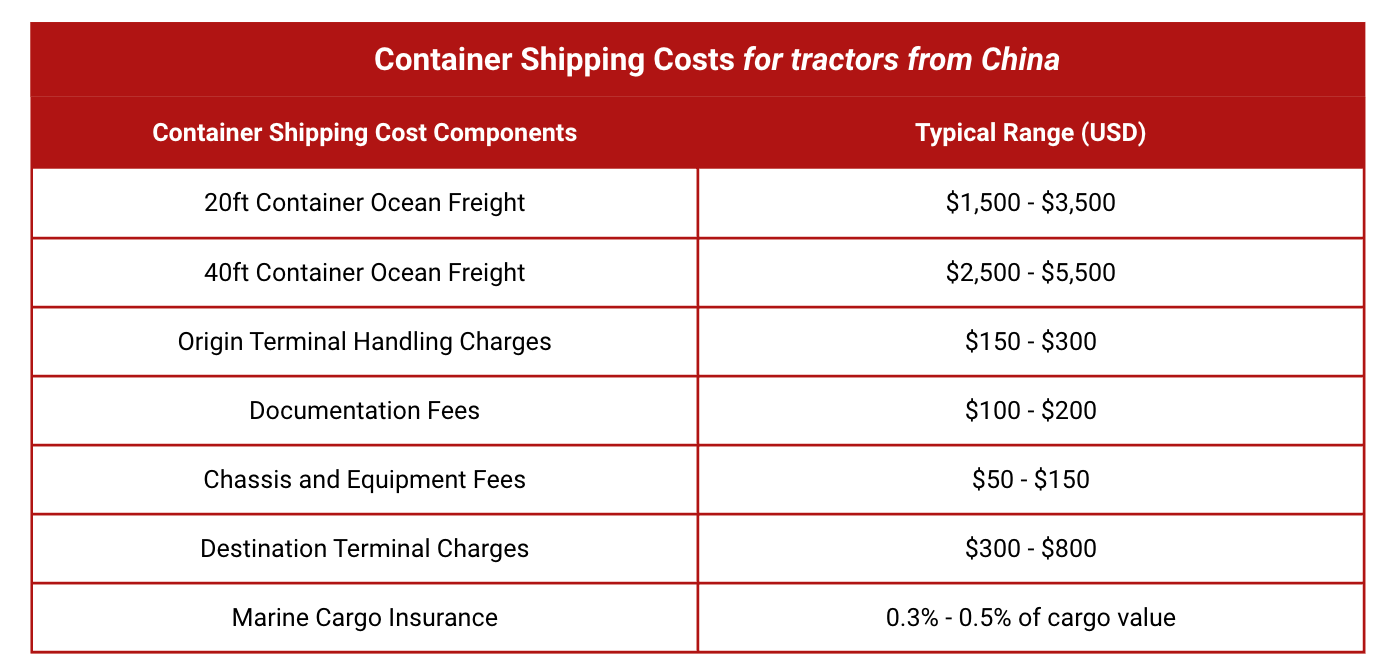
Container Shipping Costs
For standard-sized tractors that fit inside containers, you're looking at FCL (Full Container Load) pricing. A 20ft container typically costs between $1,500-$3,500 from major Chinese ports to most global destinations, though rates fluctuate based on season and demand. A 40ft container generally runs $2,500-$5,500. These base ocean freight rates represent only part of your total shipping expense.
RoRo Shipping Costs
Roll-on/Roll-off shipping works differently, charging by cubic meter or by vehicle unit. For a typical compact tractor, RoRo rates range from $800-$2,000 from China to major ports with RoRo service. This method works well when your tractor is drivable and the dimensions don't require special handling.
RoRo tends to be faster and simpler for wheeled machinery, eliminating container loading concerns. However, service availability is limited to specific routes, primarily to major ports in Middle East, Africa, Oceania, and some South American destinations.
Flat Rack and Oversized Cargo Costs
When your tractor exceeds standard container dimensions, flat rack or open-top containers become necessary. These specialized solutions cost significantly more because they occupy deck space that could hold multiple standard containers. Flat rack surcharges typically add 50-150% on top of standard container rates. A shipment requiring special handling might run $4,000-$8,000 just for ocean freight, before other charges.
Hidden Costs to Consider
Beyond freight charges, several expenses catch importers off guard. Storage and demurrage fees accumulate if you don't retrieve your container within free time (usually 3-7 days), with daily charges of $50-$150. Inland transportation from the destination port to your location varies widely by distance. Customs duties and taxes depend on your country's tariff schedule for tractors (HS code 8701.90 or similar). You may also need to arrange and pay for unloading equipment like forklifts or cranes at destination.
How Long Does It Take to Ship Tractors from China?
Shipping timelines affect your inventory planning and customer commitments. Understanding realistic timeframes helps you set proper expectations.
Ocean Transit Times
Sea freight duration depends primarily on your destination and the shipping route.
Middle East destinations typically take 15-25 days
Southeast Asia requires 7-15 days
East Africa shipments need 20-30 days while West Africa extends to 30-40 days.
Mediterranean routes take 25-35 days.
For North America, West Coast destinations require 15-25 days while East Coast ports need 30-40 days.
South American shipments take 35-45 days, and Australia or New Zealand routes require 18-28 days.
These represent port-to-port transit times for direct services. If your routing involves transshipment (changing vessels at an intermediate port), add 5-10 days.
Complete Door-to-Door Timeline
The full shipping process involves more than just ocean transit. A realistic end-to-end timeline includes:
Booking and documentation preparation (2-3 days)
Inland transport to port in China (1-3 days)
Port operations & Customs clearance in China (2-4 days)
Ocean transit (variable by destination)
Destination port operations (2-5 days)
Customs clearance at destination (3-7 days)
Final delivery to your location (1-3 days)
For most international shipments, expect a total timeline of 25-45 days from booking to final delivery, assuming everything proceeds smoothly. Peak season congestion (typically September-November) adds 5-10 days, while customs inspections can add 3-7 days if selected for examination.
Top Tractor Brands from China
China's agricultural machinery sector has matured significantly, with several manufacturers now competing globally on quality and innovation.
YTO Group Corporation stands as China's oldest and largest tractor manufacturer, with production dating back to 1955. The company produces over 200,000 tractors annually across various power ranges and exports to more than 120 countries. Their product line includes models from 25 HP to 350 HP, with particular strength in the 80-180 HP category popular for medium to large farms.
Foton Lovol has gained international recognition for combining modern technology with competitive pricing. The brand offers comprehensive ranges including compact tractors, heavy-duty models, and specialty equipment. Foton has established joint ventures and technology partnerships with European manufacturers, bringing advanced features to their product lines while maintaining cost advantages.
Dongfeng Agricultural Machinery focuses on the utility and mid-range tractor segments, producing reliable workhorses for diverse agricultural applications. Their tractors feature straightforward designs that prioritize ease of maintenance and parts availability, building a strong reputation in Asian and African markets.
Weichai Lovol Heavy Industry leverages the parent company's engine manufacturing expertise to produce well-integrated tractor solutions. Their products emphasize fuel efficiency and durability, with growing market presence in demanding agricultural environments.
Shifeng Group specializes in compact and small utility tractors ideal for small farms, orchards, and hobby farming. Their tractors offer excellent value in the entry-level segment while maintaining adequate build quality for regular use.
When selecting a brand, consider factors beyond initial cost including parts network in your region, technical support availability, and compliance with local regulations.
Where to Buy Tractors from China
Finding reliable suppliers requires more than just searching online. The right sourcing approach protects you from quality issues and ensures smooth transactions.
Direct from Manufacturers
Purchasing directly from factories offers the best pricing, though it typically requires larger order quantities. Most manufacturers welcome direct buyers for orders of 5 units or more. Contact manufacturers through their official websites, verified company emails, and by attending agricultural machinery exhibitions. Always verify business licenses and export credentials before placing substantial orders.
Authorized Distributors and Trading Companies
Licensed distributors handle smaller quantities and provide additional services including export documentation, quality inspection coordination, and sometimes warranty management. They add a modest markup (typically 5-10%), which is worthwhile considering the complexity they handle for occasional importers.
B2B Platforms
Websites like Alibaba, Made-in-China, and Global Sources host numerous tractor suppliers. When using B2B platforms, verify supplier credentials (Gold Supplier status, Trade Assurance, years in business), check transaction history and customer reviews carefully, request product certifications relevant to your market, always arrange independent quality inspection before shipment, and use platform payment protection services for initial orders.
Trade Shows and Exhibitions
Agricultural machinery exhibitions provide invaluable opportunities to see products firsthand, meet factory representatives, and compare options. Major events include China International Agricultural Machinery Exhibition (CIAME), Canton Fair, and Qingdao International Agricultural Machinery Exhibition.
Regardless of sourcing channel, conduct thorough verification by requesting business licenses and export registration documents, asking for customer references from your region, arranging factory visits or hiring third-party inspection services, reviewing product certifications, and clarifying warranty terms, parts availability, and technical support.
How to Ship Tractors from China: The Entire Shipping Process Step-by-step
Understanding the complete shipping process helps you prepare properly and avoid common mistakes. Here's what you need to know from start to finish.
Step 1: Choose Your Shipping Method
You have three main shipping options, each suited to different situations and budgets.
Container Shipping (Most Common)
Container shipping works for most tractors and offers the best protection during transit. You'll need to know your tractor's exact dimensions: length, width, and height. A standard 20ft container has internal dimensions of approximately 5.9m L x 2.35m W x 2.39m H, while a 40ft container provides 12m L x 2.35m W x 2.39m H.
Many tractors fit in containers after removing attachments like front loaders, canopies, or tall exhaust pipes. Your supplier can usually help disassemble these parts, which are then packed alongside the tractor. Container shipping provides weather protection, easier insurance claims, and is available to virtually all global ports.
RoRo Shipping (Roll-on/Roll-off)
RoRo shipping is a cost-effective alternative when your tractor is drivable and you're shipping to ports with RoRo facilities. With this method, your tractor is simply driven onto the vessel, secured on the deck, and driven off at destination. RoRo rates typically range from $800-$2,000 per unit, making it cheaper than container shipping in many cases.
RoRo works particularly well for routes to Middle East (Jeddah, Dubai), Africa, Oceania, and some South American ports. Transit times are often faster than container shipping. However, your tractor must be operational (able to start, steer, and brake) for loading and unloading. RoRo also offers less protection from weather and salt spray compared to containers, so additional rust protection measures are important.
Flat Rack for Oversized Equipment
When your tractor is too large for a standard container and RoRo isn't suitable or available, flat rack containers become necessary. These are open platforms with collapsible ends, designed for oversized cargo. Flat rack shipping costs significantly more, typically adding 50-150% on top of standard container rates, because they occupy valuable deck space.
Step 2: Prepare Proper Documentation
Correct paperwork prevents delays and customs problems. Essential documents from the supplier include commercial invoice with detailed tractor specifications, packing list showing dimensions and weight, certificate of origin, export license or customs declaration, product certificates (CE, EPA, or relevant standards), and user manual with parts catalog.
For shipping, you need the Bill of Lading (issued by shipping line), marine cargo insurance certificate, and fumigation certificate if using wooden packaging. For destination customs, prepare import license (if required in your country), customs declaration forms, payment proof for duties and taxes, and compliance certificates required by your market.
Work with your supplier to ensure all documents are complete before the tractor leaves China. Missing paperwork causes expensive delays at destination ports.
Step 3: Arrange Loading and Securing
Proper loading protects your tractor during the ocean voyage. Sea transport involves significant movement, vibration, and potential impacts.
For container shipments, your supplier or freight forwarder arranges loading at their facility or a nearby container yard. The tractor is carefully driven or lifted into the container, with wheels chocked (blocked) to prevent rolling, and secured using heavy-duty straps or chains attached to container lashing points. Key securing elements include wheel chocks or blocking, ratchet straps or chains rated for the tractor's weight, edge protectors to prevent strap damage, dunnage (filler material) to eliminate empty spaces, and moisture absorbers (desiccants) to reduce rust risk.
For RoRo shipments, the tractor is driven onto the vessel and secured to the deck using chains or straps. The supplier should ensure the tractor is clean, has minimal fuel (usually quarter tank or less), and all loose items are removed or secured.
Always request photos of the loading process to prove proper securing if damage occurs during transit.
Step 4: Export Clearance and Ocean Transit
Before your cargo can leave China, it must clear export customs. Your supplier or freight forwarder handles this process, submitting the commercial invoice, packing list, and export declaration to Chinese customs. Export clearance typically takes 1-2 days for standard tractors.
Your cargo is then loaded onto a vessel heading to your destination port. Transit time varies by destination. During this period, receive the Bill of Lading from your freight forwarder, share shipping documents with your customs broker at destination, confirm your marine cargo insurance is active, and prepare for customs clearance requirements.
Step 5: Destination Customs Clearance
When the vessel arrives, your cargo goes through customs clearance before you can collect it. Your customs broker submits all required paperwork to customs authorities. Officials verify documents, check duties and taxes owed, and may select your shipment for physical inspection. You then pay applicable import duties, VAT or sales tax, and processing fees before receiving customs release authorization.
Customs clearance typically takes 3-7 days for straightforward shipments. Physical inspections add 2-5 days. Having complete, accurate documentation speeds this process considerably.
Step 6: Final Delivery and Post-Import Tasks
After customs release, arrange to collect your tractor from the port. For container shipments, you can pick up the container yourself, hire a trucking company to deliver it, or have it delivered to a container yard where you unload it. For RoRo shipments, you simply drive the tractor off the vessel or arrange transport from the port.
Container unloading requires appropriate equipment such as a loading dock with a ramp, a forklift rated for the tractor's weight, or yard ramps. Remove the tractor carefully, check for any transit damage, and document the condition with photos.
After receiving your tractor, complete any required vehicle registration or compliance certification in your country, reassemble removed parts, perform initial service and safety checks, test all functions before putting into operation, file warranty registration with the manufacturer, and store all import documents for future reference.
Real-World Example: Importing Tractors to Saudi Arabia
Let's walk through a realistic import scenario to illustrate how everything comes together.
An agricultural equipment dealer in Saudi Arabia wants to import 2 compact tractors (45 HP, standard configuration) from a manufacturer in Shandong Province, China, for delivery to Riyadh.
Weeks 1-5: Sourcing and Production
After researching options and visiting a trade show, the dealer contacts three manufacturers and selects one offering competitive pricing at $8,500 per unit FOB Qingdao, with 30% deposit and 70% before shipment payment terms. The dealer pays the deposit ($5,100) and confirms the order. The manufacturer provides a production timeline of 3 weeks plus 1 week for pre-shipment preparation.
Week 6: Pre-Shipment Preparation
Quality inspection confirms tractors meet specifications. SASO (Saudi Standards) inspection is completed successfully, generating the Certificate of Conformity required for Saudi customs. The dealer pays the remaining balance ($11,900). The manufacturer prepares detailed documentation including commercial invoice, packing list, certificate of origin, and export customs paperwork. Both tractors are loaded into a single 40ft container with proper securing, and loading photos are provided.
Weeks 7-10: Export and Ocean Transit
The freight forwarder collects the container, transports it to Qingdao port, and handles export customs clearance. The container is loaded onto a vessel bound for Jeddah Islamic Port. Ocean transit takes 21 days. The dealer receives complete shipping documents, shares them with their Saudi customs broker, arranges marine cargo insurance, and prepares for customs clearance.
Weeks 11-12: Destination Handling and Final Delivery
The vessel arrives at Jeddah Islamic Port. The customs broker submits required documents to Saudi customs. Customs conducts a brief inspection and approves release. The dealer pays import duty (7% on CIF value), VAT (15% on CIF value plus duty), and port charges. A local transport company collects the container and delivers it to the dealer's facility in Riyadh (950 km), supervising unloading.
How Gerudo Logistics Helps You Ship Tractors from China
Importing agricultural machinery involves numerous moving parts, from coordinating with manufacturers to navigating customs regulations. Working with an experienced freight forwarder who understands machinery shipping makes the process significantly smoother.
Gerudo Logistics specializes in shipping heavy equipment and agricultural machinery from China to global destinations. We handle container shipping, RoRo arrangements, and oversized cargo, providing comprehensive solutions tailored to your specific equipment and timeline requirements.
Our team manages documentation, coordinates pre-shipment inspections, arranges proper securing and protection, and works with reliable partners at destination ports to ensure efficient customs clearance.
Whether you're importing a single tractor or managing regular shipments, we bring expertise in agricultural machinery logistics to help you avoid common pitfalls and reduce total landed costs. Contact us to discuss your tractor shipping needs with our experienced team.
Frequently Asked Questions Shipping Tractors to China
What shipping method works best for tractors from China?
Container shipping works best for most tractors because it offers superior protection and wider service availability. RoRo is a cost-effective option for drivable tractors to ports with RoRo facilities (Middle East, Africa, Oceania). Flat rack containers are needed for oversized equipment.
Can a tractor fit in a standard container?
Many compact and mid-size tractors fit in standard containers after removing attachments like loaders or canopies. A 20ft container has internal dimensions of 5.9m L x 2.35m W x 2.39m H, while a 40ft container provides 12m L x 2.35m W x 2.39m H.
What documents do I need to ship a tractor from China?
Essential documents include Commercial Invoice, Packing List, Bill of Lading, Certificate of Origin, export customs declaration, and compliance certifications for your market. Some countries require ISPM 15 certification for wooden packaging.
How do I protect my tractor from rust during shipping?
Use container desiccant poles to absorb humidity, apply VCI films around exposed metal surfaces, and ensure the container is in good condition. For RoRo shipments, consider applying additional protective coatings. Take pre-shipment photos to document condition.
What unexpected costs should I budget for?
Common surprises include oversized cargo surcharges, destination port handling charges, storage fees if you don't collect promptly, customs inspection fees, and inland transportation costs. Import duties and taxes can also be higher than anticipated.
How long does the complete import process take?
Expect 4-8 weeks total, including production time (2-4 weeks), export and ocean transit (2-5 weeks), and customs clearance with final delivery (1-2 weeks). Peak season and inspections can extend this timeline.
Is marine cargo insurance necessary?
Yes, insurance is highly recommended. It typically costs 0.3-0.5% of cargo value, which is minimal compared to the protection it provides for high-value equipment.
Conclusion
Shipping tractors from China combines logistics planning, regulatory compliance, and practical preparation. The process becomes manageable when you understand the key decisions: selecting the appropriate shipping method based on your tractor's dimensions and destination (container, RoRo, or flat rack), working with verified suppliers who provide proper documentation, budgeting for complete landed costs including duties and inland transport, and protecting your investment through proper securing and corrosion prevention.
Chinese manufacturers offer compelling value across multiple quality tiers, with established brands now competing globally on both price and reliability. Success in tractor importing comes down to preparation and partnerships. Work with suppliers who demonstrate export experience, engage freight forwarders who understand agricultural machinery logistics, and invest in proper protection materials to ensure your tractors arrive in the condition they left.
Ready to start? Begin by clearly defining your specifications, researching suppliers through verified channels, and connecting with experienced freight forwarders who can provide accurate quotes and realistic timelines.