Shipping Chinese Hot Pot Ingredients: A Complete Import Guide 2026
If you have ever watched a container of frozen beef slices arrive spoiled at the destination port, you understand why cold chain logistics can make or break a hot pot import business. The difference between a profitable shipment and a costly insurance claim often comes down to choosing the right shipping method, maintaining strict temperature control, and working with freight partners who understand food-grade logistics.
Restaurants in Los Angeles, London, Sydney, and Dubai now serve authentic hot pot experiences, creating unprecedented demand for specialty ingredients from China. Whether you are sourcing Haidilao soup bases for retail distribution or importing frozen lamb slices for your restaurant chain, understanding the logistics behind hot pot food shipping will save you time, money, and considerable frustration.
As Chinese New Year approaches, hot pot ingredient shipping from China enters peak season, driving higher demand and tighter capacity. This guide walks you through every aspect of importing hot pot ingredients from China. We will cover which products require refrigerated transport, how to manage cold chain logistics, what customs documents matter most, and how to avoid costly delays.
Shipping Feasibility of Hot Pot Ingredients from China
The Shipping feasibilitydepends on three factors: product type, destination country regulations, and your ability to maintain required conditions during transport.
Ambient products like packaged soup bases, dried noodles, and shelf-stable sauces ship without special requirements beyond standard food labeling. These items have long shelf lives and tolerate normal shipping conditions, making them accessible for new importers.
Frozen products require cold chain logistics. Meat slices, seafood items, and prepared dumplings must remain at minus 18°C or below throughout the journey. This requirement adds complexity and cost but remains entirely manageable with proper planning and the right logistics partner.
Destination country regulations create the most variability:
United States: Meat products must originate from USDA-approved facilities
European Union: Strict traceability requirements for seafood products
Australia: Specific biosecurity rules about certain plant-based ingredients
Canada: Bilingual labeling mandatory for retail distribution
Before committing to large orders, verify that your products meet import requirements for your target market.
Chinese Hot Pot Food Types and Transport Conditions
Hot Pot Soup Bases & Sauces (Ambient Cargo)
Shelf-stable soup bases represent the easiest entry point for hot pot importing. Products like Haidilao Spicy Hot Pot Base, Little Sheep Mongolian Soup Base, and Dezhuang Chongqing-style base ship as general cargo.
Key characteristics:
Shelf life: 12 to 24 months
Storage: Room temperature
Shipping mode: Standard ocean freight or air cargo
Main compliance: Ingredient labeling and additive approvals
Dipping sauces and condiments fall into this category as well. Chinese sesame paste, chili oil, and fermented bean sauce require no temperature control during shipping. Your main compliance focus involves accurate ingredient labeling and ensuring any food additives meet destination country approvals.
One consideration: some soup bases contain beef tallow or other animal fats. While these products do not require refrigeration, they may trigger additional documentation requirements in countries with strict animal product regulations.
Frozen Meat & Offal for Hot Pot
Thin-sliced frozen beef and lamb represent the highest-value category but also face the strictest import scrutiny. These products must originate from facilities approved by destination country authorities.
Certification requirements by market:
US: USDA-listed establishments
EU: EU health mark certification
UK: UK-approved processing facilities
Japan: Japanese Food Sanitation Law compliance
Beef tripe, omasum, and other offal products carry additional risk. Customs officials inspect these items more frequently due to historical concerns about improper processing. Your supplier must provide detailed health certificates documenting origin, processing facility conditions, and inspection results.
Package integrity matters significantly. Modified atmosphere packaging helps maintain quality during frozen storage, but any package damage during shipping may result in customs rejection.
Frozen Seafood & Processed Products
Fish balls, shrimp paste (shrimp slide), and seafood dumplings require cold chain shipping plus enhanced traceability documentation.
Required information:
Species identification
Catch location
Processing method
Facility approval number
Surimi-based products like crab sticks face fewer restrictions than raw seafood but still require proper temperature maintenance. Many countries maintain approved supplier lists for seafood imports. Verify your Chinese supplier appears on relevant lists before placing orders.
Tofu & Soy-Based Products
Frozen tofu cubes, tofu skin (yuba), and bean curd rolls generally face fewer import restrictions than animal products. These items still require cold chain shipping to maintain texture and prevent spoilage, but customs clearance typically proceeds more smoothly.
The main compliance issue involves coagulants and other processing aids. Some countries restrict certain food additives common in Chinese tofu production. Confirm your supplier uses approved coagulants before committing to large orders.
Noodles, Vermicelli & Vegetables
Sweet potato vermicelli (glass noodles) and similar products ship as ambient cargo, providing cost advantages over frozen items. These shelf-stable ingredients work well for importers building market presence before investing in cold chain infrastructure.
Frozen mushrooms like enoki or mixed vegetable assortments designed for hot pot require refrigerated shipping. Some suppliers offer these items in both frozen and dried formats, allowing you to choose based on your logistics capabilities and target market preferences.
Sourcing Hot Pot Ingredients in China
Finding reliable suppliers requires knowing where to look. China's hot pot ingredient market offers both online and offline sourcing channels.
Major Manufacturing Regions for Hot Pot Ingredients
Chengdu and Chongqing: Spicy soup bases, traditional hot pot ingredients, offal products
Xiamen: Seafood-based items including fish balls and surimi products
Qingdao: Frozen meat slices, lamb and beef processing
Guangzhou and Shenzhen: Mixed ingredients, comprehensive product ranges with strong export capabilities
Online B2B Platforms for Hot Pot Ingredient Suppliers
Alibaba.com: Largest B2B platform with verified suppliers and trade assurance
1688.com: Domestic wholesale platform with lower MOQs, Chinese language interface
Made-in-China.com: Specialized in manufacturing sourcing with supplier verification
Trade Fairs and Offline Supplier Verification in China
Canton Fair (Guangzhou): Held twice yearly in spring and autumn, comprehensive food and beverage section
SIAL China (Shanghai): International food exhibition with hot pot ingredient exhibitors
China Food and Drinks Fair: Rotating locations, strong domestic and international supplier presence
Local wholesale markets: Chengdu Agricultural Products Central Market, Guangzhou Jiangnan Food Market
Most established importers combine online research with trade show visits to verify supplier facilities and negotiate terms. Online platforms provide initial screening and price comparison, while face-to-face meetings at trade shows build relationships and allow quality inspection.
Shipping Methods for Chinese Hot Pot Ingredients
Sea Freight for Hot Pot Ingredients from China
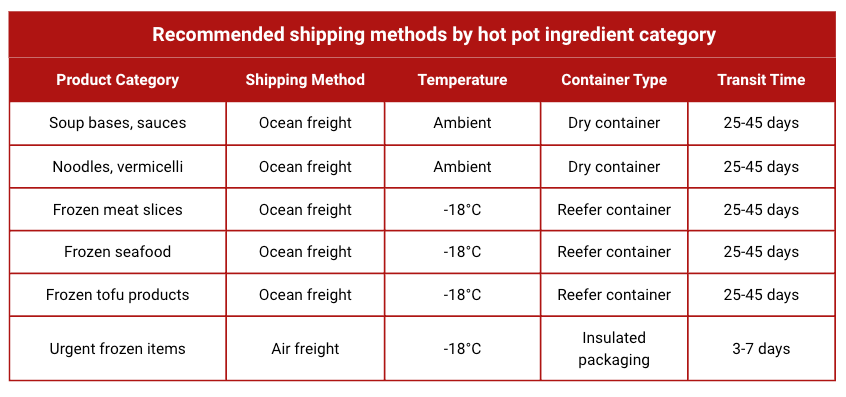
Ocean freight provides the most cost-effective solution for established importers. A full container load (FCL) offers the best per-unit economics and complete control over container conditions.
Container options:
20-foot reefer: Approximately 26-28 cubic meters
40-foot reefer: Approximately 67 cubic meters
40-foot high cube reefer: Best value for large volumes
For ambient products like soup bases and noodles, standard dry containers work well. You can consolidate multiple product types without temperature concerns.
Important note on LCL: We do not recommend less than container load (LCL) for frozen hot pot ingredients. Temperature excursions during consolidation and deconsolidation create quality risks. Your products may be handled multiple times at different facilities, each presenting opportunities for temperature compromise. For frozen goods, always book full container loads.
Major departure ports for hot pot ingredient exports include:
Shanghai (best for all product types and large volumes)
Ningbo-Zhoushan (strong for frozen seafood and meat)
Shenzhen and Guangzhou (serving Guangdong manufacturing hubs)
Qingdao (Northern gateway for frozen meat products)
Tianjin (serving Beijing and Northern China regions)
These ports offer advanced cold chain facilities and direct routes to major international markets. Inland suppliers in Sichuan or Chongqing can access ocean freight through the China-Europe Railway Express or via the International Land-Sea Trade Corridor.
When Reefer Container Shipping Is Required
Reefer containers maintain precise temperature control for frozen cargo. Modern units use microprocessor-controlled systems that adjust cooling based on real-time conditions.
Key features:
Temperature range: Minus 30°C to plus 30°C
Real-time monitoring with IoT sensors
Automated temperature adjustment
Remote alert systems
Pre-cooling the container before loading ensures products never experience a temperature rise during the shipping process. At destination ports, containers remain plugged into power sources during storage, maintaining temperature until customs clearance completes.
Port cold storage and demurrage charges accumulate if clearance takes longer than expected. Understanding these potential costs helps you budget appropriately and prioritize rapid customs processing.
Air Freight for Hot Pot Ingredients
Air freight makes sense for specific scenarios:
New product launches requiring rapid market entry
Seasonal peaks or unexpected demand surges
Small trial orders before committing to full containers
High-value items where speed justifies the premium
Air freight for frozen foods requires specialized insulated packaging with gel packs or dry ice. Airlines impose strict limits on dry ice quantities and mandate specific hazardous materials labeling. Read shipping guide when shipping with dry ice.
The cost difference between air and ocean freight can be substantial. While exact rates vary by route and season, air freight typically costs five to eight times more per kilogram than ocean freight for the same products. However, the three to seven day transit time can prevent costly stockouts during critical periods.
Door-to-Door (DDP) Shipping for Hot Pot Ingredient Imports
Delivered Duty Paid (DDP) represents the most comprehensive service level. Under DDP terms, your freight forwarder handles origin pickup, international transport, customs clearance, duty payment, and final delivery to your warehouse.
DDP typically includes:
Ocean or air freight charges
Origin handling and export clearance
Destination port charges
Customs brokerage fees
Duty and tax payment
Basic delivery to your address
DDP typically excludes:
Cold storage fees during extended customs delays
Customs inspection costs and laboratory testing
Demurrage and detention from your documentation errors
Container power charges during extended port waits
Request detailed quotations specifying exactly which services and charges DDP pricing includes. This clarity prevents disputes when unexpected costs appear.
Customs Clearance & Import Compliance for Chinese Hot Pot Food
Required Import Documents for Hot Pot Ingredients
Every hot pot shipment requires core documentation:
Commercial invoice: Product descriptions, quantities, values, HS codes
Packing list: Weights, carton counts, container numbers
Bill of lading: Title document and contract of carriage
Ingredient list: Detailed breakdown of every component
For meat and seafood products, health certificates from Chinese authorities confirm that processing facilities meet international food safety standards. These certificates cannot be obtained retroactively. They must accompany shipments from origin.
Food Labeling and Ingredient Compliance
Labels must display:
Ingredients in descending order by weight
Common allergens clearly declared
Nutritional information formatted according to local standards
Storage instructions with required temperatures
Cooking instructions for meat and seafood items
Common labeling errors causing customs delays:
Ingredient lists mismatching between labels and documentation
Allergen warnings missing or improperly formatted
Nutritional panels using incorrect formatting
Storage instructions failing to specify required temperatures
Chinese language on primary labeling is generally acceptable for wholesale imports if your destination country allows foreign language labeling with translation stickers. However, retail-ready products typically require labeling in the local language during manufacturing.
High-Risk Hot Pot Ingredients for Customs Inspection
Meat products face the highest inspection rates. Customs authorities prioritize these items due to disease control concerns and strict import requirements. Beef tripe and organ meats receive particularly close scrutiny.
Strategies to reduce inspection probability:
Ensure all documentation is complete and accurate before shipping
Use suppliers with established export track records and proper certifications
Maintain consistent product descriptions across all documents and labels
Provide clear photos of product packaging and labels during declaration
Shipping Hot Pot Ingredients From China to the US
Ocean Freight Transit Time from China to the US
Transit times vary by origin port, destination port, and shipping method.
Ocean Freight
From major Chinese ports to US destinations:
West Coast (Los Angeles, Long Beach, Seattle):
Sailing time: 15-20 days
Origin processing: 3-5 days
Customs clearance: 1-3 days
Final delivery: 1-3 days
Total: 25-35 days door-to-door
East Coast (New York, New Jersey, Savannah):
Sailing time: 30-35 days
Origin processing: 3-5 days
Customs clearance: 1-3 days
Final delivery: 1-3 days
Total: 40-50 days door-to-door
Air Freight
Flight time: 3-5 days
Origin processing: 1-2 days
Customs clearance: 1-2 days
Final delivery: 1-2 days
Total: 7-10 days door-to-door
Hot Pot Ingredients Shipping Costs from China to USA
Cost structures vary significantly by shipping method and product type. Understanding these components helps you calculate accurate landed costs and set appropriate pricing.
Ocean Freight (Reefer Container to US West Coast):
40-foot reefer container: USD 3,500 - USD 5,500
Reefer premium over dry container: 20-40%
Origin charges (trucking, documentation): USD 300 - USD 500
Destination port charges: USD 400 - USD 600
Cold storage (if delayed): USD 50 - USD 100 per day
Customs clearance: USD 200 - USD 400
Final delivery (refrigerated): USD 300 - USD 800
Air Freight (Frozen Products):
Rate per kilogram: USD 4.50 - USD 8.00 (depending on route and season)
Minimum charges: USD 150 - USD 300
Specialized packaging: USD 100 - USD 300
Handling and documentation: USD 150 - USD 250
Customs clearance: USD 200 - USD 400
Additional Costs (Both Methods):
Import duties: 0-15% depending on product classification
Import taxes (varies by state)
Inspection fees (if selected): USD 300 - USD 1,000
Temperature monitoring devices: USD 100 - USD 500 per shipment
These rates represent typical market conditions. Actual costs vary based on season, carrier, volume commitments, and specific routing requirements. Peak season (September through January for hot pot ingredients) typically sees 15-30% rate increases.
Build buffer time into your planning for unexpected delays. Weather disruptions, port congestion, or customs issues can extend transit times by several days or even weeks.
How to Choose the Right Freight Forwarder in Global Food Shipping
Your freight forwarder serves as your logistics partner throughout the import process. The right choice significantly impacts your success.
Cold Chain and Frozen Food Logistics Experience
Not all forwarders understand temperature-controlled logistics. Verify specific experience with frozen food shipments.
Key questions to ask:
What procedures do you follow for pre-cooling containers?
How do you monitor temperatures during transit?
What happens if a temperature excursion occurs?
Do you have relationships with cold storage operators at my destination port?
Request references from other food importers. A forwarder's track record with temperature-sensitive cargo speaks louder than marketing materials.
China Origin Network and Supplier Coordination
Forwarders with offices or partners in China can:
Coordinate directly with your suppliers
Arrange factory pickups with proper temperature control
Handle export customs clearance efficiently
Resolve issues quickly through local presence
Chinese logistics infrastructure has evolved considerably, but regional differences remain significant. A forwarder familiar with your supplier's location can navigate local conditions effectively.
Destination Port Capabilities for Food Imports
Strong relationships at your destination port ensure smooth operations:
Customs brokers who understand food import regulations
Cold storage operators with available capacity
Refrigerated trucking companies for final delivery
Inspection services if required
Ask potential forwarders about their specific partners at your target port. Generic answers suggest limited local presence.
Claims Handling and Temperature Excursion Management
Understand how the forwarder handles problems:
Temperature excursion documentation procedures
Claims process for damaged cargo
Communication protocols during customs delays
Response times for urgent issues
Clear procedures for documentation and rapid response prevent small issues from becoming major problems.
Gerudo Logistics specializes in cold chain logistics from China with comprehensive services covering supplier coordination, export handling, reefer container booking, real-time temperature monitoring, customs clearance, and final delivery.
Our team understands the specific challenges of food logistics and maintains the relationships and infrastructure that reliable cold chain shipping requires.
With established operations in major Chinese manufacturing regions and destination port partnerships across North America, Europe, and Asia-Pacific, we provide the expertise and network your hot pot import business needs.
FAQ: Hot Pot Ingredients Shipping from China
Can hot pot ingredients be shipped from China internationally?
Yes. Ambient products like soup bases ship easily as general cargo. Frozen items require cold chain logistics but are routinely exported worldwide with proper documentation and temperature control.
Which hot pot ingredients require cold chain shipping?
Frozen meat slices, seafood products, fish balls, shrimp paste, certain tofu items, and prepared dumplings require reefer containers maintaining minus 18°C throughout transit.
Can hot pot soup bases be shipped without refrigeration?
Most soup bases are shelf-stable and ship as ambient cargo. Only ensure proper labeling and ingredient compliance for your destination market.
Is sea freight or air freight better for hot pot ingredients?
Sea freight offers better economics for regular shipments and bulk orders. Air freight suits urgent needs, new product launches, or high-value items where speed justifies the cost premium.
What documents are required to import hot pot ingredients?
Core documents include commercial invoice, packing list, bill of lading, and detailed ingredient lists. Meat and seafood require health certificates from approved processing facilities.
How long does shipping take from China to the US?
Ocean freight to the US West Coast takes 25 to 35 days door-to-door. East Coast destinations require 40 to 50 days. Air freight delivers in seven to ten days.
Can frozen and ambient hot pot products ship together?
No. Different temperature requirements and customs handling procedures require separate shipments. Mixing these categories compromises product quality and creates compliance issues.
Final Import Checklist for Hot Pot Ingredients
Before placing your order:
Verify supplier holds required certifications for your destination country
Confirm product formulations meet destination ingredient regulations
Review and approve label designs for compliance with local requirements
Obtain sample health certificates and inspection documents
Before shipping:
Arrange cold chain logistics with experienced freight forwarder
Prepare complete documentation package including all required certificates
Set up temperature monitoring for frozen shipments
Confirm cold storage availability at destination port
Upon arrival:
Monitor customs clearance progress daily
Arrange immediate cold storage if clearance takes longer than expected
Conduct quality inspection before releasing products to distribution
Document any temperature excursions or quality issues immediately
Conclusion
Importing hot pot food from China requires attention to cold chain logistics, regulatory compliance, and cost management. Success depends on choosing the right products for your market, working with certified suppliers, maintaining proper documentation, and partnering with freight forwarders who understand food logistics.
Start with ambient products like soup bases and noodles to build import experience before tackling frozen items. As your volume grows, investing in direct supplier relationships and optimized logistics arrangements improves your margins and reliability.
Ready to import hot pot ingredients from China? Contact Gerudo Logistics for a consultation on your specific requirements. Our cold chain expertise, China network, and global delivery capabilities help you navigate the complexities of food importing while maintaining product quality and compliance.