


Shipping from China to Kuwait: Costs, Transit Times & 2026 Import Rules
Kuwait is one of the GCC's most active import markets for Chinese manufactured goods, covering electronics, home appliances, furniture, auto parts, and consumer products. China is Kuwait's largest source of imports by volume, and the logistics corridor between the two countries is well-established, with regular carrier services through the Gulf region.
This guide covers everything B2B importers need to ship from China to Kuwait in 2026: freight costs by mode, transit times, port routing, Kuwait customs documentation requirements, and DDP shipping options. The KUCAS certification process, which applies to a growing list of regulated product categories, is addressed in detail, as it represents the most common compliance gap for first-time China-Kuwait importers.
Quick Cost Reference: Shipping from China to Kuwait (2026 Feb)
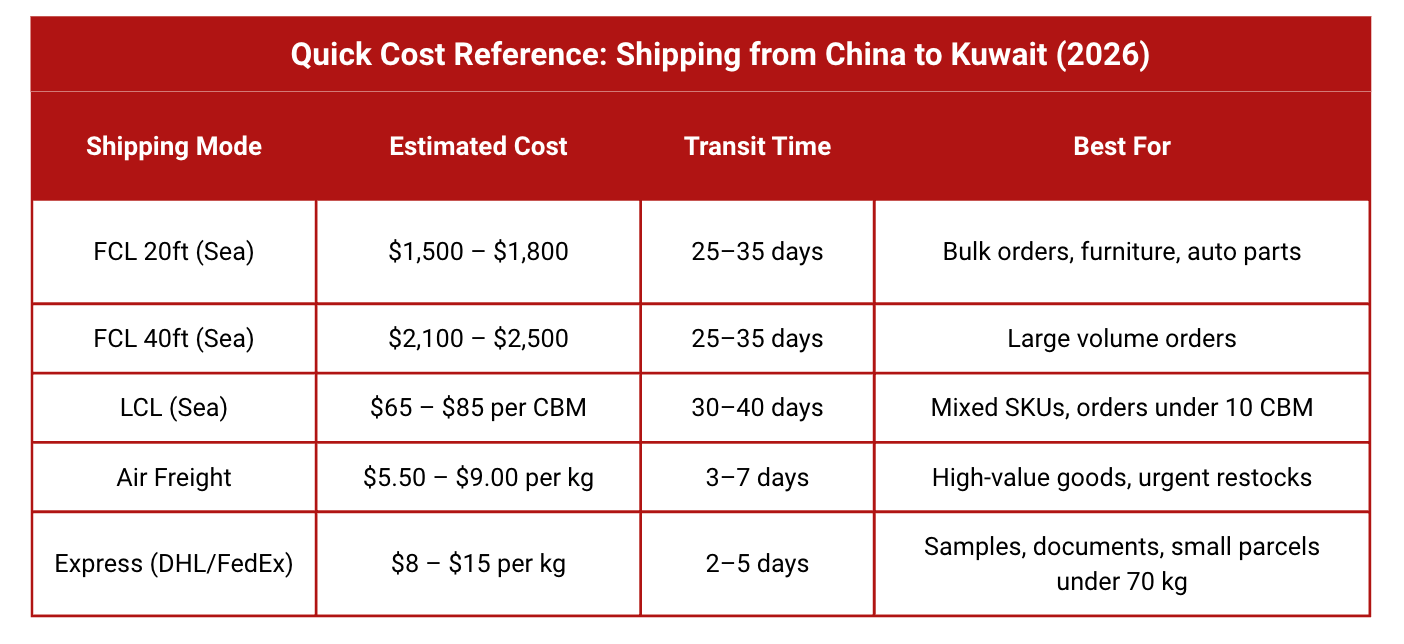
Rates are indicative for 2026 and vary by departure port, cargo type, and carrier. Contact your freight forwarder for confirmed quotes.
Sea Freight from China to Kuwait
Sea freight is the primary shipping mode for B2B importers moving bulk goods from China to Kuwait. It offers the lowest per-unit cost and is well-suited for cargo types that do not require fast delivery.
FCL (Full Container Load)
FCL is the preferred option for orders above 15 CBM or when cargo occupies most of a standard container. A 20ft container handles roughly 25–28 CBM of general cargo; a 40ft container handles 55–58 CBM.
2026 rate Feb:
20ft container: $1,500 – $1,800 (port-to-port)
40ft container: $2,100 – $2,500 (port-to-port)
These rates cover basic ocean freight only. Customs clearance, terminal handling, and inland delivery in Kuwait are billed separately.
Common departure ports from China include Shanghai, Shenzhen, Guangzhou/Nansha, and Ningbo. Most Kuwait-bound FCL cargo is routed via Jebel Ali Port (UAE) as a transhipment hub before onward transit to Kuwait. Direct vessel calls to Kuwait are less frequent, so building in 3–7 additional days for transhipment is standard practice.
Shuwaikh Port (Kuwait City) is the primary entry point for general commercial cargo. Shuaiba Port, located 40 km south, handles heavier industrial shipments including machinery, steel, and petrochemical-related cargo.
LCL (Less than Container Load)
LCL is practical for importers sending orders between 1 and 10 CBM, or those mixing multiple SKUs into a single shipment. Cargo is consolidated with other shippers at origin and deconsolidated at destination.
Indicative LCL rates for China to Kuwait currently run $65 – $85 per CBM, reflecting a market with higher destination surcharges and miscellaneous handling fees compared to some other Gulf routes. Effective transit time is longer than FCL because consolidation and deconsolidation add approximately 5–7 days at each end.
LCL suits importers who are testing new product categories, managing smaller initial orders, or sending replacement stock without wanting to wait to fill a full container.
Air Freight and Express Shipping from China to Kuwait
Air Freight
Air freight serves importers with time-sensitive requirements: urgent restocks ahead of seasonal demand, high-value electronics shipments, or perishable goods. The main gateway on the Kuwait side is Kuwait International Airport (KWI).
Current air freight rates: $5.50 – $9.00 per kg (chargeable weight, which uses volumetric weight for lightweight bulky cargo). Transit time from Guangzhou or Shanghai to Kuwait is 3–7 days including standard handling. Customs clearance in Kuwait for air cargo typically adds 1–2 days.
Air freight becomes cost-justified when cargo value is high relative to weight, or when a stockout cost exceeds the freight premium. For most bulk consumer goods, sea freight remains the right default.
Express Shipping (DHL / FedEx / UPS)
Express carriers offer 2–5 day door-to-door service at rates of $8 – $15 per kg. This mode is appropriate for samples, documentation, low-volume product launches, or shipments under 70 kg.
Express couriers manage their own customs clearance processes at the Kuwait end, but the importer remains liable for Kuwait customs duties and any applicable compliance requirements. Do not assume express shipments bypass KUCAS or Certificate of Origin requirements for regulated product categories.
Shipping Routes and Port Overview
Most China-to-Kuwait ocean freight is routed via Jebel Ali Port (UAE) as a transhipment hub, with feeder vessels connecting onward to Kuwait. Direct China-Kuwait services exist but sailings are limited and schedule flexibility is lower. For most B2B importers, the Jebel Ali routing offers the best balance of frequency and reliability.
The table below shows the main departure ports in China, their typical routing, and estimated port-to-port transit times to Kuwait.
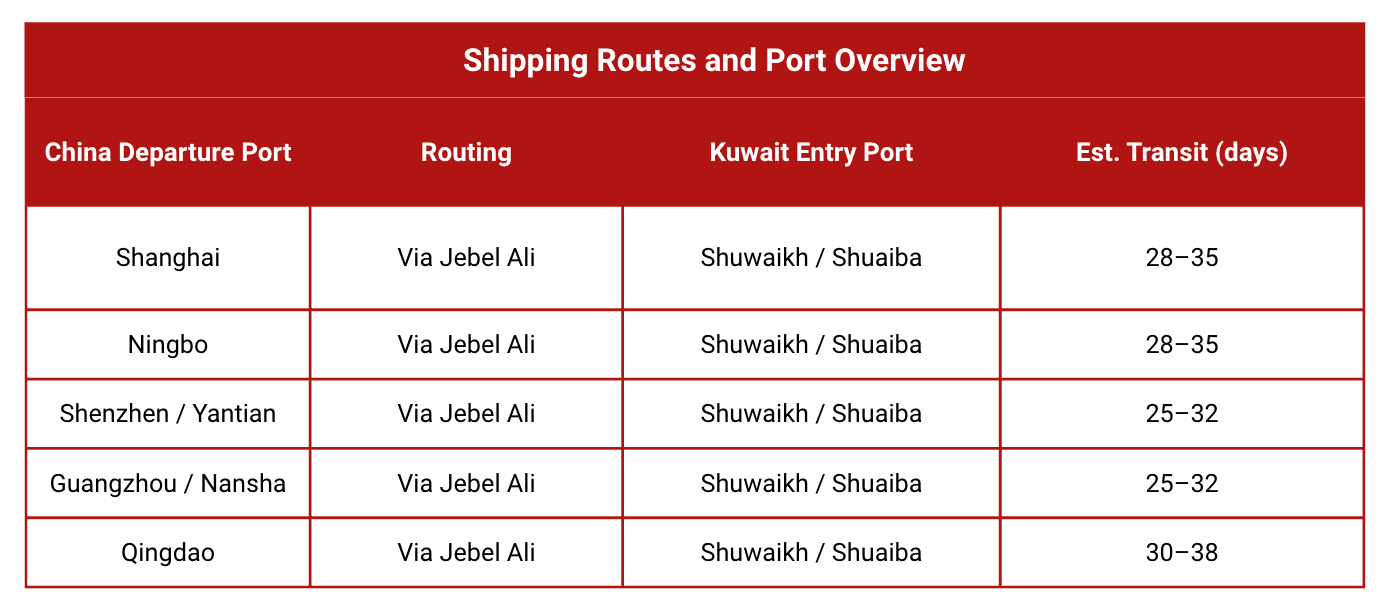
Shuwaikh Port (Kuwait City) handles the majority of general commercial and consumer cargo. Shuaiba Port, located approximately 40 km south, is the standard entry point for industrial goods, heavy machinery, and bulk materials.
Kuwait Customs Regulations and Import Documentation (2026)
Kuwait's customs framework is relatively straightforward for most commercial goods, but documentation accuracy is non-negotiable. Errors in origin declarations, missing Chamber of Commerce endorsements, or non-compliant product labeling result in holds, re-inspection, or return of goods.
Required Documents for Kuwait Customs
Every commercial shipment from China to Kuwait requires:
Commercial Invoice: Must include supplier and buyer details, itemized HS codes, unit prices, total CIF value, and country of origin. Vague or incomplete invoices trigger customs queries.
Packing List: Itemized by carton, including gross/net weight and dimensions.
Bill of Lading (sea) or Airway Bill (air): Original or telex release accepted. The consignee name must match the import license holder.
Certificate of Origin (CO): Mandatory. Must be issued by the China Council for the Promotion of International Trade (CCPIT) or the local Chamber of Commerce, and legalized accordingly. Kuwait customs uses the CO to verify country of manufacture and apply correct tariff rates. While many goods are cleared via a legalized CCPIT CO, certain high-value or sensitive categories may still require Kuwaiti Embassy authentication. Always confirm with your broker to avoid unnecessary legalization fees.
Kuwait Import Duty Structure
Kuwait applies a standard flat customs duty of 5% on the CIF (Cost, Insurance, Freight) value for most commercial goods. This applies to electronics, furniture, auto parts, home appliances, and general consumer goods.
Kuwait does not levy VAT, which simplifies landed cost calculations compared to neighboring markets like Saudi Arabia or the UAE. Select goods attract higher rates: tobacco carries a 100% duty.
Excise tax also applies to specific health-sensitive categories: electronic smoking devices face 100% excise tax, energy drinks 100%, and carbonated sugary beverages 50%. For importers sourcing battery-powered consumer electronics, confirm whether the product classification overlaps with any excise-taxable category before placing orders.
For most B2B product categories, the 5% CIF rate is the operative number. To calculate your estimated duty: (Product cost + international freight + insurance) x 5% = Kuwait import duty.
Country of Origin Labeling
Every individual product unit must carry a permanent "Made in China" marking, either embossed, printed, or engraved directly onto the product or its primary packaging. Adhesive stickers are frequently rejected by Kuwait customs and should not be relied upon. If your product cannot be printed on directly, consult your agent for the current acceptable alternative before shipment to avoid mandatory re-export.
This requirement applies at the SKU level, not just the outer carton. Coordinate with your Chinese factory to verify labeling before production is finalized.
Prohibited and Restricted Goods
The following are prohibited from entry into Kuwait:
Alcohol and alcoholic beverages
Pork and pork-derived products
Gambling equipment and materials
Narcotics and controlled substances
Content deemed offensive to Islamic values
Goods originating from sanctioned countries
Restricted goods requiring special permits include certain chemicals, batteries above threshold capacities, and specific medical or pharmaceutical products. Confirm the status of your product category with your customs agent before shipping.
Radiation Monitoring at Kuwait Ports (Effective February 2026)
As of February 17, 2026, the Kuwait General Administration of Customs issued a formal directive requiring 24-hour continuous radiation monitoring gates at all commercial ports, including Shuwaikh and Shuaiba. Every container and vehicle entering Kuwait must pass through these detection gates.
If a shipment triggers an alert, the cargo is immediately detained and cannot be released without official written authorization from the relevant Kuwaiti authority. This applies regardless of cargo type. While the directive primarily targets radioactive materials, false alerts can occur with certain electronics, medical imaging components, or specific mineral-based goods. Importers in those categories should carry relevant material safety documentation and notify their freight forwarder in advance so the Kuwait customs agent is prepared to respond promptly if a hold occurs.
KUCAS: Kuwait Conformity Assessment Scheme
KUCAS is a mandatory pre-shipment conformity assessment program governing a defined list of products sold in Kuwait. It is administered by the Public Authority for Industry (PAI) to ensure goods meet Kuwaiti and international safety standards before market entry.
Products commonly subject to KUCAS include electronics, electrical equipment, toys, lighting products, and certain home appliances. Importers of smart cameras, robotic vacuums, LED lighting, air purifiers, power stations, and similar categories should assume KUCAS applies until confirmed otherwise. Goods that arrive without valid KUCAS clearance are held at customs and cannot be released.
Critical for 2026: As of January 2025, Kuwait has transitioned to a 12-digit HS code standard. Importers must provide a valid 12-digit code to link the KUCAS Digital CoC to the customs system. Confirm your product's 12-digit classification with your customs broker before production begins.
What Importers Need to Know About KUCAS
Confirm KUCAS applicability early. Before placing your production order, verify whether your product's 12-digit HS code falls under the regulated list. Do this through your freight forwarder's local Kuwait agent.
Your factory initiates the certification. The Chinese manufacturer must engage an authorized inspection body (Intertek, SGS, or TÜV Rheinland) to obtain the Digital TIR/CoC. This is not something the importer arranges directly — but you need to confirm your supplier understands the requirement.
Plan for 2–3 extra weeks. The Digital TIR/CoC process adds lead time. Cargo cannot clear Kuwait customs without the digital document linked to the MOCI e-portal. No paper version is accepted in 2026.
Tell your forwarder upfront. A competent freight forwarder with a licensed Kuwait customs agent will coordinate the compliance steps on your behalf. The key is flagging KUCAS-regulated products at the quotation stage, not after booking.
DDP Shipping from China to Kuwait
Delivered Duty Paid (DDP) means the freight forwarder manages the full logistics chain: cargo collection from your Chinese supplier, export clearance in China, ocean or air transport to Kuwait, import customs clearance, duty payment, and last-mile delivery to your warehouse or delivery address.
DDP is increasingly used by small-to-medium B2B importers in Kuwait who want a single-invoice, managed service rather than coordinating multiple local agents. It removes the risk of customs documentation errors and avoids the importer needing a direct relationship with a Kuwait customs broker.
The standard DDP process for China-Kuwait shipments:
Cargo pickup from factory in China
Export customs clearance at Chinese port of origin
Ocean or air freight to Kuwait (Shuwaikh or Shuaiba Port / KWI)
Arrival and port handling
Import customs clearance, duty payment (5% CIF), and any applicable KUCAS document submission
Inland delivery to the importer's address in Kuwait
Important limitation: DDP does not automatically resolve KUCAS requirements. For regulated product categories, the importer still needs to ensure the Digital TIR/CoC is obtained before shipment, regardless of whether DDP or EXW terms are used. Confirm with your forwarder that their Kuwait partner has the capacity to handle KUCAS-linked digital customs entries.
Why Work with a Specialized China Freight Forwarder for Kuwait
Shipping to Kuwait involves compliance layers that a general-purpose forwarder may not be equipped to handle: KUCAS pre-shipment certification, CO legalization through the correct Chinese authority, unit-level origin labeling, and dangerous goods documentation for battery-powered or chemical products.
Gerudo Logistics is a China-based freight forwarder headquartered in Guangzhou, with operations in Shenzhen, Shanghai, Ningbo, Qingdao, and Dalian. We specialize in dangerous goods and hazardous material shipping under IATA, IMDG, and ADR standards, alongside reefer and temperature-controlled cargo and standard commercial freight.
For Kuwait-bound shipments, we manage cargo classification, export customs clearance, ocean and air routing via Jebel Ali, and coordination with licensed Kuwait customs agents for import clearance and DDP delivery. For DG categories including lithium battery-powered products, aerosols, and chemical goods, we handle UN38.3 documentation, DG declarations, and UN-certified packaging coordination from origin.
Importers sourcing from multiple Chinese cities can consolidate shipments through a single Gerudo point of contact across all major South and East China ports. Contact now for your next Kuwait Shipments.
High-Demand Products from China to Kuwait (2026 Edition)
B2B importers are actively sourcing the following categories from China for the Kuwait market in 2026. Shipping notes are included where compliance or mode selection matters.
Home office furniture (modular, flat-pack): FCL-efficient, strong demand driven by Kuwait's growing hybrid work adoption. Standard sea freight documentation applies.
Smart security cameras and WiFi-enabled devices: KUCAS applies. Obtain TIR through an authorized inspection body before booking shipment.
Air purifiers (HEPA): Consistent demand given Kuwait's dust and high-heat environment. KUCAS may apply depending on electrical classification; verify HS code with your agent before ordering.
Portable power stations: Lithium battery dangerous goods rules apply. Confirm IMDG compliance with your forwarder at the quotation stage, not at booking.
Air fryers and robotic vacuums: Steady FCL and LCL demand. Both categories are likely subject to KUCAS review as electrical appliances.
For any product that includes a battery, electrical component, or operates on mains power, confirm the KUCAS status and DG classification before finalizing the shipment plan.
Frequently Asked Questions: Shipping from China to Kuwait
1. How long does shipping from China to Kuwait take by sea?
FCL and LCL sea freight takes approximately 25–35 days port-to-port, with most routing via Jebel Ali transhipment. Add 2–4 days for customs clearance in Kuwait and inland delivery to your warehouse.
2. What is the standard import duty rate in Kuwait?
Most commercial goods are subject to a 5% flat customs duty on the CIF value (cost + insurance + freight). Kuwait does not levy VAT, which simplifies landed cost calculations.
3. Is a Certificate of Origin mandatory for Kuwait customs?
Yes. A CO issued and legalized by the CCPIT or the relevant Chinese Chamber of Commerce is required for all commercial shipments. It is used to verify the country of manufacture and apply correct tariff rates. Many shipments clear with a standard legalized CCPIT CO; Kuwaiti Embassy authentication is only required for certain high-value or sensitive product categories. Confirm with your customs broker which level of legalization applies to your goods before incurring additional fees.
4. What is KUCAS and which products need it?
KUCAS (Kuwait Conformity Assessment Scheme) is a mandatory pre-shipment certification program administered by the Public Authority for Industry (PAI). It applies to electronics, electrical equipment, toys, and certain home appliances. The key document is the Digital TIR/CoC (Technical Inspection Report / Certificate of Conformity), issued by an authorized inspection body such as Intertek, SGS, or TÜV Rheinland and linked electronically to Kuwait's customs system. Goods without a valid digital clearance cannot be released at Kuwait customs.
5. Can DDP shipping be used for B2B orders to Kuwait?
Yes. DDP is practical for importers who want a single managed service covering freight, customs clearance, duty payment, and delivery. However, DDP does not remove the importer's obligation to ensure KUCAS compliance for regulated product categories.
6. Which port handles commercial cargo from China to Kuwait?
Shuwaikh Port (Kuwait City) is the primary entry point for general commercial and consumer goods. Shuaiba Port handles heavier industrial cargo including machinery and raw materials.
7. Do individual product units need "Made in China" labels?
Yes. Each product unit must carry a permanent "Made in China" mark, printed or embossed directly on the product or its primary packaging. Adhesive stickers are frequently rejected during Kuwait customs inspection.
Conclusion
Shipping from China to Kuwait follows a well-established logistics corridor with good carrier coverage, a straightforward 5% flat import duty, and manageable documentation requirements for most product categories. Sea freight via Jebel Ali remains the primary mode for B2B importers, while air freight and express services handle time-sensitive or high-value cargo.
The most common compliance failure for China-Kuwait importers is KUCAS. For any regulated product category, including electronics, electrical appliances, and smart devices, the TIR must be obtained through an authorized inspection body before the shipment departs China. This process requires planning from the production stage, not from the booking stage.
Country of origin labeling at the unit level and correctly legalized Certificates of Origin are the other areas where documentation errors occur. Both are straightforward to manage when confirmed with your supplier and freight forwarder early in the order process.