Best Ways to Ship Small Parcels to UAE: Cost, Speed & Restrictions (2026)
Shipping small parcels from China to the UAE has become increasingly streamlined, yet many importers still struggle with unexpected costs, customs delays, and choosing the wrong shipping method. Whether you are sending fashion samples to Dubai, electronics to Abu Dhabi, or managing regular e-commerce orders across the Middle East, understanding your shipping options can mean the difference between profit and loss.
The Middle East market presents unique opportunities for cross-border sellers. UAE consumers actively seek international products, and the region's well-developed logistics infrastructure supports efficient small parcel delivery. However, success requires navigating specific regulations, understanding true landed costs, and selecting shipping methods that match your product characteristics and customer expectations.
This guide walks you through everything you need to know about shipping small parcels from China to UAE. We will explore the most effective shipping methods, break down actual costs, compare transit times, and help you avoid the common pitfalls that delay shipments at customs.
Understanding Small Parcel Shipping from China to UAE
Small parcel shipping refers to individual packages typically weighing under 30 kg and suitable for courier, express, or specialized e-commerce parcel services. Unlike bulk freight that moves in containers, small parcels follow dedicated channels designed for speed and door-to-door convenience.
The Middle East market has characteristics that make small parcel shipping particularly relevant. Fashion and apparel represent a significant portion of cross-border e-commerce sales, followed by consumer electronics and beauty products. These product categories ship well as small parcels from Chinese suppliers due to their weight, value, and shipping requirements.
Cross-border commerce plays a substantial role in UAE and Saudi Arabian online retail markets. Consumers actively seek products not available locally and competitive pricing from international platforms. The region demonstrates strong openness to cross-border trade, making it an attractive market for businesses sourcing from China.
For importers, the key to success lies in matching your product type, urgency, and budget with the right shipping channel while understanding the Middle East's specific regulatory environment.
Shipping Methods: Express vs Air Freight vs E-Commerce Lines
Express Courier Shipping to UAE (DHL, FedEx, UPS)
Express shipping offers the fastest delivery but comes at a premium price. Major carriers like DHL, FedEx, and UPS dominate this space, providing reliable door-to-door service with full tracking and insurance options.
Transit Time: 3-5 days from major Chinese cities (Shenzhen, Guangzhou, Shanghai) to Dubai or Abu Dhabi
Cost Range: $5-8 per kg for small parcels under 5kg
Best For:
High-value items requiring fast delivery
Time-sensitive business samples
Products with urgent customer commitments
Shipments where speed justifies premium pricing
Express carriers maintain strict acceptance policies. They excel at handling standard merchandise but may refuse or apply surcharges for batteries, liquids, cosmetics, or other restricted items. The advantage here is predictability and reliable customer service support.
Air Freight Shipping from China to Dubai
Air freight bridges the gap between express and ocean shipping, offering reasonable speed at moderate cost. This method works particularly well for shipments between 20-300 kg.
Transit Time: 5-10 days door-to-door, including customs clearance
Cost Range: $4-7 per kg for volumes over 100 kg
Best For:
Medium-weight shipments (50-300 kg)
Products that need reliable timing but can wait a week
Consolidating multiple small orders into one shipment
Electronics and fashion items with seasonal demand
Air freight rates are calculated based on chargeable weight (the greater of actual weight or volumetric weight). The formula for volumetric weight is: Length × Width × Height (cm) ÷ 6,000. This means packaging efficiency directly impacts your shipping cost.
E-Commerce Parcel Lines (China to UAE DDP Shipping)
E-commerce parcel lines have emerged as the sweet spot for many online sellers. These services are specifically designed for cross-border e-commerce, offering a balance between cost, speed, and handling capacity for typical online shopping products.
Transit Time: 10-20 days depending on the service tier and clearance model
Cost Range: $2-5 per kg, often 40-60% cheaper than express for similar weight ranges
Best For:
Regular e-commerce shipments to Middle East
Fashion, accessories, and consumer electronics
Shipments under 5 kg
Businesses prioritizing cost over maximum speed
E-commerce lines typically operate on a DDP (Delivered Duty Paid) basis, meaning all customs duties and VAT are handled upfront. This creates a predictable landed cost and eliminates surprise fees for the recipient.
China Post and Postal Services to UAE
National postal services like China Post offer the lowest rates but with the longest transit times and least reliable tracking.
Transit Time: 15-45 days with significant variability
Cost Range: $1-3 per kg, often 50-70% cheaper than express
Best For:
Very low-value items where cost is the only concern
Non-urgent shipments
Situations where delivery time flexibility is acceptable
Shipping Cost from China to UAE: Complete Breakdown
Understanding the true cost of small parcel shipping requires looking beyond the base freight rate.
Freight Charges by Shipping Method
This is the core transportation cost, typically quoted per kilogram:
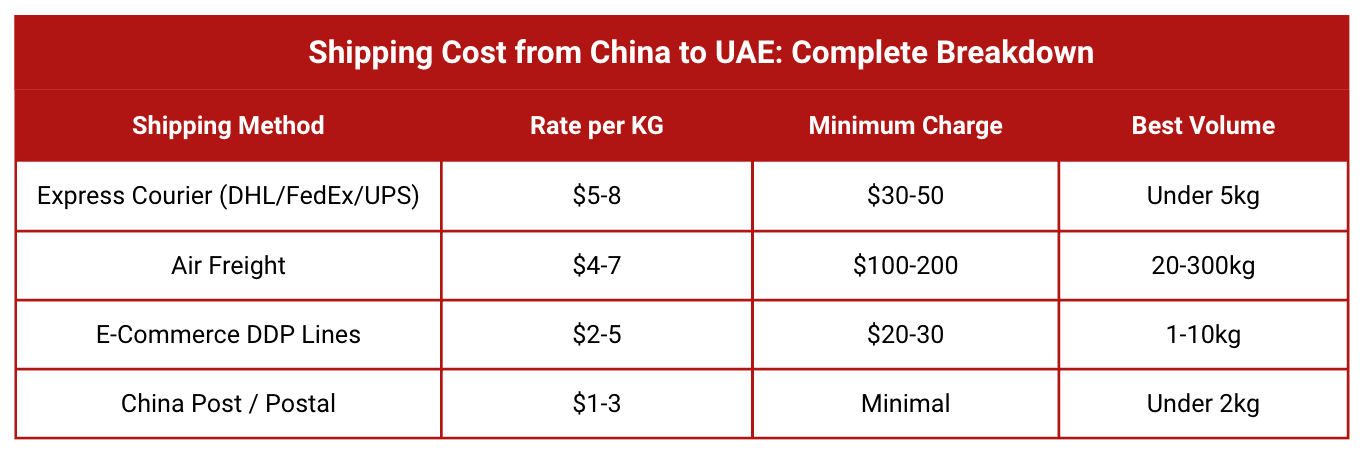
These rates fluctuate based on fuel prices, seasonal demand, and carrier capacity. Peak seasons like Chinese New Year or the period before Ramadan typically see rate increases of 20-40%.
UAE Customs Duty and VAT Calculation
The standard customs duty rate is 5% of the CIF value for most goods imported into the UAE. CIF means Cost, Insurance, and Freight, which is essentially the total value of your goods plus shipping costs.
UAE also applies a 5% VAT calculated on the CIF value plus any applicable customs duty. Here is how it works in practice:
Example Calculation:
Product value: AED 1,000
Shipping cost: AED 200
CIF value: AED 1,200
Customs duty (5%): AED 60
VAT base: AED 1,260 (CIF + duty)
VAT (5%): AED 63
Total taxes: AED 123 (12.3% of product value)
Additional Fees for Parcel Shipping to Dubai
Beyond freight and duties, expect various handling fees:
Customs Clearance Fee: AED 50-200 per shipment depending on the provider and complexity
Documentation Processing: AED 30-100 for commercial invoice and customs paperwork
Remote Area Delivery Surcharge: Additional AED 50-150 if delivering outside Dubai, Abu Dhabi, or Sharjah
Fuel Surcharge (BAF): Variable, typically 10-20% of base freight cost
Insurance: 0.5-2% of declared goods value (optional but recommended)
When comparing quotes from different freight forwarders, ensure you are looking at the complete landed cost including all these elements.
Shipping Time from China to UAE: What to Expect
Transit time affects inventory planning, customer satisfaction, and your competitive position in the Middle East market.
Express Shipping Timeline (3-5 Days)
Day 1: Pickup in China and export customs clearance
Days 2-3: International flight and arrival in UAE
Day 4: UAE customs clearance and delivery preparation
Day 5: Final delivery to consignee
Express carriers maintain tight schedules and have priority handling at customs. Delays are rare unless there are documentation issues or customs holds the package for inspection.
Air Freight Timeline (7-12 Days)
Days 1-2: Collection, consolidation, and export clearance
Days 3-5: Air transport to UAE
Days 6-8: Import customs clearance
Days 9-10: Local delivery
Air freight involves more handling steps than express, which extends the timeline. The customs clearance phase is where most variability occurs.
E-Commerce Line Timeline (12-20 Days)
Days 1-3: Collection and consolidation at origin hub
Days 4-10: International transport
Days 11-15: UAE import clearance (often batched processing)
Days 16-20: Final delivery through local networks
E-commerce lines optimize for cost and volume rather than speed. They batch shipments together, which creates economies of scale but extends transit time.
Factors That Affect Delivery Time to Dubai
Customs Clearance Efficiency: Proper documentation can save 3-7 days. Incomplete or inaccurate paperwork is the leading cause of delays.
Peak Season Congestion: During Chinese New Year, Golden Week, or Ramadan, processing times can double.
Product Type: Restricted items (batteries, cosmetics, supplements) face additional scrutiny and longer clearance times.
Origin City in China: Shipments from major hubs like Shenzhen, Guangzhou, or Shanghai move faster than from secondary cities.
Destination in UAE: Delivery to Dubai or Abu Dhabi is typically faster than to remote areas like Fujairah or Ras Al Khaimah.
Restricted Items & Product Compliance for UAE Shipping
Not all products can ship smoothly to the UAE through small parcel channels. Understanding Middle East-specific restrictions helps you avoid costly delays.
Shipping Battery Products to UAE
Lithium batteries represent one of the most common shipping challenges. Most e-commerce lines and couriers accept battery-contained-in-equipment shipments (like smartphones, headphones, smartwatches). The key requirement is proper declaration and adherence to IATA Dangerous Goods Regulations.
Acceptable:
Bluetooth earbuds with built-in batteries
Smartwatches and fitness trackers
Power banks under 100Wh properly packaged
Charging cables and adapters
Restricted:
Standalone lithium batteries
Products with removable large-capacity batteries
Battery-only shipments without equipment
Shipping Cosmetics and Beauty Products to Dubai
Cosmetics and skincare products face substantial regulatory scrutiny in the UAE. While they are not prohibited, you need proper documentation and correct classification.
Requirements:
Clear ingredient lists in English
Compliance with UAE Ministry of Health regulations
Proper labeling (English and/or Arabic)
Certificate of origin for branded products
Products making medical claims or containing prohibited ingredients will be rejected.
Food Supplements & Health Products Import Rules
Dietary supplements and food products require pre-approval from UAE authorities. Small parcel channels typically cannot accommodate these items unless you have established import licenses and health certificates.
Branded Goods & Trademark Protection in UAE
The UAE has strict intellectual property enforcement. Customs actively screens for counterfeit goods, and suspicion of trademark infringement can result in shipment confiscation.
Best Practices:
Only ship authentic products from authorized distributors
Maintain documentation proving authorization
Avoid products with prominent brand logos unless you are an official dealer
Be prepared to provide purchase invoices and authorization letters
Documents Required for UAE Customs Clearance
Proper documentation is the foundation of smooth customs clearance in the Middle East. Missing or incorrect documents cause more delays than any other factor. Here is your complete checklist for UAE customs clearance:
UAE Customs Clearance Document Checklist
Required for All Shipments:
Commercial Invoice (detailed, with HS codes and accurate values)
Packing List (quantities, weights, dimensions)
Sender company details (name, address, contact)
Consignee details (complete address, active phone number)
Country of origin declaration
Product-Specific Documents:
Electronics: CE certificates, product specifications, testing reports
Cosmetics: Ingredient lists (English), certificates of free sale, UAE Ministry of Health compliance documents
Branded goods: Brand authorization letters, purchase invoices from authorized distributors
Battery products: MSDS sheets, UN38.3 test certificates, battery specifications
Baby/children's products: EN71 or ASTM safety certificates
Electrical items: Voltage specifications (220V), plug type confirmation (Type G)
Commercial Invoice Must Include:
Detailed product descriptions (not vague terms like "electronics" or "clothes")
6 to 8-digit HS codes for each item
Unit prices and total value in USD or AED
Accurate weight (gross and net)
Intended use (commercial sale, samples, personal use)
Common Documentation Mistakes to Avoid:
Vague product descriptions
Incorrect or missing HS codes
Undervalued declarations
Missing consignee contact information
Incomplete sender company details
At Gerudo Logistics, we provide documentation templates and guidance to ensure your paperwork meets UAE customs requirements from the first shipment. Our team reviews all documents before dispatch, catching errors that could cause delays.
Best Products to Ship from China to UAE (Sourcing Guide)
Understanding what products perform well in the Middle East helps you make informed sourcing decisions when working with Chinese suppliers.
Consumer Electronics Sourcing for UAE Market
Electronics represent a significant portion of UAE e-commerce demand. The region's tech-savvy population drives consistent demand for consumer electronics, particularly wireless accessories, smart devices, and mobile phone accessories.
Top Products & Chinese Sourcing Cities:
Bluetooth Earbuds and Headphones: High-margin items that ship easily. Source from Shenzhen manufacturers with MOQs as low as 500 units. Ensure suppliers provide proper battery documentation.
Smartwatches and Fitness Trackers: Popular due to growing health consciousness in the region. When sourcing, ensure suppliers support Arabic language interfaces and provide IATA battery certificates.
Phone Cases and Screen Protectors: Low restriction, lightweight products. Guangzhou manufacturers specialize in customizable designs appealing to Middle East fashion preferences. MOQ typically 100-300 pieces.
Charging Cables and Adapters: Ensure products meet UAE electrical standards (Type G plugs, 220V). Dongguan suppliers offer bulk pricing with CE certificates required for smooth customs clearance.
Computer Accessories: Wireless mice, keyboards, USB hubs. Source from suppliers who can provide CE certificates and product testing reports required by UAE customs.
Fashion & Apparel Sourcing for Middle East
Fashion represents the largest category for small parcel shipping to UAE, making this sector particularly important for importers.
Sourcing Strategies:
Women's Apparel: Source from Guangzhou or Hangzhou garment hubs. Consider Middle East sizing preferences (modest cuts, longer lengths). MOQ typically 50-200 pieces per style.
Modest Fashion Items: Abayas, hijabs, and scarves have strong local demand. Yiwu manufacturers specialize in Muslim fashion with understanding of regional style preferences. MOQ often as low as 20-50 pieces.
Fashion Accessories: Bags, belts, sunglasses, jewelry ship efficiently. When sourcing, request samples to verify quality meets Middle East consumer expectations for premium products. Yiwu International Trade Market offers excellent variety.
Key Sourcing Tip: Middle East consumers prefer quality over rock-bottom pricing. Work with Chinese suppliers who understand the difference between mass market and premium segments.
Beauty Products Sourcing & Compliance
This category requires careful sourcing due to regulatory requirements but offers good margins.
Sourcing Considerations:
Skincare Products: When sourcing from China, ensure manufacturers can provide ingredient lists in English, certificates of free sale, and test reports meeting UAE Ministry of Health requirements. Guangzhou cosmetics manufacturers are experienced in GCC exports.
Makeup and Cosmetics: Work with Chinese manufacturers experienced in exporting to GCC countries who understand halal certification and ingredient restrictions. Avoid products with alcohol-based formulas.
Hair Care Products: Source from suppliers with experience in international shipping who use proper sealing and leak-proof packaging methods.
Personal Care Devices: Hair styling tools must meet UAE electrical specifications (220V, Type G plugs). Ningbo and Shenzhen manufacturers offer competitive pricing.
Home & Baby Products from China
Small Home Accessories: Kitchen gadgets, organizers, decor items. Yiwu market offers excellent variety with low MOQs (often 50-100 pieces) suitable for testing Middle East market preferences.
Baby and Kids Items: Toys and accessories face safety standards but clear smoothly with proper certification. Chinese manufacturers can provide EN71 or ASTM certificates required for UAE market entry. Ensure toys are labeled in English.
How to Choose a Freight Forwarder for China-UAE Shipping
Partnering with an experienced freight forwarder simplifies the entire process for Middle East-bound shipments.
What a Good Freight Forwarder Provides
Volume Discounts: Forwarders consolidate shipments across multiple clients, securing rates 20-40% lower than individual shippers can access.
Channel Selection Expertise: Experienced forwarders know which channels work best for specific product types and Middle East destinations.
Documentation Support: They provide templates, review your paperwork, and ensure everything meets UAE customs requirements.
Customs Clearance Service: Forwarders understand UAE regulations and handle clearance efficiently, reducing delays from 5-10 days to 2-3 days.
Problem Resolution: When customs issues arise, forwarders have relationships with carriers and brokers that accelerate solutions.
Consolidation Services: They can combine multiple supplier shipments into one parcel, reducing per-unit costs by up to 50%.
At Gerudo Logistics, we have established dedicated small parcel shipping channels between China and the Middle East. Our team handles thousands of e-commerce shipments monthly to UAE, Saudi Arabia, and other GCC countries.
We work directly with you to classify products correctly, prepare compliant documentation, and select the most appropriate shipping method. Our volume relationships with carriers ensure you receive competitive rates while maintaining reliable transit times.
Tips to Reduce Shipping Costs Without Delays
Optimize Packaging to Lower Dimensional Weight
Dimensional weight pricing means every centimeter counts. Use appropriately sized boxes rather than oversized packaging. Flat packaging for items like clothing saves significant costs compared to bulky boxes. Reducing package dimensions by just 5cm can move you into a lower rate bracket.
Consolidate Orders from Multiple Suppliers
Shipping multiple orders together reduces per-unit costs by 30-50%. If you source from multiple Chinese suppliers, use your freight forwarder's warehouse to consolidate everything into one shipment rather than paying for 3-5 separate parcels.
Use Correct HS Codes to Avoid Overpaying Duty
Using precise HS codes ensures you pay the correct duty rate. Many shippers overpay because of incorrect classification. Professional customs brokers can audit your HS codes and identify opportunities for legitimate savings.
Avoid Peak Season Shipping from China
Rates from China typically peak before Chinese New Year (January-February) and during Q4 holiday shopping (October-December). If your products are not seasonal, schedule shipments during quieter periods (March-May, July-September) to save 20-30% on freight costs.
Compare DDP vs DDU Shipping Terms
DDP shipping creates cost transparency but might cost more than DDU for certain product types. Compare both options. Sometimes paying duties directly through your own customs broker is 10-15% cheaper than the DDP premium.
Common Problems and Solutions When Ship Small Parcels from China to UAE
Handling Customs Holds in Dubai
Response Strategy:
Contact your freight forwarder immediately when notified
Provide requested documentation within 24 hours
For valuation disputes, provide purchase invoices from suppliers
For compliance issues, obtain necessary certificates
Prevention:
Always over-document rather than under-document
Maintain template responses for common customs queries
Keep digital copies of all certificates readily accessible
Managing Delivery Delays
Response Strategy:
Proactive communication with customers prevents complaints
Track shipments actively rather than waiting for customer inquiries
If delays exceed 3 days beyond expected delivery, escalate with your forwarder
Prevention:
Add 3-5 day buffer time to customer commitments
Choose reliability over the absolute cheapest option for important shipments
Returns Management China to UAE
Returns from UAE to China are more complex and expensive than forward shipments. Plan your return strategy in advance.
Options:
Authorize customers to keep low-value defective items (under AED 100) instead of returning
Use a UAE-based returns center to inspect and potentially resell items locally
Work with freight forwarders who have established reverse logistics channels
Frequently Asked Questions for China-UAE Small Parcels Shipping
What is the cheapest way to ship small parcels from China to UAE?
E-commerce DDP parcel lines ($2-5/kg) are the most cost-effective for regular shipments. China Post ($1-3/kg) is cheaper but unreliable. For best value with reliability, use air freight consolidation for shipments over 20kg.
How long does small parcel shipping from China to Dubai take?
Express: 3-5 days, Air freight: 7-12 days, E-commerce lines: 12-20 days, China Post: 15-45 days. Actual time depends heavily on customs clearance documentation quality.
What documents do I need to ship to UAE?
Minimum: commercial invoice with detailed descriptions, HS codes, and proper valuation, plus packing list. Restricted products (cosmetics, electronics, branded goods) require additional certificates.
How much are customs duties in UAE?
5% customs duty on CIF value, plus 5% VAT on (CIF + duty). Total tax typically 10.25% of product value. Some categories like alcohol (50%) and tobacco (100%) have higher rates.
Can I ship batteries and electronics to Dubai?
Yes, battery-contained-in-equipment (smartphones, earbuds, smartwatches) are acceptable with proper IATA documentation. Battery-only shipments are restricted and need dangerous goods handling.
What items are restricted for shipping to UAE?
Cosmetics require documentation, supplements need health approvals, counterfeit goods are strictly prohibited. Always verify product acceptance with your freight forwarder before shipping.
How can I reduce my shipping costs from China to UAE?
Optimize packaging dimensions, consolidate multiple orders, use accurate HS codes, avoid peak seasons (Chinese New Year, Q4), and work with experienced freight forwarders who access volume discounts.
Conclusion
The Middle East market offers substantial opportunity for businesses importing from China. Cross-border shopping plays a significant role in UAE and Saudi Arabian e-commerce, with consumers actively seeking international products. Success requires choosing the right shipping method based on your product characteristics and customer expectations. Express courier works when speed justifies the premium, e-commerce parcel lines provide cost-efficiency for regular sellers, and air freight fits medium-volume needs.
At Gerudo Logistics, we specialize in small parcel shipping from China to the Middle East with dedicated channels for fashion, electronics, and beauty products. Our team combines regional knowledge with carrier relationships to provide reliable, cost-effective DDP shipping solutions. Whether you are shipping samples or managing hundreds of monthly orders, we optimize your logistics for the growing GCC market. Contact us today for a customized quote.