Shipping Small Electronics from China to USA: What Works (and What Fails)
You've sourced the perfect batch of Bluetooth earbuds from Shenzhen. The price is right, the MOQ works, and your supplier swears shipping will be "no problem." Three weeks later, your parcel is stuck at customs, your freight forwarder is asking for battery documentation you've never heard of, and your launch date just evaporated.
Sound familiar?
Shipping small electronics from China to the USA isn't just about finding the cheapest rate on Alibaba. It's a precise exercise in compliance, carrier selection, and documentation, where one wrong checkbox can turn a $200 shipment into a $2,000 headache.
This article walks you through everything you need to know: from battery restrictions and FCC requirements to common costly mistakes and real-world scenarios. Whether you're importing wireless mice, power banks, or smart plugs, we'll show you how to get your products across the Pacific without the drama.
Why "Small Electronics" Are Not as Easy to Ship as They Look
In logistics, “small electronics” typically means small-parcel shipments of electronic products, including USB cables, Bluetooth speakers, smartwatches, portable SSDs, LED strip lights, and rechargeable flashlights. But "small" doesn't mean simple.
Here's what catches most first-time importers off guard:
Battery presence changes everything. A USB-C cable ships like a dream through postal networks. Add a built-in lithium battery to that same product category, say, a wireless charging cable with a battery pack, and suddenly you're dealing with UN3481 classification, carrier-specific acceptance policies, and postal prohibitions.
Wireless capability triggers regulatory scrutiny. If your product transmits radio frequency signals (Bluetooth earbuds, Wi-Fi smart plugs, wireless keyboards), you're entering FCC jurisdiction. The Federal Communications Commission governs radiofrequency device importation, and many wireless products require FCC equipment authorization before they can legally be marketed or used in the USA.
Volumetric weight punishes poor packaging. That mini Bluetooth speaker weighs 300 grams, but if it ships in a 25cm × 20cm × 15cm box with excessive padding, carriers charge you for 1.25kg. Multiply that across 500 units, and your "cheap China freight" quote just doubled.
Customs doesn't care about your Alibaba screenshot. A commercial invoice that reads "electronic accessories" might work for your internal records, but US Customs and Border Protection wants specifics: product name, model number, material composition, unit value, and country of origin. Vague descriptions increase inspection rates and clearance delays.
The gap between "easy-looking" and "actually easy" is filled with technical requirements, carrier policies, and regulatory checkpoints that most sourcing agents never mention during the sales pitch.
Common Mistakes When Shipping Small Electronics from China to USA
Let's cut straight to the errors that cost importers the most time and money.
Mistake #1: Small Size Does Not Always Mean Low Shipping Cost
Physical dimensions matter more than actual weight in modern parcel pricing.
Carriers calculate "dimensional weight" by multiplying length × width × height (in cm), then dividing by a divisor (typically 5000 for express). If your dimensional weight exceeds actual weight, you pay for the higher number. A Bluetooth speaker weighing 0.3kg in a 25×20×15cm box gets charged as 1.5kg, costing you 5× more than the actual weight.
Work with your supplier to optimize inner box dimensions before production. Remove unnecessary void fill and use form-fitting packaging. Even a 10% reduction in box volume can translate to 20–30% savings on larger shipments.
Mistake #2: Battery-Powered Appliances Are Rarely "General Cargo"
If your product contains a lithium battery, even a tiny coin cell, it's governed by dangerous goods regulations, and not all shipping channels accept it.
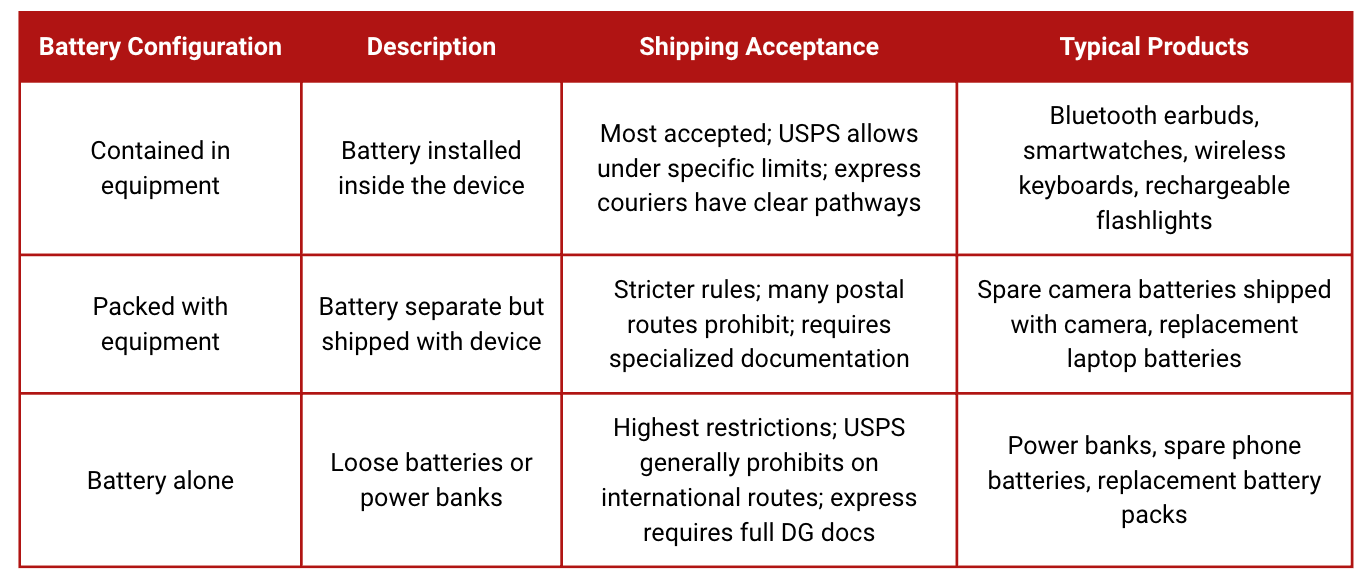
Before you finalize your product design, confirm with your freight partner which battery configuration you're using, and select a shipping channel that explicitly accepts that configuration.
For detailed battery compliance requirements and UN38.3 documentation, see our battery shipping guide.
Mistake #3: Samples Arriving Safely Doesn't Guarantee Bulk Shipments Will
Your supplier sent you three Bluetooth earbuds via DHL Express last month. They arrived in four days, no issues. So you assume your 500-unit bulk order will follow the same path.
Sample shipments often skip formal compliance. A single unit marked "sample, no commercial value" gets less scrutiny than a commercial shipment with a $3,000 declared value. Express couriers have different acceptance criteria for commercial versus sample shipments, and customs entry type changes at volume.
Treat sample logistics and bulk logistics as two separate projects. Sample success proves product quality, not shipping viability.
Mistake #4: A Cheap Quote Is Not the Same as a Low Total Cost
Choosing the lowest per-kilogram rate often leads to the highest total cost when you factor in documentation fees, customs clearance charges, storage fees during holds, and lost sales from delays.
Cheap quotes often exclude battery handling fees, customs clearance services, destination charges like fuel surcharges and residential delivery fees, rework costs when documentation is incorrect, and the opportunity cost of delays.
Request an all-in "landed cost" quote that includes freight, clearance, duties (if applicable), and delivery to your final destination. Compare total cost, not just the freight rate.
Mistake #5: Not Every Small Electronics Product Works for China-to-US Direct Shipping
Some products simply don't fit the "China direct-to-USA small parcel" model, no matter how small they are.
Power banks above 100Wh face restrictions from most postal and parcel networks. Wireless products without FCC authorization can result in seizure or mandatory re-export. Products with plug types incompatible with US standards create customer complaints and returns that erode margins.
If your supplier can't provide proper compliance documentation, don't ship until that's resolved.
For ultra-lightweight shipments under 2kg, see our specialized guide Lightweight Parcels Under 2kg Guide for optimized carrier selection.
How Importers Should Reconsider Small Electronics Shipping from China to USA
Shift from "finding the cheapest freight" to "designing a compliant, repeatable logistics process."
Step 1: Classify Your Product Correctly
Ask three questions:
Does it contain a battery? (Yes/No, and if yes: what type, what capacity, what configuration?)
Does it transmit radio frequency signals? (Bluetooth, Wi-Fi, RF remote, etc.)
What's the declared value per unit? (Affects duty treatment, loss liability, and insurance requirements)
Step 2: Match Product to Shipping Channel
Not all channels accept all products. Here's the framework:
Non-battery accessories (cables, adapters) → Postal parcel or economy express (lowest restrictions, lowest cost)
Battery-in-device, non-RF (rechargeable flashlight) → Battery-accepted parcel line or express (requires battery compliance only)
Non-battery RF devices (wired smart plug) → Standard express with FCC compliance confirmed (no battery complexity)
Battery + RF products (Bluetooth earbuds, smartwatch) → Premium express or specialized battery+RF lane (highest compliance requirements)
Power banks or loose batteries → Dangerous goods air freight or sea freight (postal networks generally prohibit)
Step 3: Prepare Documentation Before You Ship
Don't wait for your freight forwarder to ask for documents. Prepare these in advance:
For all shipments:
Commercial invoice (product description, HS code, unit value, total value, terms of sale)
Packing list (quantity, weight, dimensions per carton)
For battery-containing products:
UN38.3 test summary (if required by carrier)
Battery specification sheet (Wh rating, battery type)
Dangerous goods declaration (if shipping as DG)
For RF devices:
FCC authorization evidence (FCC ID, grant documentation, or importation-under-special-conditions justification)
Product model number that matches FCC records
Step 4: Choose the Right Incoterm for Your Situation
FOB (Free on Board): You handle ocean/air freight and all USA-side logistics. You control the process but also own all the compliance responsibility.
DDP (Delivered Duty Paid): Supplier or freight forwarder handles everything through final delivery. Simplifies your workload but requires trust that they're filing entries correctly and complying with all regulations.
For small electronics, DDP is often safer if you're new to imports, but verify exactly what's included (duties, taxes, clearance fees, battery handling) and confirm the provider is authorized to file the entry type your shipment requires.
Step 5: Monitor and Measure
Track these metrics for every shipment:
On-time delivery rate (did it arrive when promised?)
Clearance delay incidents (how often does customs hold shipments?)
Documentation rework rate (how often do you need to provide additional documents?)
Total landed cost per kg (freight + clearance + duties + delays)
If your clearance delay rate exceeds 10%, or if you're constantly providing "emergency" additional documents, your process isn't working. Adjust before scaling up.
Quick Pre-Shipment Checklist for Small Parcels of Electronic Products
Before you book your China-US small parcels shipment, verify these three things:
Product classification is clear
Battery type and configuration confirmed (contained in equipment, packed with, or alone)
Wireless/RF status verified (Bluetooth, Wi-Fi, etc.)
Declared value per unit noted
Documentation is complete and consistent
Commercial invoice has specific product description (not "accessories" or "gadgets")
Battery specs match across all documents (labels, test reports, invoices)
FCC information verified for wireless products (ID matches database)
Shipping channel is confirmed
Carrier explicitly accepts your product type (not just "accepts batteries" generally)
Route has no hidden restrictions for your battery configuration
Total landed cost calculated (freight + duties + clearance fees)
If you can't confidently check all three boxes, pause and get professional review before shipping. The 48 hours you spend verifying documentation now saves weeks of delays and thousands in extra costs later.
Real Case Scenario: Ship Bluetooth from China to the US
The Product: 300 sets of Bluetooth earbuds with charging cases (battery + wireless).
The Situation: An Amazon FBA seller ordering their first bulk shipment after successful sample testing.
Route A: The "Cheap Quote" Disaster
The seller chose a freight forwarder offering $7.20/kg because it was significantly cheaper than express quotes. The forwarder said "we ship batteries all the time, no problem." The seller provided the supplier's basic paperwork and assumed everything was fine since samples cleared customs easily.
What went wrong: Shipment arrived at US port and got flagged. Customs needed additional battery documentation. The supplier sent specs, but the numbers didn't match the actual product. Then customs wanted FCC verification. Each back-and-forth added days.
In short: the documents didn't describe the exact same product in the same way.
Final timeline: 21 days from arrival to release (9 extra days in delays).
Total cost: Original freight $432 + storage/correction fees $450 + lost Amazon sales ~$3,500 = $4,382
Route B: The Pre-Clearance Success
A different seller with the same product requested a 48-hour document pre-audit before booking. The freight forwarder checked three things:
1. Commercial Invoice - Changed vague "wireless earphones" to specific "Bluetooth 5.0 wireless earbuds with lithium-ion battery (contained in equipment), Model XYZ-2024"
2. Battery Documentation - Verified all battery numbers matched across product labels, spec sheets, and test reports
3. Wireless Compliance - Confirmed FCC ID on product matched the database and all documents listed the same model number
All corrections completed before pickup. Selected a channel with confirmed acceptance for battery+wireless products at $13.50/kg.
Final timeline: 5 days from pickup to Amazon warehouse (no delays).
Total cost: $648 freight + $0 delays = $648
The Lesson: Same Product, Two Routes, Very Different Outcomes
Route A failed because the seller chose the cheapest quote, provided documents only when asked, and discovered problems after cargo was already in transit.
Route B succeeded because documentation was verified before booking, acceptance was confirmed for the specific product type, and issues were fixed while cargo was still at the supplier's warehouse.
Remember this for any battery + wireless product:
Same product name everywhere
Same battery numbers everywhere
Channel confirmed before booking
Get these three things right 48 hours before pickup, and you avoid 90% of electronics shipping problems.
When It's Time to Stop Trial-and-Error and Get Professional Support in Small Parcels Shipping
You've read the guides, watched the YouTube videos, and tried three different freight forwarders. Your shipments still get delayed. Your costs keep creeping up. Your supplier is frustrated with constant logistics questions.
Here's the truth: small electronics shipping from China to the USA is a specialized discipline. It sits at the intersection of dangerous goods regulations, telecommunications compliance, customs clearance, and carrier network management. Most generalist freight forwarders handle it poorly because they're optimizing for volume, not complexity.
If your products contain batteries, wireless functions, or you've already experienced delays or document rework, this is where professional support actually pays for itself.
What professional support looks like:
Pre-shipment compliance audit: Before you place your order, a logistics partner reviews your product specs, battery configuration, and RF characteristics, then recommends the right channel and flags compliance gaps.
Channel optimization by product type: Different products get different lanes. Your USB cables go postal economy. Your Bluetooth speakers go battery-accepted express. Your power banks (if you absolutely must ship them) go DG air freight. You're not forcing everything through one "cheap" channel.
Proactive documentation preparation: You're not scrambling for battery test reports after the shipment is already in transit. Your logistics partner tells you exactly what's needed, when it's needed, and in what format.
Transparent pricing: You receive a detailed cost breakdown (freight, fuel surcharge, battery handling fee, clearance fee, duties if applicable) before you ship, not after.
Dedicated support for holds and exceptions: When something does go wrong, because logistics is never 100% perfect, you have a direct contact who understands your product and can resolve issues in hours, not days.
Why Gerudo Logistics?
At Gerudo Logistics, we've built our China-to-USA small parcels shipping practice around one principle: compliance-first, cost-optimized second. We've handled everything from 50kg sample shipments of wireless mice to 5,000kg commercial orders of smart home devices, and we've learned every painful lesson so you don't have to.
What makes us different:
We maintain relationships with battery-accepted parcel networks and express couriers that most brokers can't access. We have in-house compliance specialists who review FCC requirements and battery documentation before your shipment moves. We provide real-time tracking with proactive exception alerts, so you're never wondering where your products are or why they're delayed.
If you're tired of freight forwarders who promise "no problem" and then disappear when customs asks for documents, it's time for a different conversation. Contact our specialist to request a compliance-first quote for your next small electronics shipment.
Frequently Asked Questions in Shipping Small Electronics from China to USA
1. What's the best way to ship small electronics from China to the USA?
The best method depends on whether your product contains batteries and how urgently you need delivery. For non-battery items, postal or e-commerce parcel lines offer good value. For battery-containing products, use a battery-accepted parcel line or express courier. For loose lithium batteries or power banks, you'll need specialized dangerous goods handling, as many postal routes prohibit them entirely.
2. Can I ship electronics with lithium batteries via USPS to the USA?
USPS international mail allows lithium batteries only when properly installed in equipment, with specific quantity and watt-hour limits. Batteries packed separately or shipped alone are generally prohibited on international postal routes. Always verify the exact restrictions for your specific service and destination.
3. Do I need FCC certification to ship electronics from China to the USA?
If your product is a radiofrequency device (emits Bluetooth, Wi-Fi, or other RF signals), it falls under FCC importation rules. Many wireless products require FCC equipment authorization before they can be legally marketed or used in the USA. Confirm your product's FCC compliance status before shipping to avoid customs holds or potential seizure.
4. Will US customs stop my parcel if it's under $800?
Duty treatment and customs screening are separate issues. While low-value shipments may qualify for simplified entry procedures, Section 321 de minimis policy has undergone significant changes in 2025. Don't assume duty-free treatment without verifying current rules for your specific product and shipment type. Customs will still screen for compliance with safety, battery, and RF regulations regardless of value.
5. What documents do I need for small electronics shipments?
At minimum: commercial invoice and packing list with accurate product descriptions and values. For battery-containing products, carriers typically require battery compliance documentation (UN38.3 test summary or equivalent). For RF devices, ensure FCC compliance evidence is available. Incomplete or inaccurate documentation is the leading cause of shipment delays.
6. How do I reduce shipping costs for small electronics without increasing risk?
Focus on controllable factors: minimize volumetric weight through packaging optimization, choose the correct weight break for your shipment size, and avoid rework costs by declaring products accurately and selecting a channel that accepts your product type. A slightly higher freight rate with proper compliance is always cheaper than a "cheap" rate that results in holds, returns, or re-shipment.
7. Should I use DDP for small electronics shipments to the USA?
DDP (Delivered Duty Paid) simplifies landed cost predictability and transfers clearance responsibility to your freight partner. This is often advisable for electronics with batteries or RF components, as it ensures experienced customs brokers handle compliance filing. Confirm exactly what's included in the DDP price and verify that your provider is authorized to file the required entry type.
Conclusion
Shipping small parcels of electronics products from China to the USA is not a commodity service. It's a compliance-driven logistics discipline where battery regulations, FCC requirements, and customs documentation intersect with carrier policies and cost optimization.
The importers who succeed, who get consistent on-time delivery, predictable costs, and zero compliance drama, don't treat logistics as an afterthought. They classify products correctly, match them to appropriate channels, prepare documentation in advance, and work with freight partners who understand the technical requirements.
The importers who struggle keep chasing "cheap quotes," ignore battery and RF compliance until it's too late, and treat every shipment like a dice roll.
Your next step: Review your current small electronics shipments against the checklist in this guide. Identify where your process has gaps. If you're seeing clearance delays above 10%, documentation rework on more than 20% of shipments, or surprise cost overruns, your logistics strategy needs an upgrade.