Frozen Food Shipping from China to the Middle East: 2026 Cold Chain Guide
The frozen food trade lane between China and the Middle East has grown substantially over the past five years. Several factors drive this trend.
First, China's frozen food processing industry has matured significantly. Modern IQF (Individually Quick Frozen) facilities and strict quality control systems now meet international standards.
Second, the cost advantage remains compelling for buyers. Chinese suppliers often deliver 15-25% better pricing than alternative origins for comparable quality grades.
Third, the Middle Eastern market has seen strong demand growth across both retail and HORECA (hotel, restaurant, catering) channels. Population growth in the GCC, combined with rising consumer preference for convenient meal solutions, has created consistent year-round demand for frozen vegetables, seafood, prepared foods, and fried snacks.
However, shipping frozen food from China to the Middle East presents distinct challenges.
Temperature integrity must be maintained across a supply chain that typically spans 18-28 days for ocean freight. Documentation requirements are strict, particularly around Halal certification and Arabic labelling compliance. Port congestion, inspection holds, and last-mile cold storage coordination can all introduce risk.
Understanding both the logistics mechanics and the regulatory landscape is essential for success in this trade.
Understanding Reefer Container Shipping: FCL vs. LCL Options
Full Container Load (FCL) Reefer Shipping
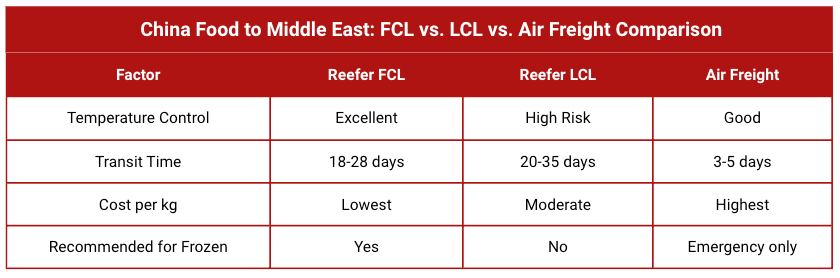
For most frozen food shipments from China to the Middle East, a 40-foot high-cube reefer container operating at -18°C or colder is the standard choice. This method provides maximum control over temperature, loading practices, and cargo security throughout the journey.
Typical Transit Times (Port to Port):
Shanghai/Ningbo to Jebel Ali: 18-22 days
Qingdao to Jebel Ali: 20-24 days
Shanghai to Jeddah: 22-26 days
Dalian to Dammam: 24-28 days
These estimates assume direct sailings. Transshipment routing can add 5-10 days but may offer cost savings for smaller buyers willing to accept longer transit.
Reefer FCL Advantages:
Complete control over temperature set point and continuous monitoring
No cross-dock exposure or mixed-cargo contamination risk
Simplified responsibility chain for temperature claims and quality disputes
Easier customs clearance process with single shipper documentation
Better protection for high-value or sensitive products
Why LCL Is Not Recommended for Frozen Food
While reefer LCL consolidation services exist in certain corridors, we strongly advise against this option for frozen food shipments.
LCL requires multiple handling touchpoints at consolidation warehouses, exposing your cargo to temperature fluctuations during the 2-5 day consolidation process. Liability becomes unclear when temperature deviation occurs across multiple parties.
Additionally, genuine reefer LCL services are limited on China to Middle East lanes, and the true cost often approaches FCL rates when you factor in higher insurance premiums and potential quality claims. If your volume is insufficient for FCL, consider coordinating with other buyers to share a container or waiting until you accumulate enough volume.
Air Freight for Frozen Food: When Does It Make Sense?
Air freight for frozen products is typically 8-12 times more expensive than ocean reefer on a per-kilogram basis. However, specific scenarios justify the premium cost:
Urgent replenishment when stock outages threaten customer commitments
High-value premium SKUs where margin supports elevated logistics cost
Short remaining shelf-life situations where ocean transit would compromise product quality
Market-testing small quantities before committing to FCL volumes
When using air freight, work with forwarders experienced in temperature-controlled air cargo. Dry ice supplementation and insulated packaging are common requirements. Ground handling at both origin and destination airports must include cold storage facilities to maintain temperature integrity during the transfer process.
Essential Documentation and Certification Requirements
Core Shipping Documents From China to Middle East
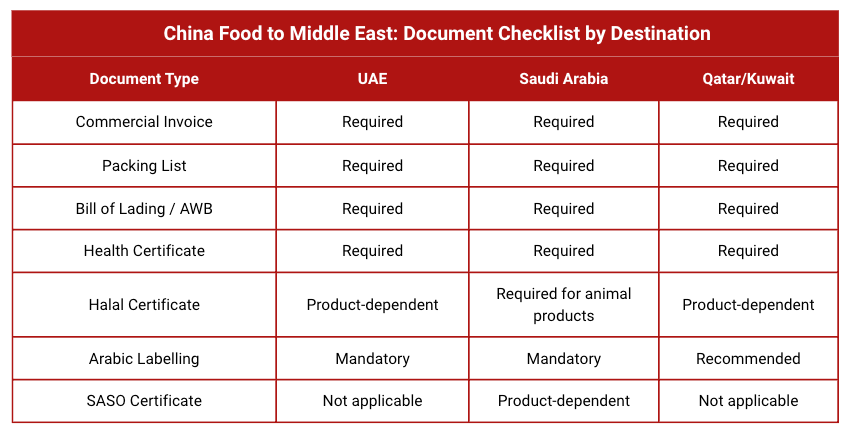
Every frozen food shipment from China to Middle East destinations requires baseline documentation.
The commercial invoice must accurately describe product, HS code, quantity, unit value, and total value. Undervaluation creates customs issues and potential penalties.
The packing list should detail carton count, net weight, gross weight, and pallet configuration. This document supports physical inspection and duty calculation.
For ocean freight, the bill of lading serves as the transport contract and title document.
For reefer containers, ensure it specifies the agreed temperature set point. For air freight, the air waybill serves the equivalent function and should note any special handling requirements for temperature-controlled cargo.
Product-Specific Certificates for Food Shipping to Middle East
Health and Sanitary Certificates
Most Middle Eastern countries require official health certificates for imported frozen food. These are issued by Chinese quarantine authorities and confirm the product was processed under hygienic conditions and is fit for human consumption.
Requirements vary by product. Frozen seafood typically requires more detailed certification than frozen vegetables. Apply for certificates early in the production process, as issuance can take 3-7 business days.
Halal Certification: When Is It Required?
The answer depends on your destination country and product type.
Saudi Arabia:
Halal certificates are mandatory for products containing animal-origin components, including meat, poultry, gelatin, and certain emulsifiers. Products labelled as "Halal" also require certification. Entirely plant-based products, such as frozen vegetables and fries made with vegetable oil, typically do not require it.
UAE:
The UAE does not mandate Halal certification for all food imports. Products containing meat or animal derivatives should carry certification from a recognized Islamic authority. Many UAE importers request Halal certificates even for borderline categories to avoid distribution issues downstream.
Obtaining Halal Certification:
Work with suppliers who already hold valid Halal certification from a body accepted by your destination country. Confirm acceptance with your buyer or destination authority before shipment, as some countries maintain approved lists of foreign certifiers.
SASO and SFDA Requirements for Saudi Arabia
SASO
Not all frozen food requires SASO certification. Most standard frozen food categories that carry proper health certificates can clear Saudi customs without it. Certain processed foods with specific additives may be an exception. Confirm the requirement for your HS code with your Saudi customs broker before your first shipment.
SFDA
Food products entering Saudi Arabia must meet SFDA requirements. For most frozen food categories, this means the manufacturing facility must be registered with SFDA. Ask your supplier to confirm their registration status in writing before you book.
Arabic Labelling Requirements for Food Import
UAE and Saudi Arabia Labelling Rules:
Both countries generally require Arabic labelling or bilingual (Arabic/English) labels on retail food packages.
UAE labelling standards require the following in Arabic:
Product name
Ingredients list
Net weight
Production and expiry dates
Country of origin
Importer name and address
Storage instructions
Saudi Arabia similarly requires Arabic labelling aligned with SFDA and GSO standards, covering:
Product identity
Full ingredient declaration
Allergen information
Date marking
Storage and handling instructions
Nutritional information for products above certain volume thresholds
Practical Labelling Strategy:
If you are sourcing private-label frozen products, coordinate Arabic-compliant artwork with your Chinese supplier before production begins. Most experienced exporters can print bilingual labels or Arabic labels directly at the factory. This eliminates costly relabelling operations at destination.
For branded products where label changes are not feasible, you may need to apply compliant stickers at a warehouse in the destination country before distribution. This adds cost and handling time, but is sometimes the only option for established brand packaging.
Most Popular Frozen Food Categories Shipped from China to the Middle East
Understanding which products dominate this trade lane helps you benchmark your own sourcing decisions. The following categories consistently show high volume and strong market acceptance across GCC markets.
Frozen Seafood from China's Coastal Regions
Fujian Abalone (Frozen Whole and Processed)
Fujian province is recognized globally for its abalone aquaculture. Frozen abalone from Fujian suppliers is exported in multiple formats: whole cleaned, sliced, and ready-to-cook preparations.
Middle Eastern importers prize this product for high-end restaurant menus and premium retail. Quality depends on rapid freezing immediately after harvest and maintaining strict temperature during the entire journey.
When sourcing Fujian abalone, verify that your supplier uses blast freezing or IQF methods to preserve texture. Request temperature records from production through container stuffing. The product should be packed in moisture-barrier materials to prevent freezer burn during the 20-25 day ocean transit to Jebel Ali or Jeddah.
Check our Seafood refeer container shipping guide for more logistics advice.
Frozen Shrimp and Mixed Seafood
China supplies significant volumes of vannamei shrimp, black tiger shrimp, squid, calamari rings, and mixed seafood assortments to GCC markets. Sizing accuracy, glazing percentage, and species verification are critical for buyer acceptance.
Ensure your supplier provides transparent net weight declarations and can support third-party inspection if required by your buyer.
Ningxia Lamb and Halal Meat Products
Ningxia Hui Autonomous Region has become a major hub for Halal-certified frozen lamb production. The region's Muslim population and established slaughter processes aligned with Islamic requirements make it a natural sourcing point for Middle Eastern importers.
When sourcing frozen lamb from Ningxia, confirm that the slaughterhouse holds valid Halal certification recognized by your destination country. For Saudi Arabia imports, SFDA maintains specific lists of approved foreign establishments. For UAE, certification from recognized bodies such as EIAC (Emirates International Accreditation Centre) is typically required.
Frozen lamb is typically shipped in carton packs of 10-25kg, arranged on pallets inside a 40-foot high-cube reefer container. Proper airflow around cartons is essential. Poor stacking can create warm pockets and compromise product integrity.
Read and learn more our Meat refeer container shipping guide.
Dalian Cherries and Premium Frozen Fruit
Dalian in Liaoning province is famous for cherry production. While fresh cherry export windows are limited to a few weeks annually, frozen IQF cherries extend availability throughout the year. Middle Eastern buyers use frozen Dalian cherries for dessert manufacturing, smoothie supply, and high-end hotel pastry operations.
Frozen fruit requires careful attention to moisture control and packaging. Clumping indicates temperature fluctuation during storage or transport. When you inspect product at destination, individual pieces should separate easily. This is a reliable quality indicator that the cold chain remained stable throughout transit.
Other High-Demand Frozen Products
The following categories also show consistent demand in Middle Eastern markets:
Frozen French Fries and Fried Snacks: Bulk foodservice staple with high rotation in UAE, Saudi Arabia, Qatar, and Kuwait markets
Frozen Dumplings and Spring Rolls: Strong performance in Asian cuisine channels and diversified restaurant concepts
Frozen Mixed Vegetables: IQF blends for HORECA kitchens and retail distribution
Frozen Prepared Foods: Ready meals and dim sum assortments require higher documentation scrutiny but offer good margins
How Gerudo Logistics Ensures Successful Frozen Food Delivery
At Gerudo Logistics, we specialize in temperature-controlled shipping from China to Middle East destinations. Our experience handling frozen food imports gives you confidence that your cargo will arrive in optimal condition and clear customs efficiently.
Pre-Shipment Temperature Verification: We coordinate Pre-Trip Inspection (PTI) for reefer units before loading, confirming refrigeration machinery operates correctly and can maintain your required set point throughout the journey. We document PTI results and share reports with you for quality assurance records.
Container Loading Supervision: Our team ensures proper cargo arrangement for optimal air circulation, correct positioning of temperature data loggers, and secure load configuration to prevent shifting during transit. Poor loading is one of the most common causes of temperature excursions.
Continuous Temperature Monitoring: Modern reefer containers include integrated monitoring systems that record temperature every hour. We provide access to these temperature logs so you can verify cold chain integrity throughout transit. If any deviation occurs, we receive immediate alerts and can coordinate intervention with the carrier.
Documentation Compliance Support: We work with you to ensure all required certificates and documents are prepared correctly before departure. Our established relationships with Chinese health certificate issuers, Halal certification bodies, and customs authorities in major Middle Eastern ports streamline this process. We review your documentation package before shipment and flag any issues early.
Customs Clearance Coordination: When your container arrives at Jebel Ali, Jeddah, Dammam, or other GCC ports, we coordinate with licensed customs brokers who understand frozen food import procedures. This includes pre-clearance document submission where permitted, coordination of required inspections, and arrangement of cold storage if clearance extends beyond standard timelines.
Cold Chain Last Mile: We arrange refrigerated trucking with GPS monitoring and temperature logging, working only with carriers who maintain dedicated reefer fleets and proper maintenance programs. This eliminates the risk of using converted trucks or poorly maintained equipment.
Case Study: Frozen Seafood Import Success from Fujian to Dubai
Background
A Dubai-based foodservice distributor specializing in premium seafood for five-star hotels and high-end restaurants.
Challenge
The client wanted to source frozen abalone and mixed seafood assortments from Fujian province. Previous shipments with another forwarder had experienced temperature fluctuations and one instance where incorrect documentation caused a five-day customs hold.
Gerudo Logistics Solution
We selected direct service from Xiamen to Jebel Ali with 19-day transit, avoiding transshipment and coordinated with the client's UAE customs broker to submit health certificates and commercial documents before vessel arrival.
We also arranged standby cold storage space at Jebel Ali in case inspection held the container beyond free time.
Results
The container arrived with perfect temperature records showing consistent -20°C throughout the journey. Customs clearance was completed within 36 hours of discharge. Product quality inspection by the client showed zero defects.
The client has since shipped 12 additional containers through our service with zero incidents.
Complete Frozen Food Shipping Process to Middle East: Step-by-Step Timeline
Understanding the full timeline helps you plan inventory, coordinate with buyers, and manage cash flow effectively.
Weeks 1-2: Pre-Production and Preparation
Order products and confirm production schedule with your Chinese supplier
Confirm container booking and sailing schedule with Gerudo Logistics
Apply for health certificates and Halal certificates (if required) through authorized Chinese agencies
Supervise container stuffing with temperature data loggers activated
Seal container and transport to the departure port
Week 3: Port Operations and Departure
Container arrives at the Chinese port (Shanghai, Ningbo, Qingdao, Xiamen, or other departure points)
Container connects to reefer monitoring system and joins the loading queue
Container is loaded onto the vessel and the final documentation package is completed
Vessel departs; you receive container tracking information and expected arrival date
Weeks 4-6: Ocean Transit
Container maintains -18°C to -20°C during the 18-28 day voyage across the Indian Ocean
Remote temperature monitoring confirms cold chain integrity throughout transit
Week 7: Arrival, Clearance, and Delivery
Container discharges at destination port and connects to reefer power in the port yard
Destination customs broker submits clearance documents; port health authority inspects if selected
Customs clearance completes and applicable duties and fees are paid
Refrigerated truck picks up container and delivers to your warehouse under temperature-controlled conditions
Total timeline: approximately 7 weeks from production start to final delivery for ocean freight. Air freight reduces this to 2-3 weeks but at significantly higher cost.
Frequently Asked Questions to Ship Frozen Food from China to the Middle East
Q: What shipping method is best for frozen food from China to the Middle East?
A: Reefer ocean freight using FCL is the default choice for stable, high-volume products due to better unit economics. Air freight is reserved for urgent replenishment or premium products. Ocean reefer costs approximately 8-12 times less per kilogram than air freight.
Q: What temperature should frozen food be kept at during transport?
A: The industry baseline is -18°C or colder with continuous monitoring and documented temperature records. We recommend setting reefer containers to -20°C to provide a safety margin against minor fluctuations.
Q: Can I ship frozen food as LCL instead of FCL?
A: We do not recommend LCL for frozen food due to high temperature control risks from multiple handling touchpoints, extended dwell time at consolidation facilities, and unclear responsibility boundaries if temperature issues occur. FCL provides the necessary control and protection for frozen products.
Q: What are the most common reasons for delays in the Middle East?
A: Typical causes include documentation gaps (missing certificates, label non-compliance), inspection holds by health authorities, port congestion or appointment delays, and insufficient cold storage arrangements after cargo discharge. Proper documentation preparation and pre-clearance coordination significantly reduce these risks.
Q: Do I need Arabic labelling for imports to UAE and Saudi Arabia?
A: Yes, both countries require Arabic labelling or bilingual (Arabic/English) labels on retail food packages. Requirements include product name, ingredients, net weight, production and expiry dates, country of origin, and importer details in Arabic. For bulk foodservice packs that will be repackaged, requirements may differ.
Q: When is a Halal certificate required for Saudi imports?
A: According to SFDA guidance, Halal certificates are required for products containing animal-origin components (meat, poultry, gelatin, certain emulsifiers) and products displaying "Halal" on labels. Plant-based frozen products like vegetables and fruits typically do not require Halal certification unless processed on shared equipment.
Q: How do I prevent temperature excursions and quality claims?
A: Confirm reefer container condition through Pre-Trip Inspection (PTI), set correct temperature with safety margin (-20°C recommended), follow proper loading practices that ensure good airflow around cargo, implement continuous monitoring with data loggers, and establish clear chain of custody for temperature responsibility between carrier, forwarder, trucker, and warehouse.
Conclusion: Partnering for Cold Chain Success
Frozen food shipping from China to the Middle East requires specialized knowledge, careful planning, and experienced logistics partners. Temperature integrity, regulatory compliance, and timing precision are fundamental requirements for success in this market. The products you import represent significant investment and customer commitments that demand professional cold chain management.
At Gerudo Logistics, we bring comprehensive expertise to every shipment. Our team has successfully delivered hundreds of reefer containers from Chinese suppliers to Middle Eastern importers, managing the technical and regulatory details that determine success.
Ready to start your next frozen food import from China? Contact us to discuss your specific requirements. Our cold chain specialists will provide detailed routing options, transparent pricing, and timeline projections customized to your products and destinations.