Frozen Seafood Shipping from China: Cold Chain, Compliance & Costs
China has established itself as the world's dominant frozen seafood supplier, exporting over 2 million tons valued at approximately $19.5 billion in 2024. Major processing hubs in Shandong, Zhejiang, and Fujian supply global markets with everything from whiteleg shrimp and tilapia fillets to squid tubes and scallops.
However, frozen seafood shipping from China comes with distinct cold-chain risks. Compared with many other frozen foods, seafood is more prone to quality loss that may only appear after thawing, making temperature discipline, airflow, and documentation timing critical.
What makes seafood different:
Enzyme activity: Seafood contains higher enzyme concentrations than meat or poultry. Lipid oxidation accelerates rapidly in fatty species, temperature abuse of just -15°C instead of -18°C doubles oxidation rates in salmon and mackerel.
Moisture sensitivity: Higher water content means improper freezing or temperature cycling causes ice crystal formation that ruptures cell walls, resulting in drip loss and mushy texture.
Species-specific requirements: IQF shrimp needs glaze protection. Tuna requires ultra-low temperatures to prevent histamine formation. Octopus becomes rubbery if frozen incorrectly.
Regulatory complexity: Seafood faces stricter scrutiny than other food categories. The EU's catch certificate requirements, FDA's HACCP controls, and destination-specific health standards create documentation challenges that can strand containers at port.
High financial stakes: A single 40-foot reefer of yellowfin tuna loins can be worth $120,000. Atlantic salmon portions? $80,000 per container. These margins don't tolerate mistakes.
This guide provides actionable intelligence for frozen seafood importers, covering the requirements, costs, regulatory frameworks, and operational practices that determine success in this high-stakes trade.
Why Import Frozen Seafood from China?
Competitive Advantages
Cost efficiency: Chinese processing labor costs offer competitive advantages compared to developed markets, translating to attractive FOB pricing even after factoring in ocean freight and import duties.
Processing capacity: China's industrial-scale processing infrastructure handles massive volumes with consistent quality. Major facilities operate with blast freezing capacity, cold storage, and integrated quality control laboratories.
Species diversity: From whiteleg shrimp (Litopenaeus vannamei) and giant tiger prawns to Nile tilapia, Atlantic salmon portions, squid tubes, scallops, and specialty species, Chinese suppliers offer comprehensive product ranges that enable one-stop sourcing.
Supply chain integration: Many Chinese processors maintain aquaculture operations or fishing fleet relationships, ensuring stable supply and traceability from harvest to export.
Established cold chain: China has invested heavily in cold chain infrastructure. Major ports like Shanghai, Ningbo, Qingdao, and Xiamen provide reefer container availability, shore power connectivity, and temperature-controlled warehousing.
China Frozen Seafood Market Positioning
Chinese frozen seafood serves multiple market segments:
Retail: Consumer-ready IQF shrimp, fish fillets, and seafood mixes for supermarket frozen sections
Foodservice: Bulk formats for restaurants, hotels, and catering operations
Processing/Re-export: Semi-processed products for value-added operations in destination markets
Industrial: Ingredients for ready meals, seafood snacks, and processed food manufacturing
The combination of competitive pricing, reliable supply, and processing sophistication makes China an essential source for global seafood importers across all these segments.
Frozen Seafood Reefer Shipping: Essential Requirements
Temperature Requirements by Species
Different seafood species require specific storage temperatures based on fat content and protein structure:
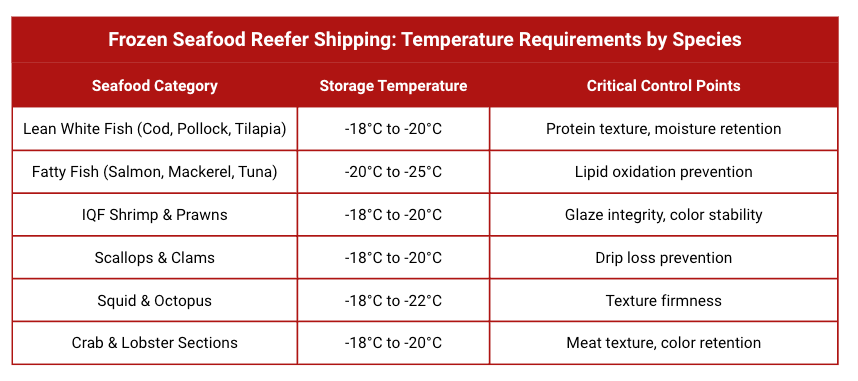
Key temperature principles:
Product must reach target core temperature 24 hours before loading
Reefers maintain temperature, they don't freeze warm cargo
Pre-cool empty reefers to setpoint before loading begins
Complete loading within 2-3 hours to minimize exposure
Deploy independent temperature data loggers inside pallets for verification
Temperature abuse is particularly damaging for seafood. Research on lipid oxidation in frozen fish shows that polyunsaturated fatty acids in marine fish are readily oxidized even at frozen storage temperatures, with the rate depending on species, storage temperature, and duration. This causes off-flavors, rancidity, and reduced nutritional value over time.
Frozen Seafood Packaging Standards: What to Verify Before Shipment
As an importer, you don't pack the cartons—but you're the one who pays when packaging failures cause rejected shipments. Here's what to audit with your Chinese suppliers to avoid costly quality claims:
1. Master Carton Strength
Standard corrugated cartons can lose up to 75% of compression strength when frozen and wet. Non-coated cartons collapse under stack pressure, block airflow, and damage product.
Verify:
Wax-coated or plastic-laminated cartons (minimum 44 ECT)
Inner polyethylene liners (freezer burn & odor control)
Proper weights: 10–15 kg retail/20–25 kg foodservice
2. Labeling Errors That Trigger Holds
Incorrect labeling is one of the most common causes of customs delays for frozen seafood — and delays mean demurrage, detention, and quality risk.
Must-have labels:
Common name and scientific species name
Net weight with glaze % declared separately
Production date, expiry date, lot codes
Storage temperature (–18°C or colder)
Catch method (wild/farmed) & origin waters
Allergen warnings in destination language
One missing label line can cost more than the ocean freight.
3. The Glaze Percentage Dispute
The most common seafood trade conflict:A buyer orders 10% glaze IQF shrimp at $12/kg. Shipment arrives at 18% glaze. That’s $960 loss per ton or $19,200 on a 20-ton container, before relationship damage.
Require from suppliers:
Drip-thaw glaze testing per batch
Target 8–12% glaze (some markets allow up to 15%)
Evidence of glazing process for high-value orders
Acknowledgement that transit reduces, not increases, glaze
4. Palletization That Affects Temperature
Poor palletization blocks airflow. The reefer looks fine, the cargo core is not.
Red flags:
Non-ISPM-15 pallets
No column stacking (airflow blocked)
Stretch wrap applied below pallet deck
No pallet-level species/lot marking in mixed loads
Shipping Methods & Cost Structure for Frozen Seafood Reefer Shipping
FCL Reefer (Full Container Load):
Standard for volumes exceeding 10 pallets. A 40-foot reefer holds 22-24 pallets or 20-24 metric tons depending on packaging density.
Typical cost breakdown from China to major global ports:
Base ocean freight: $2,000-4,500 per 40ft container (varies by trade lane and season). As of December 2024, Shanghai to Los Angeles spot rate was $2,103
Reefer premium surcharge: Additional 50-100% above dry container rates ($1,000-2,500). Reefer rates typically cost 2-2.5 times standard rates
Bunker Adjustment Factor (BAF): $300-800 (fuel surcharges vary with oil prices)
Reefer plug-in fees (electricity): $150-300 (power charges while connected at terminal and vessel)
Pre-Trip Inspection (PTI): $75-150
Pre-cooling charges: $100-200 if performed at depot
Total estimated range for FCL reefer: $4,000-8,000 per 40-foot reefer to major global ports
LCL Reefer (Less-than-Container Load):
Available but carries risks for seafood:
Consolidation delays expose cargo to temperature variations
Odor cross-contamination from mixed shippers' products
Limited temperature control during warehouse staging
Higher per-unit costs once volume exceeds 8-10 pallets
Suitable only for trial orders (2-5 pallets) before transitioning to FCL.
Air Freight:
Costs 8-12 times ocean freight rates but justified for specific scenarios:
Ultra-premium products (bluefin tuna, sashimi-grade seafood)
Contract penalty avoidance when delivery deadlines are critical
Emergency shipments during supply disruptions
For standard commercial volumes, air freight economics rarely justify the cost premium.
Cost Traps for Seafood Importers
Beyond standard shipping charges, frozen seafood faces hidden costs that can eliminate margins:
Demurrage & Detention: Reefer containers face strict charges:
Shortened free time: Typically 2 days vs. 3-5 for standard containers (varies by terminal and carrier)
Higher daily charges: $250-350/day for reefers vs. $150-200 for dry containers
Continuous power fees while awaiting pickup
Each detention day also reduces remaining product shelf life
Quality Rejection Costs: Temperature-related quality failures trigger cascading expenses:
Lost cargo value (premium seafood containers typically valued at $50,000-120,000)
Destruction/disposal fees at destination port
Damaged buyer relationships affecting future orders
Insurance premium increases after claims history
Documentation Delays: Missing or incorrect seafood certificates cause:
Port storage charges ($100-300 per day accumulating)
Inspection fees for document verification
Rush courier costs for missing certificates from China
Potential product degradation during extended port dwell time
Temperature Excursion Recovery: If temperature alarms trigger during voyage:
Reefer technician inspection fees at port of call ($500-1,500)
Potential transshipment to new container ($2,000-4,000)
Extended transit time affecting product quality
Buyer negotiation costs if quality partially compromised
Avoidance strategy: Work with experienced freight forwarders who pre-clear documentation, coordinate rapid container pickup, and maintain 24/7 monitoring to catch issues early.
Regional Import Regulations for Frozen Seafood Shipping
European Union
IUU Catch Certificate Requirements:
Wild-caught seafood entering the EU requires catch certificates proving legal fishing under IUU (Illegal, Unreported, Unregulated) controls. From January 10, 2026, the CATCH electronic system becomes mandatory for all EU importers.
Key EU compliance requirements:
Catch certificates validated by flag state authorities (wild-caught species only)
Complete vessel-to-consumer traceability documentation
Processing plant approval numbers on EU-approved establishment lists
Compliance with EU maximum residue limits for veterinary medicines
EORI number for importer registration
Health certificates from Chinese authorities (GACC)
Farmed seafood exemption: Aquaculture products don't require catch certificates but need origin and farming method declarations.
United States
HACCP and Import Monitoring:
FDA Prior Notice submission 4-8 hours before arrival
HACCP plan documentation for all fish and fishery products
Seafood Import Monitoring Program (SIMP) requirements for "at-risk" species: yellowfin tuna, Pacific cod, red snapper, shrimp require harvest documentation
Country of Origin Labeling (COOL) for retail channels
Section 301 tariff exposure for certain Chinese seafood (varies by HS code)
Key documents:
Commercial invoice with scientific species names
FDA Prior Notice confirmation
Health certificates from GACC
Processing plant FDA registration evidence
Middle East (UAE, Saudi Arabia, Kuwait)
Halal and Health Certification:
Middle Eastern markets require specific documentation:
Halal certification for applicable products (requirements vary by country and species, some markets require halal for all seafood, others only for specific categories)
Certificate of Origin certified by Chinese chambers of commerce
Health certificates endorsed by destination country embassy/consulate in China
Import permit reference numbers in all shipping documents
Arabic language labeling for retail-destined products
Pre-shipment inspection by approved agencies (varies by destination)
Growing market dynamics: UAE, Saudi Arabia, and Kuwait have rapidly expanding frozen seafood imports. Dubai's strategic position as a regional distribution hub makes it attractive for importers serving broader Middle East markets. However, documentation requirements are strict and frequently updated, working with experienced freight forwarders familiar with Middle Eastern compliance is essential.
HS Code Classification for Frozen Seafood
Proper classification determines duty rates and regulatory controls:
0303: Fish, frozen (whole, H&G)
0304: Fish fillets and fish meat, frozen
0306: Crustaceans, frozen (shrimp, crab, lobster)
0307: Mollusks, frozen (squid, octopus, scallops, clams)
Specific 8-10 digit codes determine exact duty treatment. Anti-dumping and countervailing duties may apply to certain Chinese seafood in specific markets. Work with licensed customs brokers who monitor current trade remedy investigations.
How Gerudo Logistics Supports Your Frozen Seafood Imports
At Gerudo Logistics, frozen shipping is our core competency. We've built operations around the zero-tolerance requirements that marine proteins demand.
Our specialized services:
Cold storage network: Partnerships with approved facilities in all major seafood processing regions (Shandong, Zhejiang, Fujian, Guangdong) enable strategic pre-cooling coordination
Guaranteed reefer availability: Volume commitments with major shipping lines secure container space during peak seasons
Mandatory PTI protocols: Every reefer undergoes documented Pre-Trip Inspection with performance review before release
24/7 temperature monitoring: Independent data loggers deployed in strategic pallet locations with real-time alert systems
Documentation expertise: Seafood-specific paperwork preparation including catch certificates (EU), SIMP documentation (U.S.), and Halal certifications (Middle East)
Regional compliance knowledge: Updated expertise on EU CATCH system, U.S. FDA/SIMP rules, and Middle Eastern requirements
We don't just book container space, we manage the entire cold chain to ensure your product arrives pristine. Contact us to discuss your frozen seafood import requirements with our cold chain specialists.
Best Practices for Frozen Seafood Import Success
Supplier Qualification
Processing facility verification:
Visit operations to confirm blast freezing capacity (-35°C rapid freeze)
Verify dedicated -18°C cold storage with 24/7 monitoring
Check destination market approved establishment lists
Review HACCP implementation and QC laboratory capabilities
Essential certifications:
ISO 22000 (food safety management)
BRC Global Standard (for EU/UK markets)
MSC certification (wild-caught sustainable species)
BAP certification (farmed seafood)
Destination-specific approvals (FDA registration, EU approval numbers)
Quality control verification:
Third-party lab testing for microbiology, heavy metals, veterinary drug residues
Temperature monitoring documentation from processing through loading
Species authentication testing (DNA analysis prevents substitution fraud)
Sample lot approval before bulk orders
Optimal Loading Coordination
Precise timing prevents temperature excursions:
Day -5: Book reefer container, specify PTI requirement
Day -3: Empty reefer to depot for Pre-Trip Inspection
Day -2: PTI-approved reefer moved to cold storage facility and pre-cooled
Day -1: Seafood staged in -18°C holding, core temperatures verified, documents finalized
Day 0: Rapid loading within 2-3 hours, container sealed and powered immediately
Day 1: Container to port terminal, connected to shore power before vessel loading
Real-Time Shipment Monitoring
Major shipping lines (Maersk, MSC, CMA CGM) provide web-based reefer monitoring showing real-time temperature, location, and alarm history.
Configure alerts for temperature deviations. If alarms trigger:
Contact carrier operations immediately
Request technician inspection at next port
Document communications for insurance claims
Assess cargo acceptance based on alarm duration
Supply Chain Resilience
Geographic diversification: Source from multiple Chinese provinces. If one region faces disruptions, alternative suppliers maintain supply continuity.
Species flexibility: Qualified suppliers for alternative species provide options during supply constraints or price spikes.
Multiple carrier relationships: Don't rely on single shipping lines. Maintain relationships with 2-3 carriers for rate flexibility and guaranteed space.
Route alternatives: During disruptions (Red Sea diversions adding 10-21 days), alternative routing options prevent delivery failures.
Frequently Asked Questions for Frozen Seafood Shipping
What's the optimal shipping method for frozen seafood from China?
Ocean freight in reefer containers (FCL) is standard for commercial volumes 10+ pallets. Air freight (typically 8-12x cost premium) only makes economic sense for ultra-premium products or emergency shipments where delivery delays trigger contract penalties.
What temperature should frozen seafood be shipped at?
Most seafood: -18°C to -20°C. Fatty fish (salmon, tuna, mackerel): -20°C to -25°C due to higher oxidation rates. All species require minimal temperature variance (±1°C maximum) and proper pre-cooling before loading.
What is a catch certificate and when is it required?
The EU requires catch certificates for wild-caught seafood under IUU fishing controls. From January 10, 2026, the CATCH electronic system becomes mandatory for all EU imports. Certificates prove legal fishing by validating vessel, location, and flag state authorization. Farmed seafood is exempt.
How much does reefer shipping cost from China?
Typical range: $4,000-8,000 per 40-foot reefer to major global ports. As of December 2024, Shanghai to Los Angeles base spot rate was $2,103 per 40ft container, with reefer premiums adding 50-100% ($1,000-2,500) to base rates. Additional charges include fuel surcharges ($300-800), terminal handling, plug-in fees ($150-300), and PTI inspection costs ($75-150).
What's the acceptable glaze percentage for IQF shellfish?
Industry standard: 8-12% glaze weight, with some markets accepting up to 15% for extended voyages. Critical requirement: declared glaze must be accurate. Buyers paying for "10% glaze" who receive 18% effectively paid premium prices for ice, triggering disputes.
Do I need Pre-Trip Inspection for every reefer shipment?
Yes. PTI is mandatory industry-standard refrigeration system check before loading. The inspection confirms compressor operation, temperature control accuracy, and electrical systems. Skipping PTI to save $75-150 risks loading valuable cargo into defective equipment, potential total loss of containers worth $50,000-120,000.
What are demurrage and detention charges for reefers?
Demurrage: charges when containers remain in port terminal beyond free time (typically 2 days for reefers). Detention: charges when containers are outside terminal beyond free time. Reefer rates ($250-350/day) significantly exceed standard containers ($150-200/day) due to continuous power requirements.
Conclusion
Frozen seafood shipping from China offers tremendous commercial opportunities for importers who understand operational requirements. Success demands precision in temperature management, regulatory compliance, and supply chain coordination.
The importers who consistently succeed treat seafood logistics as a specialized discipline requiring technical expertise, established cold storage relationships, reliable reefer equipment access, and comprehensive knowledge of species-specific requirements and destination regulations.
Partner with specialists who understand these requirements and have the infrastructure to deliver consistent results.