Hidden Costs in Mini Excavator Shipping from China: What Importers Really Need to Know
You found the perfect mini excavator in China. The price looks great. You negotiate freight rates. Everything seems straightforward until the bills start arriving.
Terminal handling charges you didn't budget for. Documentation fees. Container exams. Your container sits at port two days past free time, and suddenly you owe demurrage. Before you return the empty container, detention charges kick in.
Your cost-effective Chinese excavator just became significantly more expensive than planned.
This scenario repeats itself across thousands of shipments every month. The good news? Most hidden costs are entirely predictable once you understand the shipping process.
Why Importers Consistently Overpay in Mini Excavator Shipping
Most importers focus exclusively on the ocean freight rate. A forwarder quotes $2,400 for a 20-foot container. The buyer approves it. Three weeks later, the total bill reaches $4,800.
Real example from November 2025:
A Florida contractor ordered a 2.5-ton mini excavator from Shandong for $13,800. The supplier quoted CIF Miami at $3,200 total. The buyer assumed this covered delivery to port and all port charges.
When the container arrived, surprise charges appeared:
Terminal handling: $520
Customs clearance: $310
Import duties (2%): $276
Drayage to yard: $640
Demurrage (2 days): $370
Total surprise charges: $2,116
The landed cost jumped to $19,116 instead of the expected $17,000.
The pattern is consistent: buyers receive quotes for one component, then face unexpected bills for everything else. The solution is understanding the complete journey and demanding itemized quotes.
The Three Phases Where Hidden Costs Accumulate
Understanding where costs occur in the shipping process helps you identify which expenses appear in your freight quote and which ones arrive as separate invoices later.
Phase 1 – Origin Charges in China
Before your mini excavator leaves the factory, several costs come into play:
Container stuffing and supervision: Loading a mini excavator into a container requires proper positioning and securing. If your forwarder doesn't include supervision in their base rate, you might pay $150 to $300 separately.
Export customs clearance: Documentation and filing fees in China typically range from $100 to $300 per shipment, depending on complexity.
Inland trucking to port: If your supplier operates in an inland province, drayage to ports like Shanghai or Ningbo can add several hundred dollars. Some suppliers quote FOB prices including port delivery, while others quote EXW from their factory gate.
Lashing, blocking, and bracing: This is frequently excluded from initial quotes. Your mini excavator weighs between one and six tons. Without proper securing following CTU Code standards, your machine can shift or tip during ocean transit. Professional cargo securing involves:
Wooden blocking under the tracks
Steel lashing straps over the machine
Dunnage bags to fill voids
Edge protectors to prevent strap damage
Materials and labor for proper securing cost $200 to $600 per container. This investment prevents cargo damage claims that cost far more than prevention measures.
Phase 2 – Ocean Freight and Transit (What’s in the rate vs not)
As of December 2025, container rates show the following ranges based on current market conditions:
20-foot container China to U.S. West Coast: Rates have dropped to approximately $1,700 to $2,800 per container
China to U.S. East Coast: Typically $2,700 to $3,400 per container
Transit time: 15 to 20 days for West Coast, 25 to 35 days for East Coast
The market has experienced significant rate softening in late 2025 compared to earlier in the year. November and December saw downward pressure on rates due to seasonal demand patterns and increased vessel capacity on major routes.
FCL vs. LCL for mini excavators: While LCL seems economical because you only pay for space occupied, it introduces additional handling at origin and destination. This increases both cost and damage risk. Your cargo must be loaded at a consolidation warehouse, deconsolidated at destination, and handled multiple times. For machinery, FCL is almost always the smarter choice because:
Your excavator is loaded once and untouched until you open the container
You control the packing and securing process
You can include spare parts or attachments at no additional freight cost
Transit time is faster without waiting for consolidation
Phase 3 – Destination Charges (Where surprises happen)
Destination charges appear on invoices from multiple parties including the shipping line, terminal, customs broker, and drayage carrier.
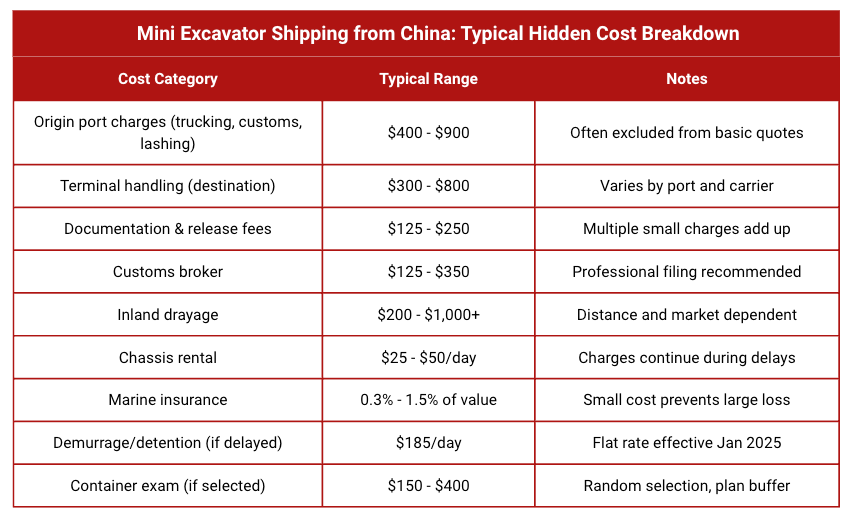
Terminal handling charges (THC): Moving your container from vessel to terminal yard. At U.S. ports, THC typically ranges from $300 to $800 per container.
Documentation fees: Administrative work for processing your shipment through the port, usually $75 to $150 per container.
Container release fees: Allow you to pick up the container from the terminal, typically $50 to $100 when charged separately.
Inland drayage: Moves your container from port to your location. A short move within 30 miles might cost $200 to $400, while longer distances can easily exceed $1,000.
Chassis rental: Provides the trailer carrying your container. Daily chassis rental typically costs $25 to $50, and charges continue if unloading is delayed.
Customs clearance: Broker fees range from $125 to $350 per entry. Additional costs include merchandise processing fees (typically 0.3464% of value) and harbor maintenance fees.
Port examinations: Government agencies randomly select containers for inspection. Exam fees range from $150 to $400, plus positioning costs and potential demurrage during the inspection period.
Demurrage and detention: These represent the most significant avoidable costs. Demurrage is charged when your container sits at the terminal beyond free time. Detention is charged when you keep the container outside the terminal beyond free time.
Major shipping lines charge $185 per day for standard containers at U.S. and Canadian ports for both demurrage and detention.
Free time typically ranges from 3 to 7 days depending on your carrier and service contract. After that, charges begin immediately.
Example Scenarios:
If your container exceeds free time by four days, you incur $740 in demurrage ($185 x 4 days).
If you also exceed detention free time by three days while unloading, add another $555 ($185 x 3 days). Total avoidable cost: $1,295.
How to Prevent Cost Overruns in Mini Excavator Shipping (What Actually Works)
Controlling hidden costs requires action at each phase of the shipping process. Here are the strategies that consistently deliver results:
Get Documentation Right from the Start
Documentation errors are the leading cause of customs holds and demurrage charges. Your commercial invoice, packing list, and bill of lading must align perfectly. Common problems that trigger delays include:
Mismatched serial numbers between documents and actual machine
Incorrect HS classification codes affecting duty calculations
Missing or incomplete certificates of origin
Valuation discrepancies between your invoice and other documentation
Work with your supplier before the container loads to ensure all shipping documents are complete and accurate. Review everything in detail. Ask your customs broker to pre-clear your entry while the vessel is in transit. Most countries allow preliminary customs filing once your shipment is on the water. This ensures any documentation issues are identified and corrected before the container arrives, not after it's sitting at the terminal accruing demurrage.
Understand Your Incoterms Completely
The Incoterms you negotiate determine who pays for what throughout the shipping journey. Get written clarification before you commit to the purchase.
FOB (Free on Board): The supplier is responsible until the excavator loads onto the vessel at the departure port. From that point forward, you handle and pay for ocean freight, marine insurance, destination charges, customs clearance, and inland delivery. FOB gives you control over carrier selection and routing but requires you to manage the entire international logistics process.
CIF (Cost, Insurance, and Freight): The supplier arranges and pays for ocean freight and basic marine insurance to the destination port. However, CIF typically does not include destination charges, customs duties, or delivery beyond the port. Many importers mistakenly believe CIF is a delivered price, then receive unexpected bills for terminal fees, drayage, and customs clearance.
DDP (Delivered Duty Paid): The supplier is responsible for delivering the excavator to your door including all freight, insurance, customs duties, and delivery costs. DDP shipments should have the fewest hidden costs because the supplier has agreed to handle everything.
Plan for Quick Customs Clearance and Pickup
Demurrage charges start the moment your free time expires. The most effective strategy is preparation before your container arrives.
Before arrival:
File preliminary customs documents while the shipment is in transit
Ensure all paperwork is complete and accurate
Confirm your specific free time in writing with the carrier
Verify your customs broker has everything needed for immediate clearance
At arrival:
Schedule drayage pickup for as soon as your container clears customs
Avoid arrivals just before weekends or holidays when you lose working days while charges continue
Have your receiving location ready with unloading equipment and personnel scheduled
During unloading:
Unload efficiently to return the empty container promptly
Each day of delay costs $185
Schedule the return pickup in advance rather than waiting until unloading is complete
The Federal Maritime Commission ruled in February 2025 that detention charges during scheduled terminal closures (weekends, holidays) may be considered unreasonable. However, carriers still enforce these charges in most cases, so plan to avoid weekend or holiday arrivals when possible.
Invest in Proper Cargo Securing
The $200 to $600 you spend on professional lashing and blocking prevents far larger costs down the line. Improper securing can trigger:
Cargo damage requiring insurance claims ($2,000 to $8,000 average)
Container rework at port if authorities deem securing inadequate ($500 to $1,500)
Delays in release while rework is completed (adding demurrage charges)
Insurance disputes if damage occurs and securing doesn't meet standards
Follow CTU Code guidelines for container packing. Use appropriate materials: wooden blocking, steel lashing straps, dunnage bags, edge protectors, and anti-slip mats. Document the securing process with photos before closing the container. This evidence is invaluable if damage occurs or if insurance questions your securing methods.
Choose FCL Over LCL for Machinery
Even though FCL costs more upfront, the total landed cost is usually lower when you account for all factors. LCL adds CFS handling fees ($75 to $200 per cubic meter), increases damage risk through multiple handling touchpoints, lengthens transit time while waiting for consolidation, and complicates liability if damage occurs.
With FCL, you pay one freight rate for exclusive container use. You control the loading and securing. You can add spare parts, attachments, or related items in unused space. The container goes directly from origin to destination without intermediate handling.
For a single mini excavator, if your cargo occupies more than half the container's cubic capacity, FCL becomes cost-competitive even before considering the reduced risk and faster transit time.
Demand Complete, Itemized Quotes
Never accept a simple ocean freight rate as your total cost estimate. A comprehensive door-to-door quote should explicitly state every charge and what it includes. Compare quotes from multiple forwarders based on equivalent scope, not just the bottom-line number.
Why You Need an Experienced Freight Forwarder to Ship Mini Excavator from China
The complexity of international heavy equipment shipping makes choosing the right logistics partner critical to controlling costs.
An experienced freight forwarder specializing in machinery:
Understands specific requirements for securing mini excavators
Knows which carriers offer best service on your trade lane
Maintains relationships with reliable customs brokers and drayage carriers
Anticipates potential issues before they become expensive problems
Provides transparent, itemized pricing so you know exactly what you're paying for
What to Look for in a Forwarder
Detailed quotations: The quote should break down every charge including origin services, ocean freight, destination charges, customs clearance, inland trucking, lashing, and insurance.
Machinery expertise: They should ask detailed questions about your excavator's weight, dimensions, and special handling needs. Be wary of forwarders who provide quick quotes without understanding your requirements.
Proactive communication: You should receive updates on shipment status and early warnings about potential delays or issues.
Complete service: Look for forwarders who handle the entire logistics chain from factory loading to delivery at your site, ensuring proper securing, complete documentation, and timely clearance.
Working with Gerudo Logistics
At Gerudo Logistics, we've built our reputation on transparent pricing and comprehensive service for construction equipment imports from China. Our team knows that hidden costs damage client relationships and project budgets.
When you work with us, you receive detailed quotations that break down every charge, proactive communication about your shipment status, and expert guidance on avoiding common pitfalls in machinery importing. We handle the entire logistics chain from factory loading to delivery at your site, ensuring proper securing, complete documentation, and timely clearance.
Contact us to learn how we make importing equipment from China straightforward and predictable.
Building Your Complete Budget for Mini Excavator Shipment
When requesting shipping quotes, demand an itemized breakdown. A complete door-to-door quote should include:
Origin charges:
Container trucking from supplier to port
Export customs clearance
Container stuffing and loading supervision
Lashing and securing materials and labor
Main freight:
Ocean freight from origin to destination port
Carrier-specific charges if applicable
Destination charges:
Terminal handling at destination port
Documentation and container release fees
Customs clearance fees
Import duties and taxes
Inland trucking from port to your location
Protection items:
Marine cargo insurance
Container tracking if desired
Free time assumptions:
Number of demurrage-free days at terminal
Number of detention-free days for container use
For variable costs like customs exams or extended storage, ask for applicable rates so you can budget appropriately if those situations arise.
A practical rule is to budget an additional 10 to 15% beyond known costs to cover unexpected charges. This buffer protects you when small issues create incremental costs outside your initial budget.
FAQs for Mini Excavator China Shipping
What are the most common hidden costs when shipping a mini excavator from China?
The most frequent surprise charges include origin and destination port charges, container release fees, documentation fees, lashing and cargo securing costs, inspection fees, inland drayage, and demurrage or detention when containers sit too long at terminals or are returned late.
What's the difference between demurrage and detention?
Demurrage is charged when a container stays in the terminal beyond free time. Detention is charged when the container is outside the terminal beyond free time. As of January 2025, both charges are $185 per day for standard containers at U.S. and Canadian ports.
Why do destination charges feel so unpredictable?
Destination charges include multiple components like terminal handling, documentation, security screening, container movements for exams, and chassis fees. These vary by port, carrier, and how quickly you clear and pick up your shipment. Each party involved can add fees not visible in your initial freight quote.
Does LCL create more hidden costs than FCL for a single mini excavator?
Yes, typically. LCL increases handling touchpoints through consolidation and deconsolidation, which multiplies handling charges and damage risk. Despite higher base costs, FCL usually provides better value when you account for all factors including reduced risk and faster transit time.
What paperwork issues commonly cause storage and extra fees?
Mismatches between invoices and actual cargo, missing serial numbers, unclear HS classification, incomplete certificates, or late filings can all trigger holds. While your shipment waits for corrected documentation, demurrage charges accumulate daily at the terminal.
Why do importers get surprise bills even when buying CIF?
CIF typically covers ocean freight and basic insurance to the destination port, but many destination-side costs still belong to the importer. Terminal charges, customs broker fees, duties, inland delivery, and any demurrage or detention charges typically remain the buyer's responsibility under CIF terms.
How can I reduce demurrage and detention risk?
Pre-clear documents before arrival, confirm your free time in writing, schedule drayage pickup as soon as your container is released, ensure your unloading facility is ready with proper equipment, and return empty containers promptly. Each day of delay costs $185.
What should I demand in a door-to-door quote to avoid surprises?
Request an itemized breakdown explicitly stating what's included for origin services, ocean freight, destination charges, customs clearance, inland trucking, lashing and securing, and insurance. Ask about free time assumptions and get written confirmation of any costs that might vary.
Conclusion
Hidden costs in mini excavator shipping from China are only truly hidden the first time you encounter them. Once you understand where charges originate and how to anticipate them, importing heavy equipment becomes manageable and predictable. The importers who consistently achieve the lowest total landed costs avoid demurrage through efficient customs clearance, prevent damage claims through proper packing, eliminate rework through accurate documentation, and work with experienced freight forwarders who understand machinery logistics.
Your goal should be transparency, not just low quotes. When you receive a comprehensive breakdown of all costs before shipping, you can make informed decisions, compare suppliers accurately, and manage cash flow effectively. Ready to ship your mini excavator with confidence and full cost transparency? Partner with logistics specialists who understand that your success depends on predictable, accurate pricing from start to finish.