How to Reduce Cost of Reefer Container Shipping from China: 7 Proven Strategies for Importers
Reefer container shipping costs from China can quickly spiral out of control if you don't understand where the money actually goes. The good news? There are practical ways to reduce these costs by 15-30% without compromising cargo quality or delivery timelines.
In this guide, you'll discover:
Where reefer shipping costs actually come from (and which ones you can control)
How costs differ across markets including US, Europe, Middle East, and Latin America
The hidden expenses that add to your total shipping bill
Proven strategies to reduce reefer container costs from China
Whether you're shipping frozen seafood, fresh produce, or temperature-sensitive pharmaceuticals, this guide provides actionable strategies to cut your reefer shipping costs from China.
Where Reefer Container Shipping Costs from China Actually Come From
Reefer container shipping from China involves multiple cost layers that many importers underestimate. Understanding each component helps you identify where to focus cost reduction efforts.
Ocean Freight Rates
Your base ocean freight rate forms the starting point. Reefer containers from China typically cost 50-100% more than standard dry containers on the same route. A 40-foot dry container from China to North America might cost $3,000-$5,000, while a comparable reefer runs $6,000-$10,000.
This premium exists because carriers face additional complexity:
Dedicated power connections on vessels
Specialized monitoring systems
Trained crew for temperature-critical cargo
Limited capacity compared to dry containers
Peak season surcharges hit reefer containers particularly hard since refrigerated capacity is more constrained than dry boxes.
Power and Plug-In Fees
Reefer containers consume significant electricity to maintain temperature. At terminals and ports, you pay plug-in fees for every day your container sits connected to the power grid.
Power charges vary by terminal but typically add $20-$50 per day. Over a week-long dwell time, that's $140-$350 in additional expenses just for electricity. Research shows reefer containers represent a substantial portion of terminal power consumption, making energy management critical for cost control.
See also: Complete Guide to Reefer Container Shipping from China
Power consumption depends on:
Temperature setpoint selection
Ambient conditions and season
Container insulation quality
Cargo loading and airflow management
Equipment and Monitoring Charges
Carriers and terminals charge various equipment-related fees:
Reefer monitoring charges
Pre-trip inspection fees
Temperature data download charges
Special handling surcharges
Genset rental for road transport
Modern smart monitoring systems can reduce some costs by automating inspections and enabling remote oversight.
Inland Cold Chain Transportation
Inland reefer transportation from Chinese factories to export ports, and from destination ports to your warehouse, requires specialized equipment. This cold-chain segment typically costs 20-40% more than standard dry cargo transport.
Moving a reefer container from an inland factory in Shandong to Qingdao port might cost $150-300 more than a dry container on the same route.
Demurrage, Detention and Storage
These charges accumulate when containers sit too long at terminals or in your possession:
Demurrage: Fees while containers sit at the terminal after discharge
Detention: Charges for holding carrier equipment beyond free time
Storage: Additional yard fees at congested ports
For reefer containers from China, these fees are particularly painful because you're paying both storage charges AND ongoing power consumption simultaneously.
Claims and Product Loss
Temperature excursions or equipment failures can result in cargo spoilage. Even a partial claim can exceed your entire transportation cost. A single load of premium seafood worth $100,000 can be completely lost if temperature control fails.
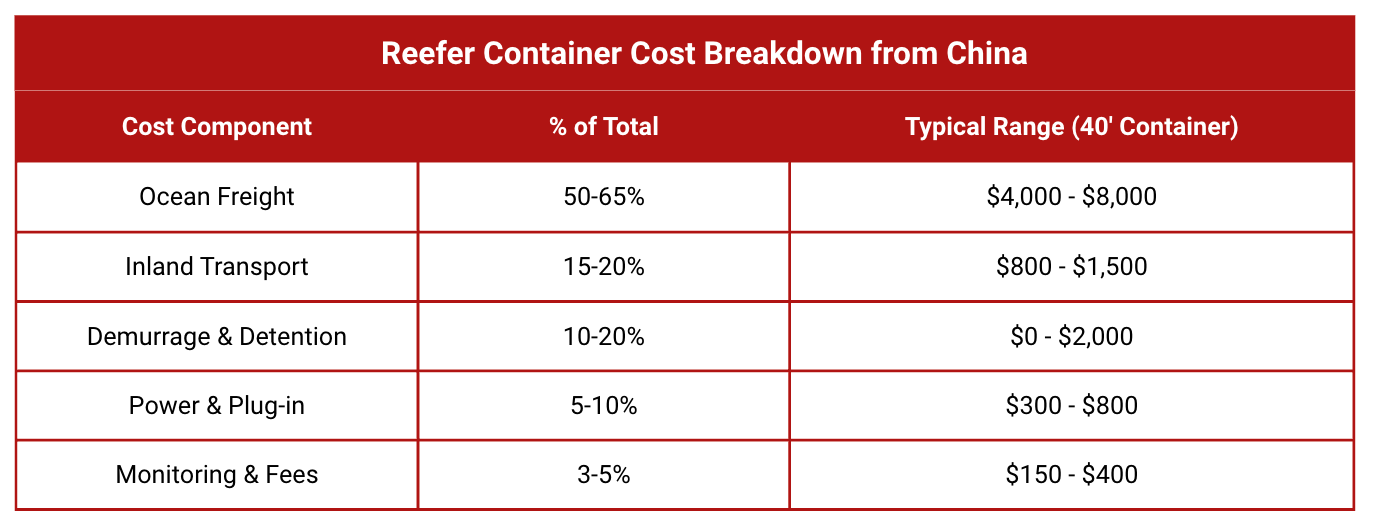
Reefer Container Cost Breakdown from China
How Reefer Shipping Costs from China Vary by Destination
Your destination market significantly impacts which cost elements dominate. Here's what drives costs to major regions.
Shipping Reefer Containers from China to USA
U.S. destinations present specific cost challenges centered on port congestion and equipment turnaround:
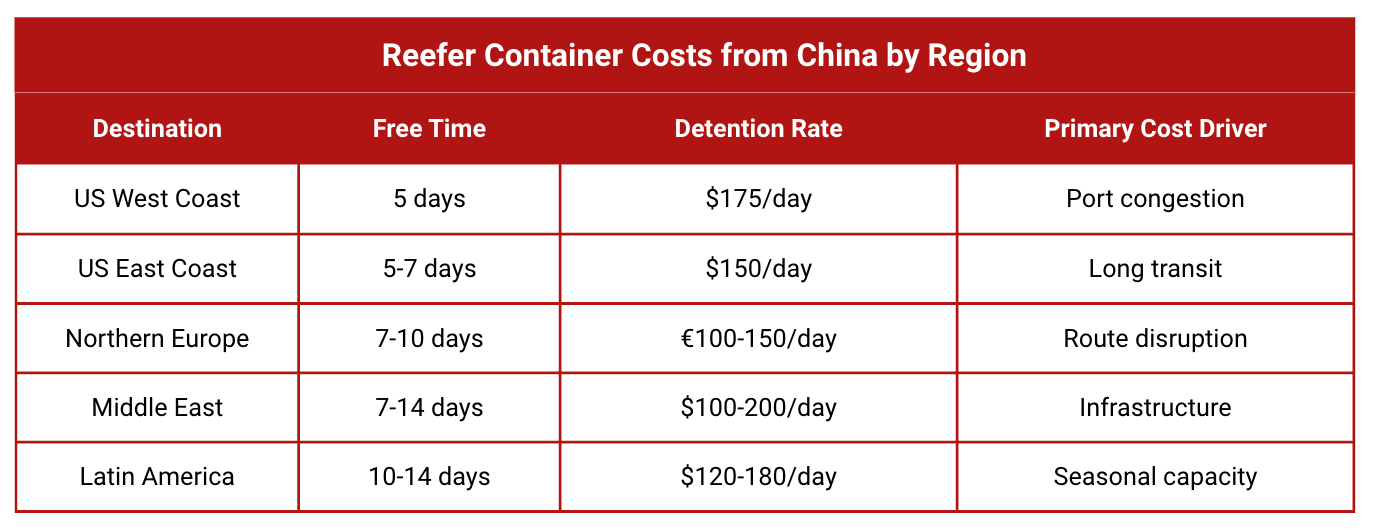
High detention rates: West Coast ports like LA/Long Beach start at $175/day for late returns
Congestion surcharges: $200-500 per container during peak periods at major terminals
Strict enforcement: U.S. ports enforce demurrage and detention more rigorously than other regions
Combined charges: You accumulate detention AND power fees simultaneously while waiting for customs
Cost reduction focus for USA: Rapid customs pre-clearance and minimizing dwell time deliver the highest savings.
Shipping Reefer Containers from China to Europe
European routes face unique cost pressures from route disruptions and regulations:
Extended transit times: Red Sea rerouting adds 7-10 days via Cape of Good Hope
Higher fuel surcharges: Longer voyages mean significantly increased fuel costs
Carbon charges: EU Emissions Trading Scheme surcharges apply to ocean shipments
Stringent regulations: European food safety requirements increase monitoring costs
Cost reduction focus for Europe: Route selection and energy efficiency matter most due to longer transit times.
Ship seafood to Europe? read this guide to learn the best way to ship seafood to Europe
Reefer Container Shipping Costs from China to Middle East
Middle East costs depend heavily on destination port infrastructure:
Infrastructure variance: Modern ports (Dubai, Jeddah) vs. less developed facilities
Limited reefer capacity: Some ports have insufficient plug points, causing delays
Equipment shortages: Reefer availability can be constrained during peak seasons
Variable free time: Ranges from 7-14 days depending on port and carrier
Cost reduction focus for Middle East: Port selection and advance equipment booking are critical.
Reefer Shipping from China to Latin America
Latin American routes experience pronounced seasonal patterns:
Seasonal rate spikes: Peak fruit export seasons (Jan-Apr) tighten reefer capacity
Equipment allocation: Empty containers prioritized for backhaul exports
Port infrastructure gaps: Major ports efficient, smaller ports may lack proper facilities
Longer free time: Typically 10-14 days, providing more flexibility
Cost reduction focus for Latin America: Timing flexibility can generate 15-30% savings during shoulder seasons.
Reefer Container Costs from China by Region
Hidden Costs in Reefer Container Shipping from China
Beyond obvious freight charges, several hidden expenses add 15-25% to your total reefer shipping costs from China.
Extended Origin Dwell Time
Containers sitting at Chinese ports before vessel departure accumulate storage and power charges. Shanghai and Shenzhen terminals have different policies on early gate-in and pre-cooling requirements. Understanding specific terminal rules helps avoid unnecessary charges.
Inefficient Temperature Setpoints
Running reefers colder than necessary wastes money. Operating at -22°C versus -18°C seems minor per day, but across hundreds of annual shipments from China, it adds up significantly. Unnecessarily low temperatures can also damage certain products like fresh produce.
Poor Loading Practices
Improper cargo loading increases power consumption and spoilage risk:
Blocked airflow channels and vents
Overloading beyond weight limits
Not pre-cooling products before stuffing
Missing floor gratings for airflow
Lack of Real-Time Monitoring
Operating without visibility means you discover temperature excursions only after cargo arrives damaged. Modern monitoring costs $50-150 per container but prevents claims costing thousands.
Documentation Errors
Incomplete or incorrect shipping documents cause delays at every journey point. Common issues include missing certificates of origin, incorrect HS codes, and improper dangerous goods declarations.
We cover this in detail in our reefer customs clearance guide from China.
Strategies to Reduce Reefer Container Costs from China
These proven strategies target the actual cost drivers in refrigerated container shipping from China.
1. Master Dwell Time Management to Cut Detention Costs
Minimizing container dwell time eliminates both demurrage/detention charges and power consumption fees.
Implementation steps:
Pre-clear customs: Submit documentation before vessel arrival for immediate release
Schedule pickup immediately: Book drayage appointments as soon as containers discharge
Expedite warehouse receiving: Coordinate advance scheduling to enable same-day unloading
Monitor free time: Set alerts before approaching detention deadlines
Track systematically: Use software or spreadsheets to monitor critical dates
Impact: Reducing dwell time by 3 days at $200/day saves $600 per container. On 100 annual shipments from China, that's $60,000 saved.
2. Optimize Temperature Setpoints for Energy Efficiency
Right-sizing temperature settings reduces power consumption without compromising quality.
Best practices:
Research optimal temperature ranges for your specific products
Pre-cool cargo to target temperature before container stuffing
Load for proper airflow (T-shaped floor pattern, unblocked vents)
Verify container insulation condition during pre-trip inspection
Train warehouse staff on correct loading techniques
3. Use Non-Operating Reefer (NOR) Containers When Possible
NOR containers (reefers with refrigeration switched off) often cost 20-30% less than standard dry containers on certain China export lanes. Carriers offer discounts because they need to reposition empty reefer equipment.
Best applications:
Dry goods backhaul or equipment repositioning
Semi-sensitive cargo benefiting from insulation without active cooling
Overflow capacity when dry containers are scarce
Trade-off: Roughly 10% less internal space due to refrigeration unit and insulation.
4. Deploy Monitoring to Prevent Costly Claims
Real-time monitoring systems provide visibility into temperature, location, and equipment status throughout the journey from China.
Cost savings from monitoring:
Prevented spoilage: Early detection enables intervention before cargo damage
Reduced inspections: Automated monitoring eliminates manual temperature checks
Optimized energy: Systems analyze consumption patterns and recommend adjustments
Better documentation: Complete records support compliance and defend against claims
For high-value shipments, add data loggers inside pallets for complete temperature records.
5. Choose Ports and Routes Strategically
Strategic routing decisions generate substantial savings on reefer shipments from China.
Route optimization factors:
Consider secondary Chinese ports: Ningbo or Xiamen sometimes offer faster turnaround than congested Shanghai/Shenzhen
Evaluate direct vs. transshipment: Direct costs more but reduces time and risk
Assess destination infrastructure: Research reefer handling capabilities before booking
Plan for seasonal patterns: Avoid peak periods when reefer capacity tightens
6. Negotiate Smarter Freight Contracts
How you structure agreements with carriers impacts annual reefer costs from China.
Effective negotiation tactics:
Bundle volume: Consolidate shipments with fewer carriers for volume discounts
Lock rates during low seasons: Negotiate long-term contracts in Feb-Mar or Jul-Aug
Extend free time: Adding 2-3 free days eliminates most detention risk
Clarify all surcharges: List every potential charge explicitly before signing
7. Standardize Documentation Processes
Documentation errors cause more delays than any other single factor in reefer shipping from China.
Process improvements:
Create detailed checklists and templates for all documents
Implement quality control review before submission
Work with experienced customs brokers understanding reefer requirements
Maintain certificate/permit libraries for your product categories
Train staff on proper completion of temperature instructions
Partner with Gerudo Logistics for Optimized Reefer Shipping from China
Implementation complexity can challenge importers managing multiple product lines and destinations. Partnering with reefer specialists makes a significant difference in achieving sustained cost reduction.
Gerudo Logistics specializes in temperature-controlled shipping from China to global destinations. Our team brings expertise in every aspect of reefer container cost optimization.
We Help You Optimize Your Reefer Costs from China
Better rates: Preferential pricing through consolidated shipper volume
Fewer delays: Average dwell time 40% below industry standard
Prevented claims: Real-time monitoring reduces spoilage incidents by 80%+
Energy savings: Temperature optimization cuts power costs 10-15%
Transparent pricing: No hidden surcharges
Many clients achieve 12-18% cost reduction in their first year through better rates, operational efficiency, and avoided claims. We serve importers across North America, Europe, Middle East, and Latin America, with particular strength in:
Frozen seafood and fish from China
Fresh produce and vegetables
Frozen meat products
Pharmaceuticals and temperature-sensitive chemicals
Dairy and specialty food products
Ready to optimize your reefer container shipping from China? Contact Gerudo Logistics for a free cold chain assessment and discover your cost reduction opportunities.
Frequently Asked Questions: Reducing Reefer Container Costs from China
What's the biggest cost factor in reefer container shipping from China?
Ocean freight typically represents 50-65% of total costs, but the combined impact of detention, demurrage, and power charges often equals or exceeds freight if not managed properly. This is why operational efficiency matters as much as negotiating good rates for reefer shipments from China.
How much can I save by optimizing reefer operations from China?
Most importers achieve 8-15% total cost reduction through operational improvements. Those with particularly inefficient processes can save 20-30%. The highest savings come from avoiding single large spoilage claims, which can exceed the cost of dozens of shipments.
Are monitoring systems worth it for reefer containers from China?
Yes. For high-value products (pharmaceuticals, premium seafood, specialty foods), monitoring systems pay for themselves by preventing a single spoilage incident. Even for moderate-value cargo, operational efficiency gains typically justify costs within 10-20 shipments from China.
What's the difference between demurrage and detention on reefer containers?
Demurrage applies while your container sits at the terminal after discharge. Detention applies after pickup, for holding carrier equipment beyond free time. Both accumulate daily charges. Avoid demurrage through pre-cleared customs and immediate pickup. Avoid detention by coordinating rapid warehouse unloading and empty return.
Should I always use the coldest temperature setting for reefer containers from China?
No. Each commodity has an optimal temperature range. Unnecessarily low temperatures increase power costs without benefits and can damage certain products. Follow product-specific temperature guidelines rather than defaulting to the coldest setting.
When do Non-Operating Reefer (NOR) containers make sense?
NOR containers work well for dry goods that don't need active cooling but benefit from better insulation. They're particularly advantageous when dry container capacity is tight but reefer availability is good. Check with your freight forwarder about NOR programs on your specific China export lanes.
What causes most documentation delays on reefer shipments from China?
The most common issues are incorrect or missing temperature setpoint instructions, incomplete phytosanitary certificates for agricultural products, incorrect HS codes causing customs delays, missing origin certificates, and incomplete dangerous goods declarations for items like dry ice.
Conclusion: Start Reducing Your Reefer Shipping Costs from China Today
Reducing reefer container shipping costs from China requires systematic attention to multiple cost drivers.
Start with high-impact changes like dwell time reduction through customs pre-clearance and immediate pickup coordination. Add temperature optimization and proper loading protocols for energy efficiency. Layer in monitoring technology for risk reduction and operational visibility.
The importers achieving sustained savings treat reefer logistics as a discipline requiring operational excellence, not just rate negotiations. With systematic implementation of these strategies, most importers reduce reefer shipping costs from China by 15-25% while maintaining or improving cargo quality and reliability.