Ship Frozen Fruit from China: Complete Import & Cold Chain Guide
The global frozen fruit market has changed substantially over the past decade. China is now one of the world's leading suppliers of IQF (Individually Quick Frozen) products. From blueberries and strawberries to mango chunks and specialty berries, Chinese suppliers ship to Europe, North America, the Middle East, and Asia-Pacific at scale.
But shipping frozen fruit from China is not as simple as booking a container. The success of your shipment depends on three things:
Maintaining strict temperature control throughout transit
Getting your documentation right at every border
Working with partners who understand cold chain logistics
Whether you're a food distributor sourcing IQF strawberries for the bakery trade, a retailer building a private-label frozen fruit line, or a food manufacturer buying mango dice, this guide covers what you need to know.
Why Buy and Ship Frozen Fruit from China?
Competitive Advantages of Chinese Frozen Fruit Suppliers
China's frozen fruit industry offers a combination of scale, certification coverage, and pricing that's hard to match from other origins.
Cost structure:
Many suppliers are vertically integrated, running their own farms or direct grower relationships in Shandong and Yunnan (berries, stone fruits), Liaoning (strawberries), and Guangxi and Hainan (tropical fruits)
Full container load buyers get better pricing than spot buyers
Fewer intermediaries compared to competing origins
Processing capability:
Modern IQF tunnel freezers and automated sorting lines
Optical sorters that grade berries by size and color
Metal detectors and in-house quality control laboratories
Climate-controlled storage from harvest through container loading
Certification coverage:
HACCP as the industry baseline
BRC (British Retail Consortium) or IFS (International Featured Standards) for European buyers
ISO 22000 for food safety management
Halal, Kosher, and organic certifications (EU and USDA) available from specialist suppliers
Product Range and Customization
Chinese suppliers cover a wide product range:
Berries: strawberries, blueberries, raspberries, blackberries, mixed berry blends
Tropical fruits: mango chunks and slices, pineapple chunks, lychee
Stone fruits: yellow peach slices, apricot halves
Specialty items: kiwi slices, ginkgo nuts, seabuckthorn berries
Most suppliers can accommodate:
Cut specifications (whole, sliced, diced, halved)
Packaging formats (bulk 10 kg cartons for food service, retail-ready 500 g or 1 kg bags)
Private labeling with custom artwork and multilingual labels
Mixed SKU containers (strawberries, blueberries, and mango in a single reefer)
Why Shipping Frozen Fruit from China Requires Specialized Cold Chain Management
The Science Behind Temperature Sensitivity
Frozen fruit quality depends on keeping cellular structure intact.
How IQF freezing works: Water inside fruit cells freezes quickly into small ice crystals. This minimizes cell wall damage and preserves texture, color, nutritional value, and flavor.
What temperature abuse does: Temperatures above -18°C cause those ice crystals to melt and refreeze as larger crystals. Larger crystals rupture cell walls. The result is mushy texture, excessive drip loss, color bleeding in berries, and accelerated browning in mango and peach.
Commercial threshold: Containers showing temperature excursions above -15°C often face rejection, claims, or mandatory discounting at the receiving end.
Why Long-Distance Transit Creates Risk
A typical shipment from China to Europe or North America spends 30-40 days in ocean transit, plus inland transport on both ends. Your product moves through multiple handover points:
Your product moves through six handover points: supplier's cold store, loading docks, reefer container, vessel holds, transshipment ports, and destination terminal.
Each transition is a risk point:
Power interruptions at container terminals
Delays connecting reefer units to shore power
Inadequate pre-cooling before loading
Equipment failures during long voyages
Modern reefer containers maintain precise temperatures, but they need continuous power and correct setup. Getting this right requires experience.
The Temperature & Handling Requirements for Frozen Fruit Reefer Shipping
Standard Temperature Specifications
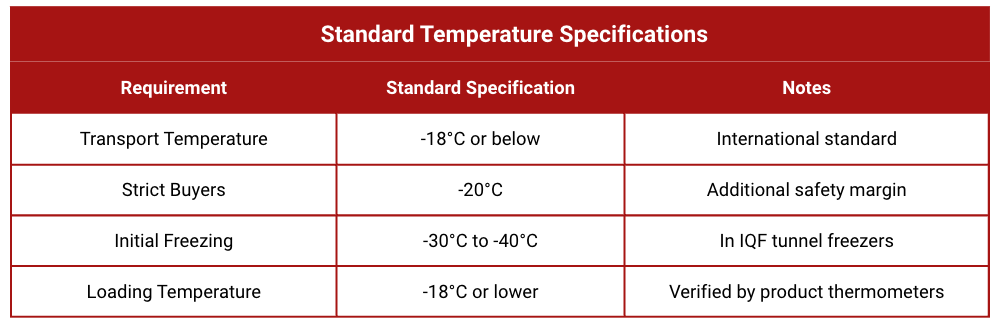
Why -18°C?
Microbial growth essentially stops
Enzymatic reactions slow dramatically
Ice crystal growth stabilizes
Product maintains commercial quality for 18-24 months
Reefer Container Set Points and Airflow
Standard container configuration:
Set point: -18°C (some buyers specify -20°C for additional margin)
Airflow: bottom-air delivery through T-floor channels
Cold air is pushed under the cargo floor, rises through the pallets, and returns to the refrigeration unit. This circulation only works if the load is stacked correctly.
Critical airflow requirements:
Pallets must allow air to circulate underneath and between boxes
Cargo must never block the return air channels at the front of the container
Poor stacking creates dead zones where product temperature can reach -12°C or higher
Maintain a 10 cm gap from walls and ceiling
Pre-Cooling and Loading Protocols
Before loading:
Pre-cool the reefer container to target temperature (allow 2-4 hours)
Confirm the container interior is at -18°C before product enters
This prevents condensation and temperature shock to the product
During loading:
Complete 40-foot container loading in under 90 minutes
Use insulated loading bays and airlocks where available
Minimize product exposure to ambient temperatures
Product core temperature must be -18°C or lower at the time of loading
Temperature Monitoring
Standard datalogger setup:
Place independent recording devices inside the cargo space
Set to record every 15-60 minutes throughout transit
Data creates a continuous record that protects both buyer and supplier
Download and review data on arrival to confirm compliance
Advanced monitoring options:
GPS-enabled dataloggers with satellite transmission
Real-time remote monitoring while the shipment is at sea
Automated alerts for any temperature deviation
Major retailers increasingly require this level of visibility
Real-World Case: Mixed Berry Shipment from Qingdao to Rotterdam
A 40-foot reefer loaded with mixed IQF berries departed Qingdao bound for Rotterdam.
Product mix: IQF strawberries (40%), blueberries (35%), raspberries (15%), blackberries (10%)
Set point: -18°C
Transit time: 34 days port-to-port
Critical incident: At Singapore transshipment, the container was unplugged for 8 hours during vessel transfer.
What saved the shipment: Three independent dataloggers placed at the front, middle, and rear of the container - plus one probe deep inside a pallet core.
When the data was downloaded at Rotterdam, it showed the product core never exceeded -17.5°C, even during the unplugged period. The container's thermal mass and pre-cooling absorbed the gap.
Result: Cargo accepted without claims. The $28,000 shipment and the buyer relationship were both protected.
Cost of the dataloggers: approximately $150-300 total.
Temperature monitoring is not an optional extra. It is the documentation you need when something goes wrong.
Packing & Palletizing Standards for Frozen Fruit Shipping from China
Primary Packaging: Cartons and Inner Liners
Carton specifications:
Material: corrugated cardboard with polyethylene inner liners
B2B bulk packs: 10 kg or 20 kg (25 lb cartons for US markets)
Retail formats: 300 g to 1 kg pouches or bags
Construction: wax-coated or poly-laminated for moisture resistance
Compression strength: must support 1,000 kg+ stacking weight
Inner liner requirements:
Food-grade polyethylene (PE), 60-100 microns thick
Prevents freezer burn and moisture migration
Sealed after filling to contain product if the outer carton is damaged
Palletizing Configuration to Ship Frozen Fruit
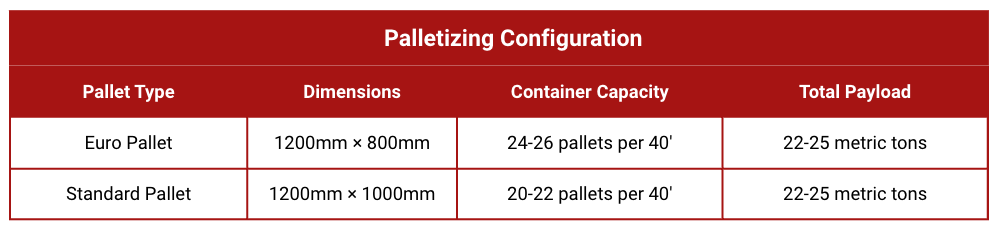
A typical palletized unit load for frozen fruit is around 1.0–1.5 t per pallet, depending on pallet design and stacking height.
A standard palletized unit load for frozen fruit runs 1.0-1.5 tonnes per pallet, depending on design and stacking height.
Pallet height: 1.2 m to 1.5 m (set by reefer container internal clearance)
Pattern: interlocking (columnar or brick-style)
Securing: 4-6 layers of stretch film, plus corner boards for stability
Load Distribution and Airflow Considerations
Critical principles for effective refrigeration:
Maintain T-floor gap: Pallets must sit on raised channels without blocking airflow underneath
Leave ventilation space: 10cm gap around perimeter; 10-15cm clearance at front wall
Uniform loading: Avoid mixed pallet heights; place shorter pallets near door if necessary
Proper weight distribution: Never exceed container weight limits or stuff cargo against ceiling
Labeling and Traceability
Mandatory carton information:
Product name and net weight
Production date and batch/lot number
Expiry date (if applicable)
Multilingual labels (Chinese + destination language)
Advanced traceability features:
Time–temperature indicator labels that change colour only if the product has been above the critical temperature (e.g. -18°C) for a defined period, giving a more realistic indication of potential cold chain breaks.
QR codes or barcodes linking to production records
Verification of origin, certification status, and test results
EU and US food safety regulation compliance
Understanding HS Codes and Documentation for Frozen Fruit Shipping
Key HS Codes for Frozen Fruit from China
Understanding proper HS (Harmonized System) codes is critical for accurate customs declarations, tariff calculations, and regulatory compliance.
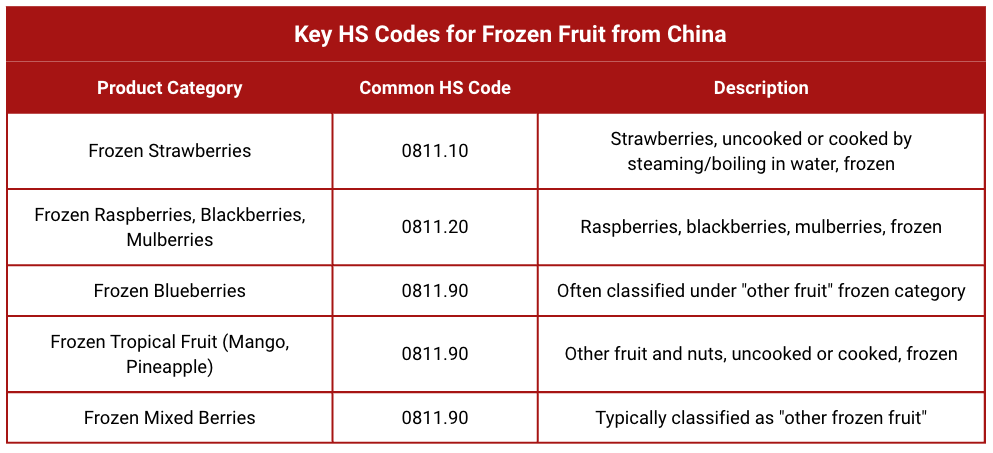
Important notes:
HS codes may have additional digits (8-10 digits) depending on destination country
Tariff rates vary significantly by destination and trade agreements
Misclassification can result in penalties, shipment delays, or incorrect duty payments
Always verify current HS codes with your customs broker before shipping
Documentation Checklist
Required for all frozen fruit shipments:
Commercial Invoice - product description, HS code, quantity, unit price, total value, supplier and buyer details, payment terms, and Incoterms
Packing List - carton count, net and gross weight per carton, pallet configuration, total shipment weight, container number and seal number
Bill of Lading - must state the reefer set point temperature, along with consignee and notify party details
Health/Sanitary Certificate - issued by China's General Administration of Customs (GACC), certifying the product meets health standards and that the supplier facility is approved for export
Certificate of Origin - Form E (ASEAN FTA), RCEP certificate, or standard CO, determines preferential tariff treatment at destination
Additional documents by market:
EU imports: TRACES-NT pre-notification, phytosanitary certificate for plant products
US imports: FDA Prior Notice, typically filed at least 8 hours before vessel arrival for sea freight and 4 hours for air freight. Confirm exact timing requirements with your customs broker based on your specific route and mode of transport.
Organic products: valid organic certificate from an EU or USDA-recognized certification body
Test certificates: pesticide residue screening, microbiological analysis, heavy metals testing
Document management practices that prevent clearance delays:
Submit documents electronically in advance where the destination allows
Verify that supplier name and address match exactly across all documents
Keep digital copies accessible for immediate sharing with authorities
Track certificate expiry dates to avoid submitting outdated documentation
Work with customs brokers who have direct experience with frozen food imports
Explore documentation checklist and clearance strategy when shipping refeers from China
Best Practices for Safe & Compliant Frozen Fruit Shipping from China
1. Select the Right Reefer Carrier
Evaluate carriers on these criteria:
Equipment age: newer containers (under 5 years old) have better insulation, more precise digital temperature control, and backup systems
Dedicated operations teams: specialized staff conducting pre-trip inspections, guaranteed plug-in times at terminals, and 24/7 monitoring
Route suitability: direct services reduce transshipment risk; if transshipment is unavoidable, confirm the intermediate port has reliable reefer infrastructure
2. Run a Proper Supplier Verification Process
Before placing a first order:
Request current certifications: HACCP (baseline), BRC or IFS (for European markets), ISO 22000; verify each certificate is within its validity period
Review recent test reports: pesticide residues (compare against your destination's MRLs), microbiological results, heavy metals
Conduct a factory audit: assess cold storage conditions, processing hygiene, pest control programs, and traceability systems
Order pre-shipment samples: evaluate quality, taste, and texture after thawing in your market before committing to a container
For ongoing orders: require batch-specific test certificates with each shipment. For initial or spot purchases, commission third-party loading inspection (SGS, Intertek, Bureau Veritas).
3. Optimize Transit Time and Route Planning
Typical sea freight transit times from major Chinese ports:
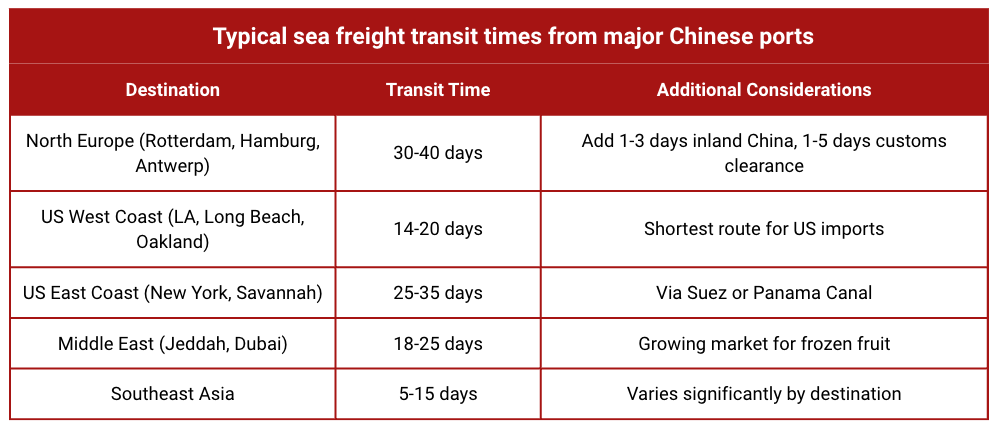
Air freight: costs 5-8 times more per kilogram than sea freight. Suitable for initial samples (50-200 kg), urgent top-up orders, or high-value organic products. The standard approach is to validate demand with air freight first, then shift to full reefer FCL once volumes justify it.
Learn how to book refeer containers for your frozen shipment
4. Manage Incoterms Strategically
Common Incoterms and recommendations:
FOB (Free On Board) Chinese port
You arrange ocean freight and insurance. Gives you full control over carrier selection and routing. The right choice if you have an established freight forwarder relationship.
CIF/CFR (Cost Insurance Freight / Cost and Freight)
Your supplier arranges ocean freight. Less control over carrier and routing. Works for smaller buyers who don't yet have logistics infrastructure.
DAP/DDP (Delivered at Place / Delivered Duty Paid)
supplier handles everything including destination customs clearance. Highest cost, least control. Less common for frozen fruit due to the added complexity of cold chain handover at destination.
Payment terms: new supplier relationships typically require 30% deposit plus 70% against documents. Established relationships may shift to Letter of Credit or 30-60 day payment terms.
5. Have Contingency Plans Before You Ship
Equipment failure: know your carrier's procedures for reefer malfunctions at sea, including backup unit availability, emergency protocols, and nearest diversion port
Port congestion: understand the cost if your container sits unplugged beyond free time. Some terminals charge $50-150 per day after the grace period ends.
Insurance: confirm your marine cargo policy covers temperature-related spoilage, not just physical damage. Typical premium: 0.3-0.8% of cargo value.
Claims documentation: keep complete temperature records from origin to destination, photograph the container at loading and discharge, and commission an independent surveyor report within 24-48 hours if you suspect a quality problem
Why Choose Gerudo Logistics for Your Frozen Fruit Shipments
Gerudo Logistics specialises in temperature-controlled cargo from China, with extensive experience managing frozen fruit shipments to global markets.
We handle the full chain: factory cold store verification, container pre-cooling confirmation, reefer booking with reliable carriers, and customs clearance coordination at destination. We do not hand off responsibility at the port gate.
What we bring to frozen fruit shipments:
Access to certified suppliers across major Chinese production regions, with verified HACCP, BRC/IFS, and organic certifications where required
Temperature monitoring protocols with datalogger services, real-time tracking options, and detailed reporting for your quality team
Documentation support covering regulatory requirements in all major destination markets
Flexible programs for both trial shipments and high-volume multi-container schedules
Whether you're shipping your first trial order of IQF strawberries or scaling to multiple containers monthly of mixed berry SKUs, our cold chain expertise ensures your frozen fruit arrives in optimal condition, meeting quality standards and protecting your investment.
Ready to start importing frozen fruit from China? Contact us today!
Frequently Asked Questions About Frozen Fruit Shipping from China
What temperature should frozen fruit be shipped at?
Maintain -18°C or below throughout the entire transit. Some buyers specify -20°C for an additional safety margin. This temperature keeps product quality, texture, and flavor stable during long ocean voyages.
Is sea freight or air freight better for frozen fruit from China?
Sea freight via reefer container is the standard for commercial volumes. Air freight is used for urgent orders, small samples, or high-value products such as organic wild berries. Most buyers start with air freight for initial trials, then move to full container loads by sea once demand is confirmed.
How long does frozen fruit shipping take from China to major markets?
Transit times vary by destination: approximately 30-40 days to Northern Europe, 14-20 days to the US West Coast, and 25-35 days to the US East Coast. These are port-to-port figures. Add several days for inland transport, customs clearance, and final delivery.
What certifications should Chinese frozen fruit suppliers hold?
HACCP is the industry baseline. For European markets, BRC or IFS certification is increasingly expected. Additional certifications include ISO 22000 for food safety management, and for specialty markets - organic (EU/USDA), Halal, or Kosher certification depending on your buyers' requirements.
Can I consolidate different frozen fruits in one container?
Yes. Combining strawberries, blueberries, mango, and other fruits in a single reefer container is standard practice, provided all products share the same temperature requirement (-18°C) and each SKU is clearly differentiated in your packaging and labeling.
What are the main risks when shipping frozen fruit?
Temperature abuse during loading, extended power disconnection during terminal delays, poor container stacking that blocks airflow, and freeze-thaw cycles at transshipment are the primary risks. Using experienced logistics providers, implementing temperature monitoring, and following correct loading protocols addresses each of these.
Do I need special import permits for frozen fruit?
Requirements vary by destination. The EU requires health certificates and TRACES-NT pre-notification. The US requires FDA prior notice and supplier facility compliance with GACC registration. Most countries also require phytosanitary certificates, certificates of origin for tariff eligibility, and laboratory test certificates.