The Complete Guide to Reefer Shipping for Frozen Vegetables from China
A single batch of green peas needs to reach the IQF freezer within 2–4 hours of harvest. Miss that window, and you've lost the crisp texture and vibrant color that your retail customers expect.
This timing pressure defines frozen vegetable logistics from China, what happens in those first few hours after harvest determines whether your IQF broccoli florets arrive in premium condition or turn into a quality claim.
China exported approximately 1.7 million tons of frozen vegetables in 2024, valued at $2.1 billion, with major buyers including Japan, South Korea, the United States, and European markets. This guide addresses the specialized demands of frozen vegetable refeer shipping from China, from harvest timing and blanching protocols to container loading patterns that maintain product integrity throughout ocean transit.
China's Frozen Vegetable Production Landscape: Key Regions and Export Products
Major Production Bases
China's frozen vegetable manufacturing concentrates in specialized industrial clusters. Shandong Province leads with the largest frozen vegetable production capacity in China, featuring major processing hubs in Qingdao, Yantai, and Weifang. The region benefits from direct access to Qingdao Port and integrated cold chain infrastructure from field to port. Shandong specializes in peas, corn, broccoli, and mixed vegetables.
Fujian Province excels in frozen vegetable processing with coastal access supporting exports to Japan and Korean markets. The region focuses on edamame, green beans, and specialty vegetables with advanced IQF facilities near growing areas.
Hebei and Jiangsu Provinces provide additional capacity, with Hebei focusing on spinach, cauliflower, and mixed vegetable blends, while Jiangsu emphasizes premium vegetable processing with strong organic production capabilities.
Top Exported Products
Based on current export data, China's primary frozen vegetable exports include:
High-Volume Products: IQF broccoli florets (largest single-product category), green peas (7.5% of global frozen vegetable exports by value), sweet corn kernels (6.7% worldwide), edamame, and spinach (4.1% of global trade). Mixed vegetable blends comprise 12.4% of frozen vegetable exports, while green beans account for 5%. Cauliflower florets, carrots, and specialty items (okra, baby corn, asparagus, bell peppers) serve specific regional markets.
Market Distribution: Japan, South Korea, and the United States rank as the top three destinations for China's frozen vegetable exports.
Asian markets prioritize edamame, spinach, and specialty vegetables with 5–10 day ocean transit times.
North American importers focus on broccoli, peas, and mixed vegetables (15–30 day transit).
European markets demand organic and premium IQF vegetables with 25–40 day transit times.
Why Shipping Frozen Vegetables from China Requires Specialized Cold Chain Management
The Harvest-to-Freeze Timeline Challenge
Fresh vegetables deteriorate rapidly after harvest. Enzymatic activity continues even after cutting, causing quality degradation within hours. Different vegetables have dramatically different harvest windows:
Green peas: Optimal maturity window lasts just a few hours
French beans: 2–3 days harvest window at peak quality
Sweet corn: Must be processed within 4–6 hours to preserve sugar content
Broccoli florets: 6–8 hours maximum from cutting to freezing
Chinese frozen vegetable manufacturers have built processing facilities near major growing regions to minimize this critical period. Coordination between harvesting operations and IQF lines determines success.
Pre-Freezing Processing Requirements for Frozen Vegetable
Nearly every frozen vegetable requires blanching (brief exposure to boiling water or steam) to inactivate enzymes. Without blanching, enzymes continue causing color loss, texture breakdown, and off-flavors even at frozen temperatures.
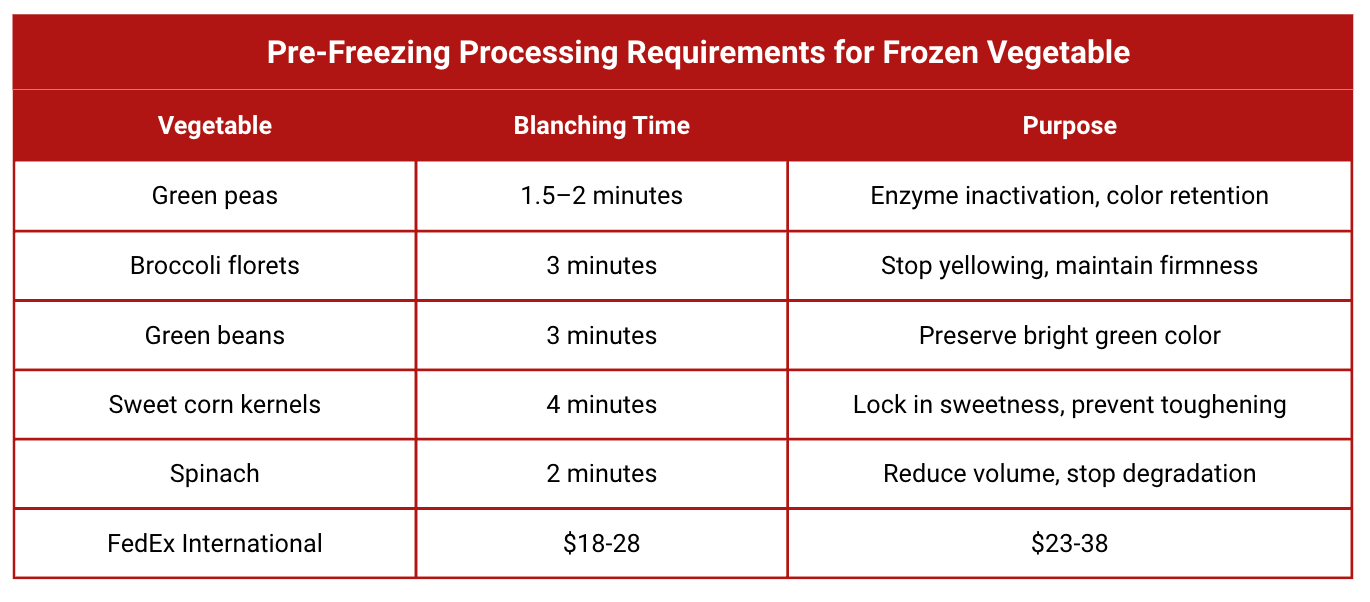
Under-blanching leaves enzymes partially active, causing quality deterioration during frozen storage. Over-blanching damages texture and reduces nutritional value.
IQF Technology and Vegetable Characteristics
Individual Quick Frozen (IQF) processing is standard for vegetables because it maintains piece separation, preserves natural texture better than block freezing, enables faster freezing rates (4–5 minutes for whole corn kernels), and facilitates portion control for foodservice and retail.
The fluidized bed IQF system uses powerful streams of cold air (-35°C to -79°C) to suspend individual vegetable pieces during freezing. This rapid freezing creates smaller ice crystals, causing less cell wall damage than slower methods.
The Continuous Cold Chain Requirement
Once vegetables reach -18°C in the IQF line, maintaining that temperature becomes critical through factory cold storage, transport to container depot, container stuffing, port handling, ocean transit (15–40 days depending on destination), destination port operations, customs clearance, and final delivery.
Temperature excursions damage frozen vegetables in specific ways. Rising above -12°C for extended periods allows ice crystal growth, which ruptures cell walls. When thawed, these vegetables become mushy and lose structural integrity, the texture damage that makes frozen vegetables unmarketable.
The Temperature & Handling Requirements for Frozen Vegetables Reefer Shipping
Standard Temperature Specifications
Frozen vegetables ship at -18°C or below throughout the cold chain, measured at core temperature. However, vegetables respond differently to temperature deviations than meat or fruit:
Enzyme Activity Window: Vegetables contain active enzymes that, even when blanched, can cause quality loss if temperatures rise above -12°C. While frozen meat primarily faces microbial growth concerns, vegetables also fight ongoing enzymatic degradation.
Ice Crystal Recrystallization: Vegetables' high water content (70–90% by weight for most varieties) makes them particularly vulnerable to ice crystal growth during temperature fluctuation.
Texture Sensitivity: The cellular structure of vegetables suffers more obvious texture changes than meat when frozen and thawed. Your customers immediately notice mushiness in previously-frozen vegetables, making temperature control essential for marketability.
Pre-Loading Temperature Verification
Before container stuffing, product core temperature must be verified at -18°C or below. Professional operations use calibrated probe thermometers to check random cartons from different pallet positions: minimum 3 pallets per container, 2–3 cartons per pallet, insert probe to carton center, allow 30–60 seconds for accurate reading, and document all readings with time stamps.
The period between removing product from cold storage and completing container loading should not exceed 30–45 minutes. Extended exposure to ambient temperature during stuffing begins the quality degradation process.
Reefer Container Configuration for Frozen Vegetables Shipping
Reefer containers for vegetables require specific settings:
Set Point: -18°C with ±2°C tolerance range
Pre-Cooling Protocol: Container must be powered on and pre-cooled to set point for 2–4 hours before loading begins. Loading warm containers forces the refrigeration unit to work as a freezer (which it cannot do effectively) rather than as a temperature maintenance system.
Ventilation Settings: Closed vent position for frozen vegetables. The refrigeration unit recirculates internal air without introducing outside air, preventing moisture infiltration and maintaining consistent temperature.
Air Circulation Requirements for Vegetables
Proper air flow in reefer containers is more critical for vegetables than for many other frozen products:
Moisture Release: Vegetables release moisture if temperature control lapses. Poor air circulation creates localized warm spots where this moisture condenses and refreezes, causing package damage and quality issues.
Package Density: IQF vegetable cartons are typically lighter and less dense than frozen meat boxes. This makes proper palletization essential, poorly stacked vegetable pallets shift more easily during transport, blocking air flow channels.
Load Configuration Standards:
Maintain 8–10 cm clearance from container walls
Keep 10–12 cm clearance from ceiling
Do not block floor T-bar air channels
Create air gaps between pallet rows (5–8 cm minimum)
Ensure pallet loads are stable and vertically aligned
Cold air flows from the reefer unit along floor channels, rises through the cargo, and returns along the ceiling. Blocking any part of this pathway creates temperature stratification.
Temperature Monitoring Technology
Independent temperature data loggers provide verification beyond the reefer unit's own monitoring. Position 2–3 loggers in different container locations, place one in the warmest anticipated spot (typically rear upper corner), insert loggers between cartons, set recording intervals to 15–30 minutes, and ensure battery life exceeds journey duration plus 20% safety margin.
After arrival, download logger data before accepting cargo. A continuous temperature record at or below -18°C confirms proper cold chain maintenance. Any periods above -15°C warrant quality inspection before accepting the shipment.
Packing & Palletizing Standards for Frozen Vegetables
Primary Packaging Formats
Frozen vegetables from China typically ship in these formats:
Bulk Cartons: 10 kg or 20 kg corrugated boxes with food-grade polyethylene inner bags, used for foodservice, industrial processing, and repacking operations.
Retail Bags: 500g, 1 kg, or 2.5 kg consumer packages, often pre-printed with buyer's private label, with master cartons containing 10–12 retail units.
Institutional Packs: 2.5 kg or 5 kg bags targeting restaurants and catering operations, balancing bulk purchasing and portion control.
Palletization Techniques for Vegetables
Vegetables present unique palletization challenges due to lighter weight. A 20 kg carton of frozen peas weighs less per volume than a 20 kg box of frozen beef. This lower density means more cartons per pallet, greater height for equivalent weight, and increased instability without proper securing.
Optimal Pallet Configuration:
Euro pallets (1200 mm × 800 mm) for European markets typically stack 8 cartons per layer, 8–10 layers high depending on carton strength, with maximum height 2.1–2.2 meters including pallet.
Standard pallets (1200 mm × 1000 mm) for other destinations accommodate 9–10 cartons per layer, 8–9 layers high, with similar height restrictions.
Container Loading Patterns
A 40-foot high cube reefer (internal dimensions approximately 11.59m × 2.29m × 2.50m) typically holds 24–26 standard pallets or 22–24 Euro pallets.
Loading sequence: Verify floor T-bar channels are clear and undamaged, position pallets leaving 8–10 cm from container walls, maintain 5–8 cm spacing between pallet rows, ensure top clearance of 10–12 cm from ceiling, and use load bars or straps to prevent forward movement during transport.
Special considerations for mixed vegetable loads: Place heavier products (corn, peas) on bottom positions, position lighter items (leafy vegetables, herbs) on upper pallets, group products by destination if container includes multiple buyers, and separate strong-smelling items (onions) from products that absorb odors (herbs, spinach).
Best Practices for Safe & Compliant Frozen Vegetables Shipping from China
1. Working with Specialized Logistics Partners
Frozen vegetable shipping requires expertise in temperature-controlled logistics, agricultural product handling, and international food safety regulations.
Gerudo Logisticsspecializes in temperature-controlled cargo from China, with dedicated teams managing frozen food exports to global markets. We provide complete DDP (Delivered Duty Paid) services for frozen product imports, handling your entire supply chain from supplier coordination and reefer container booking through customs clearance and final delivery to your warehouse door.
Our door-to-door service eliminates the complexity of managing multiple logistics providers while ensuring your frozen vegetables maintain proper cold chain integrity from IQF line to destination.
With established relationships across major shipping lines and customs authorities in key destination markets, we provide the visibility and reliability that frozen vegetable imports demand. Our services include supplier quality auditing, temperature monitoring throughout transit, documentation management, customs brokerage, and coordination with your distribution centers.
Contact our logistics specialist today!
2. Pre-Shipment Quality Control
Implement these verification steps before authorizing shipment:
Supplier Factory Audit: Confirm blanching equipment is properly calibrated, review enzyme inactivation test results, verify IQF freezing temperature monitoring records, check cold storage temperature logs (past 30 days minimum), and inspect packing and palletizing procedures.
Product Specification Verification: Core temperature measurement (-18°C or below), visual inspection for ice crystal formation on surface (indicates temperature abuse), package integrity check (no punctures, tears, or crushing), label accuracy (product name, weight, production date, expiration date), and pallet stability testing.
Container Inspection: Valid PTI (Pre-Trip Inspection) certificate dated within past 30 days, cold treatment report showing pre-cooling to set point, interior cleanliness (no odors, stains, or contamination), refrigeration unit operational test, and door seal integrity (no gaps or damage).
3. Documentation Requirements Specific to Vegetables
Standard Commercial Documents: Commercial invoice and packing list, bill of lading (ocean) or airwaybill (air freight), and certificate of origin.
Food Safety Certificates: Health certificate issued by GACC (General Administration of Customs China), phytosanitary certificate (plant health certification), processing establishment registration number, and cold chain temperature monitoring records.
Quality Documentation: Blanching time and temperature records, enzyme activity test results (peroxidase or catalase tests), pesticide residue test reports, heavy metal analysis (for certain markets), and microbiological test results.
Certification Copies: BRC or IFS certification, HACCP documentation, ISO 9001 or ISO 22000, organic certification (if applicable), and HALAL or KOSHER certification (market specific).
EU-Specific Requirements: Suppliers must be registered with Chinese authorities for EU export, listed on the EU's approved establishment list, compliant with EU pesticide maximum residue levels (MRLs), and meeting EU hygiene and food safety regulations.
US-Specific Requirements: FDA requirements include Foreign Supplier Verification Program (FSVP) compliance, Bioterrorism Act prior notice, compliance with Food Safety Modernization Act (FSMA), HACCP and preventive controls documentation, and country of origin labeling.
4. Cargo Insurance Coverage
Temperature-sensitive cargo insurance is essential.
Standard marine cargo policies should be extended with temperature deviation coverage (protection for loss due to reefer mechanical breakdown, coverage for temperature excursions from any cause, replacement value for product rendered unmarketable), delay coverage (extended insurance if port congestion threatens product shelf life, coverage for additional storage costs), and rejection coverage (insurance if cargo is rejected at destination due to temperature-related quality issues).
Recommended coverage level includes full replacement value including product cost, freight, duty, and profit margin, with typical premium of 0.5–1.5% of insured value depending on route and coverage terms.
2. Advance Planning and Timeline Management
Production and Shipping Coordination
Frozen vegetable logistics require tight coordination between harvest schedules, processing capacity, and vessel sailings. Chinese suppliers typically need 15–20 days from harvest to container stuffing Plan container bookings 3–4 weeks ahead during normal seasons, extending to 6–8 weeks during peak agricultural periods (May–October for most vegetables).
Factor destination-side timelines into your planning: 3–7 days for customs clearance (longer for first-time imports or enhanced inspection shipments), 2–5 days for inland transport to your facility, and buffer time for unforeseen delays (port congestion, customs examinations, documentation issues).
Seasonal Capacity Planning
Reefer container capacity tightens during peak seasons.
Chinese New Year (January–February) creates equipment shortages as containers accumulate at destination ports.
Northern Hemisphere summer months (June–September) see competition from deciduous fruit exports, stone fruit shipments, and other seasonal produce.
Book capacity early during these periods and maintain flexibility in sailing dates. Consider contracting annual reefer space with shipping lines if you move consistent volumes—this secures equipment availability and often provides rate advantages.
3. Staying Current with Food Safety and Transport Regulations
FDA and FSMA Compliance Updates
The FDA’s Food Safety Modernization Act (FSMA) and Food Traceability Rule (effective January 2026) require enhanced traceability for frozen vegetables. Ensure suppliers comply with current Good Manufacturing Practices (cGMP) and Hazard Analysis and Risk-Based Preventive Controls.
Foreign Supplier Verification Programs (FSVP):
Maintain up-to-date FSVP records to verify supplier approval and document hazard analysis and verification activities. Non-compliant importers risk being placed on Import Alert 99-41, which can block future shipments.
EU Pesticide and Contaminant Regulations
The EU enforces strict Maximum Residue Levels (MRLs) for pesticides. Recent regulatory changes include significantly lowered MRLs for neonicotinoid pesticides (clothianidin and thiamethoxam reduced to 0.01 mg/kg, effectively zero tolerance, as of 2024) and acetamiprid MRLs reduced by 50–80% for multiple crops effective 2025.
Actionable Advice: Ensure suppliers follow Integrated Pest Management (IPM) and conduct pesticide residue testing before shipment, especially for the EU market.
Market-Specific Import Controls
Certain frozen vegetables require enhanced inspections. For example, the EU has a 50% inspection rate for frozen chillies from specific countries like the Dominican Republic and Vietnam.
Japan and South Korea maintain stricter pesticide standards than Codex Alimentarius.
Tip: Stay informed about import restrictions, enhanced inspection programs, and changing documentation requirements in your target markets by subscribing to alerts from the European Food Safety Authority (EFSA) and FDA.
Frequently Asked Questions For Frozen Vegetables
What makes frozen vegetable shipping different from frozen meat or frozen fruit?
Frozen vegetables require specific pre-freezing processing (blanching) to inactivate enzymes, must be frozen within 2–8 hours of harvest depending on variety, and are more sensitive to texture damage from temperature fluctuation due to their high water content and delicate cellular structure. The harvest-to-freeze timing is critical for vegetables in ways that don't apply to meat or fruit.
How long can frozen vegetables remain in transit before quality degrades?
When properly maintained at -18°C, frozen vegetables retain high quality for 18–24 months. Ocean transit of 15–40 days represents only a small portion of shelf life. The critical factors are maintaining consistent temperature and avoiding temperature cycling, not the duration of transit itself.
What temperature should frozen vegetables be shipped at?
Frozen vegetables must be maintained at -18°C or below throughout the entire cold chain from factory to final destination. This temperature prevents enzymatic degradation, microbial growth, and ice crystal recrystallization that damages texture.
Do I need special certifications for frozen vegetable suppliers in China?
For retail and foodservice markets, require suppliers with BRC or IFS certification, HACCP compliance, and ISO food safety standards. Depending on your target market, you may also need HALAL, KOSHER, or organic certifications. Always verify certificates are current and cover your specific products.
What documents are required to import frozen vegetables from China?
Standard requirements include commercial invoice, packing list, bill of lading, health certificate from GACC, phytosanitary certificate, certificate of origin, and temperature monitoring records. EU and US markets have additional specific requirements including establishment approval lists and FSVP documentation.
How can I verify the cold chain wasn't broken during shipping?
Place independent temperature data loggers inside your shipment that record temperature every 15–30 minutes throughout the journey. Download the data upon arrival before accepting cargo. Continuous readings at or below -18°C confirm proper cold chain maintenance.
What regions in China produce the highest quality frozen vegetables?
Shandong Province leads in frozen vegetable processing with the largest production capacity and established export infrastructure. Fujian Province specializes in edamame and specialty vegetables, while Hebei and Jiangsu provinces focus on specific product categories. Choose suppliers based on their product specialization and proximity to growing regions.
Conclusion: Building a Reliable Frozen Vegetable Supply Chain from China
Frozen vegetable shipping from China demands attention to details that begin in the field at harvest and extend through every step of the cold chain to your warehouse door. The time-sensitive nature of vegetable processing, specific blanching requirements, and sensitivity to temperature fluctuation create challenges distinct from other frozen foods.
Success requires selecting suppliers with appropriate certifications and demonstrable cold chain capabilities, implementing rigorous pre-shipment verification procedures, and partnering with logistics providers who understand the specialized demands of frozen food shipping. Your frozen vegetables should arrive at destination with the same texture, color, and nutritional value they had leaving the IQF line in China.