The Complete Import Guide to Shipping Car Air Fresheners from China (2026)
Shipping car air fresheners from China has become increasingly strategic for businesses seeking to tap into the global automotive accessories market. Whether you're importing hanging paper fresheners, vent clips, gel cans, or aerosol sprays, understanding the logistics complexities can mean the difference between smooth operations and costly delays.
The car air freshener industry presents unique shipping challenges that many importers underestimate. From dangerous goods classification to customs documentation, each product format carries distinct requirements.
This guide walks you through everything you need to know about importing car air fresheners from China, helping you avoid common pitfalls while optimizing costs and delivery times.
Can Car Air Fresheners Be Shipped from China?
Yes, car air fresheners ship from China regularly. However, success depends on matching your product format and formulation to appropriate shipping methods and documentation.
The confusion stems from a common misconception: importers assume all car air fresheners are either "safe consumer products" or "dangerous chemicals." Reality sits somewhere between. A paper hanging freshener and an aerosol spray both serve the same purpose but require completely different logistics approaches.
Why air fresheners are often misjudged:
Most car air fresheners contain fragrance compounds derived from volatile organic materials. The term "volatile" triggers alarm bells, but volatility alone doesn't make something dangerous goods.
What matters for shipping is whether the product meets specific technical thresholds: flash point temperature, pressure levels, concentration of flammable components.
Here's where importers get tripped up: they rely on supplier claims rather than technical specifications. A factory might say "it's just fragrance, not dangerous" while the actual formulation contains alcohol-based carriers with flash points of 55°C, clearly falling into dangerous goods classification.
Common pitfalls importers face:
Assuming small size equals low risk: A 10ml liquid freshener can require dangerous goods handling if formulation is flammable, while a large paper hanger ships as general cargo
Believing "natural" means "non-regulated": Essential oil fresheners often have lower flash points than synthetic alternatives
Not accounting for format differences in the same order: Mixing paper hangers with aerosols in one shipment forces the entire order into expensive dangerous goods procedures
Trusting outdated or generic safety data: Many suppliers provide generic SDS documents that don't reflect the actual product formulation
The key is understanding your specific product before committing to production schedules or quoting customers on delivery times.
Types of Car Air Fresheners and Shipping Risk
Different car air freshener formats face distinct shipping requirements, costs, and regulatory considerations.
Paper/Hanging Fresheners
DG Status: Non-DG
Primary Shipping Risks:
Compression damage in stacked containers (bottom cartons can crush under weight)
Fragrance cross-contamination between scent variants during long ocean transits
Moisture affecting adhesive backing during ocean transit
Scent degradation on extended transits exceeding 60 days
Vent Clips & Solid Fresheners
DG Status: Non-DG to Borderline (depends on fill material)
Primary Shipping Risks:
Mechanical clip breakage during handling, especially in air freight
Temperature-induced gel softening or leaking for oil-based fills in summer shipments
Awkward carton dimensions creating wasted LCL space
Classification confusion if liquid/gel fill type unclear on documentation
Gel & Can Fresheners
DG Status: Non-DG (usually, if water-based gel)
Primary Shipping Risks:
Weight concentration increasing freight costs versus paper formats
Gel consistency changes with temperature (softening in heat, hardening in cold)
Metal can corrosion during ocean transit without VCI protection
Customs inspection triggers due to "gel" descriptor confusion with personal care products
Liquid/Oil Diffusers
DG Status: Borderline to DG (flash point determines classification)
Primary Shipping Risks:
Flash point determining DG status (most essential oil fresheners fall at 48-60°C = DG)
Leakage risk despite sealed bottles due to pressure changes during air freight
Airline restrictions even when technically non-DG
Weight making air freight economically prohibitive
Aerosol Sprays
DG Status: DG (Class 2.1 flammable or Class 2.2 non-flammable)
Primary Shipping Risks:
Mandatory DG handling with surcharges ($600-1,200 per container for ocean)
Severe airline limitations or complete refusal by most carriers
Limited carrier options reducing competitive pricing
Extended booking lead times (2-3 weeks versus 1 week for non-DG)
Fragrance-Free Absorbers
DG Status: Non-DG
Primary Shipping Risks:
Bulk/weight ratio creating poor air freight economics
Moisture absorption during transit adding 5-10% weight
Minimal risks overall; most logistics-friendly format
Is Shipping Car Air Fresheners from China Considered Dangerous Goods?
The dangerous goods question causes more confusion than any other aspect of car air freshener shipping. The answer depends entirely on product formulation and format.
Dangerous goods classification relates to materials that pose risks during transport due to flammability, toxicity, or pressure.
For car air fresheners, the most common concern is Class 3 (flammable liquids) or Class 2 (gases under pressure). Flash point is the critical factor - the lowest temperature at which vapors ignite when exposed to an ignition source. Products with flash points below 60°C typically require dangerous goods handling.
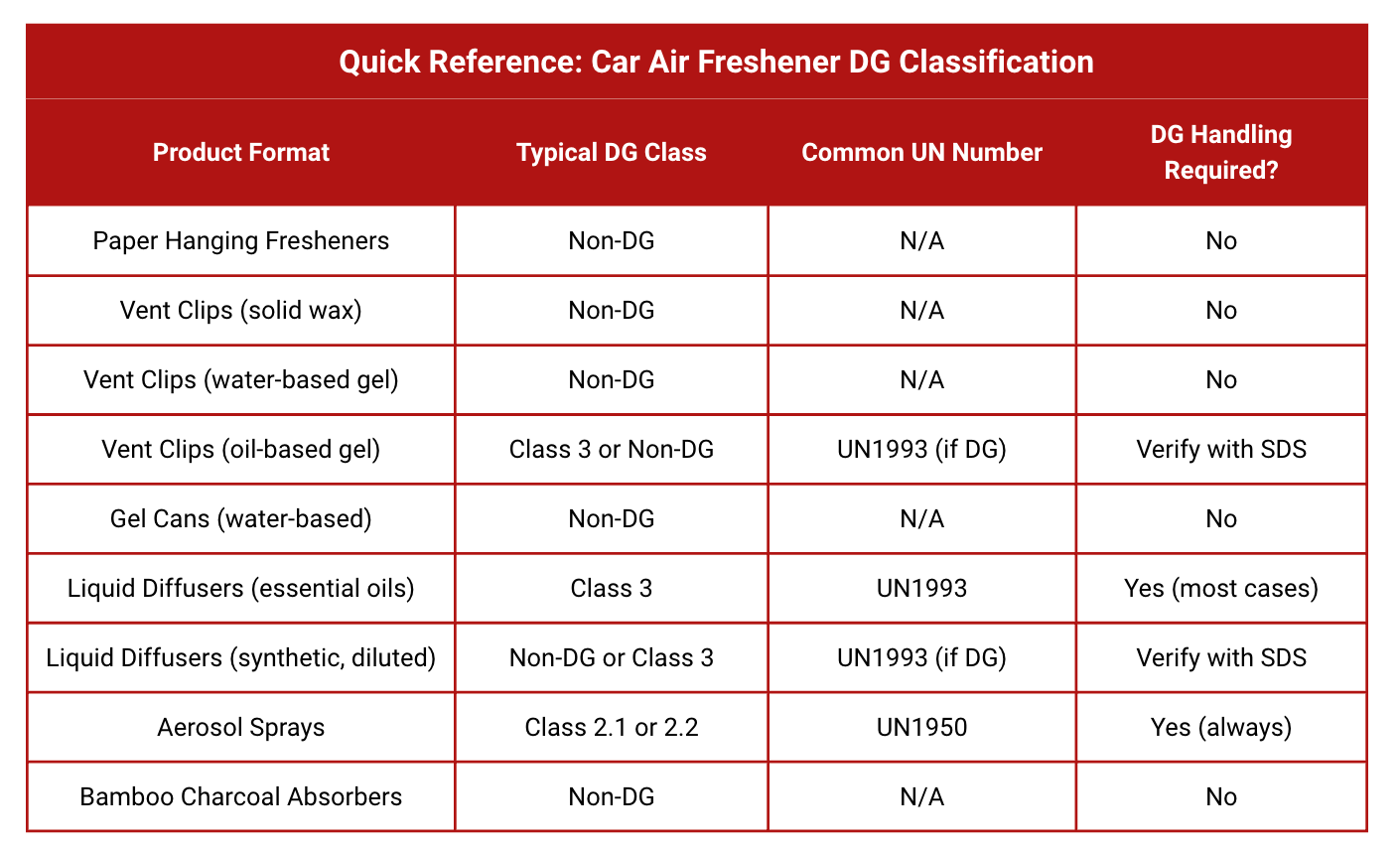
How to Verify Your Product's Classification Using SDS
Request the SDS (Safety Data Sheet) from your supplier and check Section 14 - Transport Information:
If your product is DG, Section 14 will show:
UN number (e.g., UN1993 or UN1950)
Proper shipping name (e.g., "Flammable liquid, n.o.s." or "Aerosols, flammable")
Class/Division (e.g., Class 3, Class 2.1)
Packing Group (II or III for liquids)
If your product is Non-DG, Section 14 will show:
"Not regulated for transport" or "Not dangerous goods"
No UN number
May only mention "Marine Pollutant" (environmental, not DG)
Warning signs of unclear SDS:
Section 14 is blank or says "Not available"
Conflicting information (Section 9 mentions flammability but Section 14 says non-DG)
SDS is more than 3 years old
What to do if SDS is unclear: Contact your freight forwarder to review the document. Don't assume non-DG status without verification. Essential oil fresheners and oil-based gels frequently require DG handling even when suppliers claim otherwise.
Documents Required for Shipping Car Air Fresheners from China
Documentation accuracy determines whether your shipment clears customs smoothly or faces delays and additional fees.
Standard Documents for All Shipments:
Commercial Invoice: Detailed statement listing every product with descriptions, quantities, unit values, and total value
Packing List: Details how goods are packed, including carton count, dimensions, gross and net weights
Bill of Lading or Air Waybill: Serves as receipt, contract of carriage, and document of title
New to dangerous goods shipping? Read our detailed DG Clearance & Documentation requirement for DG cargo.
Format-Specific Documentation Requirement for International Shipping
Paper Hanging Fresheners:
No special documentation beyond standard shipping documents
Product description on invoice should state: "Paper hanging car air freshener, non-dangerous goods"
Vent Clips & Gel Cans (Non-DG):
SDS recommended but not mandatory
If gel contains oil-based carriers, SDS becomes strongly recommended to prove non-DG status
Product description: "Vent clip car air freshener with [solid wax/water-based gel], non-dangerous goods"
Liquid Fresheners (Borderline/DG):
Mandatory: SDS showing flash point and classification
If DG: Dangerous Goods Declaration matching SDS Section 14 specifications
If borderline: SDS showing flash point above 60°C to support non-DG claim if questioned
Product description must include flash point reference: "Liquid car air freshener, flash point >100°C, non-dangerous goods" or "Liquid car air freshener, UN1993, Class 3, PG III"
Aerosol Sprays (Always DG):
Mandatory: SDS with aerosol specifications
Mandatory: Dangerous Goods Declaration (Class 2.1 or 2.2)
Mandatory: UN-approved packaging certification documents
Product description: "Aerosol spray car air freshener, UN1950, Class 2.1"
Fragrance-Free Absorbers:
No special documentation required
Product description: "Bamboo charcoal car odor absorber, non-dangerous goods"
Key Documentation Tip: For mixed-format shipments, separate DG and non-DG items clearly on commercial invoices and packing lists. List them in distinct sections with subtotals to prevent confusion about which cartons require special handling.
Best Shipping Methods for Car Air Fresheners
Are All Car Air Freshener Formats Suitable for Ocean Freight?
Yes, all formats work for ocean freight, making it the default choice for commercial volumes. Here's why ocean freight works universally for car air fresheners:
Temperature stability: Car air fresheners formulations typically remain stable in the 0-50°C range experienced in standard containers. Unlike chocolate or pharmaceuticals, fresheners don't require temperature-controlled shipping.
Transit duration tolerance: Even paper fresheners with absorbed oils remain effective after 60-day ocean transits. Fragrance loss during shipping is minimal when properly sealed in master cartons.
Cost efficiency at scale: Ocean freight charges by volume (cubic meter) or weight, whichever is greater. Car air fresheners pack efficiently regardless of format. A 20-foot container can hold:
150,000-200,000 paper hanging fresheners
80,000-100,000 vent clips
50,000-70,000 gel cans
40,000-60,000 liquid diffuser bottles (weight-limited)
30,000-40,000 aerosol cans (weight and DG space-limited)
DG handling feasibility: Unlike air freight where many airlines refuse DG cargo, ocean carriers routinely accept dangerous goods with proper documentation. DG surcharges are more manageable when spread across container volumes.
Air Freight Conditions and Common Rejection Reasons
Air freight for car air fresheners faces format-specific acceptance rates and carrier restrictions:
Acceptance Overview by Format:
Paper hangers: Accepted by all carriers, no restrictions
Vent clips/solid gels: Generally accepted with occasional carrier questions
Liquid fresheners (non-DG): 30-40% rejection rate despite proper classification
Liquid fresheners (DG): Severely limited, cargo-only flights required
Aerosols: Rejected by 85-90% of airlines
Express courier: Only paper hangers reliably accepted
Primary Rejection Reasons Across All Formats:
Internal carrier policies exceeding regulations: Airlines implement "no fragrance products" or "no liquids" rules beyond what regulations require, affecting even non-DG products
Liquid volume restrictions: Many carriers cap liquids at 100ml per unit regardless of DG status, eliminating most diffuser formats
"Gel product" confusion: Carriers confuse car air freshener gels with cosmetics or personal care products, triggering inappropriate restrictions
Previous incident history: One leakage or odor complaint from any fragrance shipper can create blanket carrier restrictions lasting months
Route-specific limitations: Certain destination airports maintain fragrance restrictions independent of airline policies
DG cargo capacity constraints: For aerosols and flammable liquids, limited dangerous goods space on cargo-only flights fills quickly, especially during peak season
Practical Approach: Use air freight only for paper hangers and urgent non-DG solid products. For liquids and aerosols, assume ocean freight as default unless specific carrier pre-approval obtained through experienced freight forwarder.
Customs Clearance & Destination Market Considerations
HS Code Classification by Format
Car air fresheners typically classify under Chapter 33:
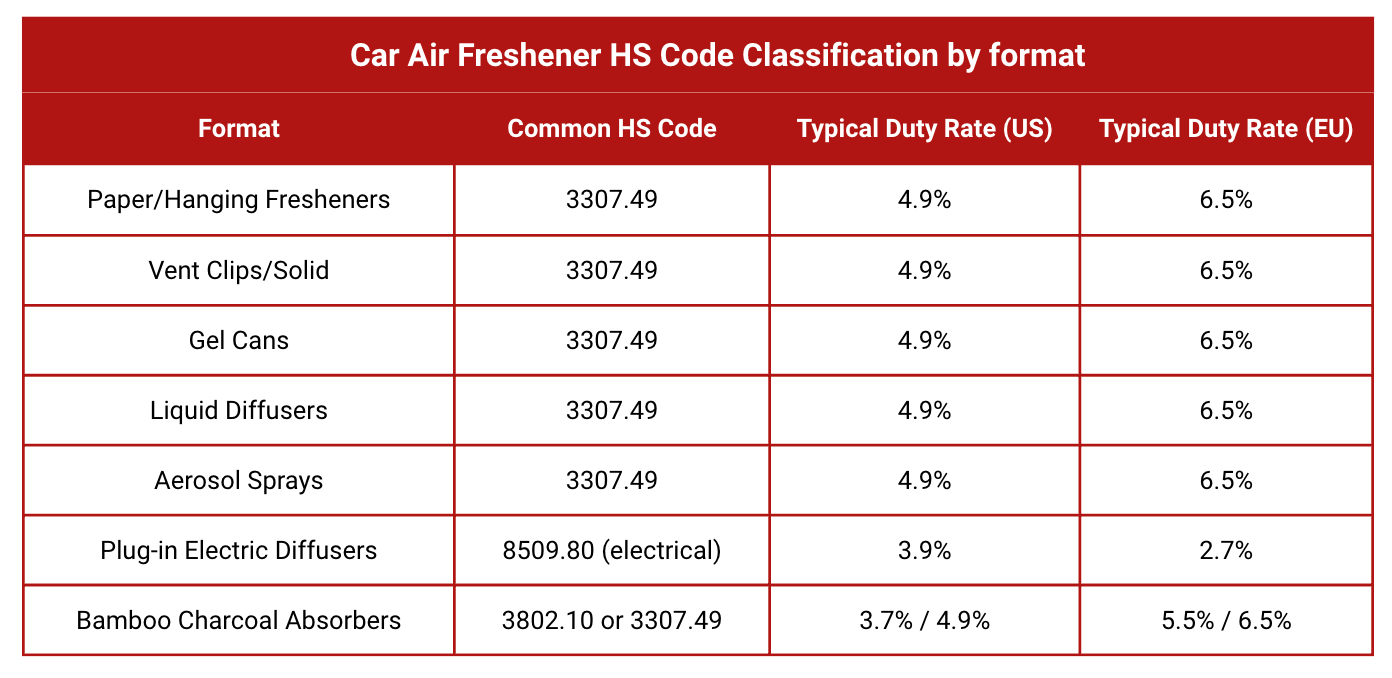
Note: Rates are general references. Actual rates vary by destination country's 10-digit extensions and trade agreements.
Destination Country Clearance Requirements for Car Fragrance
United States:
Standard entry through CBP (Customs and Border Protection)
Products making antimicrobial or sanitizing claims may trigger EPA holds
California Proposition 65: Products containing listed chemicals need warnings (common fragrance ingredients: benzene, styrene)
Estimated clearance time: 1-3 days for standard entry, 5-10 days if selected for inspection
European Union:
REACH compliance: Fragrance ingredients above 1 ton/year may require pre-registration
CLP labeling: DG products need proper hazard pictograms on consumer packaging
26 fragrance allergens must be disclosed on labels if present above thresholds
Language requirement: Labeling in destination country's official language
Estimated clearance time: 2-5 days standard, 7-14 days if documentation issues arise
Middle East (GCC Countries):
Certificate of Origin often required
Arabic labeling mandatory in Saudi Arabia, UAE, Kuwait
Pre-shipment inspection certificates may be required (varies by country)
Halal certification not required for car air fresheners but may ease clearance
Aerosol products face additional scrutiny; some countries require pre-approval
Estimated clearance time: 3-7 days, longer if Arabic labeling missing
Latin America:
Brazil: ANVISA registration required for certain formats; Portuguese labeling mandatory
Mexico: Importer must have NOM registration; Spanish labeling required
Argentina/Chile: Spanish labeling with specific consumer protection details
Import permits may be required before shipment (check country-specific requirements)
Estimated clearance time: 5-14 days depending on country and documentation completeness
Why Work with a Freight Forwarder Experienced in Fragrance Products
Generic freight forwarders often struggle with car air fresheners due to classification ambiguities and carrier-specific restrictions. Specialized experience matters.
What Gerudo Logistics provides for car air freshener imports:
DG classification verification: We review your SDS documents before booking to confirm proper classification. This prevents costly misdeclaration issues and carrier rejections.
Format-specific carrier selection: We maintain current knowledge of which carriers accept which freshener formats. Paper hangers get fast, economical routing; aerosols get directed to DG-approved carriers on your specific lanes.
Dangerous goods handling: For DG products (aerosols, flammable liquids), we provide:
UN-certified packaging coordination with suppliers
Proper dangerous goods declaration preparation
DG-approved carrier booking
Transparent pricing including all DG surcharges upfront
Regulatory guidance: We track destination-market requirements (EU CLP labeling, California Prop 65, Middle East Arabic labeling) and alert you to compliance needs before production.
Integrated service: We offer DDP logistics solutions. Single point of contact from factory pickup through customs clearance and final delivery. One team managing your entire shipment eliminates communication gaps.
Contact and discuss your car air freshener shipping requirements with our logistics specialist. Whether you're importing paper hangers, gel cans, or aerosols, we tailor our approach to your specific product format.
Frequently Asked Questions to Ship Car Air Freshener from China
Can I ship different car air freshener formats together?
Yes, but keep DG and non-DG products separate. Mixing them forces your entire shipment into DG procedures and surcharges. Ship paper hangers and non-DG gels together; ship aerosols separately to avoid unnecessary costs.
Why does my supplier claim their product is non-DG when it contains fragrance oils?
Suppliers often confuse "safe for consumer use" with "non-dangerous goods for transport." These are different classifications. Request the SDS Section 14 to verify actual shipping classification rather than relying on supplier claims.
How much do DG surcharges actually cost?
Ocean freight: $600-1,200 per FCL container, $300-500 per LCL shipment. Air freight: adds $2.50-4.00 per kg. For a 1,500kg aerosol shipment, DG surcharges add $3,750-6,000 to air freight costs.
Can I use express courier for car air freshener samples?
Paper hangers: Yes. Vent clips: Sometimes. Liquid fresheners: Rarely. Aerosols: Almost never. Courier services maintain strict internal policies beyond regulatory requirements. Even properly documented non-DG liquids often get rejected.
What's the most common customs delays?
Product description mismatches. Invoice says "paper freshener" but customs inspection reveals liquid reservoir. Or "gel" descriptor triggers confusion with personal care products. Use clear, specific descriptions: "Paper hanging car air freshener, non-dangerous goods" prevents 90% of description-related delays.
How far in advance should I book car air freshener shipments?
Non-DG formats: 1 week before desired pickup. DG products: 2-3 weeks before pickup to secure carrier space. Peak season (Sept-Nov): Add 1-2 weeks to DG timeline. Last-minute bookings for aerosols often impossible during peak periods.
Conclusion
Shipping car air fresheners from China successfully requires understanding product-specific logistics challenges and planning accordingly. From dangerous goods classification to customs documentation, each step demands attention to detail and regulatory knowledge. Start with clear product classification, work with experienced partners, ensure compliance before production, and build relationships with suppliers who understand export requirements.
The car air freshener market offers strong opportunities for businesses that approach importing strategically. By understanding the logistics complexities and working with knowledgeable partners, you can build a reliable supply chain that supports profitable growth. Whether you're launching your first product line or expanding an established business, thorough planning and expert guidance make the difference between smooth operations and frustrating setbacks.