Shipping Cosmetics from China: Skincare, Fragrance & Aerosols Explained
When you look at the beauty products lined up on shelves from Los Angeles to London, there’s a good chance their supply chain began in China. The country has become a global centre for cosmetics manufacturing, producing everything from everyday skincare to premium fragrances and complex colour cosmetics.
But here's what most importers learn the hard way: shipping cosmetics from China involves more than booking freight space.
From dangerous goods classifications to customs compliance, the process demands careful planning and expertise, shipping cosmetics from China involves complexities that catch many importers off guard. This guide walks you through everything you need to know about importing cosmetics from China in 2025.
Understanding China's Cosmetics Export Landscape
China has evolved from a manufacturing hub to a cosmetics innovation center. What makes China particularly attractive for cosmetics sourcing is the combination of competitive pricing, diverse product range, and increasingly sophisticated formulation capabilities.
In 2024, China exported 1.32 million tons of beauty cosmetics and personal care products valued at $7.2 billion, with a growth rate of 10.8% year-over-year. The top five export markets are the United States ($1.45 billion), China Hong Kong ($840 million), the United Kingdom ($530 million), Japan ($320 million), and Indonesia.
For importers, this means you're working with suppliers who understand international quality standards and can scale production efficiently. Over 62,000 cosmetic products were notified specifically for export purposes in 2024, reflecting a 34.9% year-on-year growth and highlighting the strong outbound focus among Chinese manufacturers.
How to Find a Trusted Cosmetic Manufacturer in China:
Before shipping, selecting the right manufacturing partner is essential:
Verify licenses and certifications: Request Cosmetics Production License, ISO 22716 (cosmetics GMP), FDA registration, or EU GMP compliance documents
Conduct factory audits: Visit facilities when possible or hire third-party inspection services like SGS or Bureau Veritas to audit manufacturing conditions and quality control processes
Test product samples: Order samples and test through independent laboratories to verify ingredient accuracy, safety profiles, and compliance with destination market requirements
Check export experience: Prioritize manufacturers with proven export experience to your target markets who understand documentation requirements and regulatory nuances
Use trade platforms strategically: Platforms like Alibaba and Made-in-China provide starting points, but verify credentials independently rather than relying solely on platform ratings
Cosmetics Definition and Categories for International Shipping
Understanding how logistics providers categorize cosmetics helps you prepare accurate documentation and choose appropriate shipping methods.
From a shipping perspective, cosmetics include products designed for application to the human body for cleansing, beautifying, enhancing appearance, or altering appearance. The main categories are:
Skincare Products:
Moisturizers, creams, and lotions
Serums and essences
Toners and astringents
Face masks (sheet, clay, gel)
Cleansers and makeup removers
Color Cosmetics:
Foundations, BB creams, and concealers
Lipsticks, lip glosses, and lip balms
Eye makeup (eyeshadow, eyeliner, mascara)
Blushes and bronzers
Pressed and loose powders
Hair Care Products:
Shampoos and conditioners
Hair treatments and masks
Styling products (gels, mousses, waxes)
Hair sprays and setting sprays
Fragrances and Body Products:
Perfumes and eau de parfum
Body mists and sprays
Body lotions and creams
Deodorants and antiperspirants
Nail Products:
Nail polishes and lacquers
Nail treatments and hardeners
Nail polish removers
Cosmetic Accessories:
Makeup brushes and applicators
Sponges and beauty tools
The classification matters because different product types face varying regulatory requirements, shipping restrictions, and customs procedures based on their function, formulation, and packaging method.
Dangerous Goods Cosmetics Shipping: Classification and Requirements
When Cosmetics Become Dangerous Goods (DG)
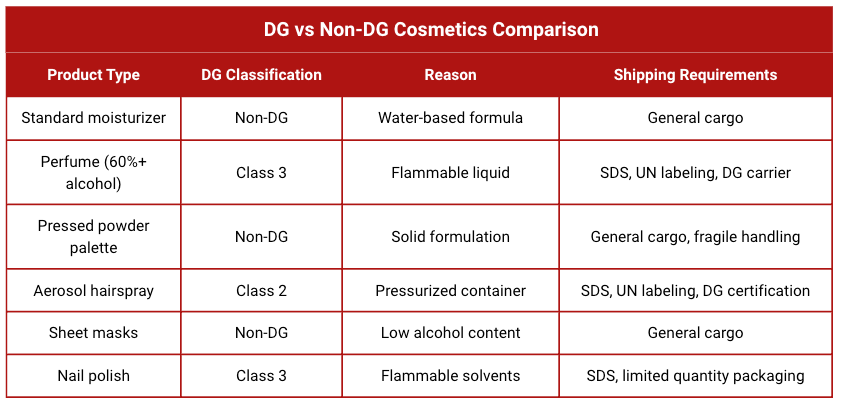
One critical distinction separates straightforward cosmetics shipping from China from complex ones: whether your products qualify as dangerous goods. This classification depends entirely on product formulation and packaging, not consumer safety.
Most cosmetics ship as general cargo without dangerous goods restrictions. These include water-based moisturizers and serums, sheet masks and clay masks, standard foundations and BB/CC creams, pressed powders and compact products, solid lipsticks and lip balms, eye palettes and pencils, and makeup brushes and tools.
However, certain categories trigger dangerous goods regulations due to their chemical composition or packaging method.
Common Dangerous Goods Examples in Cosmetics Shipping
Class 3 Flammable Liquids:
Products containing high alcohol content fall into this category. The alcohol concentration determines classification, typically products with alcohol by volume above certain thresholds.
Perfumes and eau de parfum (60-90% alcohol content)
Body mists and fragrance sprays
Nail polish and nail polish remover
Alcohol-based toners and astringents
Some makeup removers with flammable solvents
Class 2 Compressed Gases:
Any product in pressurized aerosol containers requires dangerous goods handling.
Aerosol hairsprays and dry shampoos
Setting sprays and finishing mists
Spray deodorants and antiperspirants
Sunscreen sprays
Mousse products in pressurized containers
How to Verify Dangerous Goods Status:
Request the Safety Data Sheet (SDS) from your supplier before ordering. Section 14 of the SDS specifies whether dangerous goods classification applies and provides the UN number, proper shipping name, and packing group.
If your supplier cannot provide an SDS, ask directly about alcohol content, pressurized containers, or flammable components. Reputable manufacturers understand international shipping requirements and can clarify classifications quickly.
Dangerous Goods Shipping Requirements:
When shipping DG cosmetics from China, you need proper documentation including SDS and UN classification, specialized UN-certified packaging, appropriate hazard labels and markings, and carriers certified to handle dangerous goods. Budget for additional surcharges of 20-40% on base shipping costs.
Cosmetics Shipping Methods from China: Air, Sea, Express
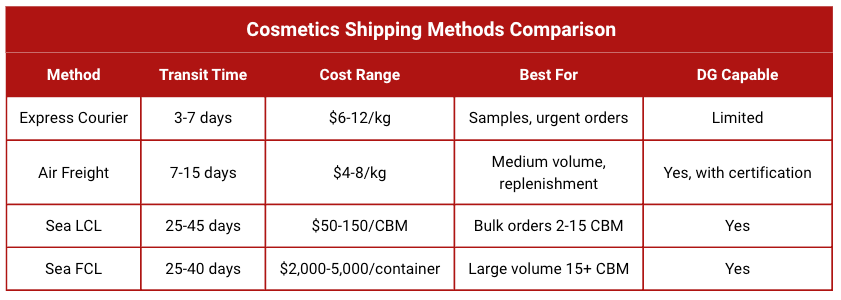
Your shipping method choice significantly impacts costs, transit times, and inventory management capabilities when importing cosmetics from China.
Express Courier Cosmetics Shipping
Best for small parcels, samples, and urgent shipments. Transit time ranges from 3-7 days with door-to-door delivery through carriers like DHL, FedEx, and UPS.
Advantages: Fast delivery, simplified customs clearance, reliable tracking
Costs: $6-12 per kilogram typically
Limitations: Higher per-unit costs, strict DG policies, volumetric weight pricing
Express services work well for product testing, market validation, and high-value low-weight items like serums.
Air Freight for Cosmetics from China
Suitable for medium-volume cosmetics shipments requiring faster delivery than sea freight. Transit time typically 7-15 days depending on routing and customs clearance.
Advantages: Balance of speed and cost, DG capability with proper certification, flexible consolidation options
Costs: $4-8 per kilogram average
Considerations: Separate customs arrangements needed, peak season capacity constraints, requires DG-certified carriers for perfumes and aerosols
Sea Freight Cosmetics Shipping: LCL and FCL
The most economical option for bulk cosmetics orders from China. LCL (Less than Container Load) shares container space, while FCL (Full Container Load) dedicates entire containers to your cargo.
LCL Shipping:
Transit: 25-45 days
Costs: $50-150 per cubic meter
Best for: 2-15 cubic meters volume
FCL Shipping:
Transit: 25-40 days
Container costs: $2,000-5,000 depending on route and season
Capacity: 20ft container holds ~28 CBM, 40ft holds ~58 CBM
Best for: Bulk orders over 15 cubic meters, heavy liquid products, cost-sensitive shipments
Sea freight accommodates dangerous goods including perfumes and aerosols with proper documentation and labeling.
DDP Cosmetics Shipping from China
DDP (Delivered Duty Paid) bundles freight, customs clearance, duties, taxes, and delivery into a single landed cost. Your forwarder handles all logistics and regulatory compliance, delivering directly to your warehouse or fulfillment center.
Benefits: Predictable costs, reduced administrative burden, single point of contact
Important note: DDP simplifies logistics but does not eliminate product safety compliance responsibilities. You remain responsible for ensuring products meet destination market cosmetics regulations.
Documents Needed to Import Cosmetics from China
Accurate documentation determines whether your cosmetics shipment clears customs smoothly or encounters delays and storage fees.
Essential Cosmetics Shipping Documents
Commercial Invoice:
Primary customs document detailing the transaction. Include complete product descriptions, unit values, total value, currency, payment terms, and supplier information. Customs authorities use this to calculate duties and taxes.
Packing List:
Provides detailed information about the physical shipment including carton counts, dimensions, weights, net and gross weights, and how products are organized within each carton.
Bill of Lading (Sea) or Air Waybill (Air):
Your contract of carriage and proof of shipment. The Bill of Lading serves as a title document for sea freight, while the Air Waybill is non-negotiable.
HS Codes for Cosmetics from China
Every product requires the correct Harmonized System (HS) code, a standardized numerical method of classifying traded products. Cosmetics typically fall under Chapter 33, but specific codes vary:
Skincare preparations: HS code 3304.99
Lip makeup products: HS code 3304.10
Eye makeup: HS code 3304.20
Perfumes: HS code 3303.00
Hair preparations: HS code 3305
Incorrect HS codes result in wrong duty calculations, clearance delays, or penalties. Work with your customs broker to verify classifications, especially for products with multiple functions or unique formulations.
Product-Specific Documentation
INCI (International Nomenclature of Cosmetic Ingredients) List:
Most countries require full ingredient disclosure for cosmetics imports. Your supplier should provide the complete INCI list for regulatory review and customs purposes.
Certificate of Origin:
Documents where products were manufactured. This certificate may qualify you for preferential duty rates under trade agreements.
Safety Data Sheets (SDS):
Required for dangerous goods and recommended for borderline cosmetics items. The SDS provides critical safety information and should always accompany perfumes, nail products, and aerosols.
Product Testing Reports:
Some markets require safety assessments or testing reports demonstrating product safety and compliance with local standards.
Customs Clearance for Cosmetics: Country-Specific Requirements
Customs clearance represents a critical phase where preparation determines success when importing cosmetics from China.
Cosmetics Import Requirements for the United States
The FDA regulates cosmetics imports to the US. Key requirements include product and ingredient compliance with FDA standards, proper English labeling with complete ingredient declarations in descending order, FDA-approved color additives, and products that are not adulterated or misbranded.
Import duties range from 0-8.4% depending on product category, applied to the CIF value. Common clearance issues include missing INCI ingredient declarations, unapproved color additives, and misleading claims that trigger drug regulatory pathways.
Cosmetics Import Requirements for Europe
The EU maintains comprehensive regulations through Regulation (EC) No 1223/2009. Requirements include CPNP registration before market placement, designated Responsible Person within the EU, Product Information File with safety assessment, compliance with prohibited and restricted substances lists, and proper labeling in the destination language. EU customs duties typically range 0-6.5% with VAT of 19-27% varying by member state.
Cosmetics Import Requirements for the Middle East (GCC)
The Saudi Food and Drug Authority regulates cosmetics for GCC countries (Saudi Arabia, UAE, Kuwait, Bahrain, Qatar, Oman). Requirements include pre-market SFDA registration and approval, Certificate of Free Sale from country of origin, product testing reports from approved laboratories, GMP compliance documentation, and Arabic labeling with ingredient lists and usage instructions.
Halal certification is required or preferred for certain products. Registration processes take 2-4 months. Verify formulations comply with GCC standards as certain ingredients prohibited in GCC markets may be permitted elsewhere, and alcohol content in non-perfume products may face restrictions.
Working with Customs Brokers
Licensed customs brokers specialize in navigating regulatory requirements and can significantly streamline clearance when importing cosmetics from China. They prepare and submit entry documents, calculate duties and taxes accurately, coordinate with customs officials, and arrange payment on your behalf.
For regular importers, developing a relationship with a reliable broker proves invaluable for learning your product mix and anticipating issues before they cause delays.
Product-Specific Cosmetics Shipping Examples
How Different Products Ship Differently
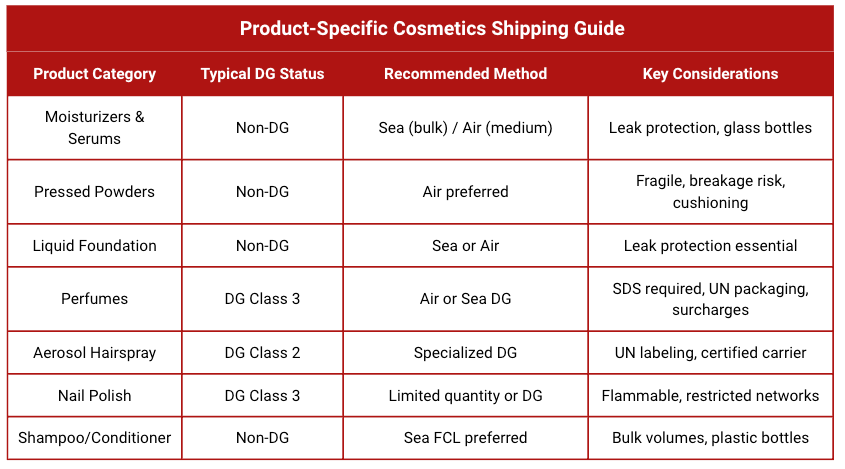
Understanding product-specific considerations helps you plan cosmetics logistics from China effectively and avoid common pitfalls.
Skincare Products Shipping:
The largest export category from China, skincare generally ships without DG complications. Water-based moisturizers, serums, and masks move as general cargo via air or sea freight. However, products with retinol, high-concentration acids (AHA, BHA), or pharmaceutical-grade actives may face additional regulatory scrutiny in certain markets.
Packaging focus: Excellent leak protection, proper sealing, and cushioning for glass bottles. Consider air freight for high-value serums to minimize transit time and handling.
Color Cosmetics Shipping:
Liquid foundations and concealers require excellent leak protection and benefit from corrugated dividers. Glass bottles need separation and cushioning to prevent breakage.
Pressed powders and eyeshadow palettes are fragile and prone to shattering. Use extra cushioning, mark cartons as fragile, and consider air freight for premium products to reduce vibration exposure during transit.
Solid lipsticks ship easily as general cargo. Liquid lip products need the same leak protection protocols as other liquid cosmetics.
Perfume Shipping from China:
Nearly all alcohol-based fragrances classify as Class 3 flammable liquids and require dangerous goods handling. You need:
Complete SDS with UN classification (typically UN 1266)
UN-certified packaging with proper markings
Dangerous goods declaration
Carrier certified for DG shipments
Budget for 20-40% surcharge on base freight rates
Premium packaging with elaborate glass bottles demands exceptional protection. Use foam inserts, individual boxing, and consider double-boxing for high-value items.
Learn more regulations about Perfume Shipping from China
Aerosol Cosmetics Shipping:
Hairsprays, dry shampoos, setting sprays, and spray deodorants classify as Class 2 compressed gases. These require the most complex dangerous goods handling.
Many brands ship standard liquid products via economical sea freight and aerosol products separately through specialized DG air freight to manage costs while maintaining compliance.
Hair Care Products Shipping:
Shampoos, conditioners, and treatments typically ship in large volumes. These bulk liquids in plastic bottles work well for FCL sea freight for established importers seeking the best per-unit costs.
Leak protection remains important even for plastic bottles. Ensure caps are properly sealed and use secondary containment like plastic bags or shrink wrap.
Nail Products Shipping:
Nail polishes and removers contain flammable solvents and classify as dangerous goods. Limited quantity provisions may apply for small shipments, simplifying requirements, but larger volumes need full DG compliance.
Some courier networks restrict nail products entirely. Verify carrier acceptance before booking shipments.
How Gerudo Logistics Helps with Cosmetics Shipping from China
At Gerudo Logistics, we specialize in complex shipping from China, combining deep understanding of dangerous goods regulations with efficient routing and competitive pricing. Our team handles SDS review, dangerous goods classification, customs documentation, and final delivery, allowing you to focus on growing your beauty brand.
Our specialized services include packaging consultation for fragile items, dangerous goods certification for perfumes and aerosols, customs clearance management for US, European, and Middle East markets, multi-carrier relationships for optimal routing, DDP solutions for predictable landed costs, and temperature-controlled options when needed.
Contact to learn more about our DG shipping solutions or request a quote.
Frequently Asked Questions About Cosmetics Shipping from China
What are the most commonly exported cosmetics from China?
Skincare products (moisturizers, serums, masks), makeup items (foundations, lipsticks, eye palettes), and hair care products dominate exports. Beauty and skincare preparations represent 60% of all exports by volume, with the US, UK, and Indonesia as primary destination markets.
How much does it cost to ship cosmetics from China?
Express courier costs $6-12/kg with 3-7 day delivery. Air freight averages $4-8/kg with 7-15 day transit. Sea freight LCL costs $50-150/CBM with 25-45 day transit. FCL containers cost $2,000-5,000 depending on route and season. Dangerous goods attract 20-40% surcharges.
Can I ship perfume and nail polish from China?
Yes, but these classify as dangerous goods requiring Safety Data Sheets, UN classification, specialized packaging, hazard labels, and certified carriers. Budget for additional DG surcharges on base shipping costs.
What documents are needed to import cosmetics from China?
Commercial invoice, packing list, bill of lading, HS codes, Safety Data Sheets for dangerous goods, INCI ingredient lists, certificates of origin, and destination-specific registrations like FDA compliance, CPNP registration, or SFDA approval.
Is DDP shipping worth it for cosmetics from China?
DDP provides predictable landed costs by bundling freight, customs clearance, duties, and taxes. It simplifies logistics but does not eliminate your regulatory compliance obligations for product safety and labeling standards.
How should I package cosmetics for shipping from China?
Use induction seals, shrink-wrap individual items, employ corrugated dividers for glass containers, fill voids with bubble wrap, and use double-wall cartons. Mark fragile items and ensure dangerous goods display required UN hazard labels.
Conclusion: Building Reliable Cosmetics Supply Chains from China
Successfully shipping cosmetics from China requires understanding dangerous goods classifications, navigating customs regulations, implementing proper packaging protocols, and working with experienced logistics partners.
Start by verifying dangerous goods classifications through Safety Data Sheets, understanding destination market regulatory requirements including FDA compliance, EU Cosmetics Regulation, and SFDA approval, and budgeting realistically for freight costs including seasonal variations. Contact Gerudo Logistics for expert guidance tailored to your specific products and markets!