China to Europe Small Parcel Shipping 2026: Guide to New EU Customs Rules
Shipping small parcels from China to the EU became more expensive when the €150 customs duty exemption ended on July 1, 2026. A temporary €3 customs duty now applies to qualifying low-value e-commerce consignments. The charge depends on the tariff categories within the shipment, so one parcel can attract more than one €3 charge.
Quick Executive Summary
Core Change: The €150 customs duty exemption ended on July 1, 2026. Qualifying e-commerce consignments with an intrinsic value of no more than €150 now attract a temporary €3 customs duty per item category, based on tariff classification.
Financial Impact: The €3 charge is not a single fee per parcel. A qualifying parcel containing two different tariff categories attracts €6 in customs duty. VAT remains separate, and handling or clearance charges must be checked individually when calculating landed cost.
Practical Action: Verify the declared value and tariff classification of each product, and confirm the customs payment arrangement with the carrier or customs representative. IOSS is a VAT scheme, not a system for paying the €3 customs duty; registration is not mandatory for every shipment.
B2C e-commerce platforms like Temu, Shein, and AliExpress will see the most significant impact. B2B importers handling small sample shipments or low-value orders will also face new cost structures and compliance requirements that demand immediate strategic adjustments.
This guide shows exactly what changes, how to calculate your new costs, and which operational changes you must complete before July 2026.
EU Customs Reform 2026: The End of the €150 Duty-Free Exemption
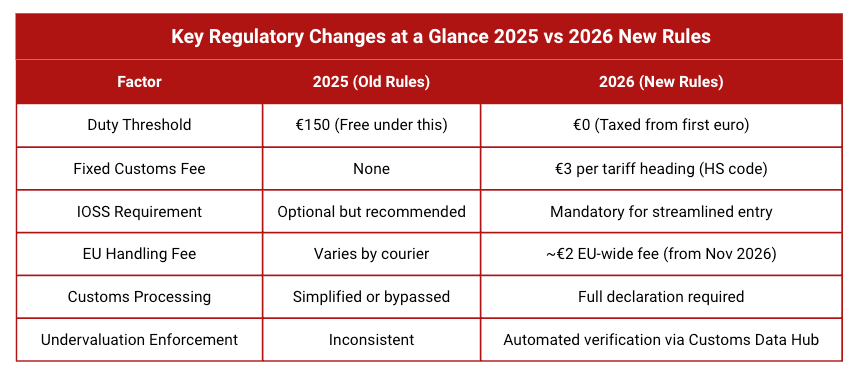
The EU customs reform removed the €150 de minimis duty exemption on July 1, 2026. Under the old system, qualifying small packages with an intrinsic value of no more than €150 benefited from customs duty relief, though VAT still applied.
What the Old System Allowed:
Packages under €150 entered duty-free
IOSS registration (VAT pre-collection system) was optional
Sellers could underdeclare values with minimal risk
Many parcels skipped full customs processing
What Happens Under 2026 Rules:
Since July 1, 2026, qualifying e-commerce consignments from China with an intrinsic value of no more than €150 have been subject to a temporary €3 customs duty per tariff category.
For qualifying consignments, a parcel containing one tariff category attracts €3 in customs duty. A parcel containing three different tariff categories attracts €9 (€3 × 3 tariff categories).
For consignments with an intrinsic value above €150, the temporary €3 treatment does not apply. Normal customs tariff treatment applies instead.
Key Regulatory Changes at a Glance
Implementation Timeline: When Each Fee Takes Effect
July 1, 2026:
Temporary €3 customs duty per tariff category took effect for qualifying consignments.
The €150 customs duty exemption ended.
By November 1, 2026:
EU handling fee: Member states will begin applying the separate fee no later than November 1, 2026.
Fee amount: The European Commission sets the amount. This handling fee is separate from the €3 customs duty.
EU Customs Data Hub: Planned E-Commerce Launch in 2028
The EU Customs Data Hub (automated system that cross-checks all declarations against historical data) is scheduled to become operational for e-commerce on July 1, 2028.
It connects directly to IOSS registrations, verifies declared values against market prices, and flags suspicious declarations for physical inspection (cargo hold that delays delivery 5-10 days).
If you declare a €50 smartphone as worth €10 to save on VAT, the AI system compares your price against thousands of similar smartphones and automatically triggers an inspection. Your cargo sits in customs for 5-10 extra days, and you may face penalties.
Landed Cost Analysis: How the €3 Duty Impacts Small Parcel Margins
The €3 flat duty sounds small until you calculate the compounding effect with VAT, handling fees, and the HS code multiplication factor (when multiple product categories trigger multiple €3 charges).
In our experience handling cross-border e-commerce shipments, most importers underestimate total landed costs by 15-20%. They only factor in the headline duty rate and forget about handling fees, the VAT on CIF value, and the per-HS-code penalty.
Real Cost Breakdown: Shipping a Single-Item Small Parcel to Germany
Consider a €50 facial cleansing device shipped from Shenzhen to Germany:
Cost Structure:
Product Value: €50
Import VAT (19% Germany): €9.50
Fixed Customs Duty: €3
EU Handling Fee (Nov 2026): €2
Total Additional Cost: €14.50 (29% of product value)
Your €50 product now costs €64.50 landed. If your product retails at €75, your margin drops from €25 to €10.50, a 58% reduction in gross profit.
€3 Customs Duty per Item Category: Why Mixed Parcels Cost More
The €3 duty applies per tariff heading (HS code), not per parcel. This creates a multiplication effect for mixed-category shipments.
Case Study: Multi-Category Package (€120 value)
A package contains three items:
Cotton t-shirt (HS 6109)
Plastic toy (HS 9503)
LED desk lamp (HS 9405)
Cost Breakdown:
Product Value: €120
Import VAT (19% Germany): €22.80
Fixed Customs Duty: €9 (€3 × 3 different HS codes)
EU Handling Fee: €2
Total Additional Cost: €33.80 (28% of product value)
The triple HS code classification triples your fixed duty from €3 to €9, even when all items ship in a single box with one tracking number.
Country-Specific VAT Rates: Location Matters
Import VAT rates vary significantly across EU member states:
VAT Rates by Major Markets:
Germany: 19% VAT
France: 20% VAT
Netherlands: 21% VAT + potential early national handling fee
Romania: 19% VAT + confirmed early national handling fee
Spain: 21% VAT
Italy: 22% VAT
A €100 parcel to Germany pays €19 VAT. The same parcel to Italy pays €22 VAT. Over 1,000 parcels, this 3% difference costs an extra €3,000 in VAT payments.
B2C vs B2B Impact Comparison
B2C E-commerce:
Faces full €3 + VAT + handling fee structure
Most platforms absorb costs to maintain competitive pricing
Margins compress by 20-30% on average
B2B Small Sample Shipments:
Follow standard tariff rates (not the flat €3 fee)
Lose the benefit of €150 duty-free threshold
A €100 sample that previously entered duty-free now pays full customs duties plus VAT
Small Parcel Compliance: Critical Actions Before July 1, 2026
Companies that delay IOSS registration (VAT pre-collection system) or continue using inaccurate HS codes will face delivery delays, unexpected fees, and penalties starting July 1.
IOSS Registration: Why It’s No Longer Optional for B2B Importers
The Import One-Stop Shop (IOSS) allows sellers to pre-collect VAT at checkout and remit it through a single monthly declaration. Under 2026 rules, IOSS becomes effectively mandatory.
What Happens Without IOSS:
Customs holds parcel and contacts courier
Courier pays customs duties and VAT on behalf of recipient
Courier adds service fee (typically €10-25) on top of duties and VAT
Recipient must pay courier before delivery
Many customers refuse delivery when faced with unexpected fees
Action Required: Initiate IOSS registration by March 2026 (process takes 4-6 weeks). Non-EU businesses need EU VAT number through intermediary/fiscal representative.
HS Code Classification: Critical Accuracy Requirements
Every product needs an accurate 6-digit or 8-digit HS code. The new Customs Data Hub (automated AI verification) performs real-time checking of HS codes against product descriptions.
What Misclassification Triggers:
Customs reclassifies your product to higher duty category
Physical inspection delays delivery by 5-10 business days
Repeated misclassification flags your account for enhanced screening on all future shipments
Common Classification Errors:
1. Generic "Electronics" Classification
Wrong: Classifying smartphone accessories under general "electronics"
Right: Specific accessory categories (phone cases, chargers, screen protectors have different HS codes)
Error can shift duties from 2% to 8%
2. Textile Blend Guesswork
60% cotton / 40% polyester has different HS code than 60% polyester / 40% cotton
Wrong classification triggers inspection and reclassification
3. Multi-Function Product Errors
Classify based on principal function (is lamp with Bluetooth mainly a lamp or mainly a speaker?)
Customs catches incorrect classification and reclassifies with penalty
Consult customs specialist before July 2026. The cost (typically €50-100 per product category) is minimal compared to systematic misclassification penalties.
Documentation Requirements Checklist
Every shipment requires complete documentation. Missing or incorrect paperwork triggers automatic customs holds (cargo stuck in warehouse until corrected).
Required Documents:
Commercial Invoice Must Include:
Accurate HS codes for each item
Detailed product descriptions (not generic "electronics")
Correct declared values matching actual transaction price
Complete seller and buyer information
IOSS VAT number
Packing List Requirements:
Itemized contents with quantities
Individual item values
Country of origin for each item
EORI Number:
Economic Operators Registration and Identification number (EU business registration system)
Required for both sender and recipient in B2B transactions
Product Compliance Certificates:
CE marking documentation for relevant categories
Safety test reports for electronics
Material composition certificates for textiles
Selecting the Best Small Parcel Shipping Method in 2026
In our experience managing thousands of China-Europe shipments, carrier choice significantly impacts both cost and delivery time under 2026 rules.
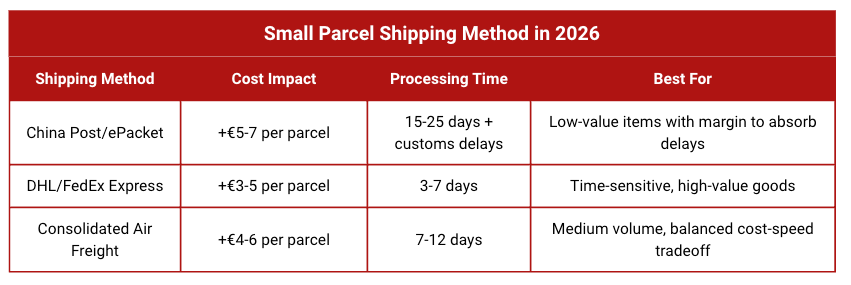
Express Carriers (DHL, FedEx, UPS):
Offer integrated customs clearance services
Handle IOSS declarations automatically
Premium freight cost (30-40% higher than postal) offset by faster clearance and lower customer delivery refusal rates
Consolidated Air Freight:
Multiple shippers' parcels combine into larger shipments
Receive priority customs processing
Best for sellers shipping 50+ parcels weekly
Packaging Strategy Under New Rules
The old strategy of splitting orders into multiple small packages no longer works. This approach now increases costs because each package pays the €2 handling fee separately.
Optimal 2026 Packaging Strategy:
Consolidate Items by HS Code:
If customer orders three items from same HS code, ship together in one package
Pay one €3 duty instead of three separate €3 duties
Mixed HS Code Packages:
Consolidating different HS codes into one package does NOT reduce the €3-per-HS-code duty
Only savings come from reduced shipping fees and single €2 handling fee
Package Size Optimization:
European customs bases VAT on CIF value
Higher shipping costs = higher VAT you pay
Use appropriately sized packaging to reduce dimensional weight charges (pricing based on package size rather than actual weight)
2026 Product Selection: High-Margin Trends for Small Parcel Shipping
The €3 duty plus €2 handling fee plus VAT creates a fixed cost floor of approximately €5-7 per parcel. This reality eliminates profitability for many low-value products.
Successful products in 2026 share three characteristics:
Sufficient margin to absorb €5-7 in fixed costs
Fall under single HS code to avoid multiplication effect
Offer enough perceived value that customers willingly pay duty-inclusive prices
Top Recommended Small Parcel Categories for the Post-Exemption Era
Beauty Tech (Facial Cleansing Devices, LED Masks)
Products typically sell for €40-80 retail with 50-60% margins. A €50 facial cleansing device absorbs the €14.50 in duties and fees while maintaining €10+ profit margin. Consumer demand remains strong because customers view beauty tech as premium wellness products.
Smart Home Devices (Wi-Fi Smart Sockets, LED Controllers)
Combine compact size (low shipping costs) with high perceived value. A €25 smart socket costs €5-6 to ship and pays €8-9 in duties and fees, but retails for €45-50. The "smart living" trend supports premium pricing.
Wireless Electronics (Earbuds, Portable Chargers, GaN Chargers)
High-quality wireless earbuds retail for €60-100, easily absorbing the new cost structure. GaN chargers (Gallium Nitride fast chargers, 65W+) sell for €35-50 and offer differentiation from standard chargers.
Fitness Accessories (Resistance Bands, Yoga Mats)
Lightweight (low shipping costs), consumable or regularly replaced (repeat purchases), and often sold in sets (multiple units under one HS code). A set of resistance bands sells for €30-40, absorbs €10 in costs, and maintains healthy margins.
Mobile Accessories (Phone Cases, Screen Protectors)
Premium mobile accessories with unique designs command prices that cover new costs. A €35 premium leather case with card slots maintains profitability, while a €15 basic case struggles.
Low-Value Small Parcel Items to Avoid Under the New Fee Structure
Low-Value Commodity Items (Priced Under €10 Retail)
Cannot profitably absorb €5-7 in fixed costs:
Basic phone cables priced under €8
Generic clothing items priced under €15
Commodity household items (sponges, brushes) priced under €12
Fashion jewelry priced under €10
Generic Products with Thin Margins (15-20%)
Face compression to breakeven or loss when €5-7 fixed costs apply.
Products Requiring Multiple HS Codes
Single orders that trigger multiple €3 duties destroy unit economics.
The market shifts toward fewer SKUs at higher price points rather than broad catalogs of low-priced items.
How Gerudo Logistics Supports Your 2026 Small Parcel Shipping
DDP (Delivered Duty Paid) Service: We handle all customs duties, VAT, and handling fees. You pay us a single landed cost. Your European customers receive parcels with no additional fees at delivery, eliminating the 20-30% delivery refusal rate we see when customers face unexpected courier fees.
IOSS Registration: We assist with fiscal representative coordination, VAT number acquisition, integration with your e-commerce platform, and monthly VAT declarations across all 27 EU member states.
HS Code Classification: Our customs specialists classify products according to EU Combined Nomenclature. For product lines with 50+ SKUs, we conduct bulk classification (typically €2,000-3,000) that prevents ongoing clearance delays and penalties.
Consolidated Air Freight: We operate consolidated services from Guangzhou, Shenzhen, and Shanghai to major European airports. For 100+ parcels weekly, our dedicated consolidation service collects at your warehouse, pre-sorts by destination, and coordinates single customs declarations for shipment groups.
Real-Time Tracking: See exactly when parcels enter customs, when duties are paid, and when clearance completes. Early warning alerts notify you of potential delays.
Frequently Asked Questions for China-Europe Small Parcel Shipping
Q: When does the new €3 customs duty take effect?
A: The fixed €3 customs duty starts July 1, 2026. An additional €2 EU handling fee begins in November 2026. Some countries like Romania and the Netherlands may implement national handling fees earlier.
Q: Is the €3 fee per parcel or per item?
A: The fee applies per tariff heading (HS code). If one package contains three items from different HS code categories, you pay €9 total (€3 for each category). Items from the same HS code in one package pay only one €3 fee.
Q: Does the €3 duty replace VAT?
A: No. Import VAT remains mandatory at rates of 17-27% depending on destination country. The €3 duty is an additional charge on top of VAT.
Q: How do I pay these new duties?
A: For e-commerce orders, duties are collected at checkout through the IOSS system when the seller is registered. Without IOSS registration, the courier pays customs on your behalf and charges you upon delivery, typically adding a €10-25 service fee.
Q: Can I avoid the fee by splitting orders into smaller boxes?
A: No. Splitting shipments increases total costs because each package pays the €2 handling fee separately. Consolidation saves money under new rules.
Q: Will this affect shipping times?
A: Expect initial delays in July-August 2026 as customs authorities adjust. Shipments with complete IOSS registration and accurate HS codes clear faster. Typical processing may extend from 1-2 days to 3-5 days during transition period.
Q: What is the EU Customs Data Hub?
A: A centralized digital platform launching in 2026 that manages e-commerce data and automates duty calculations across all 27 EU member states. The system verifies declared values, checks HS code accuracy, and flags suspicious declarations.
Conclusion
The 2026 EU customs reform adds €5-7 minimum cost per parcel before product-specific duties. Successful adaptation requires immediate action:
Four Critical Steps:
Audit product catalog - Eliminate items with insufficient margin, focus on products priced above €25 retail with 40%+ margins
Initiate IOSS registration by March 2026 - Process takes 4-6 weeks, requires fiscal representative for non-EU businesses
Verify HS codes for all active SKUs - Invest in professional classification for complex products, document classification rationale
Test DDP shipping solutions - Evaluate consolidated air freight for medium volumes (50-100+ parcels weekly), consider express carriers for time-sensitive goods
Companies that delay these preparations will face compressed margins, delivery delays, and customer satisfaction problems starting July 1. The window for proactive adjustment closes rapidly as spring 2026 approaches.
Gerudo Logistics offers comprehensive DDP solutions, IOSS registration support, and expert customs classification for China-Europe small parcel shipping. Contact us to prepare your 2026 logistics strategy.