Shipping Oral Care & Dental Products from China: DG Classification, Compliance, Cost & Logistics Guide
When you're planning to import toothpaste, mouthwash, or dental equipment from China, you might assume it's straightforward, after all, these are everyday consumer products.
But certain oral care items fall under dangerous goods (DG) classifications, triggering strict transport regulations, additional documentation, and surcharges that can derail your shipment timeline and budget.
Whether you're launching a private-label teeth whitening brand or stocking dental supplies for clinics, this guide walks you through the compliance requirements, shipping methods, and cost factors you need to know.
If you ship toothpaste, mouthwash, whitening products, or dental devices from China, this guide will save you time, money, and inspection trouble.
Which Oral Care & Dental Products Are Risk-Sensitive in Shipping?
Not all oral care products face the same level of scrutiny during transport. Understanding which items ship as general cargo versus those requiring dangerous goods handling helps you plan packaging, documentation, and routing from the start.
Products Usually Treated as General Cargo (Non-DG)
Most basic oral care items move through international logistics channels without triggering special regulations:
Manual toothbrushes (plastic or bamboo variants)
Dental floss and floss picks (waxed or unwaxed)
Basic fluoride toothpaste (without whitening agents)
Tongue cleaners (silicone, plastic, or stainless steel)
Simple dental kits (mirrors, bibs, basic instruments)
These products won't face additional DG scrutiny or fees. Your main concerns are packaging integrity and accurate customs declarations.
Products That Trigger DG or Special Handling
This is where shipments encounter the most complications:
Alcohol-based mouthwash – formulas with more than 24% alcohol by volume
Teeth whitening gels – products with hydrogen peroxide or carbamide peroxide
Oral disinfectants – solutions with chemical active ingredients
Aerosol dental sprays – pressurized containers for breath fresheners
Electric toothbrushes – devices with lithium-ion or lithium-metal batteries
Water flossers – oral irrigators with built-in rechargeable batteries
The challenge is that many suppliers don't proactively inform you about DG status. You might receive a competitive quote, only to discover after production that your cargo needs reclassification, repackaging, or route changes, all adding cost and delay.
Your Oral Care & Dental Shipment: Dangerous Goods Classification Explained
For most people, dangerous goods sounds extreme when applied to consumer oral care products. But DG classification isn't about whether a product is dangerous to use, it's about transport risk. During shipping, cargo experiences temperature changes, pressure variations, and physical impacts that don't occur in normal consumer use.
How to classify your DG cargo?
Why alcohol equals flammable
Mouthwash with alcohol content above certain thresholds can ignite under specific conditions during transport, particularly in aircraft cargo holds where temperature and pressure fluctuate. Airlines impose strict limits or refuse such cargo entirely.
Why peroxide is reactive
Hydrogen peroxide and carbamide peroxide used in teeth whitening products are oxidizing agents. In concentrated forms or when improperly packaged, they can react with other substances or degrade under heat during long-haul shipping.
Why batteries face regulation
Lithium batteries in electric toothbrushes and water flossers have a documented history of thermal runaway incidents in cargo holds. Aviation authorities worldwide require specific testing, packaging, and labeling protocols for any lithium battery shipment.

Understanding these classifications early helps you choose the right shipping method and prepare proper documentation. It's the difference between a 7-day air shipment and a 35-day sea route, or between smooth customs clearance and cargo detention.
Required Documents for Shipping Oral Care & Dental Products from China
Documentation requirements vary based on product type, destination market, and transport method. Missing or incorrect paperwork is one of the leading causes of shipment delays and customs holds.
Standard Export Documents (All Shipments)
Every oral care shipment from China needs:
Commercial invoice – transaction value, product description, quantity, unit prices
Packing list – carton count, dimensions, gross and net weights
HS code declaration – typically HS 3306 for oral hygiene preparations, HS 9018 for dental equipment
Certificate of origin – for preferential duty treatment under trade agreements
Purchase order / sales contract – proof of commercial relationship
Extra Documents for Chemicals, Liquids, and Batteries
When your shipment contains DG-classified items:
MSDS (Material Safety Data Sheet) – details chemical composition, hazards, and handling procedures. Carriers review this to determine cargo acceptance.
DG declaration – shipper's declaration formally notifying the carrier you're shipping classified materials. Errors can result in cargo rejection or penalties.
UN38.3 test report – for lithium battery shipments, demonstrates batteries passed required safety testing. Most airlines won't accept battery cargo without it.
Factory compliance certificates – ISO 9001, ISO 13485, or GMP certifications demonstrating quality management standards.
Destination market approvals – FDA registration (U.S.), EU cosmetics portal notification (Europe), or other market-specific requirements.
Important: Clarify documentation responsibilities with your supplier in the purchase agreement before production begins. Many Chinese manufacturers expect buyers or freight forwarders to handle compliance paperwork.
Best Shipping Methods: Air, Sea or Express?
Your choice of transport method affects not just cost and speed but also which products you can ship and what restrictions apply.
Air Freight: Fast, Expensive, and Restrictive
Best for:
Teeth whitening pens and strips with short lead times
Professional dental instruments and handpieces
Electric toothbrushes for rapid restocking
Sample shipments for quality approval
Key limitations: Airlines refuse or strictly limit alcohol-based mouthwash and impose weight restrictions on lithium batteries. Even non-DG liquids face rejection if packaging doesn't prevent leakage. Air freight rates typically range $4–$8 per kg, with DG surcharges adding $100–$300 per shipment.
Sea Freight: Economical and Flexible
Ideal for:
Bulk toothpaste orders (1,000+ units)
Carton loads of mouthwash bottles
Dental care kits for retail distribution
OEM production runs with 30+ day lead times
Ocean carriers generally accept a wider range of DG products with fewer restrictions. You can ship larger quantities of alcohol-based mouthwash, whitening gels, and battery-operated devices.
FCL vs LCL:
FCL (Full Container Load) suits orders of 10+ cubic meters. A 20-foot container holds enough for 10,000–15,000 units of toothpaste depending on packaging size.
LCL (Less than Container Load) works for smaller volumes where you share container space, cost-effective for orders under 10 cubic meters.
Transit times run 20–35 days to North America, 25–40 days to Europe, and 15–25 days to Southeast Asia and Australia.
Courier and DDP Shipping
When courier shipping makes sense:
Amazon FBA shipments under 100 kg
Direct-to-consumer test markets
Rapid sample approvals before bulk orders
Destinations with complex customs procedures
Express services handle customs clearance under DDP (Delivered Duty Paid) terms. You pay higher rates, typically $8–$15 per kg, but avoid dealing with customs brokers directly. However, couriers enforce strict DG policies. Battery-operated products and chemical formulations may face rejection or significant surcharges.
Packaging Rules to Ship Oral Care & Dental Products: Liquids, Chemicals & Devices
Proper packaging prevents damage, leakage, and regulatory rejection. We estimate that roughly 80% of oral care shipment problems stem from packaging issues rather than documentation errors.
Packaging for Liquids (Mouthwash, Whitening Gels, Liquid Toothpaste)
Liquids require multiple protection layers:
Inner containment – induction seal under each cap, then individual polybags or shrink wrap
Shock absorption – dividers or corrugated inserts between bottles within cartons
Outer cartons – double-wall corrugated boxes marked with "This Side Up" and "Liquid" labels
For DG liquids – UN-certified packaging with proper hazard labels required
Packaging for Electric Devices (Toothbrushes, Water Flossers)
Battery-operated products need protection from physical damage and short-circuit risk:
Each device in retail packaging or wrapped separately
Battery terminals protected from metal contact
Cartons with sufficient crush resistance for warehouse stacking
Moisture-barrier bags for ocean shipments
UN38.3 test reports and proper battery labeling
Packaging for DG Cargo
Dangerous goods require UN-specification packaging:
UN-certified cartons – boxes carrying UN markings indicating they meet international standards for hazardous materials
Hazard labels – appropriate hazard diamond (Class 3 for flammable liquids, Class 9 for lithium batteries) with UN numbers
Overpack requirements – outer boxes containing multiple DG packages need specific labeling
Penalties for mislabeled or improperly packaged dangerous goods can reach thousands of dollars. Serious violations may result in carrier blacklisting.
Cost Breakdown: What Importers Actually Pay
Understanding the full cost picture helps you budget accurately and identify where you might reduce expenses without compromising compliance.
Key cost components:
Base freight – what the carrier quotes for moving your cargo (per container for sea, per kg for air/express)
DG surcharges – $100–$500 depending on classification and transport mode
Packaging upgrades – additional $0.50–$2.00 per unit for UN-certified DG packaging
Battery handling fees – $50–$200 per shipment regardless of quantity
Port and terminal charges – $200–$800 covering container handling and customs examination facilities
Customs clearance and brokerage – $100–$500 per shipment for standard clearances
Duties and taxes – varies by destination and HS code (typically 0%–15% for HS 3306 oral care products)
Inspection and testing fees – $200–$1,000 for markets requiring product testing
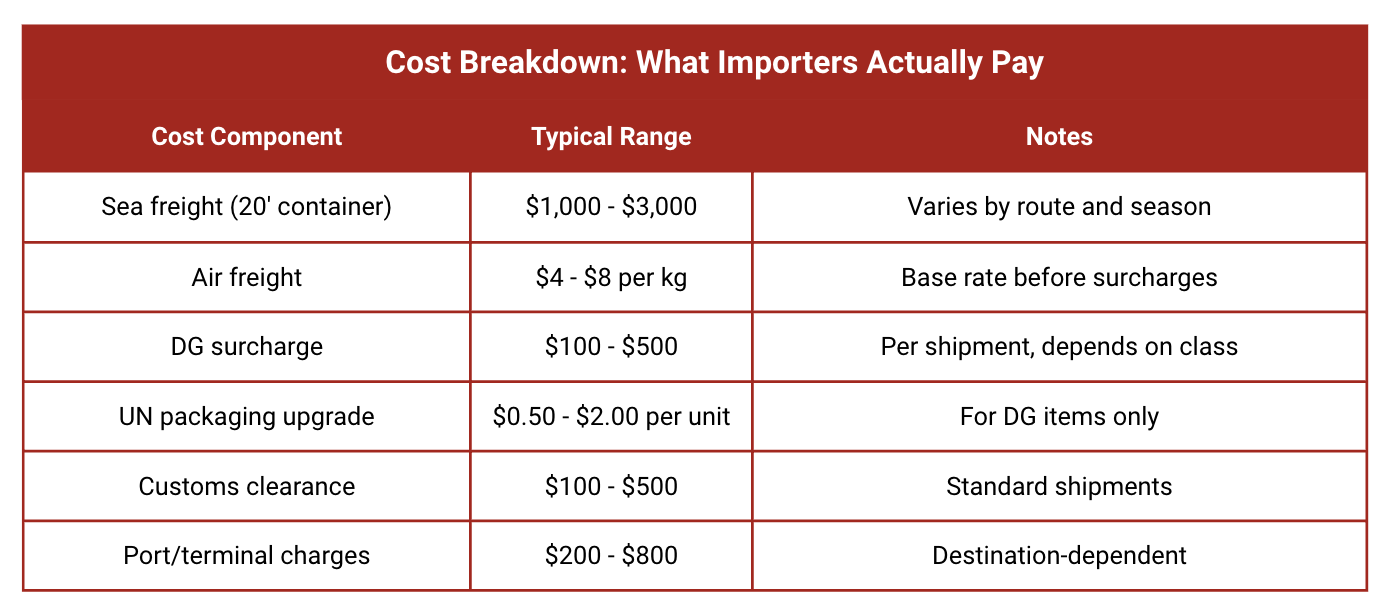
The cheapest freight quote often becomes the most expensive shipment when you factor in DG surcharges, repackaging requirements, and customs delays.
Common Mistakes in Oral Care Shipping from China
Learning from others' mistakes is cheaper than making your own.
1. Assuming all toothpaste is the same
Whitening toothpaste with active bleaching agents has different compliance requirements than basic fluoride toothpaste. Always specify exact formulations when discussing shipping requirements.
2. Ignoring battery specifications
Watt-hour ratings, whether batteries are removable or integrated, and testing certifications all affect shipping feasibility and cost.
3. Underestimating lead times
From production to delivery, total lead time can easily reach 60–80 days including manufacturing, transit, and customs clearance. Plan inventory accordingly.
4. Failing to communicate about packaging
Many factories use minimal packaging suitable for domestic China shipping but inadequate for international transport. Specify your packaging requirements in the purchase order with photos or samples if possible.
5. Choosing freight based solely on price
The $500 difference between quotes may reflect different DG handling capabilities or included fees that only become apparent when problems arise.
6. Not checking MSDS before ordering
Request Material Safety Data Sheets during the sampling phase, not after bulk orders. This gives you time to adjust formulations or shipping plans if needed.
How Gerudo Logistics Handles Dental & Oral Cargo
When you're shipping regulated products like oral care and dental supplies from China, having a freight forwarder who understands DG classifications and compliance requirements saves you significant time and money.
At Gerudo Logistics, we've built expertise specifically around complex DG products that many general forwarders prefer to avoid. Our team reviews your product specifications before quoting, identifies potential DG issues early, and designs compliant routing and packaging solutions.
What we do differently:
We analyze product composition (alcohol content, peroxide concentrations, battery specifications) to determine DG classification before you commit to shipping methods.
We verify supplier packaging meets transport standards or coordinate UN-certified packaging upgrades when necessary.
Our team prepares or reviews MSDS sheets, DG declarations, and UN38.3 battery test reports to ensure documentation is in order before cargo arrives at the port.
We work with carriers experienced in handling oral care DG products, coordinate customs pre-clearance to identify potential issues early, and provide transparent pricing that includes all DG fees and compliance costs upfront, no surprise charges after booking.
Whether you're shipping 100 units of teeth whitening strips via express or a full container of mouthwash by ocean, we assess risk factors and compliance needs before problems arise, so your products clear customs smoothly and reach your market on schedule. Contact us for a free consultation!
Frequently Asked Questions to Ship Oral Care & Dental Products
How do I know if my mouthwash is considered dangerous goods?
Check the alcohol content on the MSDS or product specification. Mouthwash with more than 24% alcohol by volume typically classifies as Class 3 flammable liquid. Request an MSDS from your supplier and share it with your freight forwarder for proper classification.
Can I mix dangerous goods and non-dangerous goods in the same shipment?
Yes, but with restrictions. In ocean freight, you can combine DG and non-DG items in the same container if properly segregated and documented. For air freight, mixing is more restrictive and depends on specific classifications involved.
What's the typical customs duty rate for oral care products?
Most countries classify oral care products under HS code 3306, with duty rates ranging from 0% to 15%. The United States applies rates of 0% to 2% for most oral care items. Check your country's customs tariff schedule for exact rates.
How much more expensive is shipping dangerous goods compared to general cargo?
DG surcharges typically add 10% to 30% to your freight costs. For a $1,000 air freight shipment, expect $100-$300 in DG fees. For ocean freight, DG container surcharges range from $150-$500 depending on classification and carrier.
What happens if my shipment is rejected for improper DG classification?
The carrier will refuse to load your cargo. You'll need to reclassify with proper documentation, repackage to meet standards, or find an alternative carrier. Meanwhile, your goods accrue warehouse storage fees, best case you lose 1-2 weeks, worst case you miss sales deadlines entirely.
Can electric toothbrushes ship by air to all destinations?
Most destinations accept electric toothbrushes by air when properly packaged and documented, but restrictions apply. Some airlines limit battery-powered cargo on passenger flights, requiring cargo-only aircraft. Always confirm with your specific carrier and route before booking.
Do I need special licenses to import teeth whitening products?
It depends on your destination market and the product's peroxide concentration. Some markets require professional supply channels for products over certain thresholds, while others classify high-concentration products as medical devices requiring regulatory clearance.
Conclusion
Shipping oral care and dental products from China involves more complexity than many importers expect, particularly when your products contain alcohol, chemicals, or batteries that trigger dangerous goods classifications. Success requires understanding which products face special regulations, preparing proper documentation, choosing appropriate shipping methods, and ensuring packaging meets international transport standards.
Start by verifying whether your products require DG handling before finalizing orders. Work with a freight forwarder experienced in regulated oral care shipments who can guide you through classification, documentation, and carrier selection.
Ready to discuss your specific oral care or dental product shipment from China? Contact Gerudo Logistics for a comprehensive assessment covering DG classification, documentation requirements, routing options, and total landed cost for your products. We help you identify potential issues before they become expensive problems.