


Shipping from China to Italy: Costs, Transit Times & Import Guide (March 2026)
Italy is one of the EU's top five import markets, and China consistently ranks as its largest single source of goods. For B2B importers in Milan, Rome, or Bologna sourcing from Guangzhou, Shenzhen, or Ningbo, the trade lane is well-established. However, "well-established" does not mean simple.
EU customs compliance, Italian VAT (IVA) at 22%, CE Mark requirements, and EORI registration are non-negotiable entry points into this market. Getting any one of them wrong can result in goods held at Genoa or La Spezia for weeks, with demurrage fees accumulating daily. The paperwork complexity alone causes a large share of first-time importers to either overpay or miss their delivery windows.
This guide covers everything you need to plan a compliant, cost-effective shipment from China to Italy in 2026: freight costs across all modes, the latest rate movements, customs procedures, product-specific requirements, and DDP options.
March 2026 Rate Update: China to Italy Logistics
Market rates on this lane have shifted meaningfully in early 2026. The table below reflects reference rates from our operations as of March 2026, compared to the February baseline.
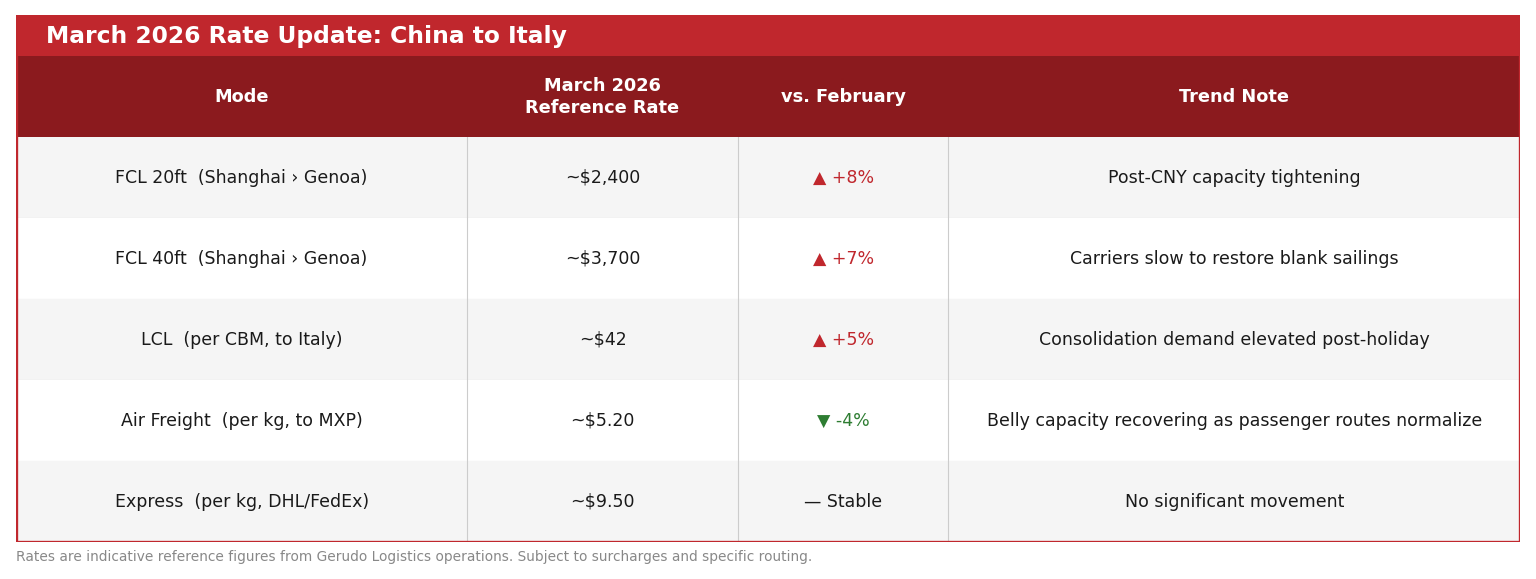
The post-CNY surge in production and export bookings has tightened ocean capacity on Asia-Europe routes. Carriers that implemented blank sailings in February are slow to restore full schedules, keeping FCL rates elevated. This pattern typically eases by mid-April. If you are booking FCL now, locking in a rate sooner rather than waiting for the market to soften is the lower-risk approach.
China to Italy: Key Port and Airport Pairings
Choosing the right origin-destination combination affects both transit time and total cost. The table below covers the primary routing options on this lane.
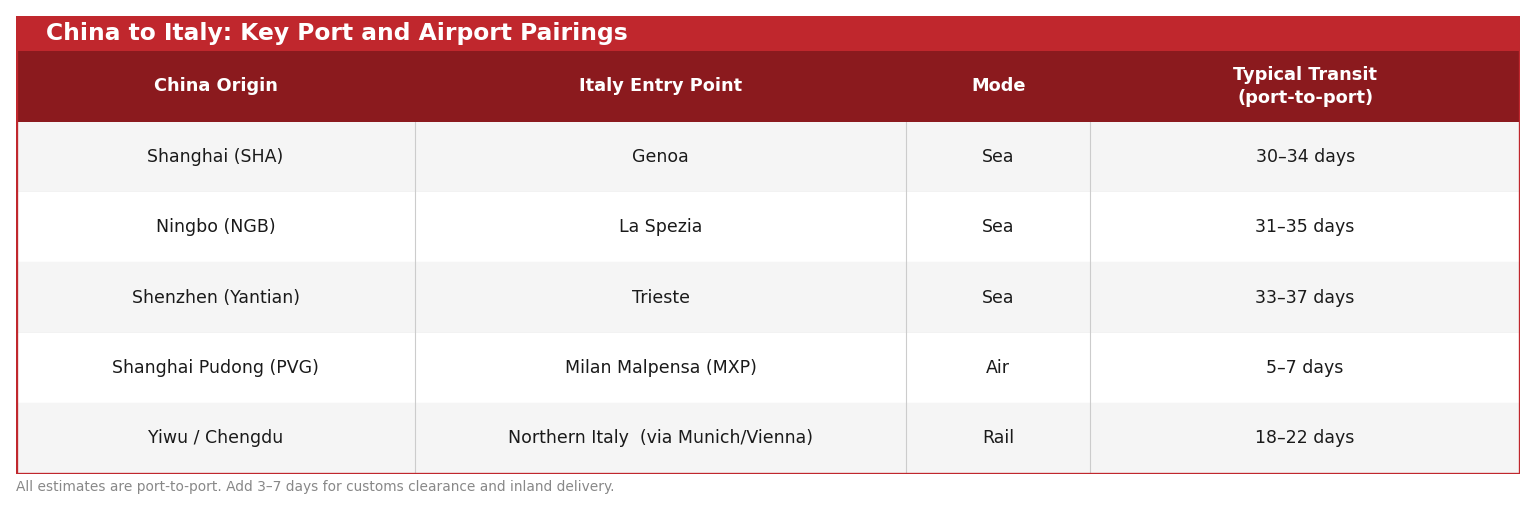
Italian port selection guide:
Genoa — Italy's largest container port; broadest domestic distribution network, best for most standard B2B shipments
La Spezia — often less congested than Genoa; practical alternative for northwest Italy
Trieste — preferred entry point for northeastern Italy, Austria, and the Balkans
All estimates exclude customs clearance and inland delivery; add 3–7 days for final delivery to destination.
Sea Freight from China to Italy
As seen in our March 2026 rate update above, sea freight remains the most economical mode for the majority of B2B importers on this lane, particularly for shipments above 2 CBM.
FCL (Full Container Load)
FCL is the right choice when your cargo fills at least 15 CBM of a 20ft container, or roughly 25 CBM of a 40ft. Below that threshold, LCL almost always delivers a lower per-unit cost.
The standard routing runs from Shanghai, Ningbo, or Shenzhen via the Suez Canal to Genoa or La Spezia. FCL rates cover ocean freight only. Port handling, customs clearance, inland delivery, and import IVA are additional costs that must be factored into your landed-cost calculation.
LCL (Less than Container Load)
LCL is practical for shipments between 2 and 15 CBM. Your cargo shares container space with other shippers, reducing cost but adding handling time at both the consolidation and deconsolidation stages.
In our experience, LCL transit to Italy runs 5–10 days longer than FCL on the same route, primarily due to deconsolidation time at the destination port. If your cargo is time-sensitive, build that buffer into your delivery schedule.
Air Freight from China to Italy
Air freight makes commercial sense for high-value goods, time-sensitive samples, or cargo where the cost of a 30-day stock-out exceeds the freight premium.
Chargeable weight applies: actual weight or volumetric weight (L x W x H in cm / 5,000), whichever is higher. This matters particularly for bulky, lightweight goods — a large carton that weighs 10 kg but measures 0.1 CBM will be rated at 20 kg.
Milan Malpensa (MXP) handles the majority of air cargo into Italy, with direct freighter services from Shanghai Pudong (PVG), Guangzhou Baiyun (CAN), and Shenzhen (SZX). Rome Fiumicino (FCO) is a secondary option for central or southern Italy. Incomplete documentation is the most common reason for customs delays at Malpensa — well-prepared shipments typically clear within 1–2 days.
Rail Freight from China to Italy
Rail is a genuinely viable option for this lane. Northern Italy is reachable within 18–25 days via established China-Europe routes, making rail a practical middle ground between sea and air for mid-volume shipments.
Most trains serving Italy route through Chengdu, Yiwu, or Xi'an, crossing Central Asia via Kazakhstan, then transiting Germany or Austria, with onward trucking completing the final leg into Italy.
Rail is well-suited for:
Goods in the 500 kg to 5,000 kg range where air freight is too expensive
Shipments where a 35-day sea transit creates stock pressure but air cost cannot be justified
Non-DG cargo with flexible but not unlimited delivery windows
One practical limitation: rail availability can be inconsistent depending on geopolitical and logistical conditions along the corridor. Discuss lead time reliability with your forwarder before committing rail for time-critical cargo.
Express Shipping from China to Italy
Express services (DHL, FedEx, UPS) are appropriate for shipments under approximately 70 kg. Common use cases include:
Product samples and prototypes for Italian buyers
Spare parts and replacement components with urgent timelines
High-margin, lightweight goods where 3–5 day delivery justifies the rate premium
Documents requiring physical delivery
As shown in our March rate snapshot, express pricing has remained stable. Italy applies full EU customs procedures, including IVA, to all commercial imports above EUR 150. A commercial invoice with accurate HS codes and declared value is required for every shipment regardless of mode. Express does not mean duty-free for commercial cargo.
Product-Specific Considerations: China to Italy
Shipping Electronics from China to Italy
Electronics is the highest-compliance category on this lane. The product mix includes consumer electronics, smart home devices, EV charging equipment, solar inverters, and industrial components.
CE marking is mandatory for virtually all electronics sold in Italy. This covers EMC Directive compliance, Low Voltage Directive requirements, and in many cases Radio Equipment Directive (RED) compliance for wireless devices. Products arriving without a valid CE Declaration of Conformity will be blocked at customs.
Additional requirements specific to electronics:
Lithium batteries or built-in cells classify cargo as Dangerous Goods under IATA and IMDG — standard freight terms do not apply
RoHS compliance (restriction of hazardous substances) is required for all electrical and electronic equipment sold in the EU
WEEE registration may be required for importers placing products commercially on the Italian market
Italian customs performs more frequent documentary and physical checks on electronics from China than on most other categories. Allow extra clearance time when planning delivery windows.
Shipping Industrial Machinery and Equipment
Italian workshops, manufacturers, and SMEs regularly import CNC equipment, laser cutters, injection moulding machines, and automation components from China. FCL is the standard mode for most machinery.
CE marking under the EU Machinery Directive is mandatory for most powered machinery. A technical file must demonstrate compliance with applicable health and safety requirements, and for machinery above certain power thresholds, a Notified Body assessment is required before CE marking can be applied. Customs duty for machinery entering Italy is typically 0–3.7% under the EU CET.
Suppliers who self-apply a CE mark without completing the actual conformity assessment process create direct liability for the importer at Italian customs. Verify your supplier's compliance documentation thoroughly before shipment.
Shipping Dangerous Goods (Lithium Batteries, Chemicals, Flammables)
Dangerous Goods require a separate operational track from standard freight, and this lane has specific carrier acceptance restrictions to understand before booking.
For sea freight, DG cargo must comply with the IMDG Code: correct packing group assignment, UN-certified packaging, proper labelling, and an MSDS. Lithium batteries by sea require a valid UN38.3 test report and compliance with the applicable packing instruction (PI 965–970 depending on battery type). For air freight, IATA DGR applies, and not all airlines accept lithium cargo to Italy for larger watt-hour batteries. Carrier acceptance must be confirmed before booking.
The most common error we see is shippers treating lithium-containing consumer products — power banks, handheld devices, e-scooters — as general cargo. Consequences at port or airport include shipment seizure, fines, and in some cases destruction of the cargo.
Shipping from China to Italy: Customs Clearance Requirement
EORI Number
Every business importing goods into the EU must hold an EORI (Economic Operator Registration and Identification) number. Without it, no customs declaration can be filed and your shipment cannot be released. Registration is free and handled through Italy's Agenzia delle Dogane e dei Monopoli, typically completed within a few working days.
Import VAT (IVA)
Italy's standard VAT rate is 22%, calculated on the CIF value (cost of goods + insurance + freight to the Italian border) plus any applicable customs duties. This is payable at import by the importer of record. Businesses registered for VAT in Italy can reclaim IVA as input tax on their returns.
Customs Duties
Italy applies the EU Common External Tariff (CET). Rates vary significantly by HS code: general manufactured goods attract 0–12%, electronics are often lower, textiles and footwear may be higher. Misclassification is the most common reason shipments are flagged for inspection or reassessed at higher rates. Verify your HS code with a licensed customs broker before booking if you have any uncertainty.
Required Documentation
Every commercial import into Italy requires:
Commercial Invoice — accurate declared value per unit, in English or Italian
Packing List — detailed, with weights and dimensions per item
Bill of Lading (sea) or Airway Bill (air)
Certificate of Origin — for certain goods or duty preference claims
CE Declaration of Conformity — for electronics, machinery, toys, and other regulated categories
Importers typically have 20 days to provide corrected documentation before demurrage and storage fees begin escalating. Customs holds on the Italy lane are almost always documentation-driven.
CE Mark Requirements
Most consumer-facing products sold in Italy require the CE Mark, covering safety, health, electromagnetic compatibility, and environmental standards. CE marking is a self-declaration by the manufacturer or importer, supported by a technical file. For some product categories, third-party testing by a Notified Body is required before the mark can be applied. Products arriving without a valid CE declaration will be blocked and may face forced return or destruction.
DDP Shipping from China to Italy
Delivered Duty Paid (DDP) means the freight forwarder handles all shipping, customs clearance, duty payment, and IVA on behalf of the buyer. The Italian recipient receives goods with no further payments required.
DDP is most common for:
Amazon FBA sellers shipping into Italian fulfillment centers, where FBA requires clean, duty-paid delivery
Dropshippers who need to avoid unexpected customs charges landing on their Italian end-customers
Importers new to the Italian market who prefer a single, predictable landed cost over managing separate local customs arrangements
The trade-off: DDP places responsibility on the freight forwarder's actual local customs capability. An inexperienced forwarder offering DDP as a checkbox service can create problems around IVA handling, IOSS registration for e-commerce shipments under EUR 150, and duty rate classification. Choose a forwarder with verified Italian customs execution.
How Gerudo Logistics Handles China-to-Italy Shipments
Gerudo Logistics is a China-based freight forwarder specialising in Dangerous Goods and temperature-controlled cargo. On the China-to-Italy lane, our value comes from what we can execute, not just what we can quote.
End-to-End Logistics Support. We control the full shipment cycle under one point of accountability. Export customs declaration, ocean or air booking, import entry coordination in Italy, and DDP settlement — duty and IVA included — are all managed through a single instruction. There are no handovers between unconnected agents, and no situations where the China side and the Italy side are working from different information.
Complex Cargo Capability. We are built for cargo that standard forwarders decline or handle poorly. For Dangerous Goods shipments — lithium batteries, flammable liquids, adhesives, aerosols — we manage packing verification, UN38.3 documentation, MSDS preparation, and carrier DG declarations before the shipment leaves China, where errors are fixable. For reefer and cold chain cargo, we manage temperature-controlled FCL bookings with port-to-port monitoring for frozen food, pharmaceuticals, and other temperature-sensitive goods moving to Italy.
Local Network in Italy. When a shipment requires on-the-ground resolution — a customs query, a port hold, a documentation request from the Agenzia delle Dogane — we respond through our established Italian customs partners rather than relying on email chains across time zones. Inland delivery from Genoa, La Spezia, or Malpensa to the final destination is coordinated through the same network.
To discuss your China-to-Italy shipment requirements, contact our team today.
How to Ship from China to Italy: Step by Step Process
The process from purchase order in China to cleared goods in Italy follows a consistent sequence. Understanding each step helps you identify where delays occur and what to prepare in advance.
Step 1: Confirm cargo details and compliance requirements
Establish three things before contacting any forwarder: the correct HS code for your product, whether your goods are Dangerous Goods, and whether CE marking or other certifications are required. Getting this wrong at the start creates problems at every subsequent stage.
Step 2: Choose your shipping mode and request landed-cost quotes
Select the appropriate mode based on volume, timeline, and product type. Request a full landed-cost breakdown covering origin charges, freight, destination handling, customs clearance, and inland delivery. A low headline rate that excludes destination fees is not a competitive quote.
Step 3: Book the shipment and prepare export documentation
Your Chinese supplier prepares the Commercial Invoice, Packing List, and any required DG declarations or CE certificates. For DG cargo, the forwarder verifies packing compliance and prepares the MSDS and DG declaration before the container is accepted at port. Export customs in China is filed by your forwarder or their origin agent.
Step 4: Cargo collection, loading, and departure
Your forwarder arranges inland trucking from factory to port or airport. For FCL, the empty container is delivered to the supplier, loaded, and returned to port. For LCL, cargo moves to a consolidation warehouse. For air, cargo is tendered to the airline at the freight terminal with the Airway Bill.
Step 5: Transit and pre-arrival preparation
Once the vessel departs, your forwarder issues the Bill of Lading. Sea freight to Italy takes 30–35 days — use this window to prepare Italian customs entry documentation before arrival. Pre-arrival clearance reduces port dwell time and avoids demurrage exposure.
Step 6: Italian customs clearance
Your Italian customs broker files the import declaration with the Agenzia delle Dogane upon vessel arrival or aircraft landing. Straightforward shipments clear within 1–3 working days. Physical inspection, if selected, adds 2–5 days. Your EORI number must be on file before this step.
Step 7: Duty and IVA payment, then final delivery
Customs duties and IVA are payable before goods are released. Under DDP terms, your forwarder settles this on your behalf. Once cleared, cargo moves by road to your Italian warehouse or buyer's premises. Delivery from Genoa to Milan takes approximately 2–3 hours by truck.
Frequently Asked Questions Shipping From China To Italy
How long does it take to ship from China to Italy in 2026?
Transit time depends on the mode. Express takes 3–5 days door-to-door. Air freight runs 5–8 days. Rail freight arrives in 18–25 days. Sea freight takes 30–45 days, with Genoa and La Spezia on the shorter end. All sea estimates are port-to-port — add 3–7 days for inland delivery and customs clearance.
What is the cheapest way to ship goods to Italy from China?
Sea freight LCL is the most cost-effective option for shipments above 2 CBM. For very small parcels under 2 kg, consolidated e-commerce lines can be cheaper than standard express. For full container loads, FCL drops the per-CBM cost significantly once you reach a reasonable fill rate.
Do I need an EORI number to import into Italy?
Yes. Every business importing into the EU requires an EORI number for customs clearance. Without one, no import declaration can be filed and your goods cannot be released. Registration through Italy's Agenzia delle Dogane is free.
How much is import VAT in Italy?
The standard IVA rate is 22%, applied to the CIF value plus any customs duty. Businesses registered for VAT in Italy can reclaim this as input tax. Importers using DDP terms will have IVA settled by their forwarder before delivery.
Can I ship lithium batteries from China to Italy?
Yes, but they are Dangerous Goods and require proper handling. Required documentation includes a UN38.3 test report and MSDS. Air transport applies strict watt-hour and state-of-charge limits, and not all carriers accept lithium cargo. Sea freight requires IMDG-compliant packing. Shipping them as general cargo risks seizure or rejection at the destination.
What certifications are required to sell products in Italy?
Most consumer goods require the CE Mark under applicable EU directives. Electronics, machinery, toys, and PPE are the most common categories. CE marking must be accompanied by a Declaration of Conformity and, for some categories, third-party testing by a Notified Body.
What happens if my goods are held at Italian customs?
The most common causes are incorrect HS codes, under-declared value, or missing documents such as the CE Declaration. You typically have 20 days to submit corrected documentation before storage fees escalate. Physical inspection may be required in some cases, adding time and cost.
Plan Your China-to-Italy Shipment
The China-Italy trade lane is mature and well-served across all modes. What separates smooth deliveries from costly holds is almost always documentation quality and DG compliance, not the carrier or the route itself.
The decisions that matter: the right mode for your volume and timeline, accurate HS codes and CE documentation prepared before booking, and a freight partner with verifiable Italian customs capability.
Gerudo Logistics handles the full process from cargo classification in China to DDP delivery in Italy. Contact our team to get started.