China Shipping Market Update October 2026
October opens with continued divergence in freight rates from China. Compared with the early-September benchmarks, rates to Europe have fallen, while Transpacific rates and the Shanghai–Jebel Ali benchmark remain higher. The Intra-Asia Container Index has also increased.
October also brings changes to carrier charges and destination filing requirements. The FDA food facility renewal window is now open, while the published US–China tariff lists remain recommendations subject to domestic implementation procedures.
This Month’s Five Key Developments at a Glance
CMA CGM: Replacement emergency fuel surcharge levels apply from October 1, with separate dry and reefer rates.
DHL Express: The demand surcharge period runs from October 1, 2026, through February 5, 2027.
US–China trade: Published product lists recommend reduced tariff treatment, subject to domestic implementation procedures.
UAE MPCI: Hapag-Lloyd’s advisory identifies October 1 as the start of full enforcement following the transition period.
FDA: The 2026 food facility registration renewal window is open through December 31.
CMA CGM Revises Its Emergency Fuel Surcharge
CMA CGM’s revised Emergency Fuel Surcharge (EFS) applies from October 1, 2026, based on the loading date and subject to applicable regulatory filings. The carrier attributes the adjustment to higher fuel costs following renewed escalation around the Strait of Hormuz and Bab el-Mandeb.
The announced levels remain applicable until further notice.
| Trade category | Dry container (USD/TEU) | Reefer container (USD/TEU) |
|---|---|---|
| Head haul | 265 | 320 |
| Back haul | 75 | 90 |
| Intra-regional | 75 | 90 |
Source: CMA CGM. Effective October 1, 2026, based on loading date and subject to applicable regulatory filings. These amounts replace the previous EFS levels. Proportional rates apply to out-of-gauge and breakbulk cargo.
The announcement groups charges by trade direction rather than listing individual port pairs. It does not identify every China-origin shipment as a head-haul movement.
DHL Express Introduces Its Peak-Season Demand Surcharge
DHL Express’s demand surcharge period began on October 1, 2026, and is scheduled to end on February 5, 2027. Covered services include DHL Express Worldwide and specified time-definite international products, including their corresponding import and third-country services.
The USD/kg table on DHL’s United States website lists these amounts for China/Hong Kong-origin shipments:
Europe: USD 2.10 per kilogram of billing weight.
Americas: USD 2.25 per kilogram of billing weight.
Middle East and North Africa: USD 1.70 per kilogram of billing weight.
Fuel surcharge also applies to the demand surcharge. DHL states that amounts and application dates can change during the period with prior notice.
These figures represent DHL’s published US billing-market schedule; other country schedules use different currencies and amounts.
US–China Product Lists Propose Reduced Tariff Treatment
The United States and China published recommended product lists on September 27 under the US–China Board of Trade’s “30-for-30” framework. USTR describes approximately USD 30 billion of trade on each side as potentially benefiting from more favorable tariff treatment.
The recommended US import list includes selected products in these groups:
Household goods: Specified plastic tableware and kitchenware, blankets, and household linens.
Consumer products: Garden umbrellas and specified household appliances.
Toys: Listed toy products, with exclusions stated in the published descriptions.
Eligibility is defined by the listed tariff classifications and product descriptions; some entries cover only part of a tariff category.
The White House announcement states that reduced treatment would be considered reciprocally under each country’s domestic laws and procedures. The September announcements reviewed for this article do not establish an implementation date or a new payable duty rate.
UAE MPCI Full Enforcement Follows the Transition Period
Hapag-Lloyd’s September advisory states that the UAE Maritime Pre-load Cargo Information (MPCI) transition period ended on September 30, with full enforcement beginning October 1, 2026.
The carrier’s notice sets out these requirements:
Shipping instructions: The applicable MPCI Code/Party ID must be included.
Direct bill-of-lading filings: Non-consolidated filings require a six-digit HS code, complete party details, accurate container and seal information, and a specific cargo description.
House bill filings: Forwarders and non-vessel-operating common carriers must file 24 hours before loading at the last foreign port before the UAE, reference the master bill, and complete the required assessment.
Missing, incomplete, or inaccurate data can lead to Do Not Load instructions, shipment holds, loading restrictions, or penalties.
FDA Food Facility Registration Renewal Window Opens
The FDA’s 2026 biennial food facility registration renewal window is now open, following the reminder covered in September’s market update.
Renewal period: October 1 through December 31, 2026.
Facilities covered: Domestic and foreign facilities required to register because they manufacture, process, pack, or hold food for human or animal consumption in the USA.
Registration identifier: An FDA-accepted unique facility identifier, currently the DUNS number.
FDA’s September 29 notice confirms electronic submission through FDA Industry Systems, unless the agency has granted a waiver. Registrations that are not renewed by the deadline will be considered expired.
The requirement concerns the facility’s registration status and is separate from shipment-level FDA Prior Notice for food imports from China.
Regional Freight Rate Snapshot for October 2026
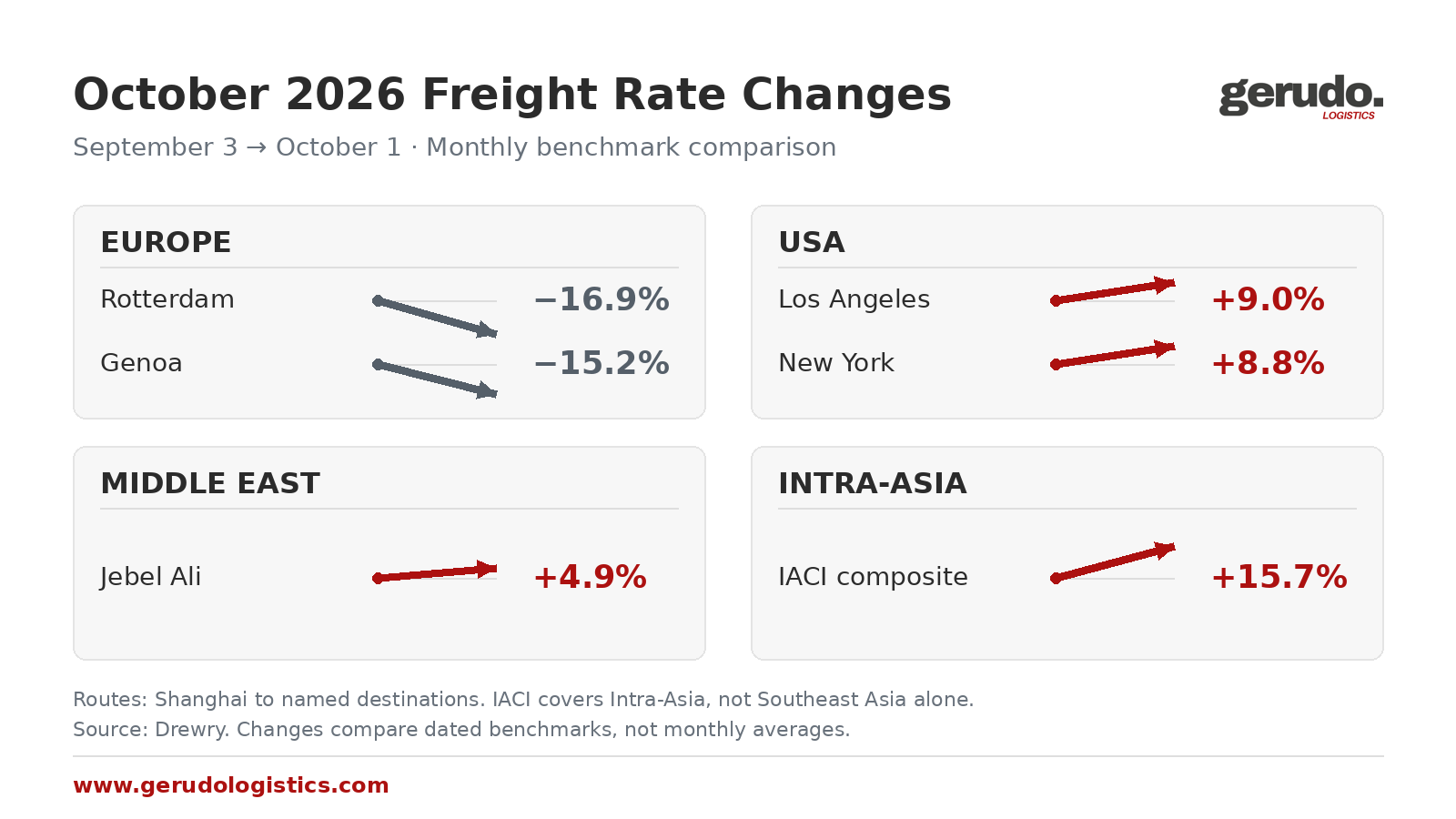
The container benchmarks do not represent door-to-door quotations or shipment-specific dangerous goods and reefer prices.
China to Europe
European freight benchmarks remained below their early-September levels:
Shanghai–Rotterdam: USD 3,399 per 40-foot container, down 16.9% from September 3.
Shanghai–Genoa: USD 3,702 per 40-foot container, down 15.2% from September 3.
Weak demand and increasing effective capacity as more vessels transit the Suez Canal continue to put downward pressure on Asia–Europe rates. Carriers are seeking higher freight-all-kinds (FAK) rates in the second half of October, although implementation remains uncertain.
China to USA
Transpacific benchmarks were higher than the figures used in September’s update:
Shanghai–Los Angeles: USD 7,835 per 40-foot container, up 9.0% from September 3.
Shanghai–New York: USD 10,428 per 40-foot container, up 8.8% from September 3.
Demand remains resilient, while carriers continue to manage capacity through blank sailings. Scheduled capacity has increased in the latest assessment period, although both routes remain above their early-September price levels.
China to Middle East
The Shanghai–Jebel Ali benchmark remained elevated:
October 1 rate: USD 8,662 per 40-foot container.
Change from September 3: An increase of 4.9%, from USD 8,254.
Regional tensions continue to support elevated freight rates. Disruption around the Strait of Hormuz and higher fuel costs add to the pressure on shipping operations and carrier charges.
China to Southeast Asia
The regional index has risen since early September, alongside higher rates on selected Southeast Asian routes:
Intra-Asia Container Index: USD 1,518 per 40-foot container, up 15.7% from September 3.
Shanghai–Ho Chi Minh City: USD 1,377 per 40-foot container on October 1.
Shanghai–Singapore: USD 2,073 per 40-foot container on October 1.
Typhoon disruption, port congestion, and carrier network adjustments have reduced effective capacity and supported higher rates. The Ho Chi Minh City and Singapore figures provide additional October market references; no month-to-month percentage is shown for either route.
| Region / benchmark | September 3, 2026 (USD/40ft) | October 1, 2026 (USD/40ft) | Change vs September |
|---|---|---|---|
| Europe: Shanghai–Rotterdam | 4,092 | 3,399 | −16.9% |
| Europe: Shanghai–Genoa | 4,368 | 3,702 | −15.2% |
| USA: Shanghai–Los Angeles | 7,185 | 7,835 | +9.0% |
| USA: Shanghai–New York | 9,587 | 10,428 | +8.8% |
| Middle East: Shanghai–Jebel Ali | 8,254 | 8,662 | +4.9% |
| Intra-Asia Container Index (IACI) | 1,312 | 1,518 | +15.7% |
Source: Drewry. Changes compare September 3 with October 1, 2026, rather than monthly averages. The IACI covers Intra-Asia routes and is not a Southeast Asia-only index. Intra-Asia rates exclude origin and destination terminal handling charges.
Gerudo Logistics provides freight quotations and routing support for general cargo, chemicals, dangerous goods, and temperature-controlled shipments from China. October quotations reflect the applicable route, equipment, and carrier surcharges.
Frequently Asked Questions
How much is CMA CGM’s head-haul EFS for a 40-foot container?
A standard 40-foot container represents two TEU, giving USD 530 for dry equipment or USD 640 for reefer equipment at the announced head-haul levels. These calculated amounts apply only when the shipment falls within that trade category and the revised schedule applies.
Are connected toys included in the proposed US tariff list?
The listed toy entry excludes items enabled with radio frequency, Wi-Fi, Ethernet, or Bluetooth. A general description of “toys” therefore does not establish eligibility for that entry.
Does updating an FDA registration count as completing the 2026 renewal?
No. FDA treats updating and biennial renewal as separate functions, so an earlier information update does not replace the required renewal.