


Shipping from China to Belgium: Rates, Routes and Import Requirements (2026)
Shipping from China to Belgium in 2026 involves more moving parts than it did two years ago. Ocean freight routing has shifted following Red Sea disruptions, the EU's Carbon Border Adjustment Mechanism (CBAM) entered its definitive phase in January 2026, and the long-standing €150 duty-free threshold for small consignments is being phased out.
This guide covers shipping costs, transit times, major port options, customs clearance requirements, and what has changed this year for importers bringing goods into Belgium from China.
Quick Cost Overview
Sea Freight FCL (40ft): $2,200 - $5,900
Sea Freight LCL: $35 - $100 per CBM
Rail Freight (FCL): $5,000 - $8,500
Air Freight: $3.85 - $11.00 per kg
Express Courier: $4.80 - $7.50 per kg
Shipping from China to Belgium - Comparison by Shipping Methods
Choosing a freight mode comes down to three variables: cargo volume, urgency, and budget. The table below summarises your main options for the China-Belgium route in 2026.
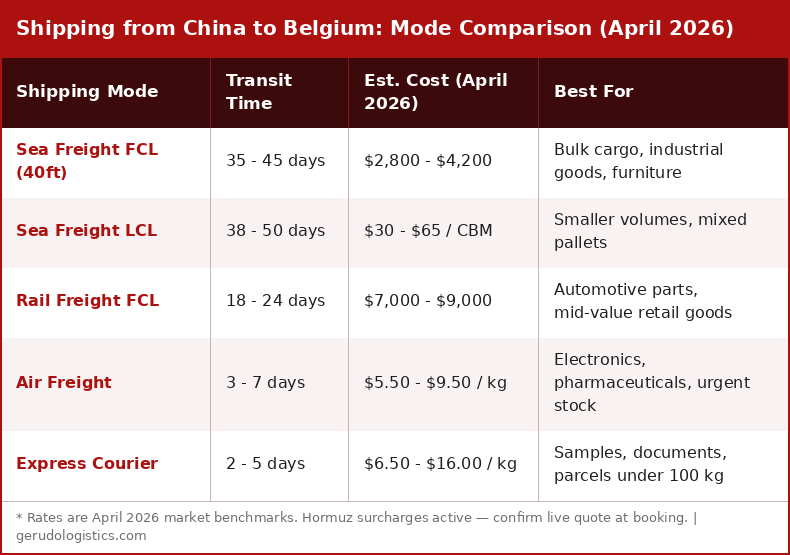
Shipping Cost from China to Belgium
Sea Freight Cost
Sea freight remains the most cost-effective option for large or heavy shipments. For a standard 40ft High Cube (40HQ) container, current market rates from major Chinese ports to Antwerp range from $2,200 to $5,900, depending on the origin port, carrier, and departure timing. A 20ft container typically prices at 65-75% of the 40ft rate and is better suited for dense or heavy cargo.
For importers who cannot fill a full container, LCL (Less than Container Load) consolidation is priced per cubic metre. Rates from China to Belgium currently run between $35 and $100 per CBM.
Keep in mind that LCL shipments carry additional handling charges at both origin and destination, and transit times run slightly longer than FCL due to consolidation and deconsolidation at the freight station.
In our experience, importers shipping less than 15 CBM per cycle tend to use LCL, while those above that threshold generally find FCL more cost-efficient once port and handling fees are factored in. The Antwerp destination port handles relatively high LCL fees, which pushes the breakeven point higher than on shorter routes.
Rail Freight Cost
China-Europe rail freight via the China Railway Express connects Chinese manufacturing hubs to Belgium's logistics corridor. Current FCL rates run approximately $5,000 to $8,500 per container, placing rail firmly between sea and air on the cost spectrum. The main China-Belgium rail routes pass through Kazakhstan and Poland, terminating at Liège or Antwerp rail terminals.
Rail is worth evaluating when your cargo is time-sensitive but air freight is cost-prohibitive. Standard rail services have restrictions on most dangerous goods classifications.
For temperature-controlled cargo, standard services are not suitable, though specialised reefer rail solutions on routes such as Xi'an to Liège are now a viable option for sensitive shipments - worth discussing with your forwarder if cold chain by rail is relevant to your cargo.
Air Freight Cost
Air freight from major Chinese export airports - Shanghai Pudong (PVG), Shenzhen Bao'an (SZX), and Guangzhou Baiyun (CAN) - to Brussels Airport (BRU) and Liège Airport (LGG) ranges from $3.85 to $11.00 per kg depending on volume, carrier, and lane demand. Liège operates a dense schedule of cargo-only flights from Chinese cities, making it a competitive option for high-value or time-critical consignments.
Chargeable weight applies across all carriers: they use whichever is greater between actual weight and volumetric weight (length x width x height in cm, divided by 5,000 for most international carriers). For bulky, light cargo, volumetric weight will typically drive your invoice.
Express Courier Cost
Services from DHL, FedEx, and UPS offer door-to-door delivery from China to Belgium in 2 to 5 business days at $4.80 to $7.50 per kg. Express is cost-effective only for shipments under roughly 100kg. Above that threshold, dedicated air freight almost always offers better value once courier surcharges and fuel fees are applied.
How Long is Shipping from China to Belgium?
Sea freight
35 to 45 days port to port from major Chinese ports to Antwerp-Bruges, reflecting extended Cape of Good Hope routing in place since early 2024. Add 3 to 7 working days for customs clearance and inland delivery after vessel arrival.
Rail freight
18 to 24 days from Chinese inland hubs to Liège or Antwerp. Reliability on established corridors has improved, though border crossing times at Kazakhstan and Poland can vary with capacity and seasonal demand.
Air freight
3 to 7 days port to port. Including export clearance at origin and import clearance in Belgium, realistic door-to-door time runs 5 to 10 days for most standard shipments.
Express courier
2 to 5 business days in most cases. Customs holds on under-declared or incorrectly documented parcels can add several days to that estimate.
Shipping Routes and Major Ports Between China and Belgium
Key Export Ports in China
The five main export gateways for cargo moving to Belgium are:
Shanghai (CNSHA): widest carrier selection and most direct routing for central China production areas
Shenzhen (CNSZX) and Guangzhou/Nansha (CNGZH): competitive rates and strong weekly frequency for Guangdong province sourcing
Ningbo (CNNGB): strong option for Zhejiang and Jiangsu manufacturers, with good direct services to Antwerp
Qingdao (CNTAO): primary gateway for northern China production, including Shandong and inland manufacturing bases
Major Entry Points in Belgium
The Port of Antwerp-Bruges is the primary sea freight gateway into Belgium and the second-largest port in Europe by container throughput. It provides direct onward trucking access to Germany, the Netherlands, France, and Luxembourg, making it a practical entry point for importers distributing across the wider European market.
For air and rail, the main entry points are:
Liège Airport (LGG): handles a significant volume of Chinese cargo-only flights, including pharmaceutical and express freight; well-positioned for onward distribution across Benelux
Brussels Airport (BRU): serves both belly freight on passenger services and dedicated cargo operations
Antwerp and Liège rail terminals: termination points for China Railway Express services, connecting to the broader European intermodal network
Customs Clearance for Importing into Belgium
2026 EU Compliance Updates
CBAM - Carbon Border Adjustment Mechanism
The CBAM definitive regime entered force on 1 January 2026. If you import any of the following from China, you are now required to register as an authorised CBAM declarant and purchase CBAM certificates to cover the carbon emissions embedded in your goods:
Iron and steel (including semi-finished products)
Aluminium
Cement
Fertilisers
Hydrogen
Certain processed downstream products, including screws, bolts, and other steel fabrications
Importers who are not registered and compliant face financial penalties at the Belgian border.
For importers sourcing consumer goods, electronics, or textiles from China, CBAM does not currently apply. However, those handling industrial materials or metal-intensive products should verify their commodity classification against the CBAM scope before the first shipment departs.
EU De Minimis Reform
The EU is phasing out the €150 duty-free threshold that previously exempted low-value consignments from customs duties. From 1 July 2026, this threshold is abolished for cross-border e-commerce consignments, and a five-tier bucketed duty system will apply to eligible low-value parcels during the 2026-2028 transition period:
Tier 1 - 0%: books, printed materials, certain scientific materials
Tier 2 - 5%: toys, office supplies, certain non-precious metal goods
Tier 3 - 8%: glassware, ceramics, silk products, certain chemical goods
Tier 4 - 12%: clothing, footwear, accessories, home textiles
Tier 5 - 17%: certain food products, alcohol, high-value leather goods
For commercial importers, the direct effect is limited, but those regularly ordering low-value samples from Chinese suppliers should anticipate additional customs handling costs on parcels under €150 from mid-year.
Required Documentation
Belgian customs (the Douane) requires the following documents for commercial imports from China:
Commercial Invoice: must include the EORI numbers of both the exporter and the importer, with declared values matching the packing list
Packing List: itemised breakdown of contents, quantities, and weights
Bill of Lading (sea or rail) or Air Waybill (air): your contract of carriage and title document
Certificate of Origin: required for certain preferential duty claims or origin-sensitive products
CE Marking documentation: mandatory for electronics, machinery, medical devices, and toys placed on the EU market
Discrepancies between the commercial invoice value and the packing list are the most common cause of preventable customs holds on China-Belgium shipments. Check both documents against each other before cargo departs origin.
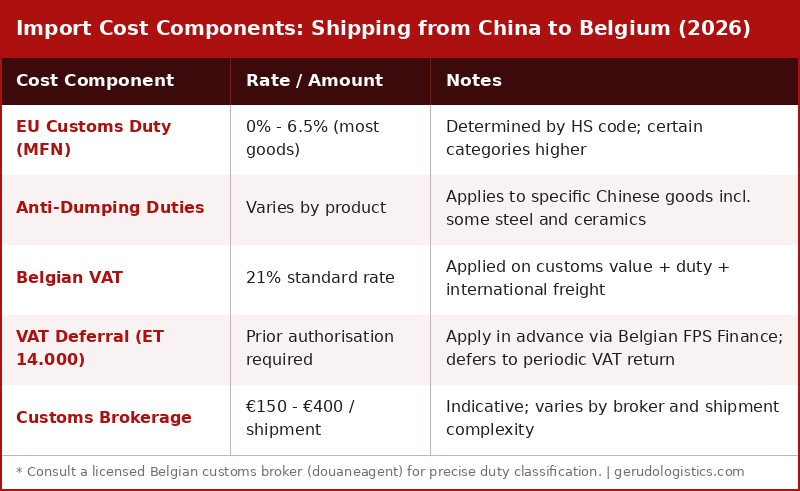
Belgian importers who hold a valid ET 14.000 authorisation can defer import VAT to their periodic VAT declaration rather than paying at the point of customs clearance. This is not automatic - importers must apply for this specific licence in advance through the Belgian FPS Finance. It is a meaningful cash flow benefit for regular importers and worth arranging before your first shipment.
An EORI number (Economic Operators Registration and Identification) is mandatory for all businesses importing commercially into the EU. Register through the Belgian Customs and Excise administration (FPS Finance) before your cargo arrives, as import declarations cannot be filed without it.
Door-to-Door Shipping from China to Belgium
A standard door-to-door shipment on the China-Belgium route moves through the following stages:
Step 1 - Cargo readiness and documentation
Your Chinese supplier prepares the goods and issues the commercial invoice and packing list. Confirm that all documents reference the correct HS codes, declared values, and your EORI number before the cargo leaves the factory.
Step 2 - Inland collection and export consolidation
Your freight forwarder arranges factory pickup or delivery to the origin port or freight station. For FCL shipments, the container is stuffed at origin. LCL cargo moves to a consolidation warehouse for grouping with other consignments.
Step 3 - Chinese export customs clearance
The forwarder files export declarations with Chinese customs. For dangerous goods or temperature-controlled cargo, additional permits and pre-clearance steps apply at this stage and must be prepared before the cargo reaches the port.
Step 4 - International transit
The shipment moves by sea, rail, or air to Belgium. For sea freight, current transit time is 35 to 45 days via the Cape of Good Hope routing. Your forwarder should provide milestone updates throughout this phase.
Step 5 - Arrival at Belgian port or airport
The carrier notifies your forwarder of arrival. For sea freight at Antwerp, demurrage-free time is typically 5 to 7 days depending on the carrier and service. Act on arrival notifications promptly to avoid port storage charges.
Step 6 - Belgian import customs clearance
Your customs broker files the import declaration, applies the correct duty and VAT treatment, and arranges release of the cargo. CBAM declarations are handled at this stage for applicable goods. Standard clearance takes 1 to 3 working days for compliant shipments with complete documentation.
Step 7 - Inland delivery to final destination
Released cargo is trucked from Antwerp or Liège to your warehouse or distribution facility. Belgium's central location means most domestic destinations are within a few hours of the port, and onward cross-border delivery to Germany, the Netherlands, or France is straightforward.
Finding the Best Freight Forwarder from China to Belgium
The right freight forwarder does more than book space on a vessel. For importers handling complex cargo - whether dangerous goods, temperature-controlled shipments, or products subject to CBAM - the forwarder's compliance capabilities matter as much as their rates.
Gerudo Logistics is a China-based freight forwarder specialising in Dangerous Goods (DG) and Reefer (Cold Chain) shipping to global markets, including Europe. Our operations span Guangzhou, Shenzhen, Shanghai, Ningbo, Qingdao, and Dalian, covering all major Chinese export gateways for the Belgium route. We handle:
DG shipments across all hazard classes, with full cargo classification, packing compliance, and IATA and IMDG documentation
Temperature-controlled cargo, including reefer container management and cold chain integrity throughout transit
General cargo under FCL, LCL, and air freight, coordinated from a single point of contact
Door-to-door execution under DDP terms, including export clearance in China and coordination with destination customs brokers in Belgium
Every shipment is handled with the documentation discipline that EU customs requires.
Frequently Asked Questions for China-Belgium Shipping
How long does sea freight from China to Antwerp take in 2026?
Current transit times run 35 to 45 days from major Chinese ports to the Port of Antwerp-Bruges, reflecting extended Cape of Good Hope routing. Add 3 to 7 working days for customs clearance and local delivery after the vessel arrives.
Do I need an EORI number to import into Belgium?
Yes. An EORI number is mandatory for all commercial importers bringing goods into the EU. Register through the Belgian Customs and Excise administration (FPS Finance) before your first shipment arrives, as customs declarations cannot be filed without it.
What is the import VAT rate in Belgium?
Belgium applies a standard 21% VAT on most imported goods, calculated on the customs value plus applicable duty and international freight charges. Eligible businesses can apply for ET 14.000 authorisation to defer VAT payment to their periodic return, which benefits cash flow for regular importers.
Which products are subject to CBAM when importing from China?
CBAM currently covers iron, steel, aluminium, cement, fertilisers, hydrogen, and certain processed downstream products such as screws and bolts. If your products fall outside these categories, CBAM does not apply to your imports at this stage, though the scope may expand in future review cycles.
Is rail freight from China to Belgium a reliable option?
China-Europe rail has become more consistent on established corridors. Transit times of 18 to 24 days are achievable, and it fills a useful gap between sea and air on cost and speed. Standard rail services have restrictions on most dangerous goods classifications, and temperature-controlled cargo requires specialised reefer rail arrangements rather than standard container bookings.
What is the practical difference between FCL and LCL for the Belgium route?
FCL gives you exclusive use of a container and generally faster, more predictable transit with fewer handling touchpoints. LCL shares container space with other shippers and involves additional handling at the freight station, which adds cost and extends transit time. For the Belgium route specifically, destination port LCL fees at Antwerp are relatively high, so FCL typically becomes the more efficient choice above roughly 15 CBM per shipment.
What happens if my cargo is held by Belgian customs?
A customs hold typically results from documentation errors, valuation queries, or physical inspection requirements. Your licensed customs broker handles the resolution process. Providing any requested supporting documents quickly is the fastest way to secure release and avoid demurrage charges at Antwerp.
Conclusion
Shipping from China to Belgium in 2026 is manageable with the right preparation. Sea freight via Antwerp remains the standard for volume cargo. Rail offers a practical middle ground for time-sensitive industrial shipments. On the compliance side, CBAM registration is now a hard requirement for importers of carbon-intensive goods, and the phasing out of the €150 duty-free threshold will affect sample and small-order workflows from mid-year onward.
Getting these details right before your first shipment departs China is considerably less costly than resolving them at the port.