


Shipping from China to Spain: Costs, Transit Times & DDP (2026)
Spain is China's fourth-largest export destination within the EU, with bilateral trade exceeding €50 billion in 2025. For importers sourcing industrial equipment, consumer goods, frozen food, or temperature-controlled cargo from China, Spain presents a routing complexity that many buyers underestimate: the country faces both the Mediterranean and the Atlantic, and the port you choose at destination significantly affects your freight cost and transit time. Valencia and Bilbao operate on entirely different shipping lanes, and the Yiwu-Madrid railway begins at an inland origin far removed from China's coastal manufacturing hubs.
This guide covers the 2026 cost benchmarks, transit times, customs requirements, and practical decision points for every major shipping method on the China-Spain lane.
Shipping from China to Spain: Cost and Method Comparison at a Glance
The table below covers the five main shipping options currently available on this lane. Costs reflect Q1 2026 market conditions and are subject to seasonal surcharges, particularly during peak periods in Q3 and around Chinese New Year.
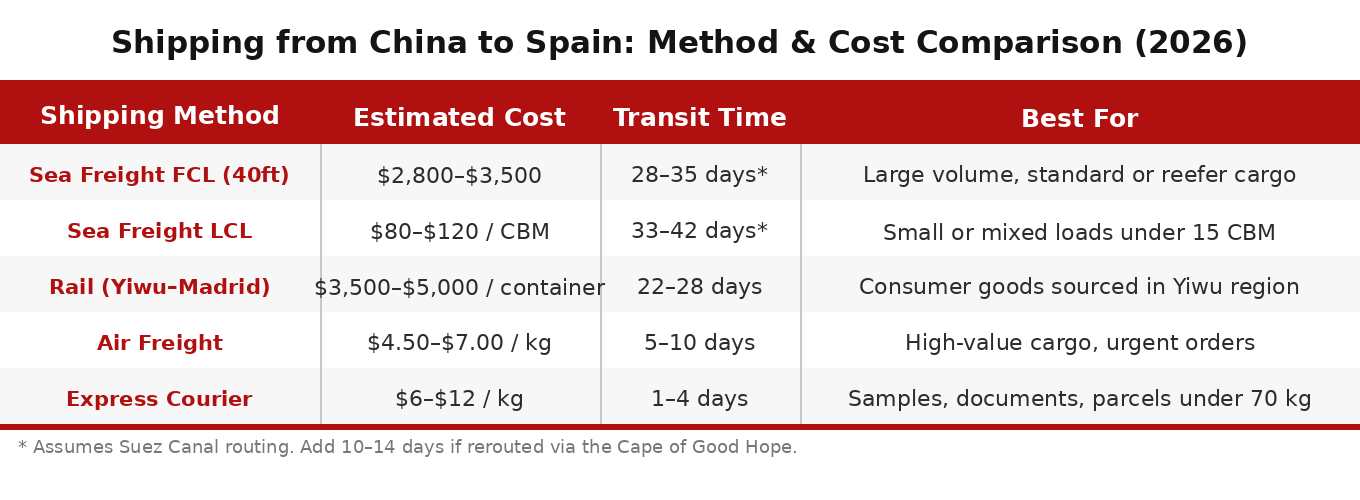
Note that EU ETS carbon surcharges took effect at 100% implementation on January 1, 2026, adding approximately $75–$150 per FEU on Europe-bound sea freight. While most major carriers have absorbed this into their base rates, B2B freight quotes will typically still itemise it as a "Carbon Surcharge" or "ETS Adjustment" line.
Routing note: Transit times above assume standard Suez Canal routing. If vessels are rerouted via the Cape of Good Hope due to Red Sea disruptions, add 10–14 days to all sea freight estimates.
Sea Freight from China to Spain
Sea freight remains the dominant mode for B2B cargo on this lane due to its cost efficiency at volume. It is also the only viable option for reefer (temperature-controlled) cargo, oversized equipment, and hazardous goods that cannot move by rail or air.
FCL: Rates, Port Pairings, and Route Logic
Full Container Load (FCL) is cost-effective from approximately 15 CBM or 8 metric tons upwards. A 20ft dry container from Shanghai to Valencia currently runs $1,600–$2,200; a 40ft container runs $2,800–$3,500 depending on departure port and season. Reefer containers carry a premium of $800–$1,500 per box above dry container rates, plus a power/electricity surcharge of $15–$30 per day.
The principal port pairings on this lane are:
Shanghai / Ningbo → Valencia: The most frequented route for East China cargo. Valencia is Spain's leading container port by TEU throughput and offers the highest sailing frequency from Chinese ports, typically 3–4 departures per week from major Chinese hubs.
Shenzhen / Guangzhou Nansha → Valencia or Barcelona: Standard routing for South China manufacturing. Nansha has strengthened direct Mediterranean services in recent years and is competitive on rate.
Any Chinese port → Algeciras: Algeciras sits at the mouth of the Strait of Gibraltar and functions primarily as a transshipment hub. It is the most practical arrival point for cargo destined to southern Spain (Seville, Malaga, Cadiz), where overland distance from Valencia would add significant inland cost.
Any Chinese port → Bilbao: Bilbao is Spain's primary Atlantic-facing port, serving the Basque Country and northern Spain. Routing from China requires vessels to clear the Strait of Gibraltar and continue northward along the Atlantic coast, adding 5–8 days compared to Valencia. Choose Bilbao only when your final delivery destination is northern Spain or Portugal, as overland costs from Valencia to Bilbao would otherwise exceed the additional sea freight cost.
LCL: When It Makes Sense
Less than Container Load (LCL) consolidation is practical for shipments between 2 CBM and 14 CBM. Below 2 CBM, express air freight is often more cost-effective once LCL handling and consolidation fees are factored in. LCL shipments typically take 5–7 days longer than FCL due to consolidation and de-stuffing at the destination, bringing the realistic door-to-door transit to 38–45 days.
One practical limitation: dangerous goods (DG) cargo cannot be co-loaded with general cargo in LCL without specific approval. If you are shipping lithium batteries, chemical products, or other regulated items, FCL is the operationally cleaner option. In our experience, DG LCL shipments to Spain have a higher incidence of customs holds due to documentation mismatches at the point of consolidation.
Rail Freight: The Yiwu-Madrid Line
The Yiwu-Madrid railway, part of the China-Europe Block Train network, connects Yiwu in Zhejiang Province to Madrid's Abroñigal freight terminal. At 22–28 days door-to-door (including cargo assembly at Yiwu and final delivery in Spain), it occupies the middle ground between sea and air. The service is particularly relevant for buyers sourcing small commodities, textiles, and household goods from Zhejiang and Jiangsu suppliers, where Yiwu is the natural aggregation point.
Key operational parameters:
Cost: $3,500–$5,000 per container, approximately 25–40% above sea freight but 60–70% below air
Frequency: Limited weekly departures, reducing flexibility compared to ocean shipping
Cargo restrictions: Reefer, dangerous goods, and oversized cargo are not accepted
Geopolitical note: The route transits the Poland-Belarus border at Małaszewicze for gauge change; cross-border timing can vary with political conditions, which is one reason we use 22–28 days rather than the 18-day "best case" figure sometimes quoted by rail operators
The South China buyer calculation. For importers based in Guangdong, the Yiwu-Madrid line rarely makes commercial sense. Trucking a container from Shenzhen or Guangzhou to Yiwu covers approximately 1,200 km and costs $800–$1,200 in inland transport. Added to a $4,500 rail rate, the total reaches $5,300–$5,700 against a $3,000 sea freight baseline. Unless there is a severe port congestion situation or an urgent delivery window that does not justify air rates, South China cargo is better served from Nansha or Yantian.
Air Freight from China to Spain
Air freight from China to Spain operates primarily through two destination airports: Madrid Barajas (MAD) and Barcelona El Prat (BCN). Madrid handles higher cargo volumes and has better-established connections with Chinese carriers. Key origin airports on the China side are Shanghai Pudong (PVG), Guangzhou Baiyun (CAN), and Shenzhen (SZX).
Current rates and key parameters:
General cargo: $4.50–$7.00/kg
Express services: $8–$12/kg
DG surcharge: $0.80–$2.00/kg above standard rates for regulated cargo
Chargeable weight: Standard air freight uses volumetric weight at (L × W × H in cm) / 6,000; express couriers (DHL, FedEx, UPS) apply 1:5,000, which produces a higher chargeable weight for the same parcel dimensions. Carriers bill whichever is higher between actual and volumetric weight; bulky lightweight goods pay significantly more than the headline rate per kg
CAO restrictions: Lithium batteries shipped separately from equipment are limited to Cargo Aircraft Only routing, reducing carrier options and increasing cost
Air freight is cost-justified for high-margin, time-critical cargo: electronics components, fashion items with seasonal windows, pharmaceutical-grade products, or emergency replacement parts. For standard commercial volumes, the 5–8x premium over sea freight is rarely recoverable in the landed cost structure.
Express Courier Services
DHL, FedEx, and UPS all operate direct China-to-Spain services with 1–4 day transit times at $6–$12/kg depending on weight bracket and service level. This mode is practical for shipments under 70kg: product samples, commercial documents, small spare parts, and low-volume urgent orders.
For shipments above 70–100kg, consolidated air freight through a freight forwarder typically undercuts express courier rates by 30–50% with comparable or slightly longer transit times. Express courier for DG cargo is subject to strict quantity limits and package-level restrictions; Class 3 flammable liquids, for example, are typically capped at 1 litre per package on passenger aircraft routing.
Landed Cost Example: Frozen Vegetables from China to Spain
In late 2025, we managed a reefer shipment for a Spanish food importer bringing frozen vegetables from China. The cargo departed from a major East China port and arrived at Valencia without customs holds or cold chain interruptions, clearing EU phytosanitary inspection on schedule. Final delivery reached the client's warehouse in Madrid within the standard door-to-door window for this lane. The cost breakdown below reflects that shipment as a working reference.
The table below summarises the key cost categories for 1 x 20ft reefer container of frozen mixed vegetables (10 metric tons), shipped from Shanghai to Valencia.
Chinese frozen garlic, mushrooms, edamame, and spinach are among the highest-volume cold chain exports from China to Spain, driven by price competitiveness and year-round supply availability.
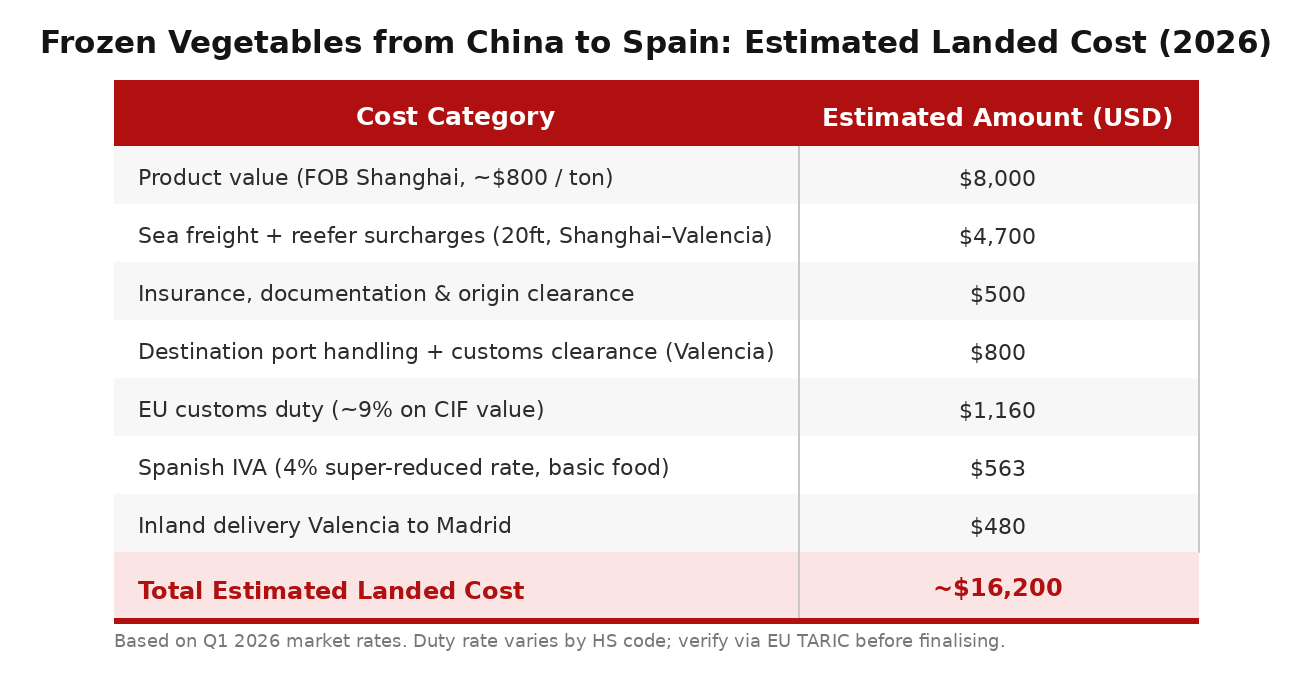
At approximately $1.62/kg all-in, the total landed cost is roughly double the FOB product value. A few points to note before using this as a planning benchmark:
EU customs duty varies by HS code. Frozen garlic (HS 0710.80) carries a different rate than frozen spinach or peas. Always verify your specific code via the EU TARIC database before calculating.
IVA rate depends on product form. The 4% super-reduced rate applies to basic unprocessed foodstuffs. If the product is seasoned, cooked, or value-added, IVA rises to 10%. Note that Spanish customs has on occasion classified frozen and pre-treated vegetables as processed food, triggering the 10% bracket rather than 4%. Verify classification with your customs broker before finalising your landed cost calculation.
A Phytosanitary Certificate from GACC (China's General Administration of Customs) is mandatory for all plant-based food exports to the EU. Without it, the shipment will be held at Valencia port pending compliance.
Spain Customs Clearance and Import Duties
EU Common External Tariff and IVA
Spain applies the EU Common External Tariff (CET) as a member state, meaning import duty rates are set at the EU level and are uniform across all 27 member countries. Most manufactured goods from China carry duties between 0% and 17% depending on the HS code. The TARIC database is the authoritative source for current rates.
IVA (Impuesto sobre el Valor Añadido), Spain's VAT, is levied on the CIF value of the goods plus customs duty:
21% standard rate for most commercial goods
10% reduced rate for certain processed food products and pharmaceutical items
4% super-reduced rate for basic staple foods, books, and medicines
EU ETS carbon surcharges reached 100% implementation in January 2026. Most major carriers have absorbed this into their base rates, but B2B freight quotes will typically still itemise it as a "Carbon Surcharge" or "ETS Adjustment." On the China-Spain lane, this currently adds $80–$130 per FEU.
EORI Number Requirement
Every business importing goods into the EU from outside the EU must hold a valid EORI (Economic Operators Registration and Identification) number. Spanish importers register through the Agencia Tributaria (tax authority) website. Without an EORI number, customs clearance cannot proceed, and the shipment will be held at port. EORI registration typically takes 3–5 working days.
Required Import Documents
The standard document set for a commercial import from China to Spain:
Commercial Invoice: must state accurate HS codes, full product descriptions, unit values, and both buyer and seller details
Packing List: itemised by package with quantities, weights, and dimensions
Bill of Lading (sea freight) or Air Waybill (air freight)
Certificate of Origin: required to claim preferential duty rates under any applicable trade arrangement
Phytosanitary Certificate: mandatory for all plant-based food and agricultural products, issued by GACC in China
CE Marking documentation: required for electronics, machinery, toys, and medical devices; non-compliant goods are detained at Spanish customs without exception
Dangerous Goods documentation (MSDS, DG Declaration): required for any shipment falling under IMDG or IATA dangerous goods classifications
Restricted and Regulated Goods
CE marking non-compliance is the most common reason for shipment detention on the China-Spain lane, particularly for electronics and electrical equipment. Spain's customs authority applies EU product safety regulations strictly, and goods without valid CE documentation may be confiscated rather than simply returned. For DG cargo including lithium batteries, aerosols, and chemicals, compliance with IMDG (sea) or IATA (air) regulations is mandatory before departure from China.
DDP Shipping from China to Spain
Delivered Duty Paid (DDP) service transfers all customs, duty, and local delivery responsibilities to the freight forwarder. The importer receives a single landed cost quote and takes delivery at their warehouse without dealing with Spanish customs, IVA payments, or local carriers.
DDP is appropriate when you do not have an established customs broker in Spain, when your shipment involves complex documentation (DG cargo, food products), or when you are entering the Spanish market for the first time and want to avoid clearance surprises. The typical DDP process on this lane runs as follows:
Cargo preparation and export packing in China with correct labelling and documentation
Chinese customs export declaration and cargo booking with carrier
International transport (sea, air, or rail depending on mode selected)
EU entry point customs declaration at Valencia, Barcelona, or Madrid depending on arrival port
Spanish IVA payment and customs duty settlement coordinated by the DDP provider
Final delivery to your warehouse or FBA centre in Spain
The main trade-off with DDP is cost transparency: an all-inclusive quote is operationally simpler but gives you less visibility into how costs are broken down between freight, duty, and handling. For high-volume importers, managing customs clearance independently through a local Spanish broker typically reduces total cost once you have established processes in place.
Why Work with Gerudo Logistics for China-Spain Shipments
Gerudo Logistics specialises in Dangerous Goods and reefer (cold chain) shipping from China to global markets, including Spain and the broader EU. For importers sourcing temperature-controlled cargo, lithium battery products, chemicals, or any cargo classified under IMDG or IATA regulations, compliance at origin is as important as compliance at destination.
Our operations cover China's main export ports: Guangzhou, Shenzhen, Shanghai, Ningbo, Qingdao, and Dalian. For Spain-bound shipments specifically, we provide:
FCL and LCL bookings coordinated from both South and East China export ports
Reefer container pre-trip inspections before loading to reduce cold chain risk
Full DG documentation prepared to EU and Spanish customs standards (IMDG / IATA)
DDP service covering IVA payment, Spanish customs clearance, and final warehouse delivery
If you are planning a China-Spain shipment involving DG cargo, reefer containers, or consolidated LCL loads, contact our logistics expert for a tailored freight quote.
Frequently Asked Questions: Shipping from China to Spain
How long does sea freight from China to Spain take in 2026?
Most FCL shipments from major Chinese ports to Valencia take 28–35 days port to port. Add 3–5 days for customs clearance and inland delivery for a realistic door-to-door window of 32–40 days. Shipments to Bilbao take 5–8 days longer due to the additional Atlantic routing.
How much does a 40ft container from China to Spain cost in 2026?
As of Q1 2026, a standard 40ft dry container from Shanghai or Shenzhen to Valencia runs $2,800–$3,500. Reefer containers carry a premium of $800–$1,500 above dry rates, plus a daily electricity surcharge. Rates fluctuate seasonally and are subject to EU ETS carbon surcharges.
Is rail freight a realistic option for Spain?
The Yiwu-Madrid line is viable for buyers with suppliers in the Yiwu-Zhejiang region who need goods in Spain within 3–4 weeks. It does not suit reefer cargo, dangerous goods, or oversized equipment. For South China buyers, the inland trucking cost to Yiwu typically eliminates the price advantage over sea freight.
What import taxes apply when importing from China to Spain?
EU customs duty rates vary by HS code, ranging from 0% to 17% for most goods. Spanish IVA applies at 21% standard rate, with reduced rates of 10% or 4% for food products depending on category. Both are calculated on the CIF value of the shipment.
Do I need an EORI number to import into Spain?
Yes. All businesses importing goods from outside the EU into Spain require an EORI number registered with the Agencia Tributaria. Without it, customs clearance cannot proceed and the shipment will be held at port.
What documents are required for Spanish customs?
Core documents are the Commercial Invoice, Packing List, and Bill of Lading or Air Waybill. Depending on the product, you may also require a Certificate of Origin, Phytosanitary Certificate, CE marking documentation, or DG declaration. Missing or incorrect documentation is the leading cause of customs holds on this lane.
Can I ship DDP to Spain from China?
Yes. DDP service is available for most cargo types and is particularly practical for first-time importers or shipments involving complex compliance requirements. The freight forwarder handles all customs, duty payment, and final delivery under a single all-inclusive cost.
Are there restrictions on importing electronics or batteries into Spain?
Electronics and electrical products must carry valid CE marking to enter the EU. Lithium batteries are subject to IATA (air freight) or IMDG (sea freight) dangerous goods regulations. Non-CE-compliant goods are detained at Spanish customs and may be confiscated. Ensure your supplier provides valid CE test reports before shipping.
Conclusion
The China-Spain shipping lane offers genuine choice across five transport modes, each with a different cost and time profile. Sea freight remains the default for volume cargo and is the only practical mode for reefer and dangerous goods shipments. Rail via Yiwu-Madrid fills a specific niche for Zhejiang-sourced consumer goods. Air and express are reserved for urgent, high-value, or small-volume shipments where transit time drives the decision.
For importers new to this lane, the two most common cost errors are underestimating EU customs duties and IVA at destination, and failing to budget for EU ETS carbon surcharges now embedded in ocean carrier rates. Run a full landed cost calculation before comparing supplier quotes: the gap between FOB price and delivered cost on the China-Spain lane is consistently 60–100% of the FOB value once freight, duties, IVA, and handling are included.
Ready to plan your next China-Spain shipment? Contact Gerudo Logistics today!