

Current Tariffs on China 2026: Complete Import Duty Guide
Whether you're searching for "china tarriff," "china terrif," "chian tariff," or the correct spelling "china tariff" - you're looking for the same thing: current tariffs on China. The answer isn't simple. The often-quoted "47%" average tariff on Chinese goods is no longer accurate.
Following the expiration of the 10% Section 122 global tariff, a new 12.5% Section 301 tariff took effect on most Chinese goods on July 24, 2026, subject to product exemptions.
What does 12.5% mean in practice? For goods subject to this tariff, you are paying $125 extra for every $1,000 worth of products you import -- before other applicable duties are added.
Why do China tariffs remain elevated? The rate comes from multiple tariffs that may apply depending on the product: a new 12.5% Section 301 tariff, existing Section 301 tariffs of 25% on many manufactured goods, and Section 232 tariffs of 50% on steel and aluminum. The "fentanyl" tariffs imposed under IEEPA were struck down by the US Supreme Court on February 20, 2026 and are no longer in effect.
In 2025, the average US tariff on imports from China peaked at 127.2% before falling following US-China negotiations. Since then, a Supreme Court ruling and the new Section 301 action effective July 24, 2026 have further reshaped the tariff structure.
That's exactly why you need this guide. We'll break down current tariffs on China, show you how to calculate your real import costs, and give you tools to stay updated when rates change again.
Current Tariffs on China 2026 Overview (August 2026 Updated)
What are the current tariffs on China? As of August 2026, most Chinese goods are subject to an additional 12.5% Section 301 tariff, effective July 24, 2026, subject to product exemptions. This followed the expiration of the temporary 10% Section 122 global tariff.
Why do rates vary? Current China tariffs use multiple overlapping systems:
Base structure: 12.5% Section 301 tariff on most Chinese goods, effective July 24, 2026, with specific product exemptions
Existing Section 301 tariffs: Additional 25% on most manufactured goods; 100% on EVs; 50% on solar cells and semiconductors
Section 232 tariffs: 50% on steel, aluminum, and derivative products (raised from 25% in June 2025; still in effect)
Electronics: Certain electronics may qualify for product exemptions from the new 12.5% Section 301 tariff, but existing Section 301 rates of 7.5-25% still apply depending on the product
Rate outlook: The temporary Section 122 tariff expired on July 24, 2026. The new 12.5% Section 301 tariff is now in effect, subject to the applicable product exemptions.
What determines YOUR rate? Your product's Harmonized System (HS) code determines which tariffs apply. Complex items like displays and control boards can trigger multiple tariffs based on how each component is classified.
China continues to face multiple overlapping tariff measures. While other investigated economies are now subject to Section 301 rates of 10% or 12.5%, Chinese goods may also face existing China-specific Section 301 tariffs and applicable Section 232 duties.
China Import Tariff Rates by Category
China import tariff rates vary significantly based on your product's HS code. Most Chinese products face an additional 12.5% tariff, but many pay much more depending on their classification and any sector-specific penalties.
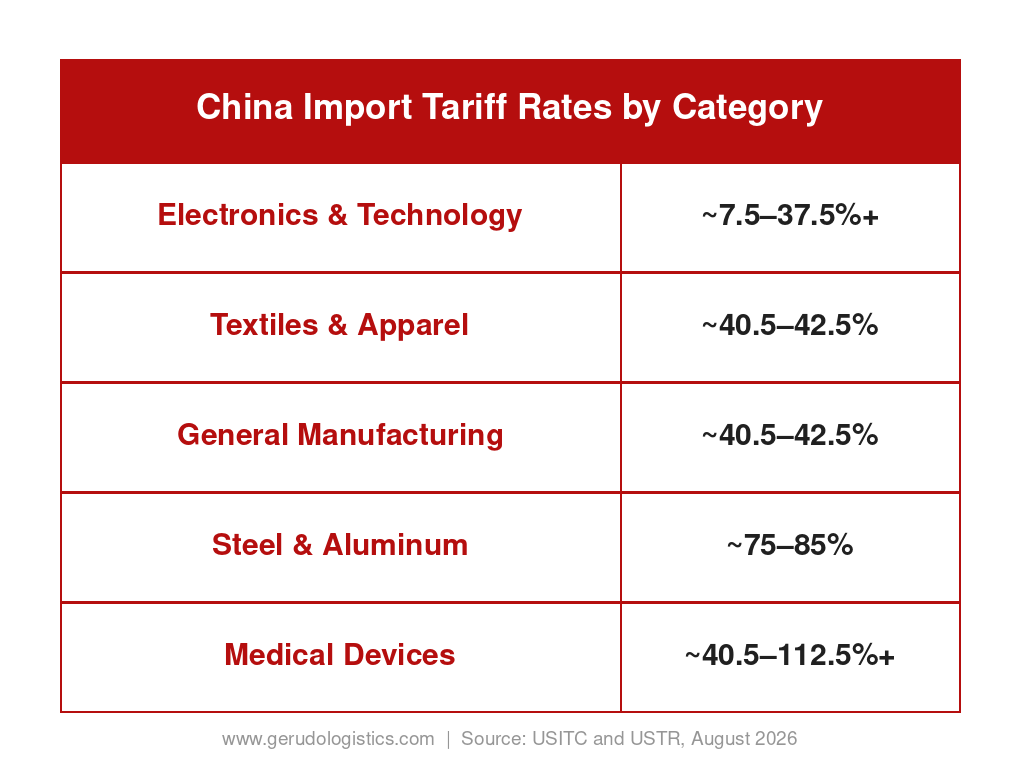
The rates below reflect how China duty rates stack together differently for each category. Certain electronics may qualify for exemptions from the new 12.5% Section 301 tariff, though existing Section 301 rates of 7.5-25% still apply depending on HS classification.
Most other categories face the new Section 301 tariff (12.5%) plus existing Section 301 tariffs (25%), putting general manufacturing and textiles at approximately 40.5-42.5% including typical MFN duties.
Steel and aluminum products carry a 50% Section 232 tariff. Under current stacking rules, products subject to Section 232 are exempt from the new 12.5% Section 301 tariff, putting their combined rate at approximately 75-85% above MFN depending on the product.
Medical devices represent another special case. Syringes and needles face 100% Section 301 tariffs, medical gloves 30%, and respirators 25-50%.
For practical planning: a $10,000 electronics shipment that qualifies for an exemption from the new 12.5% Section 301 tariff may cost $750-2,500 in tariffs (depending on the existing Section 301 rate). The same value in general manufacturing costs approximately $4,050-4,250. Steel products run $7,500-8,500.
China import duty rates depend on precise HS code classification. Complex products like displays or control boards can trigger multiple tariff categories based on their components. Always verify your exact HS code before importing, as misclassification can result in higher rates and penalties.
How to Calculate Import Tax From China to USA
How to calculate import tax from china starts with understanding the difference between your shipment's CIF value and customs value. The basic calculation is simple:
Getting the right inputs requires knowing your product's HS code and current tariff category from our previous section.
Step-by-step calculation process:
Step 1: Calculate your customs value - the CIF value includes the product cost, international shipping, and insurance, but US customs value generally excludes separately identified international shipping and insurance. If you paid $10,000 for goods plus $800 shipping and $200 insurance, your CIF value is $11,000, while your customs value is generally $10,000.
Step 2: Find your tariff rate using your product's HS code and category. Electronics may face approximately 7.5-37.5% or more, most manufacturing goods face approximately 40.5-42.5%, and steel/aluminum products face approximately 75-85%.

Step 3: Apply the formula shown above. This gives you the estimated amount you'll pay to US Customs before receiving your goods.
Real calculation examples:
Electronics Example: You're importing $15,000 worth of smartphones with $1,200 shipping and $300 insurance. Your CIF value is $16,500, while your customs value is generally $15,000. Electronics that qualify for an exemption from the new 12.5% Section 301 tariff may face approximately 7.5% in existing Section 301 duties. Calculation: $15,000 × 7.5% = $1,125 in import taxes. Total landed cost: $17,625, excluding other import fees.
Textiles Example: You're importing $8,000 worth of clothing with $600 shipping and $150 insurance. Your CIF value is $8,750, while your customs value is generally $8,000. General manufacturing and textiles may face approximately 40.5% (new Section 301 12.5% + existing Section 301 25% + ~3% MFN). Calculation: $8,000 × 40.5% = $3,240 in import taxes. Total landed cost: $11,990, excluding other import fees.
How much is import tax from china depends entirely on these two factors: your accurate customs value and correct tariff rate classification.
The most common mistake is using the CIF value as the customs value without separating identifiable international shipping and insurance costs.
Important for planning: Import tax from china to usa must be paid when goods clear customs, before delivery to your warehouse. Always verify your HS code classification before calculating, as misclassification can result in surprise rate changes and penalties.
China Tariff Calculator and Tools
China tariff calculator tools help you estimate import costs before shipping, but accuracy depends on using the right inputs and understanding each tool's limitations.
Official Government Calculators
The most reliable china import tax calculator comes from official US sources.
The United States International Trade Commission (USITC) provides the Harmonized Tariff Schedule (HTS) lookup tool, which shows current tariff rates for specific HS codes. This tool gives you the exact tariff percentage for your product category, including any China-specific rates.
US Customs and Border Protection (CBP) offers duty calculation guidance through their official website, though it requires you to know your precise HS code classification. These government tools provide the most accurate and up-to-date tariff rates since they're the same systems customs officers use.
Third-Party Calculator Tools
Several import tax from china to usa calculator options exist from trade websites and logistics companies. These tools typically ask for basic product information and shipping details, then estimate total landed costs including tariffs, duties, and fees.
Popular options include calculator tools from freight forwarders, customs brokers, and international trade websites. While convenient, these calculators often provide estimates rather than exact figures, and their databases may not reflect the latest tariff changes that occurred throughout 2025 and 2026.
What You Need for Accurate Calculations
Any china import duty calculator requires specific information for accurate results. You'll need your product's correct HS code (usually 6-10 digits), customs value, and current tariff rates for your product category.
The most common calculation errors come from wrong HS code classification or incomplete customs values. Double-check your product classification using multiple sources, as different HS codes can result in significantly different tariff rates.
When to Consult Professionals
China tariff calculator tools work well for straightforward products and standard shipments. However, complex products with multiple components, high-value shipments requiring precise compliance, or products with unclear HS code classification benefit from professional customs broker consultation. The cost of expert advice often pays for itself by avoiding costly misclassification penalties and delays.
Import Duties From China to USA: Additional Costs
Import duties from china to usa represent just one part of your total import costs. Beyond tariffs, expect additional fees that can add 15-25% to your shipment value, depending on your cargo type and port of entry.
Customs Brokerage Fees
Customs fees from china to us include mandatory brokerage services ranging from $100-500 per shipment. Basic customs clearance typically costs $100-200 for standard shipments, while complex products requiring detailed documentation or special permits can reach $300-500. This fee covers customs form preparation, duty calculation, and communication with CBP on your behalf.
Full container loads (FCL) generally pay flat rates around $150-250, while less-than-container loads (LCL) often face higher per-shipment costs of $200-400 due to additional handling requirements.
Port and Terminal Charges
Port fees vary significantly by location and shipment size. Import costs from china include terminal handling charges of $200-600 for standard containers, plus documentation fees of $50-100. Major ports like Los Angeles charge different rates than smaller East Coast ports.
Container demurrage can add $100-200 per day if your cargo sits at the port beyond free time (typically 3-5 days). Pier pass fees in California ports add another $30-80 per container for off-peak delivery scheduling.
Additional Import Fees
Customs charges from china to us extend beyond basic clearance. Merchandise Processing Fees (MPF)cost 0.3464% of cargo value (minimum $33.58, maximum $651.50 per entry). Harbor Maintenance Fees add 0.125% of cargo value.
If CBP selects your shipment for physical inspection, expect examination fees of $100-300. Automated Commercial Environment (ACE) filing fees cost $2-5 per entry. Storage fees apply if cargo remains in customs custody beyond standard processing time.
Real Total Cost Example
A $10,000 electronics shipment from China that qualifies for an exemption from the new 12.5% Section 301 tariff and remains subject to a 7.5% existing Section 301 duty might break down as: Product cost ($10,000) + Shipping ($1,200) + Insurance ($150) + Tariffs 7.5% ($750) + Customs brokerage ($200) + Port fees ($350) + MPF ($34.64) + HMF ($12.50)= $12,697.14 total landed cost.
Import fees from china add substantial costs beyond the sticker price. Budget at least 20-30% above your product and shipping costs to cover all import-related expenses accurately.
What Are the Current China Tariff Changes in 2025-2026
The 2025 tariff cycle was the most volatile in recent memory, with rates fluctuating from 20% to over 127% before stabilizing -- and then being reshaped again by a Supreme Court ruling in early 2026.
Early 2025: Initial Escalation
February 4, 2025: The administration imposed a 10% "fentanyl" tariff on all Chinese goods, citing drug trafficking concerns. This was increased to 20% on March 4, 2025. The rate was later reduced to 10% following the October 2025 US-China meeting and eliminated after the US Supreme Court's February 20, 2026 ruling.
China retaliated on February 10, 2025, with 15% tariffs on US coal and LNG, plus 10% on crude oil, agricultural machinery, and vehicles. Additional Chinese retaliation came March 10, 2025, with 15% tariffs on chicken, wheat, corn, and cotton, plus 10% on soybeans, pork, beef, and dairy products.
Spring 2025: Peak Escalation
The most volatile period occurred in April-May 2025. April brought multiple tariff increases, with reciprocal tariffs of 34% announced, then raised to 84%, and finally 125% by April 10. Average US tariffs on Chinese exports peaked at 127.2% in early May 2025.
China matched this escalation, imposing 34% tariffs on all US goods on April 10, then raising them to 84% and finally 125%.
Summer 2025: Negotiated Reduction
The turning point came in May 2025. After US and Chinese officials met in Geneva, both sides agreed to reduce their reciprocal tariffs to 10% effective May 14, 2025. This brought average US tariffs on Chinese imports down from 127.2% to 51.8%.
July 30, 2025: New 50% tariffs were imposed on copper products, effective August 1, 2025, affecting pipes, wires, cables, and electrical components. At that point, the changes pushed average rates to approximately 54.9%.
October 30, 2025 -- Busan Summit
Following a Trump-Xi meeting in South Korea, the US canceled the additional 10% fentanyl tariff (reducing it from 20% to 10%) and extended the tariff truce to November 10, 2026. China suspended planned retaliatory tariffs on US agricultural goods and agreed to extend certain tariff exclusions.
February 20, 2026 -- Supreme Court Ruling
In a 6-3 decision, the Court found that IEEPA does not authorize the President to impose import tariffs, eliminating the remaining 10% fentanyl tariff and 10% reciprocal tariff on Chinese goods. Section 301 and Section 232 tariffs were not affected by the ruling.
February 24, 2026 -- Section 122 Replacement Tariff
Trump signed an executive order imposing a 10% global tariff under Section 122 of the Trade Act of 1974. The tariff was limited to 150 days and expired on July 24, 2026. Exemptions included energy, pharmaceuticals, certain electronics, and aerospace products.
July 24, 2026 -- New Section 301 Tariff Takes Effect
Following the forced labor investigation, USTR imposed a new 12.5% Section 301 tariff on most Chinese goods entered for consumption on or after July 24, 2026, subject to product exemptions. The new tariff took effect as the temporary 10% Section 122 global tariff expired.
Frequently Asked Questions About China Tariffs
Q: What are the current tariffs on China?
A: As of August 2026, most Chinese goods face an additional 12.5% Section 301 tariff, effective July 24, 2026, subject to product exemptions. Existing China-specific Section 301 tariffs of 7.5-25% and applicable Section 232 tariffs may also apply depending on the product's HTS classification.
Q: What are the current US Tariffs on China for orders under $800?
A: Orders under $800 from China no longer qualify for the duty-free de minimis exemption. As of July 24, 2026, this suspension applies across all transport modes. The applicable duty depends on the product's HTS classification and any Section 301 or Section 232 tariffs, rather than a single rate based only on the shipment value or carrier.
Q: Who pays the tariffs - me or the Chinese supplier?
A: You (the US importer) pay all tariffs to US Customs when your goods clear customs. Your Chinese supplier doesn't pay US tariffs, though they may face their own export costs.
Q: How much is import tariff from China on my $3,000 order?
A: For a $3,000 order, the tariff depends on your product. Electronics qualifying for an exemption from the new 12.5% Section 301 tariff may pay approximately $225 at an existing 7.5% rate. General manufacturing may pay approximately $1,215-1,275 at 40.5-42.5%, while steel and aluminum products may pay approximately $2,250-2,550 at 75-85%.
Q: How to calculate tariffs from China accurately?
A: Use this formula: Customs Value × Applicable Tariff Rate = Tariff Due. Find your tariff rate using your product's HS code on the USITC website at hts.usitc.gov, and verify Section 301 and Section 232 tariffs apply, including any product exemptions.
Q: What is the tariff rate for China electronics?
A: Certain electronics -- including smartphones, computers, and semiconductors -- may qualify for product exemptions from the new 12.5% Section 301 tariff. Section 301 rates of 7.5-25% or 50% still apply depending on HS classification. Verify your specific code at hts.usitc.gov before shipping.
Q: What is the current tariff rate for China on small packages?
A: There is no single tariff rate for small packages from China. The duty-free de minimis exemption is suspended, and applicable duties are now determined by the product's HTS classification and relevant Section 301 or Section 232 measures. Postal shipments may use the new postal informal entry process when eligible.
Conclusion
Understanding current tariffs on China is essential for successful importing in 2026. With rates ranging from approximately 7.5-25% for certain electronics to 75-85% for steel and aluminum, these costs significantly impact your bottom line. Remember that tariffs are just one part of total import costs - factor in customs brokerage, port fees, and other charges when budgeting.
China import tariffs remain volatile and can change with little notice. The temporary Section 122 tariff expired on July 24, 2026, and a new 12.5% Section 301 tariff is now in effect on most Chinese goods, subject to product exemptions. Stay informed about rate updates, verify your HS codes carefully, and consider professional guidance for complex shipments.
Smart importers prepare for both current rates and potential changes to maintain competitive pricing and healthy profit margins.
Need help planning your current China-US Shipment? Contact Gerudo Logistics for a free landed-cost consultation