LED Lights from China: A Guide to Tariffs, Compliance, and Landed Costs (2026)
China makes roughly 70% of the world's LED lighting. For commercial importers, that means a wide product range at prices that local suppliers rarely match. The cost advantage is real - but only if the shipment is planned correctly.
Importing LED lights involves more variables than most product types. Tariff rates have changed significantly since 2024, and certification rules differ by destination market. Some LED products - those with built-in lithium batteries - also carry dangerous goods classification, which standard freight channels cannot handle without proper documentation.
This guide breaks down the essential shifts you must navigate to keep your margins intact.
Why Importers Source LED Lights from China
China's LED industry is concentrated in three main areas:
Shenzhen: LED chips, drivers, and high-output commercial fixtures
Zhongshan (Guzhen district): The world's largest hub for decorative and residential LED products, with thousands of factories
Guangzhou and the Pearl River Delta: Industrial-grade and export-market products
Knowing where the supplier is based matters for logistics. Shenzhen factories ship mainly through Yantian and Shekou terminals. Zhongshan and Guangzhou suppliers typically use Nansha port or route through Shenzhen.
For orders spread across several suppliers in the same region, consolidating cargo at a local warehouse before export reduces per-unit freight cost.
LED Product Types and Shipping Classifications
The product type being imported determines the right HS code, which certifications are needed, and whether any transport restrictions apply.
Standard commercial LED products
Panel lights, T8/T5 tubes, high-bay fixtures, strip lights, downlights
No special transport restrictions
Require careful packaging due to fragility
Marine and industrial LED products
Navigation lights, explosion-proof floodlights, offshore helideck lights
Must carry certification from an approved marine classification body
The certificate must match the specific product model - a brand-level certificate for a different SKU is not accepted
LED products with integrated lithium batteries
Emergency exit signs, solar marine lanterns, portable work lights with built-in cells
Classified as Class 9 Dangerous Goods - requires specific documentation and packaging
Dangerous Goods Requirements for Battery-Equipped LED Products
When an LED product contains a built-in lithium cell - even a small backup battery - it falls under Class 9 Dangerous Goods regulations for both sea and air freight. This applies regardless of whether the battery is the product's main function or just a secondary component.
Under IMDG (sea freight) and IATA (air freight) rules, the relevant UN numbers are:
UN 3481: Lithium-ion batteries contained in or packed with equipment
UN 3480 / UN 3090: Lithium-ion and lithium metal batteries shipped on their own
Required Documentation and Packaging
Shipping these products legally requires:
A UN 38.3 test report confirming the battery cells passed the required safety tests
An MSDS (Material Safety Data Sheet) for the specific battery chemistry
A completed Dangerous Goods Declaration matching the correct IMDG or IATA packing instruction
Packaging that meets Packing Instruction 967 (for lithium-ion batteries in equipment) or the applicable IATA instruction for the battery type
For air freight, many airlines restrict lithium battery cargo - limiting quantities per shipment or refusing shipments above certain watt-hour thresholds. Sea freight is generally more practical for bulk orders, as long as the DG documentation is complete before the vessel loads. For a full breakdown of battery-specific import requirements into the US, see our guide on importing batteries from China to the USA.
Some suppliers will suggest shipping battery-equipped products without declaring the battery. This creates legal risk for the importer and may result in cargo being rejected at the destination port.
If any product in the order contains a built-in battery, confirm the DG requirements with the freight forwarder before booking -contact our team for an assessment.
How to Ship LED Lights from China
Four main shipping modes are available for LED light imports from China. The right choice depends on order volume, urgency, and whether the cargo contains lithium batteries.
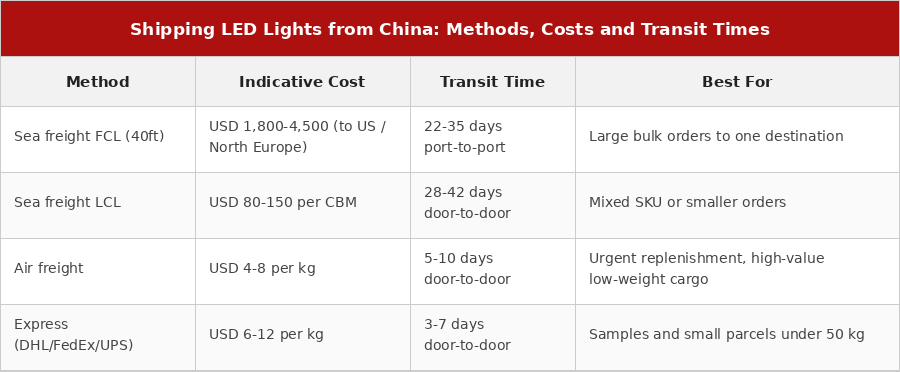
FCL rates are indicative Q2 2026 ranges for major trade lanes. They move with fuel surcharges and seasonal demand. Always confirm current rates with the freight forwarder before building a landed cost estimate.
Why DDP Has Become More Relevant in Post-De Minimis Era
Before May 2025, many small importers shipped LED lights via DHL or FedEx express under the $800 de minimis threshold, effectively paying no import duties. That exemption was removed for Chinese-origin goods on May 2, 2025. Every shipment now requires a formal customs entry and full duty payment - including express parcels.
This changes the value of DDP (Delivered Duty Paid). Under DDP, the freight forwarder handles customs clearance, pays duties on the importer's behalf, and delivers to the final destination.
The practical value of DDP has shifted. A licensed customs broker now handles formal entry and duty payment on the importer's behalf - this step is required for every China shipment regardless of size, and DDP bundles it into one arrangement.
Importers should request an itemized cost breakdown under DDP to verify what was paid in duties versus freight and handling charges.
Packaging Requirements for LED Light Shipments
LED products are fragile and moisture-sensitive. Poor packaging is one of the most common causes of damage claims for this category.
When reviewing supplier packaging before shipment:
Confirm individual units are packed in foam-lined boxes, not loose in a carton
For FCL or palletized LCL shipments, check that cartons are palletized and stretch-wrapped to prevent shifting in transit
For humid-season shipments or routes with long sea transit times, ask about desiccant sachets inside master cartons to control moisture
If the supplier uses wooden pallets, confirm they carry the ISPM 15 stamp (International Standards for Phytosanitary Measures No. 15). Pallets made from untreated raw wood without this mark can be refused entry at destination port, adding cost and delay
A pre-shipment inspection should cover packaging, not just product quality.
How to Find LED Light Suppliers from China
The first distinction to confirm is whether the counterparty is a manufacturer or a trading company. Trading companies resell products from multiple factories. This gives importers less control over quality and production timelines. Manufacturers offer more direct accountability and usually better pricing at volume.
Before placing an order, complete these checks:
Request the supplier's current business license
Check their export history on trade data platforms (Panjiva, ImportGenius) to confirm they actually ship to the destination market
Ask for certification documents tied to the specific product model being ordered - not a certificate for a different SKU
Order samples and inspect them before committing to a full production run
In our experience, the most common problem is not fraud but specification drift - where the sample and the mass-production batch differ in materials or component quality. For first orders above a meaningful value, an independent pre-shipment inspection from a third-party quality control firm is worth the cost.
LED Light Certification Requirements by Market
LED lighting is a regulated product in every major import market. Missing or incorrect certifications is one of the most common causes of customs holds.
United States: UL or ETL listing (electrical safety) and FCC Part 15 (electromagnetic interference). Both are required before products can be sold.
European Union: CE marking, RoHS, and ErP. CE is self-declared but must be supported by test reports and a Declaration of Conformity referencing the applicable EN standards. ErP covers energy efficiency requirements.
United Kingdom: UKCA marking and RoHS. Post-Brexit replacement for CE marking. CE is still accepted in some product categories - check current OPSS guidance for the specific product type.
Saudi Arabia / GCC: SASO certification. Mandatory for most electrical goods entering the Saudi market. Allow 6-8 weeks for the approval process.
Marine and offshore: CCS, ABS, DNV, or BV classification society certificate. Required for any lighting installed on vessels. The applicable body depends on the vessel's flag state.
One practical note on CE marking. A supplier can self-declare CE conformity without independent lab testing. Always ask for the Declaration of Conformity and the underlying test reports that reference the specific EN standards. A CE certificate with no supporting test documentation provides no real compliance assurance.
LED Light HS Codes and Import Duties (2026)
HS Codes for LED Lights and US Tariff Structure
The two main HS codes for LED lighting are 8539.52 (LED lamps: bulbs, tubes, bare units) and 9405.42 (LED fixtures and assembled luminaires). US importers use 10-digit HTS codes extended from these; EU importers use 8-digit CN codes. The specific code determines which tariff rate applies - verify at hts.usitc.gov before calculating duties.
Most LED lighting from China falls under Section 301 List 3. As of May 2026, the applicable tariff layers are:
MFN base rate: 0-3.9% (LED drivers and components typically 0%; complete fixtures typically 3.9%)
Section 301 surcharge (List 3): 25% for most LED fixtures and lamps
Section 122 import surcharge: 10% - a temporary global surcharge under the Trade Act of 1974, currently in effect until July 24, 2026 unless extended
All three rates apply to the CIF value (product cost plus freight plus insurance). For a standard LED fixture, the combined effective rate is approximately 35-39% on CIF value.
Verify the exact 10-digit HTS code at hts.usitc.gov before finalizing any landed cost budget. The Section 122 surcharge has a stated expiry of July 24, 2026 and should be rechecked for shipments planned beyond that date.
De Minimis Changes in the US and EU
United States: From May 2, 2025, the US removed the $800 duty-free threshold for Chinese-origin goods. Every shipment from China now requires a formal customs entry and duty payment, regardless of value.
European Union: From July 1, 2026, the EU is scheduled to officially abolish the €150 customs duty exemption on low-value imports. In place of the exemption, a temporary €3 flat-rate duty per item category is set to apply. This affects all commercial shipments from China entering the EU, regardless of declared value. Importers sourcing LED lighting for EU distribution should factor this into landed cost calculations for any orders arriving after that date.
How to Import LED Lights from China Step by Step
Step 1 - Confirm certifications before production starts Do not wait until goods are ready to ship. Check certification status at the quotation stage to avoid delays later.
Step 2 - Find the correct HS code and calculate duties Look up the 10-digit HTS code (US) or 8-digit CN code (EU) before placing the order. Getting this wrong at customs is expensive to fix.
Step 3 - Confirm whether the products contain lithium batteries Inform the freight forwarder early. DG classification changes routing options, documentation list, and carrier choice.
Step 4 - Book freight under FOB terms Provide the freight forwarder with the full cargo details: CBM, weight, product description, HS code, and DG status. For sea freight, book at least two to three weeks before the cargo readiness date.
Step 5 - Arrange a pre-shipment inspection For first orders or new SKUs, an independent inspection at the factory before loading is a practical safeguard.
Step 6 - Prepare the customs document set Standard documents: commercial invoice, packing list, bill of lading or airway bill, certificate of origin. DG cargo adds: MSDS, DG declaration, UN 38.3 test report. Destination certifications (UL, CE, SASO) should be ready before the customs filing.
Step 7 - Clear customs and arrange final delivery Allow three to seven days for customs clearance at destination. Arrange inland transport before the vessel arrives to avoid port storage fees.
LED Light Landed Cost Calculation for US Imports
The scenario below uses a USD 10,000 FOB order of LED high-bay fixtures (assembled luminaires, MFN rate 3.9%) shipped by LCL to the US West Coast, based on the May 2026 tariff structure.
Product cost (FOB Shenzhen): USD 10,000
Ocean freight (LCL, approx. 5 CBM): USD 580
Marine cargo insurance (1%): USD 106
CIF value: USD 10,686 (duty calculation base)
MFN base duty (3.9% on CIF): USD 417
Section 301 surcharge (25% on CIF): USD 2,672
Section 122 import surcharge (10% on CIF): USD 1,069
Merchandise Processing Fee (0.3464%, min. USD 33.58): USD 37
Harbor Maintenance Fee (0.125%): USD 13
Customs brokerage: USD 220
Approximate total landed cost: USD 15,014 - a landed cost uplift of roughly 50% above the FOB price.
The Section 122 surcharge is scheduled to expire on July 24, 2026. For shipments planned after that date, recheck whether it has been extended. All other rates are confirmed as of May 2026.
Choosing a Freight Forwarder in China for LED Light Shipments
Gerudo Logistics specializes in dangerous goods and specialist cargo shipping from China to global markets. We operate from Guangzhou, Shenzhen, Shanghai, Ningbo, Qingdao, and Dalian, with door-to-door execution to the US, Europe, the Middle East, and India.
For standard commercial LED cargo, we handle FCL and LCL bookings across all major China export ports, manage customs documentation, and deliver under DDP terms where required.
For LED products containing lithium batteries, our team manages the full DG compliance process:
Cargo classification under IMDG and IATA
Preparation of DG documentation: MSDS, declarations, and packing instruction verification
Carrier booking on routes that accept Class 9 battery cargo
We also handle marine and industrial LED shipments that require classification society documentation. We treat all DG-classified cargo according to its actual transport requirements, not as standard freight.
To discuss your LED light shipment, contact our team for a quote.
Frequently Asked Questions for LED Lights Shipping
What HS code applies to LED lights from China?
The main 6-digit codes are 8539.52 (LED lamps) and 9405.42 (LED fixtures). US importers extend these to 10-digit HTS codes; EU importers use 8-digit CN codes. Verify the correct code at hts.usitc.gov (US) or the EU TARIC database before calculating duties.
Does the $800 de minimis exemption still apply to Chinese goods?
No. The exemption was removed for Chinese-origin goods on May 2, 2025. All shipments from China now require a formal customs entry and full duty payment, regardless of value.
What are the current US tariff rates for Chinese LED lights?
As of May 2026, LED fixtures from China face three stacked tariffs: an MFN base rate of 0-3.9%, a Section 301 surcharge of 25%, and a Section 122 import surcharge of 10% (in effect until July 24, 2026 unless extended). The combined effective rate for most assembled fixtures is approximately 35-39% on CIF value. Verify the specific HTS code at hts.usitc.gov.
Are LED lights classified as dangerous goods?
Standard LED fixtures without batteries ship as general cargo. LED products with built-in lithium batteries - emergency lights, solar marine lanterns, battery-backup units - are Class 9 DG under UN 3481 or UN 3480/3090. These require UN 38.3 certification, an MSDS, and DG-compliant packaging.
What certifications are needed to sell Chinese LED lights in the US?
UL or ETL safety listing and FCC Part 15 compliance are required for the US market. For marine applications, additional certification from an approved classification society (CCS, ABS, DNV, or BV) is required.
How do I verify a Chinese supplier's certifications are genuine?
Ask for the full test report, not just the certificate. CE declarations should list the specific EN standards tested and the name of the test lab. UL and ETL certificates can be checked by certificate number in UL's Product iQ database and Intertek's online search tool.
Which shipping mode works best for large LED orders?
Sea freight FCL is the most cost-effective option for large, single-destination bulk orders. LCL suits smaller or mixed-SKU orders that do not fill a container. Air freight is practical for urgent replenishment where the cost of being out of stock justifies the freight premium.
Conclusion
The cost advantage of importing LED lights from China is real. Realizing it depends on a few fundamentals: the correct HS code, verified certifications before production begins, and a logistics setup that matches the specific cargo type.
The most avoidable problems come from compliance gaps found after goods are ready to ship. Checking certifications, HS codes, and DG status at the quotation stage removes the most costly delays. For LED products containing lithium batteries, early involvement from a DG-capable freight forwarder is a practical requirement.