How to Import a Power Transformer from China: Step-by-Step Guide 2026
Chinese manufacturers supply power transformers to utility grids, industrial facilities, and renewable energy projects across the Middle East, Africa, Europe, and the Americas. The price advantage over Western or Japanese alternatives is real. So is the complexity of moving the unit from a Chinese factory to your project site.
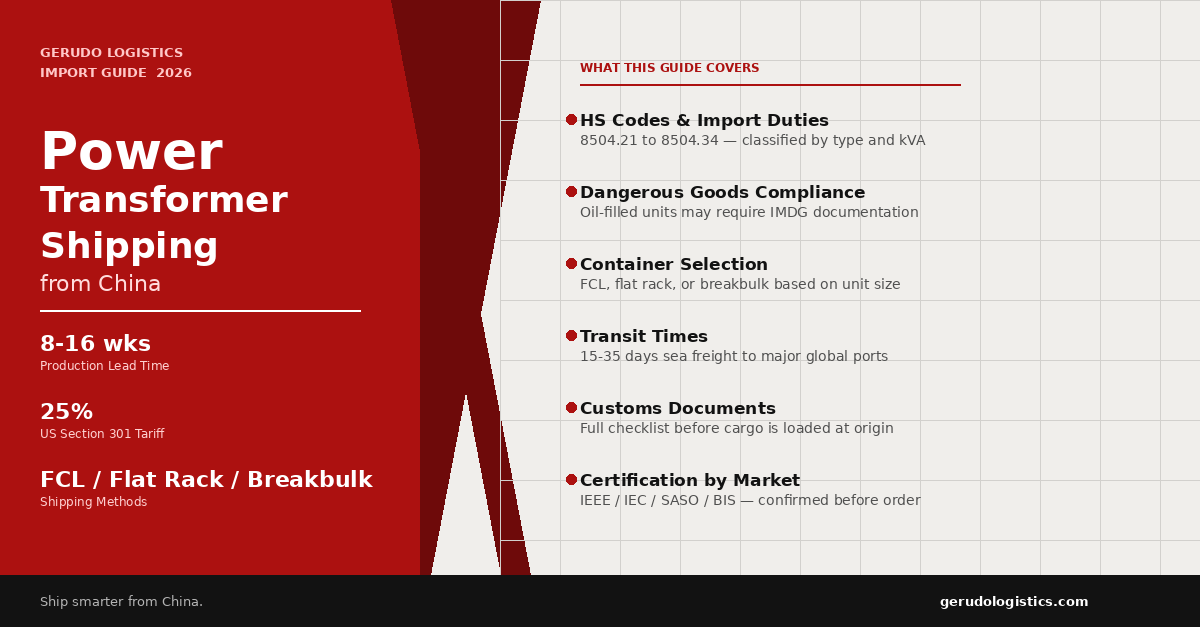
Transformer imports involve custom production schedules, oversized cargo handling, and in some cases dangerous goods compliance for oil-filled units. This guide covers the full process: container selection, freight costs, transit times, documentation, and compliance checks before the unit leaves the factory.
Types of Power Transformers You Can Import from China
China manufactures four main categories of power transformers for export. The type you are buying determines which shipping method applies, what packaging is required, and whether additional compliance documents are needed.
Dry-type transformers use air or resin for cooling instead of oil. They are the simplest to ship. Carriers accept them without restrictions, and no oil-related documentation is required.
Amorphous alloy transformers are a newer design built for low energy loss. From a shipping perspective, they follow the same rules as dry-type or oil-immersed units depending on their cooling method.
Large substation transformers above 10,000 kVA are the most complex category to move. Some units weigh hundreds of tonnes and cannot fit inside any standard container. They require specialised transport arrangements planned well in advance of the production completion date.
Oil-Filled Transformers and Dangerous Goods Rules
Oil-immersed transformers are the most common type used in power distribution and utility infrastructure. They are filled with mineral oil, which acts as both a coolant and an insulator. This oil classification creates an additional compliance step that catches many importers off guard.
Mineral oil is a combustible liquid. Depending on its flash point, it may fall underClass 3 flammable liquid classification under international shipping regulations.
Under the IMDG Code - the global standard for ocean transport of hazardous materials - oil-filled transformers may require dangerous goods treatment depending on the oil volume and flash point of the specific unit.
Not every oil-filled transformer automatically triggers DG requirements. The classification depends on the technical parameters of your unit. But this is not something to determine at the port. If DG status applies, the shipment requires a Dangerous Goods Declaration and UN-compliant packaging. Some carriers also impose their own restrictions ondangerous goods cargo, which limits vessel and route options.
The right approach is to confirm oil volume and flash point with your supplier before contacting a freight forwarder. Share those details at the first inquiry so DG classification can be assessed before any booking is made.
Shipping Methods for Importing Transformers from China
The size and weight of your transformer determines which method is physically available. This is a feasibility question before it is a cost question.
FCL (Full Container Load) is the standard option for most distribution-class transformers. A 40HQ container accommodates units up to approximately 25 tonnes within standard internal dimensions. This is the most straightforward option and the easiest for carriers to handle.
Flat rack containers are used when a transformer is too tall or too wide to fit inside a standard box container. The unit sits on an open steel platform with no side walls, requiring specialist lashing and weatherproofing. Not every port has crane equipment capable of handling flat rack cargo, so destination port capabilities must be confirmed before booking.
Breakbulk applies to very large substation transformers that are too heavy or too large for any container format. The unit is loaded directly onto the vessel as a single piece of cargo.
Breakbulk requires advance coordination with port authorities at both origin and destination, and the lead time to arrange a sailing is typically several weeks longer than a standard container booking.
A freight forwarder with experience in heavy and oversized cargo will confirm which method applies after reviewing the unit's weight, dimensions, and the capabilities of your destination port.
Power Transformer Import Shipping Cost from China to Major Markets
Freight cost is directly tied to the container type your transformer requires. The table below shows approximate port-to-port ocean freight rates for standard FCL shipments as of early 2026. These figures cover the ocean leg only and do not include terminal handling, customs clearance, inland delivery, or insurance.
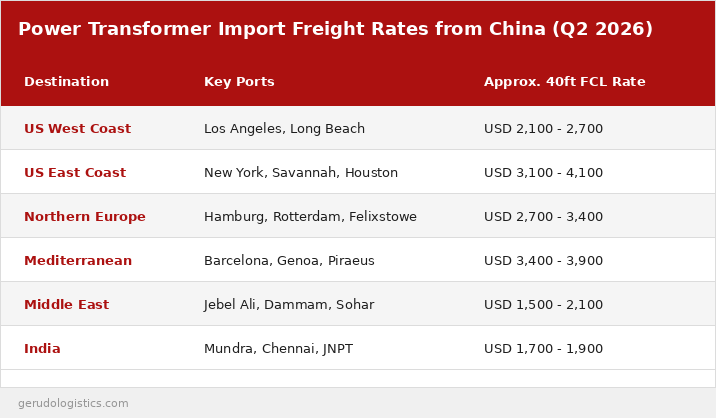
For flat rack shipments, the cost is significantly higher. Flat rack and open-top containers carry a premium of 150% to 250% above the standard FCL rate for the same route. A flat rack shipment to the US West Coast may cost USD 5,000 to USD 9,000 or more for the ocean freight leg alone.
For breakbulk shipments of large substation transformers, there is no fixed rate. Every shipment is quoted individually based on unit dimensions, weight, vessel type required, and port conditions at both ends.
Beyond the base ocean freight, a complete landed cost estimate should also account for:
Terminal Handling Charges (THC): USD 80-300 at origin, USD 150-500 at destination
Bunker Adjustment Factor (BAF): USD 200-800 per container depending on fuel market
Heavy lift surcharge: Applies when unit weight approaches the structural limit of the container or lifting equipment
DG handling surcharge: Applies when the shipment is classified as dangerous goods
Customs clearance fees, import duties, marine insurance, and inland delivery to site
The ocean freight component is typically 15% to 25% of the total landed cost for high-value transformer cargo. Import duties often represent a larger share of the total than the freight itself.
Lead Times and Transit Times When Importing Transformers from China
The total timeline has two parts. Most importers underestimate the first.
Production lead time for a custom-specification transformer is typically 8 to 16 weeks from order confirmation. Standard catalogue units ship faster. Purpose-built units for specific voltage ratings, capacity requirements, or certification standards take longer. Get the production schedule in writing before locking in any project deadlines.
Sea freight transit times from major Chinese ports to key global destinations:
Southeast Asia and India: 10 to 20 days port to port
Middle East: 18 to 28 days port to port
Northern Europe: 28 to 35 days port to port
US West Coast: 15 to 20 days port to port
US East Coast: 28 to 35 days port to port
East Africa: 20 to 30 days port to port
Add 3 to 7 days for customs clearance at the destination port, plus inland haulage time to your site. For breakbulk cargo, add additional time for vessel scheduling and specialist unloading at destination.
The total door-to-door timeline for a custom transformer order is typically 5 to 7 months from purchase order to site delivery. Build this into your project schedule from the start.
Sourcing from Chinese Power Transformer Manufacturers
China has a well-established transformer manufacturing base supplying export markets across the Middle East, Africa, Southeast Asia, Europe, and the Americas. Several manufacturers have built significant international track records.
TBEA is one of the largest power transformer manufacturers in the world by output. Their product range covers three-phase distribution transformers, high-voltage power transformers, and ultra-high voltage substation units. TBEA holds certifications for multiple international markets and supplies major grid infrastructure projects globally.
Baoding Tianwei is one of China's most established power transformer manufacturers, specialising in large oil-immersed power transformers and substation transformers. Their product lines cover three-phase high-voltage units up to 1,000kV and supply to utility and industrial projects across Asia, the Middle East, and Africa.
Sieyuan Electric specialises in high-voltage and extra-high voltage transformers, along with switchgear equipment. Their export product range includes three-phase power transformers and substation transformers certified to IEEE and IEC standards for European and North American markets.
XD Group is a state-owned manufacturer focused on high-voltage and ultra-high voltage power transmission equipment. Their range includes large three-phase power transformers, substation transformers, and power station step-up transformers for grid and industrial power projects worldwide.
When sourcing from any Chinese manufacturer, always request the Type Test Report for the specific model, voltage class, and kVA capacity you need. Certification claims vary by product line. A manufacturer certified for one voltage range may not hold the same certification for a different configuration.
Where to Source Chinese Power Transformers
Most importers source through three channels: direct factory contact, B2B platforms, and trade shows.
Alibaba and Made-in-China.com list hundreds of transformer manufacturers. Both platforms allow you to filter by certification, export experience, and verified factory status. For large or custom orders, always move from the platform to direct communication early. Procurement of high-voltage equipment requires technical dialogue that cannot happen through a message thread.
The Canton Fair, held twice a year in Guangzhou, is the most practical venue for meeting transformer manufacturers in person. Power and electrical equipment falls under Phase 1. The 139th Spring session Phase 1 ran April 15-19, 2026, with the Autumn session Phase 1 scheduled for October 15-19. For buyers planning procurement trips, the fair allows you to compare product specifications, inspect build quality, and meet export teams from multiple manufacturers in a single visit.
Direct factory visits remain the most reliable way to assess production capability for large or custom orders. Major manufacturing clusters for power transformers are located in Shandong, Hebei, and Guangdong provinces.
Packaging Requirements for Importing Transformers from China
Poor packaging is one of the main causes of transformer damage in transit. These are the minimum requirements to confirm with your supplier before the unit is loaded.
Crating: The transformer must be secured in an ISPM-15 certified wooden crate or a welded steel frame. Many destination countries will reject shipments if the crating material does not meet this standard.
Internal protection: Vibration-dampening pads between the tank and crate base, plus internal bracing, prevent the unit from shifting during loading and ocean transit.
Oil-immersed units: Large oil-filled transformers are typically drained before shipping, then protected with a nitrogen gas blanket to preserve internal components. The unit must be refilled with oil at destination before commissioning. Confirm with your supplier whether the unit ships oil-filled or nitrogen-blanked, as this affects both documentation and your receiving procedure.
Impact recorders: These devices log G-force readings throughout transit. If damage is found on delivery, the data identifies when and where the shock occurred - critical evidence for any insurance or liability claim.
Customs Clearance Documents for Transformer Imports from China
Missing or incorrect documents are the most common cause of preventable customs delays for transformer shipments. Prepare this checklist before the cargo is loaded at origin.
Commercial Invoice: Must show the correct HS code, unit description, quantity, and declared value in the transaction currency
Packing List: Shows gross weight, net weight, dimensions, and number of packages
Bill of Lading: Issued by the carrier; this is the title document for your cargo
Certificate of Origin: May be required for preferential duty rates depending on your destination country's trade agreements with China
Factory Test Reports (Type Test Reports): Required for customs classification and to demonstrate that the unit meets the applicable technical standard
Dangerous Goods Declaration: Required if the unit is classified as DG under the IMDG Code
MSDS (Material Safety Data Sheet): Required for all oil-immersed transformers regardless of DG classification status
Factory Test Reports deserve particular attention. Customs authorities in the US, EU, and several other markets may request these documents to verify that the declared HS code is consistent with the actual unit specifications. If the report is not available at the time of customs filing, clearance will stop until it is produced.
Standards Compliance and Marine Insurance for Transformer Imports
IEEE, ANSI and IEC Certification
If you are importing into the United States or Canada, your transformer most likely needs to meet IEEE or ANSI standards. For European markets, IEC standards apply. Leading Chinese manufacturers produce export units tested to these standards, but you need to verify compliance independently before the unit ships.
The correct way to verify is to request the Type Test Report for the specific model and capacity you are ordering.
This document records that a representative unit was tested against the relevant standard at a certified laboratory, identifying the standard applied, the laboratory, and the test results. A supplier who cannot produce a Type Test Report for your specific configuration cannot demonstrate compliance.
For high-value orders, some importers arrange third-party factory inspection before shipment. An independent inspector attends the factory acceptance test and confirms the results on your behalf. This adds a modest cost but removes the risk of discovering a compliance problem after the transformer has already left China.
HS Codes and Import Duties
Every transformer imported from China is classified under HS Chapter 8504. The correct code depends on the cooling method and power capacity in kVA.
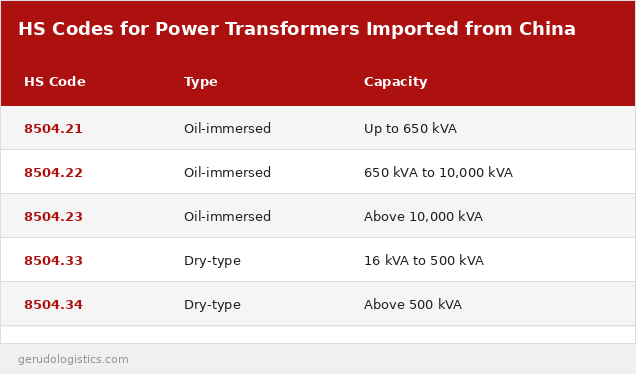
For US-bound shipments, most Chinese-origin electrical equipment is subject to Section 301 tariffs of 25% on top of the standard import duty rate. A transformer valued at USD 100,000 carries USD 25,000 in Section 301 tariffs alone.
For EU shipments, standard customs duties on transformers are generally 0% to 2.7%, with VAT applied on top of the CIF value.
For the Middle East and Southeast Asia, duty rates vary by country and should be confirmed with your customs broker before finalising any landed cost calculation.
Marine Insurance
Standard freight contracts provide only minimal coverage calculated on weight, not value. For a transformer worth USD 200,000, this will not come close to replacing the unit if it is damaged in transit.
The correct policy for transformer cargo is All-Risk Marine Insurance. This covers physical damage, theft, loading and unloading accidents, and general average claims.
General average is a maritime law principle under which all cargo owners share the cost if part of a ship's cargo is sacrificed to save the voyage. Without All-Risk coverage, your cargo can be held at port until you pay a substantial bond.
All-Risk Marine Insurance for transformer shipments typically costs 0.3% to 0.6% of the CIF value. For a USD 200,000 transformer, this is USD 600 to USD 1,200. Given the 5 to 7 month replacement cycle for a custom unit, this is a cost worth paying.
How to Find the Right Freight Forwarder in China for Transformer Shipments
Power transformer shipments require two things most general freight forwarders are not equipped to handle: heavy and oversized project cargo and, for oil-filled units, dangerous goods compliance.
Gerudo Logistics is a DG and specialised cargo freight forwarder headquartered in Guangzhou, with operations across Shenzhen, Shanghai, Ningbo, Qingdao, and Dalian. We handle transformer shipments in all configurations: FCL, flat rack, and breakbulk. For oil-immersed units, we assess DG classification before booking and prepare all required documentation under IMDG, IATA, and ADR frameworks.
Shipments are executed on a door-to-door DDP basis to the Middle East, India, Europe, and the United States, with milestone updates at every stage.
Contact our forwarder specialist now!
Frequently Asked Questions
How long does it take to ship a power transformer from China?
Sea freight takes 15 to 35 days depending on the destination port. Add 8 to 16 weeks for custom production, plus customs clearance and inland delivery at destination. Total door-to-door time for a custom order is typically 5 to 7 months.
What HS code applies to my power transformer?
Oil-immersed transformers use 8504.21, 8504.22, or 8504.23 depending on kVA rating. Dry-type transformers use 8504.33 or 8504.34. Confirm the correct code with your customs broker before the shipment leaves China.
Can oil-filled transformers be shipped as standard cargo?
Not always. Depending on oil volume and flash point, an oil-filled transformer may require dangerous goods documentation under the IMDG Code. Confirm DG status with your freight forwarder before booking, not after the cargo reaches port.
What packaging is required for transformer shipping?
Units must be crated in ISPM-15 certified timber or welded steel frames with vibration-dampening pads and internal bracing. Large oil-immersed units are typically shipped with a nitrogen gas blanket after the oil is drained for transit.
How are oversized transformers shipped?
Units that exceed standard container dimensions ship on flat rack containers. Very large substation transformers that cannot be containerised ship as breakbulk cargo, loaded directly onto a vessel. Both arrangements require advance planning with port authorities at origin and destination.
Are Chinese power transformers compliant with IEEE and ANSI standards?
Leading manufacturers produce units tested to IEEE, ANSI, IEC, and CSA standards for specific export markets. To verify compliance, request the Type Test Report for the exact model and capacity you are buying. A general certification claim from a supplier is not sufficient.
What documents are required for customs clearance?
The standard set is: Commercial Invoice, Packing List, Bill of Lading, Certificate of Origin, and Factory Test Reports. Oil-immersed units classified as DG additionally need a Dangerous Goods Declaration and MSDS.
Do I need to pay Section 301 tariffs when importing to the USA?
Yes. As of 2026, most Chinese-origin electrical equipment including transformers is subject to Section 301 tariffs of 25% on top of the standard import duty rate. Include this in your landed cost calculation before finalising the purchase.
Is marine insurance mandatory for transformer shipments? It is not legally required, but All-Risk Marine Insurance is strongly recommended given the high unit value and the 5 to 7 month replacement lead time for custom units. Coverage typically costs 0.3% to 0.6% of the CIF value.
How can I monitor my transformer during transit?
Impact recorders installed on the transformer tank log G-force readings throughout loading, sea transit, and inland haulage. If damage is found on delivery, the data identifies when and where it occurred - which is critical evidence for any insurance or carrier liability claim.
Conclusion
Shipping a power transformer from China is manageable with the right planning. Production runs 8 to 16 weeks for custom units. The shipping method depends on size and weight. Documentation depends on whether the unit contains oil. And the total landed cost includes import duties, handling, insurance, and inland delivery - not just the ocean freight rate.
The importers who avoid delays and cost surprises work with a freight forwarder who knows this cargo category: one who can assess DG classification, select the correct container type, prepare a complete document set, and manage customs clearance at the destination.