China Shipping Market Update July 2026
July 2026 is moving into a tighter logistics window for shipments from China. Ocean rates are still rising across the Transpacific and Asia-Europe lanes, US-bound cargo is being pulled forward before the July 24 tariff deadline, and two US compliance changes now affect consumer product entries and hazardous material parcels.
For dangerous goods, reefer cargo, small parcels, electronics, toys, appliances, and regulated consumer products, July now brings a combined cost, compliance, booking, and delivery risk.
Booking timing, product classification, certificate data, HazMat declaration, and final-mile delivery compliance now have a direct impact on cost and release timing.
This month’s five key developments at a glance:
Ocean Freight Rates Keep Rising - Drewry’s World Container Index reached $4,530 per 40ft container on July 2, with Transpacific and Asia-Europe rates still moving up.
US Importers Frontload Cargo Before the July 24 Tariff Deadline - The temporary Section 122 additional 10% duty remains in effect through July 24, 2026, unless changed earlier or extended.
CPSC eFiling Becomes Mandatory for US Consumer Product Imports - From July 8, 2026, importers of consumer products subject to CPSC certification requirements must electronically file certificate data.
USPS HazMat Parcels Add Final-Mile Cost Risk - From July 12, USPS adds HazMat handling and noncompliance fees for certain US parcel services, affecting small DG parcels, samples, returns, and USPS-connected final-mile delivery.
Asia-Europe Routes Face Suez Uncertainty While Air Freight Demand Remains Elevated - Selected Suez sailings are returning, Red Sea risk remains unresolved, and air cargo demand remains above last year’s level.
Ocean Freight Rates Keep Rising as July GRIs and PSS Take Hold
The July ocean freight market is still moving upward. Drewry’s World Container Index reached $4,530 per 40ft container on July 2, a 9% week-on-week increase driven by rate increases on both Transpacific and Asia-Europe routes.
On the Transpacific lane, Shanghai to New York rose to $7,902 per 40ft container, while Shanghai to Los Angeles increased to $6,349 per 40ft container. Blank sailings are still reducing available space, especially for cargo that needs a specific vessel window.
On Asia-Europe, Shanghai to Genoa rose to $6,360 per 40ft container, and Shanghai to Rotterdam increased to $4,682 per 40ft container. Carriers are still applying higher FAK rates and peak season surcharges, with additional PSS activity scheduled in July.
For DG and chemical cargo, the headline rate does not show the full cost impact. Dangerous goods surcharges, special acceptance requirements, documentation review, and earlier cut-off windows sit on top of the base ocean rate, GRI, PSS, and bunker adjustment.
For reefer cargo, rate pressure is one part of a wider operational problem. Equipment availability, plug planning, port dwell, and pickup timing can affect whether the shipment remains safe after loading and after discharge.
Before confirming a July booking, importers should check whether the quoted rate includes GRI, PSS, bunker, DG surcharge, reefer surcharge, and destination charges. They should also confirm whether the booking is tied to a specific vessel, or based on estimated space.
US Importers Frontload Cargo Before the July 24 Tariff Deadline
US-bound cargo remains under frontloading pressure. Transpacific demand is still elevated as importers move seasonal inventory earlier and respond to tariff and fuel-related uncertainty. Space is tight across Asia-North America services, and spot rates have reached their highest level this year.
The policy date behind this behaviour is July 24, 2026. The Section 122 additional 10% ad valorem duty applies to covered imported articles entered for consumption, or withdrawn from warehouse for consumption, from February 24 through July 24, 2026, unless exempt.
The July 24 date is shaping booking behaviour now, and the cost picture after that date remains uncertain. Cargo that misses a target entry window may still face rate changes, policy uncertainty, inspection delays, or destination-side cost changes.
This affects a wide range of US-bound shipments from China, including:
electronics and small appliances
consumer products subject to CPSC rules
lithium battery products
DG parcels and HazMat small packages
seasonal retail goods
samples and urgent replenishment cargo
If the cargo is still in production, the first question is whether the shipment can realistically arrive, clear, and enter the market before the target tariff window. The relevant timeline goes beyond sailing date. Cargo ready date, vessel departure, ETA, customs entry, inspection risk, and final delivery all matter.
US-bound shipment planning should separate ocean freight, destination charges, customs duty, Section 122 duty, and product-specific tariffs. A low freight quote has limited value if the entry timing or tariff assumption is wrong.
CPSC eFiling Becomes Mandatory for US Consumer Product Imports
July 2026 also brings a major US consumer product compliance change.
For imported general consumer products, the effective date for updated certificate and eFiling requirements is July 8, 2026. Importers of consumer products subject to CPSC certification requirements must electronically file certificate data from the applicable effective date.
This is a significant shift for regulated consumer products. Certificate data can no longer be treated only as a record kept for later review. If the product is subject to CPSC certification, the importer must be ready to provide certificate data during the import process.
The July 8 date applies to imported general consumer products covered by the rule. Products entered from a Foreign Trade Zone have a later effective date of January 8, 2027.
The impact extends beyond toys. Depending on the product and applicable rule, eFiling may be relevant to children’s products, electrical goods, household products, sports goods, furniture, battery-powered consumer products, and other regulated categories.
Importers can transmit either a Full PGA Message Set or a Reference PGA Message Set in CBP’s ACE system. The Full PGA Message Set includes seven required product certificate data elements:
Product ID
Citation Codes
Manufacture Date
Manufacture Place
Product Test Date
Testing Laboratory
Point of Contact
The logistics risk is data readiness. If the supplier, testing lab, product model, manufacture date, or certificate basis is unclear, the shipment may face more questions during entry.
Before shipping regulated consumer products to the US, the importer should confirm whether the product requires a CPC, GCC, or other CPSC certificate. Product ID, testing basis, manufacturer details, testing lab, and certificate contact should also match the invoice, packing list, certificate, and broker data.
USPS HazMat Parcels Add Final-Mile Cost Risk
USPS will implement new competitive product pricing and mailing standard changes from July 12, 2026. The direct impact sits in the US domestic parcel leg after arrival, especially when the final-mile service uses USPS.
For commercial Priority Mail Express and commercial Priority Mail, the HazMat Handling Fee is listed at $7.50. The HazMat Noncompliance Fee is listed at $50.00 when hazardous materials are detected but were not properly declared and handled.
USPS Ground Advantage is different. The HazMat Handling Fee is listed at $0.00 for commercial USPS Ground Advantage, but the $50.00 HazMat Noncompliance Fee still applies.
This matters for small parcels, samples, returns, e-commerce fulfilment, and low-weight DG items that enter the US and then move through USPS-connected delivery services.
Products that may be affected include:
perfumes and fragrances
aerosols
nail polish and cosmetics with flammable ingredients
lithium battery products
cleaning products
essential oils
alcohol-based liquids
small electronic devices packed with batteries
The risk is often created after the international leg. A shipment may be correctly arranged from China, while the US parcel leg may still fail if the product is not declared, labelled, or routed as HazMat in the domestic network.
Before using USPS-connected final-mile delivery, importers should check whether the final-mile carrier is USPS, a private parcel carrier, or a mixed handoff service. HazMat markings, service type, and electronic shipment data must match the actual product classification.
Asia-Europe Routes Face Suez Uncertainty While Air Freight Demand Remains Elevated
Asia-Europe routing is entering a transition period. Selected Suez Canal sailings are returning under the Gemini network, including a service linking Asia, the Mediterranean, and Europe. This may shorten transit time for selected services compared with the Cape of Good Hope diversion.
Asia-Europe shipping still remains unstable. Other services remain unchanged, and further routing adjustments still depend on regional stability. Q3 planning should stay flexible until the route pattern becomes more stable.
The rate impact may also move in opposite directions. A partial return to Suez can reduce voyage distance and vessel absorption, while peak season demand, security risk, port pressure, and carrier capacity discipline continue to support high rates in July.
European destination operations also need attention. Several Mediterranean and North European ports are facing summer pressure, including heat-related productivity issues, labour constraints, pilot availability limits, and yard congestion.
For reefer cargo, destination port delay is a direct risk. The weak point may be terminal dwell, pickup appointment availability, reefer monitoring, or delayed delivery after discharge.
For DG cargo, route and port changes can affect approval windows, carrier acceptance, local handling permissions, and documentation timing. A vessel schedule that looks shorter on paper may still require careful checking if the cargo is chemical, battery, aerosol, flammable liquid, or temperature-sensitive.
Air freight also remains active. Global air cargo demand increased year-on-year in May 2026, with Asia-Pacific, Europe, and North America all showing demand growth. Middle East air cargo, however, remains affected by regional disruption.
Air freight from China remains active and sensitive to commodity restrictions. High-value, urgent, sample, and temperature-sensitive shipments should move with accurate cargo data, especially when the shipment includes batteries, dry ice, chemicals, cosmetics, or DG accessories.
For Asia-Europe ocean cargo, confirm whether the routing is via Suez, Cape of Good Hope, or another adjusted service. For air cargo, confirm commodity restrictions, DG acceptance, battery status, and uplift space before cargo reaches the airport.
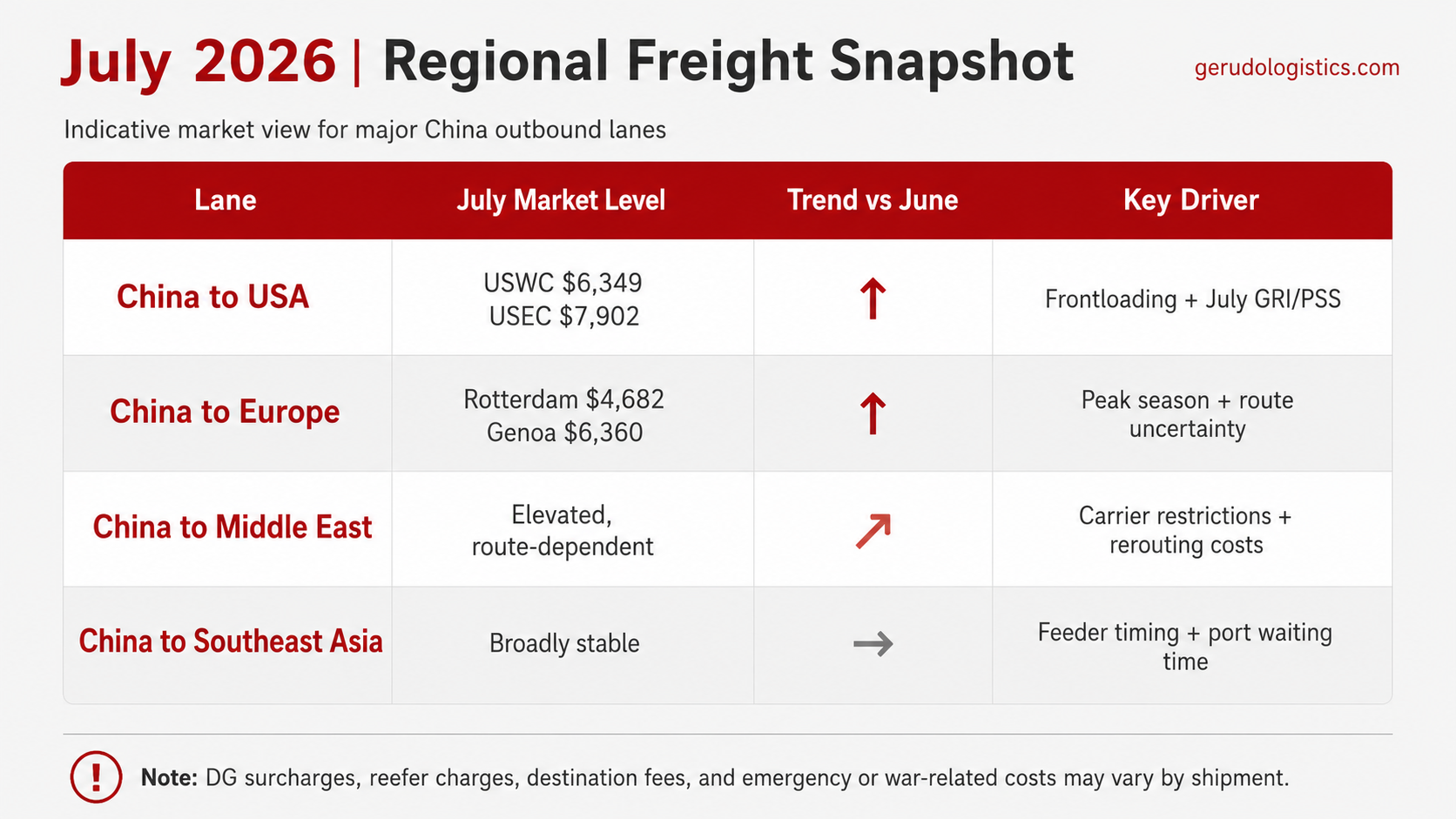
Regional Freight Rate Snapshot - July 2026
China to Europe
Rates remain high, with routing uncertainty. Shanghai to Rotterdam reached $4,682 per 40ft container, and Shanghai to Genoa reached $6,360 per 40ft container in Drewry’s July 2 assessment. Asia-Europe rates are still being supported by peak season demand, FAK increases, and PSS activity.
The route picture is more complex than the rate number. Selected Suez sailings are returning, but Red Sea security remains an active variable. European port operations also face summer pressure, with Rotterdam, Antwerp, and Genoa all requiring more buffer time in July.
For reefer and DG cargo to Europe, confirm the actual route, ETA reliability, destination free time, and cargo release plan before accepting a rate.
China to USA
Rates are sharply up. Drewry reported Shanghai to Los Angeles at $6,349 per 40ft container and Shanghai to New York at $7,902 per 40ft container on July 2. Transpacific capacity is tight, and blank sailings are still affecting available space.
US-bound demand is being pulled forward by tariff timing, fuel cost uncertainty, and seasonal inventory planning. The practical question is all-in landed cost.
Freight, PSS, customs duty, Section 122 duty, CPSC eFiling readiness, and domestic parcel compliance may all affect the same shipment.
China to Middle East
Rates remain elevated for special cargo, even where base ocean freight is less clear. Middle East shipping remains shaped by rerouting risk, carrier restrictions, emergency charges, and different acceptance rules by destination and cargo type.
The most affected markets include Iraq, Kuwait, Qatar, Bahrain, the UAE, and parts of Saudi Arabia. Some selected gateways remain available depending on cargo type, routing, and carrier acceptance.
For Middle East DG and reefer cargo, the base rate is only one part of the cost. Importers should ask for carrier acceptance, routing, emergency charges, plug availability, storage exposure, and inland recovery options before shipment.
China to Southeast Asia
Rates are broadly stable, but operational pressure is rising. Short-haul intra-Asia routes are less exposed to the sharp East-West rate movements, but feeder timing, port waiting time, and inland connections still need attention.
Several major Asia ports are operating with short waiting times, while some ports continue to show one to three days of vessel waiting time. Qingdao and Manila have shown longer waiting times in recent market updates.
For shipments using Southeast Asia routes, the rate may look stable, but the schedule still needs checking. This is especially important for reefer shipments, DG cargo, and cargo connecting from Southeast Asia to the US or Europe.
Frequently Asked Questions for July China-Shipping
Is July 2026 a good time to wait for ocean rates to fall?
For most urgent cargo, waiting is risky. July rates are still moving upward on both Transpacific and Asia-Europe lanes, and carriers continue to apply GRIs and PSS.
Does the July 24 Section 122 tariff deadline mean US import costs will drop after that date?
Current information does not support a fixed conclusion yet. The current timing points to July 24, but the duty may be changed, suspended, terminated, or extended depending on policy decisions.
Does CPSC eFiling apply to every product imported into the US?
It applies only to consumer products that are subject to CPSC certification requirements. Importers should check whether the specific product needs a CPC, GCC, or other CPSC certificate before shipment.
Does CPSC eFiling apply to low-value Section 321 shipments?
Yes, if the product requires certification. Low-value entry does not remove the eFiling requirement when the product is subject to CPSC certification rules.
Does the USPS HazMat fee apply to ocean freight containers?
The USPS change applies to USPS parcel services, mainly affecting small packages, returns, samples, and domestic delivery legs handled through USPS.
Can Asia-Europe shipments now assume shorter transit time because Suez sailings are returning?
Selected services may have shorter transit times, but a full network return to Suez has not happened. Importers should confirm the actual routing for each booking instead of assuming the same transit time across all Asia-Europe services.
Conclusion
July 2026 combines rate pressure, US tariff timing, consumer product compliance, USPS parcel HazMat enforcement, and route uncertainty into one planning window. For general cargo, the main issue is cost. For DG, chemical, reefer, battery, and regulated consumer products, the larger risk is a shipment that is booked but cannot move, clear, or deliver as planned.
The priority for July shipments is to verify the shipment file before cargo moves. HS codes, CPSC certificate data, product identifiers, DG classification, HazMat labels, carrier acceptance, and final-mile service selection should be checked before booking decisions are made.
Importers shipping from China in July should avoid treating freight cost, customs compliance, and cargo acceptance as separate issues. In the current market, they affect the same shipment timeline.