The 2026 Guide to FCL Shipping from China to Europe
Importers shipping full containers from China to Europe in 2026 are managing two compounding realities at once. T
he Cape of Good Hope rerouting that added 10 to 14 days to most Asia-Europe voyages has not resolved. And from January 1, 2026, the EU Emissions Trading System (EU ETS) moved to 100% emissions coverage, converting what was a minor line item in 2024 into a recurring cost that now represents 6 to 12% of base freight on some lanes.
These are structural changes that have reshaped the cost and schedule assumptions for this trade lane. Planning an FCL shipment to Rotterdam, Hamburg, or Antwerp this year means budgeting and scheduling differently than in 2023 or even 2025.
This guide covers current rate benchmarks, how the EU ETS surcharge works in practice, the sea-versus-rail decision, container selection logic, and the compliance checklist that applies before your cargo leaves a Chinese port.
What Does an FCL Shipment from China to Europe Actually Cost Right Now?
Ocean freight rates on the Asia-Europe trade lane have stabilized well below the 2021 to 2023 crisis-period peaks. As of Q1 2026, however, rates are trending upward again. According to Drewry's World Container Index assessed the week of March 26, 2026, the Shanghai-Rotterdam spot rate stood at $2,552 per 40ft container. Shanghai-Genoa came in higher at $3,474, reflecting the longer ETS-applicable voyage distance to the Mediterranean.
For planning purposes, market benchmarks for the ocean leg to major North European ports (Rotterdam, Hamburg, Antwerp) currently run in the range of $2,100 to $3,500 per 40HQ. The final figure depends on your origin port, chosen carrier, and booking timing. Mediterranean destinations tend to attract higher rates due to additional port calls and longer in-scope voyage legs under the EU ETS.
These figures cover the ocean leg only. Once you add the full surcharge stack, the all-in cost per container will be materially higher. Common additions include:
THC (Terminal Handling Charges): Origin and destination port handling
BAF (Bunker Adjustment Factor): Fuel cost recovery, adjusted periodically
EU ETS surcharge: Carbon emissions cost, covered in detail below
Documentation and seal fees: Typically $50 to $120 per container
Inland delivery: Port to warehouse trucking, varies significantly by country
Budget an additional $600 to $1,200 per container for these items, depending on the destination country and trucking distance.
For high-cube containers (40HQ), the rate premium over a standard 40ft is typically modest, around $50 to $150 on the ocean leg. Given the added 8 CBM of usable volume, most importers moving bulky or lightweight cargo will find the 40HQ the better value per cubic meter across most lanes to Europe.
How Long Does the Transit Take from China to Europe in 2026?
The Red Sea security situation has not materially improved as of early 2026. Most major carriers continue to route Asia-Europe services via the Cape of Good Hope, adding approximately 10 to 14 days compared to pre-2024 schedules.
Current port-to-port transit times from major Chinese ports to key European destinations:
Northern Europe (Rotterdam, Hamburg, Antwerp): 35 to 45 days
Mediterranean ports (Genoa, Barcelona, Piraeus): 30 to 38 days from South China
UK ports (Felixstowe, Southampton): 32 to 42 days
Booking lead time matters more than transit time for many importers at this point. On peak sailings from Ningbo and Shanghai, securing space confirmation for a specific vessel may require booking 2 to 3 weeks in advance.
Waiting until cargo is physically ready before contacting your forwarder is a reliable way to miss your intended sailing window.
One operational point worth stating clearly: the cargo cut-off date at the port falls 3 to 5 days before vessel departure, not on departure day. Export customs filing, trucking to port, container stuffing, and terminal receipt all need to be completed before that cut-off. Work backward from your target sailing to set realistic cargo-ready deadlines with your supplier.
What Is the EU ETS Surcharge and How Does It Appear on Your Invoice?
The EU Emissions Trading System requires shipping lines to purchase carbon allowances (EUAs) for verified CO2 emissions on voyages to, from, or between EU and EEA ports. The phased implementation reached 100% coverage from January 1, 2026, with the scope expanded to include methane and nitrous oxide.
Carriers pass this cost to shippers via a dedicated surcharge line, variously labeled as EES, EMS, or Emissions Surcharge. According to Searoutes data from January 2026, this charge averages approximately $168 per dry 40ft container on Asia to North Europe routes, representing 6 to 7% of the base freight rate at current market levels.
Hapag-Lloyd stated in November 2025 that it expected its ETS surcharge to increase by approximately 45% as a result of the full coverage threshold, reflecting both higher required allowances and EUA market price movements. The practical implications for importers:
The surcharge is revised quarterly based on EUA carbon allowance market prices
Two quotes for the same route from different carriers can show meaningfully different ETS lines
Some carriers, including Maersk, incorporate ETS into the base freight rate on China-origin bookings rather than listing it separately, making cross-carrier comparison harder without asking specifically
ETS costs are expected to continue rising as EUA allowance supply is progressively reduced under the EU's decarbonization framework
Importers who treat the surcharge as a stable number in their cost models are likely to be surprised over successive annual cycles.
Sea or Rail: Which Option Fits Your Cargo?
The China-Europe Railway Express has expanded in capacity and scheduling reliability since 2022 and now represents a viable intermediate option for importers who find sea freight too slow and air freight too expensive.
Rail transit times from major Chinese departure hubs (Chongqing, Chengdu, Xi'an) to Western European terminals (Hamburg, Warsaw, Tilburg) run 16 to 22 days in 2026, making rail roughly twice as fast as Cape-routed sea freight. Cost sits above ocean FCL rates but below air freight.
Rail works best for:
High-value electronics and auto components where 2 to 3 weeks of additional sea transit represents real inventory cost
Precision equipment that benefits from fewer transshipment touchpoints than air consolidation
Time-sensitive inventory refills where air freight margins cannot be justified
Rail has real constraints that importers sometimes underestimate:
Gauge changes at the China-Kazakhstan and Belarus-Poland borders require transshipment, adding handling risk
Capacity is finite: securing space on scheduled services during peak periods requires advance booking comparable to sea freight
Reefer rail is limited in network coverage; frozen or chilled cargo generally cannot substitute sea reefer with rail
For bulk commodities, heavy machinery, or cargo requiring cold chain conditions, sea freight remains the standard option.
20GP or 40HQ: Which Container Should You Book?
This decision affects both your per-unit shipping cost and your compliance exposure at the destination port.
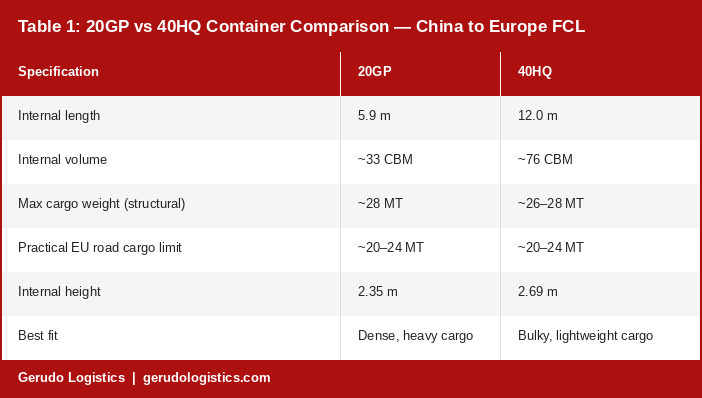
40HQ containers (internal volume approximately 76 CBM, internal height 2.69 m) are suited to cargo that is volume-heavy relative to weight: furniture, textiles, consumer electronics in retail packaging, and similar goods that fill the cube without approaching the weight threshold.
20GP containers (internal volume approximately 33 CBM) make more commercial sense for dense, heavy cargo: steel components, machinery, ceramic tiles, and similar goods that hit the weight ceiling long before the volume is filled. Booking a 40HQ for a 22-ton steel shipment means paying for unused cubic space.
A consideration specific to the European inland delivery leg: road weight regulations differ by country and truck configuration. Even if the container's structural limits allow 26+ tons, many European jurisdictions cap total gross vehicle weight at 40 to 44 metric tons, translating to a practical cargo limit of 20 to 24 tons once the tractor, chassis, and container tare weights are factored in. Confirm country-specific road weight limits before loading dense cargo.
What Compliance Requirements Apply Before Cargo Loads in China?
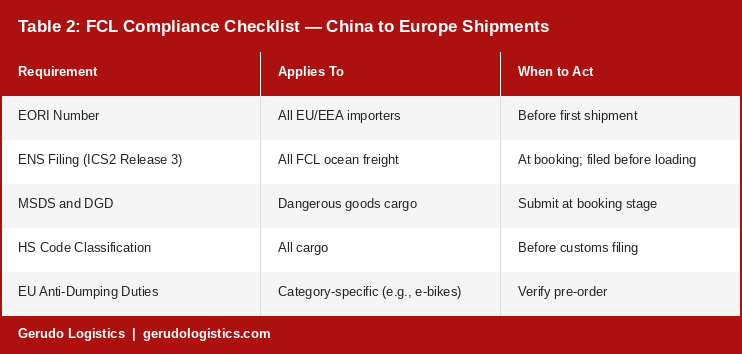
Three compliance areas specific to FCL shipments from China to Europe need to be addressed before the container is committed to a vessel.
EORI Number
Every commercial importer into the EU or EEA must hold an Economic Operators Registration and Identification (EORI) number. This is a pre-registration requirement and cannot be obtained at the point of customs filing. Apply through the customs authority of your country of establishment well ahead of your first planned shipment.
ICS2 Release 3
Under the 2026 ICS2 framework, a full Entry Summary Declaration (ENS) containing safety and security data must be submitted to EU customs before cargo is loaded onto the vessel in China. Key points:
Your carrier or forwarder files the ENS, but the accuracy depends on data you provide
Errors in the ENS trigger holds on the European end that are costly and slow to resolve from a distance
Confirm at booking time who is responsible for ENS filing and what the data submission cut-off is for your specific service
Dangerous Goods in FCL Shipping
If your cargo includes items classified as dangerous goods under the IMDG Code (lithium batteries, flammable adhesives, chemical products, and similar), the following must be confirmed before the container is booked:
Carrier DG acceptance on the specific vessel and service
A compliant MSDS (Material Safety Data Sheet) and DGD (Dangerous Goods Declaration)
UN-certified packaging for the relevant hazard class and packing group
Not all vessels or services accept DG cargo; some carriers restrict specific DG classes on specific routes. These constraints need to be established at the booking stage, not after the cargo has sailed.
Which Chinese Port Should You Use for Europe-Bound FCL?
Port selection should be driven by supplier geography and service frequency on your target route. Defaulting to a major hub regardless of where the cargo originates is a common source of avoidable inland trucking costs.
Shanghai and Ningbo-Zhoushan offer the widest carrier selection and the most frequent weekly sailings to Rotterdam, Hamburg, and Antwerp. For manufacturers in Jiangsu, Zhejiang, and the greater Shanghai area, these ports are the natural starting point and carry the most competitive rates on Northern European lanes.
In our experience, one of the more straightforward inefficiencies to fix is an importer defaulting to Shanghai for all shipments regardless of where the factory is located; transporting cargo 800 to 1,000 km by road within China before it reaches the port adds cost and time that a better-matched origin port would eliminate.
For the Pearl River Delta manufacturing cluster covering Guangdong Province, Shenzhen's Yantian and Shekou terminals are the primary export gateways. Direct services to European ports run on regular schedules, and the port infrastructure handles DG cargo well.
Northern China manufacturing clusters in Shandong, Hebei, and Liaoning are best served by Qingdao, Dalian, or Tianjin. Sailing frequency and carrier choice are more limited than Shanghai, but transit times to Europe via the Cape are broadly comparable. For suppliers in the north, these ports eliminate the cost and time of transporting cargo south.
A quick summary by sourcing region:
Yangtze River Delta (Jiangsu, Zhejiang, Shanghai): Use Shanghai or Ningbo
Pearl River Delta (Guangdong, including Guangzhou and Shenzhen): Use Shenzhen Yantian or Shekou
Northern China (Shandong, Hebei, Liaoning): Use Qingdao, Tianjin, or Dalian
Why Work with Gerudo Logistics for FCL Shipping to Europe
Gerudo Logistics is headquartered in Guangzhou with operations across Shenzhen, Shanghai, Ningbo, Qingdao, and Dalian. Here is what importers on the Europe lane work with us for:
China-side network coverage: We manage the full origin leg directly, from factory pickup to port gate-in, without outsourcing to intermediaries. With operational presence across the Pearl River Delta, the Yangtze River Delta, and northern port clusters, we match the export port to where your supplier is located rather than defaulting to the same hub for every shipment.
No language gap in daily coordination: Our team handles supplier communication, documentation preparation, and export customs coordination in both Chinese and English. Information gaps between factory, domestic shipping agent, and port operator are one of the more common sources of avoidable delay on Europe-bound FCL; a local team resolves these before they escalate.
End-to-end execution under one roof: Export customs filing, space booking, container stuffing, bill of lading issuance, destination customs clearance, and DDP final delivery are coordinated by the same team. Importers do not need to relay information between a China forwarder and a European agent or reconcile two separate sets of charges.
Dangerous goods and reefer as core competencies: Gerudo's primary business is DG cargo and cold chain, not general freight with DG handled on the side. Dangerous goods documentation (MSDS, DGD, UN-certified packaging), carrier DG acceptance confirmation, and reefer equipment arrangement are completed at the booking stage, not after the container has already sailed.
To discuss FCL routing from your Chinese supplier to your European destination, contact us today!
FAQ for FCL Shipping from China
What is the current FCL rate from China to Rotterdam in 2026? Drewry's World Container Index assessed the Shanghai-Rotterdam spot rate at $2,552 per 40ft container in the week of March 26, 2026. Add surcharges including THC, BAF, EU ETS, and documentation fees to arrive at a port-to-port all-in figure. Carriers including CMA CGM announced FAK rates of approximately $3,500 per FEU for April, indicating continued upward pressure.
How does the EU ETS surcharge appear on my freight invoice? Most carriers list it as a separate line labeled EES, EMS, or Emissions Surcharge, revised quarterly based on EUA carbon allowance market prices. As of Q1 2026, this averages approximately $168 per dry 40ft container on Asia to North Europe routes (Searoutes, January 2026), though figures vary by carrier and lane.
What is ICS2 and does it affect my FCL booking? ICS2 Release 3 requires a full Entry Summary Declaration (ENS) to be filed with EU customs before your cargo loads in China. Your carrier or forwarder handles the filing, but data accuracy depends on information you provide. Errors in the ENS cause holds on arrival in Europe that are slow and costly to resolve remotely.
Can I ship lithium batteries in an FCL container to Europe? Yes, but lithium batteries are classified as dangerous goods under the IMDG Code. Carrier DG acceptance must be confirmed at booking, and you need a compliant MSDS, DGD, and UN-certified packaging. Attempting to organize this after the container is booked onto a vessel creates significant delays.
Do I need an EORI number to import FCL cargo into Europe? Yes. Any commercial importer into the EU or EEA requires an EORI number for customs clearance. It is issued by the customs authority of your country of establishment and must be obtained before your first shipment, not at the time of arrival.
When does rail make more sense than sea for China to Europe? When your cargo is high-value relative to its weight and you need delivery in under 25 days without paying air freight rates. Rail runs 16 to 22 days versus 35 to 45 days for Cape-routed sea freight, making it most suitable for electronics and precision goods rather than heavy bulk cargo or reefer shipments.
Which Chinese port has the best frequency to Northern Europe? Shanghai and Ningbo-Zhoushan have the highest sailing frequency to Rotterdam and Hamburg. For Pearl River Delta suppliers in Guangdong, Shenzhen Yantian is generally the more efficient origin. Choose based on where your supplier is located, not simply on which port has the largest overall volume.
Conclusion
FCL shipping from China to Europe in 2026 involves a longer baseline transit, a more complex surcharge structure, and tighter pre-shipment compliance requirements than most importers planned for two or three years ago. The Cape of Good Hope rerouting, the EU ETS reaching full coverage, and ICS2 Release 3 data requirements are now permanent features of this trade lane.
The adjustment for importers is primarily about lead time planning, invoice transparency, and addressing compliance at the booking stage rather than at the port. Cost benchmarks will continue to move with the market, but the structural framework is set for 2026 and beyond.