The Complete Guide to Cheap Shipping from China to USA for Small Packages in 2025
If you're shipping small packages from China to the USA, 2025 has brought the biggest regulatory shake-up in cross-border e-commerce history. The suspension of the de minimis exemption, which previously allowed duty-free entry for shipments under $800, has fundamentally altered how cross-border e-commerce works between these two countries.
For online sellers, Amazon FBA merchants, and small business owners or personal buyer, understanding how to navigate these changes while keeping shipping costs manageable is essential. This guide breaks down the most economical shipping methods, provides real cost benchmarks, and shares practical strategies that successful importers are using right now.
Whether you're shipping 10 packages a month or 1,000, the information here will help you make informed decisions that protect your margins while ensuring reliable delivery to your US customers.
Understanding De Minimis Rules and Duty Changes Affecting China–USA Shipping in 2025
Before we discuss shipping options, you need to understand the regulatory shift that happened in 2025. The United States suspended the de minimis exemption for shipments from China and Hong Kong in May 2025, then extended this suspension to all countries later in the year.
What this means for you:
Small packages are no longer automatically duty-free just because they're valued under $800
Most China-to-USA shipments now incur tariffs or postal processing fees
Customs scrutiny on low-value parcels has increased significantly
Your landed cost calculations must now include duties and fees
This change has prompted major platforms like Temu to stop direct cross-border small parcel shipments to the USA, instead moving inventory to US warehouses. For individual sellers and small businesses, adapting your shipping strategy to these new rules is no longer optional.
Note: These policies have been changing quickly since 2025. Always double-check the latest guidance from U.S. Customs and Border Protection (CBP) and your carrier before finalising your shipping strategy.
Read Import Duty Guide, to better understand China–U.S. tariff changes and how to calculate your real import costs.
Main Shipping Options from China to USA Small Parcels
When shipping small packages (typically 0.1-2 kg) from China to the USA, you have several carrier categories to choose from. Each serves different priorities: cost, speed, reliability, or tracking capability.
1. Postal and Economy Services
China Post (including ePacket)
China Post's small packet and ePacket services partner with USPS for last-mile delivery and remain one of the most economical options for lightweight parcels.
Key characteristics:
Weight limit: Typically up to 2 kg
Transit time: 7-20+ days, depending on season and route
Best for: Low-value items where slow delivery is acceptable
Tracking: Available but less detailed than express carriers
Cainiao Super Economy/Standard
Part of Alibaba's ecosystem, Cainiao Super Economy is designed for ultra-low-cost shipments from AliExpress and similar platforms.
Key characteristics:
Transit time: 15-30+ days (sometimes up to 50 days)
Best for: Very low-margin products where cost is the primary concern
Tracking: Basic tracking available through Cainiao's platform
2. Cross-Border E-Commerce Lines
These specialized services bridge the gap between postal rates and express carrier prices, offering better tracking and speed than postal services at competitive rates.
YunExpress
A popular choice among dropshippers and small-volume sellers, YunExpress operates dedicated lines with USPS and other local carriers for final delivery.
Key characteristics:
Transit time: 6-15 days depending on service level
Tracking: Generally reliable throughout journey
Best for: E-commerce sellers needing predictable delivery times
4PX Cross-Border Logistics
4PX offers both express (6-12 days) and economy (12-20 days) options with extensive warehouse and last-mile partner networks.
Key characteristics:
Strong tracking capabilities
Multiple service tiers for different budgets
Good for electronics and general merchandise
Yanwen International
Another major player in the cross-border small package space, Yanwen is frequently used for budget-conscious shipments.
Key characteristics:
Transit time: Similar to YunExpress (8-18 days typical)
Competitive pricing for parcels under 2 kg
Decent tracking support
3. Express Carriers
DHL, FedEx, UPS
While not the "cheapest" option per kilogram, express carriers can offer better value when you factor in speed, reliability, and lower loss rates.
Key characteristics:
Transit time: 2-5 business days
Best for: High-value items, time-sensitive shipments, or when customer experience is priority
Comprehensive tracking and insurance options
When express makes sense:
Your product margins can absorb the higher cost
You're shipping samples or prototypes
Fast delivery is part of your competitive advantage
The item value justifies premium shipping
4. DDP (Delivered Duty Paid) Services
DDP small parcel services have the forwarder collect duties and taxes upfront and handle customs clearance, eliminating surprise charges for your customers.
Advantages:
Predictable landed costs
No unexpected customs fees for recipients
Smoother customs clearance process
Often includes USPS or FedEx last-mile delivery
Considerations:
May not be the absolute lowest base rate
Requires accurate HS code classification
Best for sellers with consistent shipping volumes
Choosing the Right Carrier by Package Weight (China to USA)
Understanding which carriers work best for different weight ranges helps you optimize costs. Here's how to match your packages to the most economical shipping methods:
1. Ultra-Light Parcels: 0–500g
Typical products: Phone cases, cables, small accessories, jewelry
Recommended channels:
ePacket/China Post small packet
Cainiao Super Economy/Standard
Economy lines from YunExpress/Yanwen
Why these work best:
Postal and economy lines are still very competitive at this weight
Dimensional weight normally doesn't hurt you yet
Best choice when you care more about cost than speed
2. Standard Small Parcels: 500g–2kg
Typical products: Clothing sets, small electronics, cosmetics sets
Recommended channels:
YunExpress/4PX/Yanwen e-commerce lines for a balance of cost and tracking
China Post/ePacket for low-value, low-urgency parcels
DDP small-parcel lines when you want duties prepaid
Why these work best:
This is the "sweet spot" for cross-border e-commerce lines
Per-kg cost is lower than express, but you still get reasonable transit time
If your average parcel weight is under 2kg and costs feel unpredictable,
Read our Guide on Lightweight Parcels Under 2kg gives a practical framework to fix that.
3. Heavy "Small" Parcels: 2–5kg
Typical products: Small household appliances, bulk clothing orders, bundles
Recommended channels:
DDP air/special lines (especially if you want a smoother customs process)
Economy express (DHL/UPS/FedEx economy) for time-sensitive goods
Why these work best:
Postal services become less competitive as weight increases
Per-kg express rates get closer to special lines above 2 kg
Tip: At 3–5 kg, always compare e-commerce lines vs. economy express vs. consolidation. Sometimes a small consolidated shipment is cheaper than sending 3–4 individual parcels.
4. Borderline Freight: 5–30kg (Still Shipped as Parcels)
Typical products: Multiple units in one box, small B2B shipments, samples for distributors
Recommended approach:
Always request quotes for bulk/consolidated shipping, not just courier
Compare against parcel express , this is often where bulk starts to win
Real China-US Small Package Shipping Cost Benchmarks
Understanding actual shipping costs helps you budget accurately and negotiate better rates with carriers. Keep in mind that prices fluctuate based on fuel surcharges, seasonal demand, and individual carrier negotiations.
Weight-Based Pricing Examples (Approximate 2025 Ranges)
Note: These are general benchmarks. Your actual rates will vary based on volume, account type, and specific routing.
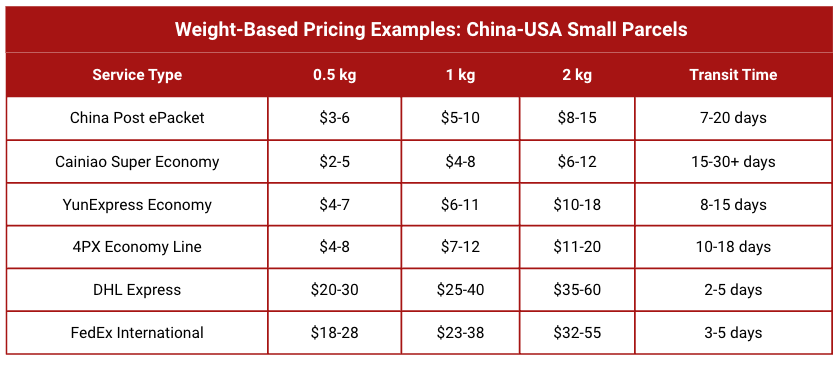
Important: These rates typically do NOT include:
Duties and tariffs (now required for most shipments)
Remote area surcharges
Fuel surcharges
Customs clearance fees (if not using DDP)
Hidden Shipping Costs Most China–USA Shippers Overlook
Dimensional Weight Charges
Carriers calculate chargeable weight as either actual weight or dimensional weight (Length × Width × Height ÷ 5000 or 6000), whichever is greater.
Example calculation:
Package dimensions: 30cm × 20cm × 15cm
Dimensional weight: (30 × 20 × 15) ÷ 5000 = 1.8 kg
Actual weight: 0.8 kg
Chargeable weight: 1.8 kg (the higher value)
This is particularly important for bulky but lightweight items like clothing, plush toys, or packaged electronics.
Not sure when to switch from couriers to bulk shipping? See our breakdown on Bulk vs Small Package Shipping from China and how to find your break-even point.
Duties and Tariffs
With the de minimis suspension, most packages now face:
Product-specific tariff rates (varies by HS code)
Section 301 tariffs on many Chinese goods
Merchandise Processing Fee (MPF) for commercial entries
For a $50 product with a 25% tariff rate, you're adding $12.50 to your landed cost, which can completely eliminate the "savings" from choosing the cheapest carrier.
Brokerage and Clearance Fees
If you're not using a DDP service, you may encounter:
Customs brokerage fees: $50-100 per shipment (for commercial entries)
Disbursement fees
Documentation processing fees
These fixed costs can be devastating for low-value small packages.
Cost-Saving Strategies That Serious US Sellers Actually Use
1. Volume Consolidation
Instead of shipping individual small packages as orders come in, consider consolidating orders at a China warehouse and shipping in batches.
How it works:
Use a China-based fulfillment center or 3PL
Accumulate 50-100+ packages
Ship consolidated air freight or sea LCL to your US location
Distribute domestically using USPS or regional carriers
When this makes sense:
You have predictable monthly volume
Your products aren't extremely time-sensitive
You can maintain some US-side inventory
Potential savings: 30-50% on per-package shipping costs
2. Hybrid China + US Fulfillment
Many successful sellers now split their inventory:
Phase 1 (Testing/Low Volume):
Ship direct from China using economy lines
Test product demand without large upfront investment
Phase 2 (Scaling):
Move proven SKUs to US fulfillment (Amazon FBA or 3PL warehouse)
Stock via air freight or sea freight in bulk
Ship slow-moving or new items direct from China
This approach optimizes for both speed and cost across your product catalog.
3. Negotiate Better Rates
Once you reach consistent monthly volumes, you have leverage:
Volume thresholds that matter:
100+ packages/month: Qualify for small business rates with most carriers
500+ packages/month: Can negotiate directly with carriers or secure better 3PL pricing
1000+ packages/month: Access to wholesale rates and multiple carrier options
What to negotiate:
Base shipping rates per kg
Fuel surcharge percentages
Remote area fee waivers
Free or discounted customs clearance
4. Optimize Packaging
Every gram counts when you're paying per kilogram:
Practical optimization steps:
Use poly mailers instead of boxes (where product allows)
Switch to corrugated boxes with lower basis weight
Eliminate unnecessary packaging materials
Design product packaging with shipping in mind
Real impact example:
Original package: 200g
Optimized package: 100g
For 1,000 monthly shipments at $10/kg: $1,200 annual savings
5. Accurate HS Code Classification
Tariff rates vary dramatically by product category. Proper classification can significantly impact your duties:
Some product categories have lower tariff rates
Misclassification can result in penalties or delays
Working with a customs broker for proper classification pays for itself
6. Use Multi-Carrier Shipping Software
Instead of being locked into one carrier, use platforms that compare rates across multiple options in real-time:
Benefits:
Automatically select cheapest option for each shipment
Batch process shipping labels
Integrate with your e-commerce platform
Track all carriers in one dashboard
7. Consider DDP for Customer Experience
While DDP services may not have the lowest base shipping rate, they often win on total cost and customer satisfaction:
Why DDP can be cheaper overall:
No surprise customs bills for customers
Fewer abandoned shipments at customs
Reduced customer service inquiries
Lower return rates due to unexpected fees
Smoother, faster customs clearance
Working with a Reliable China Freight Forwarder for Your Small Package Shipping
Navigating the complexity of international shipping regulations, carrier options, and cost optimization can be overwhelming, especially when you're focused on growing your business. This is where partnering with an experienced freight forwarder becomes valuable.
Gerudo Logistics operates globally, supporting importers and manufacturers with complex logistics needs — including dangerous goods (DG), cold-chain shipping, and regulated cargo across air, sea, and ground transport. Our role goes far beyond booking couriers or chasing rates. We help clients manage compliance, risk, routing, and documentation across international supply chains.
For small parcels shipping from China to the USA, we apply our expertise to:
identify compliant shipping routes
claim the correct classifications
manage duty exposure
and design scalable shipping structures
If most of your volume is small packages from China to the USA and you're struggling with new 2025 rules, we can help you design a lane-by-lane plan: which parcels should go postal, which should use e-commerce lines, and when DDP or consolidation makes more sense.
Contact Gerudo Logistics for a free small-parcel cost and compliance review for your China-USA shipments.
Special Considerations for Different Product Types
Electronics and Items with Batteries
Many economy postal lines do not accept lithium batteries or dangerous goods, which affects electronics significantly.
Requirements:
UN 38.3 test reports for lithium batteries
Proper DG classification and packaging
Use carriers with DG capability (certain YunExpress/4PX lines, or express carriers)
Cost impact: Battery-capable lines typically cost 20-40% more than standard services
Critical warning: Declaring batteries as "normal goods" on non-DG lines risks:
Package seizure or destruction
Account suspension
Legal penalties
Clothing and Soft Goods
Advantages:
Light weight relative to volume
Generally low customs scrutiny
Flexible packaging options
Watch out for:
Dimensional weight charges on bulky items
Country of origin labeling requirements
Textile-specific tariff rates
High-Value or Fragile Items
For items over $100 value or fragile products:
Consider:
Express carriers with better handling
Additional insurance coverage
Stronger packaging (may increase weight)
Signature confirmation upon delivery
How to Track Small Packages Shipped from China to USA
Reliable tracking is essential for managing customer expectations and resolving issues quickly.
Universal Tracking Platforms
17TRACK - A universal platform supporting over 2,800 carriers including USPS, China Post, YunExpress, 4PX, Cainiao, and Yanwen. Available as both website and mobile app.
ParcelsApp - Specializes in tracking Cainiao Super Economy, China Post, and other postal services with detailed transit stage information.
Cainiao Global Tracking - Direct tracking for AliExpress and Taobao shipments using Cainiao services.
Best Practices for Tracking Management
Provide tracking numbers to customers immediately upon shipment
Set up automated tracking updates via email or SMS
Monitor tracking for exceptions or delays proactively
Keep tracking information for at least 90 days for dispute resolution
Common Mistakes in Small Package Shipping from China to USA
1. Choosing Cheapest Option Without Considering Total Cost
The carrier with the lowest per-kg rate often isn't the most economical when you factor in:
Longer transit times (higher inventory carrying cost)
Higher loss/damage rates
Customs clearance problems
Customer service issues
2. Inaccurate Weight and Dimensions
Even small errors compound quickly:
Always weigh packages on a calibrated scale
Measure dimensions precisely
Account for packaging materials in your calculations
Test dimensional weight calculations before committing to packaging designs
3. Poor Customs Documentation
Incomplete or inaccurate customs documents cause:
Shipment delays at customs
Unexpected fees and penalties
Package returns or abandonment
Damaged customer relationships
Critical documents:
Commercial invoice with accurate product descriptions
Correct HS codes
Accurate declared values
Required certifications (FDA, FCC, etc., depending on product)
4. Ignoring Seasonal Variations
Shipping costs and transit times vary significantly by season:
Peak seasons (higher costs, longer times):
November-December (holiday shopping)
Chinese New Year period (January/February)
Singles' Day (11.11) aftermath
Planning tip: Negotiate annual contracts during slow periods, ship inventory early before peak seasons
5. Not Testing Multiple Carriers
Your ideal carrier mix often includes 2-3 different services:
Economy line for low-value, non-urgent items
Mid-tier service for standard products
Express option for high-value or urgent shipments
Testing reveals which carriers perform best for your specific products and destinations.
Frequently Asked Questions for Small Parcels Shipping from China to USA
Is shipping from China to the USA still duty-free under $800?
No. The US suspended the de minimis exemption for China and Hong Kong in May 2025, then extended it to all countries. Most small packages now incur tariffs or postal fees regardless of value.
What's the cheapest shipping method for packages under 1 kg?
For very light packages, China Post ePacket or Cainiao Super Economy typically offer the lowest rates, though transit times are longer (7-30+ days). Total cost including duties must be considered.
How long does economy shipping from China to USA take?
Economy postal services typically take 15-30+ days, while special lines like YunExpress or 4PX range from 6-15 days. Express carriers deliver in 2-5 business days.
Can I ship electronics with batteries from China to USA cheaply?
Most economy postal lines don't accept lithium batteries. You'll need DG-capable services like specific YunExpress/4PX battery lines or express carriers, which cost 20-40% more but ensure compliance.
What's the difference between DDP and regular shipping?
DDP (Delivered Duty Paid) means the shipper pays all duties and taxes upfront, providing predictable costs and smoother customs clearance. Regular shipping may result in unexpected fees for recipients.
At what volume should I consider consolidation instead of individual packages?
Consolidation typically becomes cost-effective at 50-100+ packages monthly. This allows you to ship bulk air freight or sea LCL to the US, then distribute domestically for significant savings.
How do I track cheap shipments from China to USA?
Use universal tracking platforms like 17TRACK, ParcelsApp, or carrier-specific portals like Cainiao Global Tracking. These aggregate tracking across multiple carriers including USPS, China Post, and special lines.
Conclusion
Shipping small packages from China to the USA in 2025 is no longer about finding the lowest rate, it's about building a shipping strategy that actually works. With de minimis exemptions suspended, you must calculate total landed cost, not just freight. The right channel depends on your product type, order volume, and delivery expectations: economy lines suit low-value goods, special lines balance speed and cost, express works for urgent or high-value items, and DDP helps avoid customs surprises.
Serious sellers test multiple carriers, optimize packaging, and adjust their approach as volume grows, from China-direct shipping to hybrid US fulfillment. Track real costs (freight, duty, fees), review performance quarterly, and stay aligned with policy changes. Master the basics, measurement, documentation, and carrier selection, and you'll protect your margins while delivering a better experience to US customers.
Start by testing small volumes with 2-3 different carriers to understand which services work best for your products. Track your true total costs including all fees and duties. As your volume grows, revisit your shipping strategy every quarter, what works at 50 packages monthly may not be optimal at 500.