China to Indonesia Door-to-Door Shipping: DDP Rates, Transit Times, and Customs Guide (2026)
Every year from December through March, Indonesian customs ramps up import controls in coordination with other regulatory agencies. During this period, Red Line (Jalur Merah) assignment rates spike, physical inspections become the norm, and clearance timelines stretch. Shipments from China, in particular, remain the primary focus.
Even outside this high-pressure window, Indonesia consistently ranks among the most complex customs environments in Southeast Asia. Documentation gaps, SNI (Indonesian National Standard) compliance failures, and unlicensed IOR (Importer of Record) arrangements create significant delays and unexpected costs year-round.
For many business buyers, the challenge begins after finding a viable product on Alibaba or 1688. The supplier is ready, but the logistics are a black box: How do I import this legally? Do I need a local entity? Who handles the import taxes? What is the real risk of a physical inspection?
This guide explains the practical mechanics of DDP shipping from China to Indonesia, common pitfalls to avoid, and exactly what to verify before your cargo leaves the factory.
Understanding DDP Shipping — The All-In Solution for China-Indonesia Trade
What DDP Actually Means for Your Business
DDP (Delivered Duty Paid) is a shipping arrangement where you pay one all-in price and your freight forwarder handles everything else — export clearance in China, international freight, Indonesian import customs, duty and tax payment, and last-mile delivery to your address.
For importers sourcing from China, DDP answers the three questions that usually stop a first shipment from happening:
Do I need an Indonesian company to import? No, under a DDP arrangement your freight forwarder handles clearance under their own licensed entity.
Who pays the customs taxes? Your freight forwarder does, and the cost is included in your quoted rate.
Do I need to deal with Indonesian customs directly? No. Your freight forwarder manages the entire clearance process.
This is the practical value of DDP: it converts a multi-step compliance process into a single commercial transaction.
How DDP Works: The IOR Mechanism
DDP is made possible by a Compliant Importer of Record (IOR) service. Your freight forwarder holds its own API-U licensed Indonesian entity and acts as the legal importer on your behalf.
Your goods enter Indonesia under the forwarder's license. The forwarder files the customs declaration at correctly declared values, pays import duties and the 12% VAT (PPN), and delivers the goods to your address.
This is a standard service model recognized under Indonesian customs law. The key word is compliant: duties and taxes are declared and paid in full, at accurate values.
This is what separates a legitimate DDP service from the grey-channel clearance operations that carry significant legal and seizure risk for importers.
DDP vs DDU: When Each Makes Sense
DDP is the practical option if you do not have an Indonesian PT company, NIB, or API-U import license. You get a single all-in invoice with no interaction with Indonesian customs.
DDU (Delivered Duty Unpaid) puts import clearance in your hands. You file the declaration and pay duties under your own license. This requires a registered PT, NIB, and API-U — but it also means the 12% PPN you pay becomes reclaimable as input tax credit against your Indonesian VAT liability.
For high-volume B2B importers with an established Indonesian entity, DDU can be the more cost-efficient structure once PPN reclaim is factored in. If that applies to your business, contact us to discuss a DDU or structured IOR arrangement suited to your tax position.
How DDP Shipping Works: From China Factory to Indonesian Warehouse (5 Stages)
Understanding the full process tells you where your cargo is at each point, what to prepare, and why timelines sometimes extend. Here is what happens from order confirmation to delivery.
Stage 1: Pre-Shipment Compliance Check
What happens: Before anything moves, a reliable door-to-door freight forwarder reviews your product against Indonesia's current import requirements. This includes:
Confirming the correct HS code for Indonesian customs
Identifying whether your product requires SNI certification (mandatory for many electronics and appliances since June 2025)
Checking whether any import quotas or special permits apply
Importer's action point: Send your freight forwarder a product specification sheet, product images, and the supplier's draft commercial invoice. A thorough pre-shipment check takes one to two business days. It can prevent weeks of delays at Jakarta customs.
Skipping this step is where most cargo problems originate. In our experience, even importers who have shipped similar products before should request a fresh compliance check when introducing a new SKU, because Indonesia's regulated product list expanded significantly in 2025 and 2026.
Stage 2: Pickup and Consolidation at the Export Hub
What happens: Your freight forwarder arranges inland trucking from your supplier's location to the nearest export port consolidation hub — Shanghai, Ningbo, Guangzhou, Shenzhen, or another major port city depending on your supplier's base.
For LCL shipments, your cargo consolidates with other importers' goods into a shared container.
For FCL shipments, your goods fill a dedicated container at a lower per-CBM rate.
Importer's action point: Confirm your supplier's exact address and contact person. Provide the commercial invoice and packing list to your freight forwarder before pickup. Missed pickup windows during peak seasons can push your vessel booking by one to two weeks.
Stage 3: International Transit on the China Indonesia Freight Route
What happens: Your container departs China and travels to the Indonesian destination port.
Sea freight LCL or FCL: Approximately 14 to 18 days port to port from Guangzhou or Shenzhen to Tanjung Priok Jakarta
Air freight: Three to five days from major Chinese airports to Jakarta
Choosing between sea and air comes down to two factors: cargo volume and time sensitivity. Sea freight LCL is standard for shipments below 15 CBM that are not urgent. FCL makes more economic sense above approximately 12 to 14 CBM and also reduces customs inspection risk, since single-shipper containers move faster through clearance. Air freight suits high-value, low-volume goods where the cost of a stockout outweighs the freight premium.
For a detailed breakdown of LCL versus FCL for this specific route, including Jakarta port congestion data, see our FCL vs LCL Sea Freight from China to Indonesia guide.
Importer's action point: Monitor tracking updates from your freight forwarder. Confirm your Indonesian delivery address and receiving contact ahead of the vessel's estimated arrival.
Stage 4: Customs Clearance in Indonesia — Navigating Jalur Merah
What happens: Your freight forwarder files the import declaration through INSW (Indonesia National Single Window), which coordinates customs, BPOM, quarantine, and other agencies in a single submission. Indonesian customs assigns your shipment to one of three clearance channels:
Green Line (Jalur Hijau): Automatic document clearance, one to two days
Yellow Line (Jalur Kuning): Document verification required, two to four days
Red Line (Jalur Merah): Physical inspection of cargo, three to seven days minimum
Your freight forwarder handles all of this. Import duty and 12% VAT (PPN) are paid by the forwarder under the DDP arrangement and included in your all-in quote.
Importer's action point: No action required, but plan for the possibility of Red Line. Electronics, mixed LCL cargo, and first-time importers on a given route face higher Red Line assignment rates. Examination fees triggered by physical inspection may be billed separately. Confirm this with your freight forwarder upfront.
Stage 5: Last-Mile Delivery to Your Indonesia Address
What happens: Once customs releases your goods, inland trucking moves the cargo from the port to your specified delivery address.
Jakarta addresses near Tanjung Priok: straightforward delivery, typically one to two days
Surabaya, Medan, Bali, or other provinces: additional transit time and port surcharges apply
Importer's action point: Confirm the exact delivery address and ensure someone is available to receive the goods. If your destination is outside Jakarta, ask your freight forwarder for a city-specific quote before booking. A rate quoted for Jakarta delivery does not automatically cover other destinations.
Indonesia Customs Risks — What Gets Cargo Held at Jakarta Port
Most cargo problems on this route are preventable. They fall into three categories, addressed in the order you should think about them: before sourcing, before placing a purchase order, and before booking your shipment.
Before You Source: Unauthorized Brand Goods
The risk is definitive. Indonesia's customs authority has integrated its IP brand database with the INSW clearance system. The de minimis threshold is $3 USD, meaning commercial-volume shipments face full IP scrutiny regardless of size.
Consequences of shipping unauthorized brand copies:
Goods are seized at customs
Cargo insurance does not cover IP seizure
The financial loss falls entirely on the importer
Reputable licensed freight forwarders will not knowingly accept this cargo
The practical position: if you want to import branded products, obtain a formal authorization letter from the brand owner before sourcing. If that is not possible, source unbranded or private-label alternatives instead.
Before You Place a Purchase Order: SNI Certification for Electronics
SNI (Standar Nasional Indonesia) is Indonesia's mandatory product safety standard, and cargo without the required certification is subject to seizure at Jakarta customs. This is the most common reason electronics shipments are held at Tanjung Priok.
Under Ministry of Industry Regulation No. 75/2024 and Permendag No. 47/2025, mandatory SNI enforcement for audio and video equipment took effect on 2 June 2025. The applicable technical standard is SNI IEC 62368-1:2014. Products currently within scope include:
LED televisions and monitors
Amplifiers and speakers
USB-C hubs and power adapters
LED lighting strips and smart lighting products
Portable electronic devices and small home appliances
Cordless vacuums, video doorbells, and similar consumer electronics
The certification required is the SPPT SNI (Sertifikat Produk Penggunaan Tanda SNI), issued by a BSN-accredited certification body. Jakarta customs in 2026 is cross-referencing SPPT SNI certificate numbers against an official database. Invalid or copied certificates trigger immediate Red Line assignment and potential seizure.
SNI certification must be obtained before goods are shipped. It cannot be completed after arrival. Before placing a purchase order for any electronics or appliance product, send the product specification sheet to your freight forwarder for a pre-shipment compliance check. This costs nothing and takes one to two business days.
Before You Book: Lithium Battery Classification
Products containing lithium batteries — power banks, wireless earphones, electric scooters, smart devices — require UN38.3 test reports and are classified as sensitive cargo by most door-to-door freight forwarders. This affects your rate, your mode options, and your documentation requirements.
Air freight for battery-containing goods requires compliance with IATA Dangerous Goods Regulations
Sea freight follows IMDG standards
Your freight forwarder must confirm which classification applies before the goods leave the factory
For detailed dangerous goods shipping requirements covering lithium batteries and other regulated items, see our Dangerous Goods Shipping from China services page.
2026 China-Indonesia DDP Shipping Method and Costs
Door-to-Door Shipping Rate: China to Jakarta
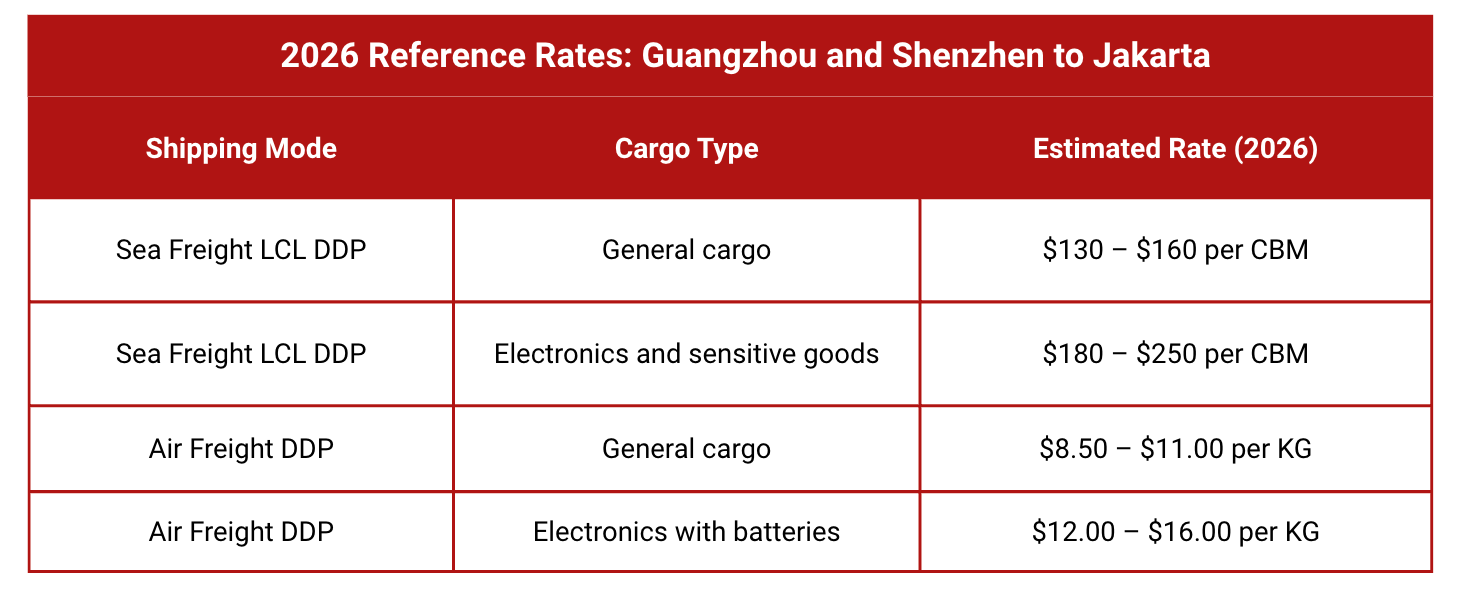
Included in these rates: International freight, export clearance in China, import duty, 12% VAT (PPN), and standard last-mile delivery to Jakarta.
Not included:
Red Line inspection and examination fees (billed at cost if triggered)
Cargo insurance (recommended at 1 to 2% of declared cargo value)
Delivery surcharges for Surabaya, Medan, Bali, or other destinations outside Jakarta
These are 2026 market estimates for standard cargo on the Guangzhou and Shenzhen to Jakarta route. Actual rates may vary based on fuel surcharges, seasonal demand, cargo dimensions, and commodity type. Request a formal quote for your specific shipment.
Door-to-Door Transit Times: China to Indonesia
Sea freight LCL door-to-door to Jakarta (DDP): 20 to 35 days. Port-to-port ocean transit is approximately 14 to 18 days; the remainder covers export handling in China, deconsolidation at Tanjung Priok, customs processing, and last-mile delivery.
Air freight door-to-door to Jakarta (DDP): 5 to 10 business days.
Tanjung Priok experiences recurring congestion, particularly during peak import periods. LCL shipments during these windows can face deconsolidation delays of three to seven additional days. Build this buffer into your restocking timeline.
For a full breakdown of shipping costs and methods on this corridor, refer to our Shipping from China to Indonesia overview.
Three Things That Expand Your Final Invoice
1. Red Line inspection fees. When customs assigns your shipment to the Red Line channel, physical examination fees and extended port storage charges are generated. Most freight forwarders pass these through at cost. Confirm whether they are included in your quoted rate or billed separately before you book.
2. Destination port surcharges. A rate quoted for Jakarta does not cover Surabaya or Medan. If your delivery address is outside the Jakarta area, request a destination-specific quote upfront.
3. Missing cargo insurance. Standard DDP all-in rates do not include insurance. For electronics shipments valued at $5,000 or more, shipping uninsured is a straightforward financial risk. An all-risk marine policy costs approximately 1 to 2% of declared cargo value.
How to Choose a Freight Forwarder for the China-Indonesia Route
Rate is not the primary filter. Before you commit, verify three things:
Licensed Indonesian entity: Does the forwarder hold its own API-U licensed Indonesian entity, or does it subcontract clearance to a third party? Subcontracted clearance means less control over Red Line outcomes and timelines.
Genuinely all-in pricing: Is the quoted rate all-in, including Red Line examination exposure? A lower rate that excludes port handling and inspection fees is not cheaper — it is incomplete.
Pre-shipment SNI compliance review: Can the forwarder confirm SNI certification requirements before goods leave China? This needs to happen at the purchase order stage, not after goods are detained at Tanjung Priok.
These are operational capabilities, not administrative ones. The gap becomes visible at Jakarta customs, not before.
Why Gerudo Logistics for Indonesia Door-to-Door
Gerudo Logistics is a Guangzhou-based freight forwarder specializing in dangerous goods and temperature-controlled cargo, with door-to-door DDP execution to Indonesia as part of our core service scope.
Our pre-shipment compliance review covers SNI certification requirements, HS code verification, and dangerous goods classification for battery-containing cargo — conducted before goods leave the factory, not after detention at Tanjung Priok. For DG shipments, we apply IATA and IMDG standards from cargo classification through final delivery.
We serve importers shipping general cargo, electronics, consumer goods, and regulated products from Guangzhou, Shenzhen, Shanghai, Ningbo, and other major export hubs to Jakarta and secondary Indonesian destinations.
To get a quote, have the following ready: your product type and specification, approximate shipment volume in CBM or KG, your supplier's city in China, and your delivery address in Indonesia. A reliable freight forwarder provides a confirmed all-in DDP rate within one business day.
Get a Quotation from Gerudo Logistics
Frequently Asked Questions: Door-to-Door Shipping from China to Indonesia
What does door-to-door DDP shipping from China to Indonesia include? Factory pickup in China, export clearance, international freight, Indonesia import customs clearance, import duty and 12% VAT payment, and last-mile delivery to your address. Cargo insurance and Red Line inspection fees are typically excluded and quoted separately.
Do I need an Indonesian import license to use a DDP door-to-door service? No. When your freight forwarder provides a licensed Importer of Record service, they use their own API-U licensed Indonesian entity to clear goods on your behalf. You do not need a PT, NIB, or API-U of your own.
What is the minimum shipment size for door-to-door sea freight? Most freight forwarders accept a minimum of 0.1 to 1 CBM for LCL sea freight. Air freight minimum chargeable weight is typically 1 to 5 KG. Confirm with your freight forwarder before quoting to your own customers.
How long does door-to-door shipping from China to Jakarta take? Sea freight LCL door-to-door (DDP): 20 to 35 days. Air freight door-to-door (DDP): 5 to 10 business days. Red Line inspection adds three to seven days to either timeline.
Does my product need SNI certification to enter Indonesia? Many electronics and appliance categories do, including LED lighting, chargers, audio-visual equipment, and portable devices. Mandatory enforcement began June 2025. Send your product spec sheet to your freight forwarder for a compliance check before placing a purchase order.
What is Form E and does it reduce my import taxes? Form E is a Certificate of Origin issued by Chinese authorities (CCPIT or CIQ) that activates ACFTA duty reduction — typically 0 to 5% instead of standard MFN rates. It must be issued before your goods are shipped. On a $15,000 shipment this can save several hundred dollars in taxes. For food-specific import tax structures, see our Indonesia food import compliance guide.
Can I ship products containing lithium batteries door-to-door to Indonesia? Yes, but they are classified as sensitive cargo and carry higher rates ($12 to $16 per KG for air freight DDP). UN38.3 test reports are required. Your supplier must prepare this documentation before shipment.
Conclusion
Shipping from China to Indonesia involves more moving parts than most other trade corridors in Southeast Asia. Customs channel assignments, SNI certification requirements, IOR licensing, and red light period controls all affect whether your cargo clears on time and at the cost you planned for.
Through a door-to-door DDP arrangement, you can import from China to Indonesia without your own Indonesian company, without filing customs declarations directly, and without separate negotiations with Indonesian tax authorities. Your freight forwarder holds the import license, pays the duties and VAT on your behalf, and delivers to your address. The cost is consolidated into a single quoted rate.
Whatever arrangement you use, the variables that determine outcome are the same: accurate documentation, compliant product certification, and a freight forwarder with genuine operational capability on this specific route.