Bonded Re-export Goods Through China: Customs and Duties for Transit Cargo
Consider an illustrative scenario: A trading company buys frozen goods from a supplier in Russia and plans to sell them to a buyer in Africa. Instead of shipping directly, the proposed route sends the cargo to Dalian, where it enters bonded cold storage before leaving China for its final destination. The goods are not intended for sale in China, but the shipment still needs a workable customs arrangement while it is there.
This is a typical reason traders consider whether they can re-export frozen goods through China. The route is possible in principle, but re-exporting, international transshipment, and importing goods into China before exporting them again are not the same customs procedure. This guide explains the available routing options, their effect on duties, the required documents, the operating process, and the mistakes that can disrupt a re-export shipment.
Can Goods Be Re-exported Through China?
Yes. Foreign-origin goods can be routed through China and shipped onward to another country. The appropriate customs arrangement depends on whether the cargo only transfers at a Chinese port, enters bonded storage, or is released into China’s domestic market.
The three possible arrangements are:
International transshipment: The cargo remains under customs control while transferring to its onward vessel, aircraft, or container. It does not enter a bonded warehousing arrangement or China’s domestic market.
Bonded re-export: The cargo enters an approved bonded warehouse or customs-supervised zone for storage or permitted handling before being exported to the final destination.
Formal import followed by export: The cargo completes normal import clearance and enters China’s domestic circulation before being exported again. Chinese import duties, taxes, permits, and product controls can apply under this arrangement.
The first two arrangements are relevant when China serves only as an intermediate logistics point. Formal import followed by export is a different transaction and falls outside the bonded re-export route covered in this guide. The cargo must still be accepted by the port, carrier, terminal, and relevant customs-supervised facility. The selected arrangement determines how the cargo is treated while it is in China; duties and country of origin at the final destination are separate questions addressed later in this guide.
Transshipment vs. Bonded Re-export: Which Route Fits Your Cargo?
When the goods will not enter China’s domestic circulation, the main decision is whether they can remain within the port transfer process or need to enter bonded storage for additional time or handling. Customs transit may form part of either arrangement when cargo must move under customs control between approved locations in China.
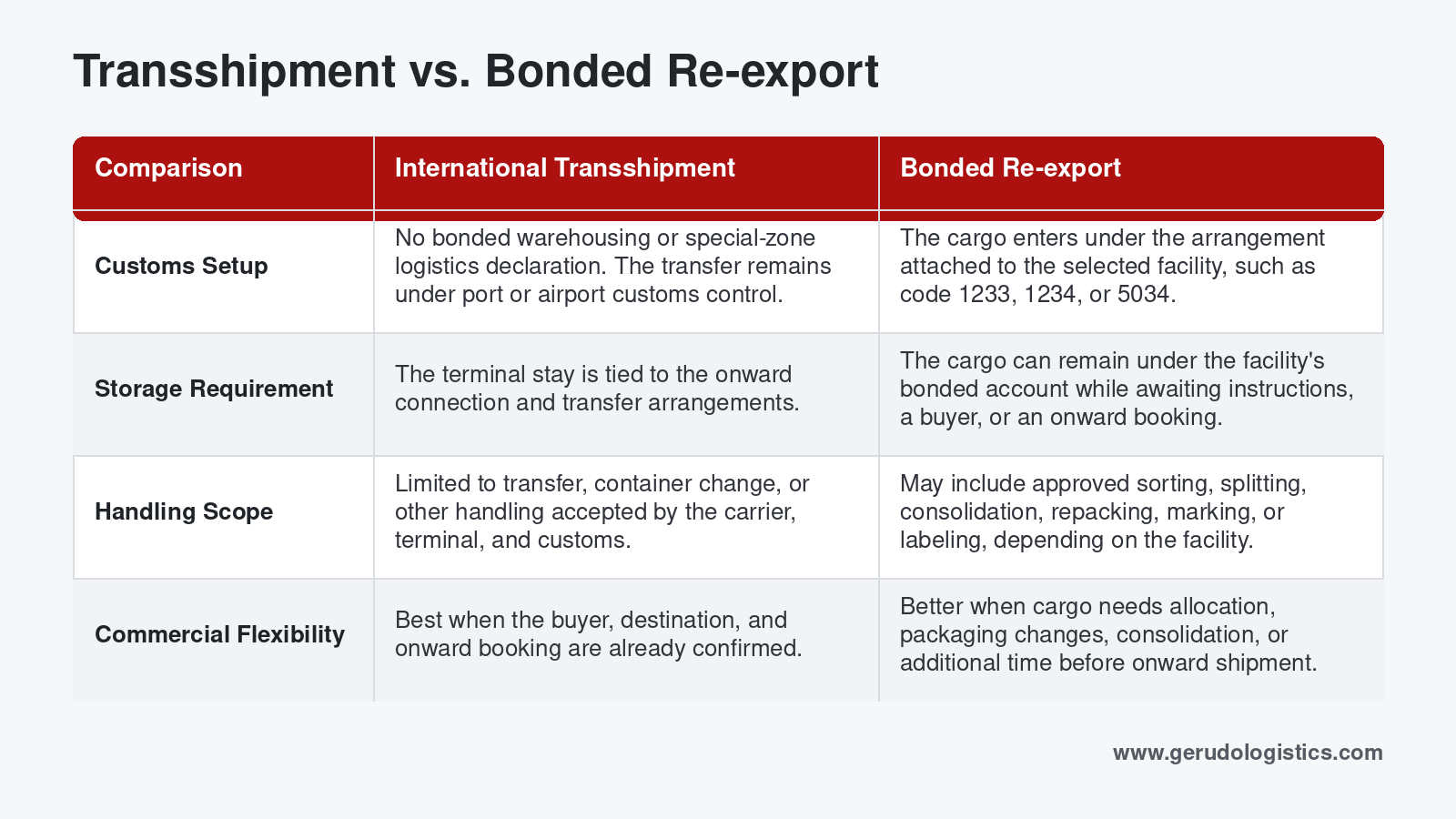
Different customs supervision codes can apply to bonded re-export through China:
1233 — Bonded Warehouse Goods: Applies when foreign goods enter or leave an approved bonded warehouse.
1234 — Warehousing and Re-export Trade in Bonded Zones: Applies to warehousing and re-export cargo moving through a bonded zone.
5034 — Logistics Goods in Customs Special Supervision Areas: Applies to logistics goods moving between a customs special supervision area and overseas, including qualifying storage, distribution, and re-export movements.
The applicable code follows the selected facility, its customs account, and the local declaration arrangement. These codes are not interchangeable options selected according to convenience or expected tax treatment.
For frozen goods that require storage or order handling in China, the bonded arrangement also depends on whether a customs-supervised cold-storage facility accepts the product and can maintain its required temperature. This is a facility acceptance requirement rather than a separate re-export customs category.
Import Duties and Country of Origin After Re-export
Import Duties While the Goods Are in China
A shipment does not incur standard Chinese import duties simply because it passes through a Chinese port or enters bonded storage. If the cargo remains under customs supervision and leaves China again, it has not been imported for sale or use in the Chinese market.
Chinese import duties and taxes become relevant only if the goods are cleared out of the bonded arrangement and released into China’s domestic market. That is a different transaction from the transhipment and bonded re-export routes covered in this guide.
Can Re-exporting Through China Reduce Duty at the Final Destination?
Re-exporting through China can affect the duty payable at the final destination in some transactions, but the benefit does not arise simply because the goods depart from China.
It depends on the destination country’s rules for customs valuation, tariff classification, origin, preferential treatment, trade remedies, and any product- or end-use-specific relief.
Country of Origin at the Final Destination
Re-exporting through China does not turn foreign goods into Chinese goods when the cargo only undergoes storage and logistics handling. If genuine manufacturing in China materially changes the product, the destination country applies its own origin criteria; that situation falls outside the re-export arrangement covered here.
For example, Thai-origin natural rubber remains Thai-origin if it is stored, divided into separate orders, repacked, or relabeled in a bonded facility in Qingdao. Changing the buyer, seller, invoice, consignee, or bill of lading also does not change where the product was made.
The destination customs authority therefore assesses the shipment according to its actual origin, product classification, declared value, and transaction history. Routing the goods through China cannot be used to conceal their origin or bypass origin-based duties and trade restrictions.
Certificate of Re-export
A Certificate of Re-export provides additional evidence that foreign-origin goods passed through China without becoming Chinese-origin. In practical terms, it helps connect the original origin records with the cargo’s entry into and departure from China.
The certificate can be issued by the China Council for the Promotion of International Trade (CCPIT) or one of its authorized local branches. It is not required for every shipment, does not assign a new origin, and does not give the goods an automatic duty reduction at the final destination.
Documents Required to Re-export Goods Through China
The document set depends on whether the cargo remains in international transshipment or enters bonded storage. A transshipment normally relies on the carrier’s transfer documents and cargo manifest, while bonded re-export also creates customs and warehouse records for the goods entering and leaving the supervised facility.
Commercial and Cargo Documents
The documents normally prepared for the shipment include:
Supplier commercial invoice: Identifies the original transaction, product description, value, seller, and buyer.
Packing list: Records the packages, quantities, weights, dimensions, and marks received in China.
Inbound transport document: The original bill of lading, sea waybill, or air waybill covering the movement into China.
Original-country origin evidence: A Certificate of Origin or other records supporting where the goods were produced. This is separate from the Chinese Certificate of Re-export described in the previous section.
Outbound commercial invoice and packing list: Reflect the sale and cargo allocation for the final buyer without misrepresenting the product’s origin.
Onward transport instructions: Provide the carrier with the final consignee, destination, cargo description, and release arrangement.
Food, agricultural products, chemicals, dangerous goods, and other regulated cargo can require additional health, quarantine, safety, or transport documents. For dangerous goods, theChina-side shipping document checklist helps identify the transport records that may be needed for the outbound leg. The final document set depends on the product, the Chinese entry point, the carrier, and the destination country.
Records for Bonded Re-export
When cargo enters bonded storage, the declaration party and facility operator create additional records to connect the goods received in China with those later shipped abroad. Typical bonded records include:
Bonded entry declaration or filing: Places the goods under the customs arrangement connected to the facility.
Warehouse receipt or inbound record: Confirms the cargo received by the bonded facility.
Inventory or customs account record: Tracks the stored quantity and any approved handling performed inside the facility.
Outbound customs declaration: Records the goods leaving China for the final destination.
Warehouse release or exit record: Confirms the quantity released for onward shipment.
If a Certificate of Re-export is needed, the application may require the original-country origin evidence together with the inbound and outbound invoices, transport documents, customs declarations, and a statement showing how the goods moved or were stored in China. The exact supporting set is confirmed with the issuing body for that shipment.
When a Switch B/L Is Used
A Switch Bill of Lading is a second bill of lading issued by the carrier to replace the first set. It is commonly requested in triangular trade when an intermediary does not want the final buyer to see the original supplier, or when an approved change to the shipper or consignee needs to appear on the replacement document.
A Switch B/L is not a Chinese customs requirement for every re-export shipment. If the original bill of lading already shows the correct parties and shipping details, it can normally remain in use. A routine amendment may also be sufficient when only limited information needs to change.
When a full switch is required, the carrier normally asks for the first set of original bills to be surrendered, canceled, or made void before issuing the replacement set. Acceptance, permitted changes, fees, and submission deadlines vary by carrier and destination.
A Switch B/L and a Certificate of Re-export serve different purposes. The Switch B/L manages the transport and commercial document chain, while the Certificate of Re-export supports the declared origin of foreign goods passing through China.
How the Bonded Re-export Process Works in China
The following six-step process applies when foreign goods enter a bonded warehouse or comprehensive bonded zone before shipment to another country. Direct international transshipment follows a separate terminal transfer process and does not require bonded warehousing.
Step 1: Confirm the Route and Bonded Facility
Before booking the shipment to China, confirm that the arrival port, bonded facility, carrier, and onward route can accommodate the cargo.
The facility must accept the product and have approval for any planned handling. Frozen cargo also requires suitable cold storage, reefer connections, temperature monitoring, and a controlled transfer between the terminal and the facility. The same temperature-control principles used in reefer container shipping from China apply when the onward movement uses an ocean reefer.
Step 2: Prepare the Inbound Bonded Declaration
Before arrival, check that the product descriptions, quantities, package numbers, values, container numbers, and origin details match across the commercial and shipping documents.
The inbound declaration uses the customs arrangement attached to the selected facility. Depending on the facility and cargo movement, this can involve code 1233, 1234, 5034, or another applicable declaration mode confirmed with the China-based declaration party.
Step 3: Move the Cargo into the Bonded Facility
After the vessel or aircraft arrives, the carrier and terminal complete the manifest and arrival procedures. The customs declaration is then submitted for review, and customs decides whether the cargo requires inspection.
Once customs authorizes the movement, the cargo travels from the port or airport to the declared bonded facility under supervision. It cannot move to an ordinary warehouse or enter China’s domestic market under the same bonded entry.
Step 4: Receive the Cargo and Record the Inventory
At the facility, the arriving cargo is checked against the declaration and warehouse instructions. The check can cover package quantities, container and seal numbers, cargo condition, markings, weight, and temperature.
The facility records the accepted quantity in its bonded inventory account. Any shortage, damage, broken seal, or information mismatch must be resolved because the outbound declaration will later need to match the recorded stock.
Step 5: Complete the Approved Handling and Prepare the Onward Shipment
The facility completes only the storage or handling previously agreed upon and permitted under its customs approval. Any change to package quantities or cargo allocation must remain traceable in the bonded inventory records.
Once the buyer, destination, and shipment quantities are confirmed, the onward transport can be booked and the final commercial and shipping instructions prepared. Frozen cargo must remain within its required temperature range during storage, handling, and transfer back to the terminal.
Step 6: Complete the Outbound Declaration and Inventory Reconciliation
Before departure, the outbound declaration records the final destination, quantity, value, and transport information. After customs completes the necessary procedures, the facility releases the cargo for transfer to the departure terminal.
The cargo then leaves China by the booked vessel, aircraft, train, or truck. The outbound quantity is deducted from the bonded inventory and matched against the original inbound record. The importer or trading company receives the final transport and customs records needed for clearance at the destination.
The bonded re-export process ends when the physical cargo movement, customs declarations, and facility inventory records all correspond. Any unresolved difference can prevent the original bonded entry from being properly closed.
Five Common Mistakes in Re-exporting Goods Through China
1 Booking an Ordinary Warehouse Instead of a Bonded Facility
An ordinary warehouse cannot receive foreign cargo under a bonded re-export arrangement. If the booking does not match the facility named in the customs declaration, the cargo may need to be redirected, re-declared, or formally imported before it can leave the port.
How to avoid it: Confirm the facility’s customs status and applicable inbound arrangement before booking the shipment to China. A warehouse description or storage quotation alone does not confirm that the facility can handle bonded cargo.
2 Assuming Every Bonded Facility Can Accept the Product
Bonded status does not mean that a facility can store every type of cargo. Frozen products require suitable cold storage, while dangerous goods, chemicals, food products, and other controlled cargo can require specific facilities, handling conditions, or additional acceptance checks.
How to avoid it: Submit the product information, HS code, packaging details, storage conditions, and relevant technical or health documents for review before departure. Confirmation of available warehouse space is not the same as product acceptance.
3 Using Inconsistent Origin Information Across the Shipment
Problems arise when the original origin evidence identifies one country, while later invoices, labels, declarations, or transport instructions suggest another. Changing the seller or transport document does not provide a valid reason to change the product’s origin.
How to avoid it: Keep the declared origin and supporting transaction history consistent throughout the shipment. If commercial information changes during re-export, check that the revised documents still describe the cargo truthfully and do not create a conflicting origin record.
4 Requesting the Certificate of Re-export Too Late
A Certificate of Re-export is not required for every shipment, but waiting until the outbound stage to determine whether one is needed can create problems. The application may be difficult to support if the original origin evidence or China entry records were not collected when the cargo arrived.
How to avoid it: Confirm whether the buyer, bank, or destination customs authority expects the certificate before the shipment reaches China. If required, preserve a continuous record connecting the original shipment with its entry into and departure from China, and confirm the appropriate issuing channel.
5 Treating a Switch B/L as a Simple Clerical Change
A Switch B/L affects the transport document chain and, in some transactions, control over delivery of the cargo. Requesting it after the original documents have circulated can create duplicate originals, conflicting consignee information, payment disputes, or destination clearance delays.
How to avoid it: Confirm the carrier’s switch policy before the first bill is issued. If the carrier approves the request, surrender or cancel the original set as required and check the replacement bill against the commercial transaction, customs records, and destination clearance instructions.
Why Choose Gerudo Logistics for Re-export Shipping Through China
Gerudo Logistics gives global importers and trading companies one China-based, bilingual team for their re-export shipments. Instead of managing separate contacts for the Chinese port, customs declaration, bonded facility, and onward transportation, traders can coordinate the China side of the shipment through one service provider.
Our coverage includes major Chinese port such as Dalian, Qingdao, Tianjin, Shanghai, Ningbo, Xiamen, Shenzhen, and Guangzhou, allowing us to assess alternative Chinese gateways when the original route does not suit the cargo.
Our team has experience with cold-chain cargo, chemicals, batteries, and Class 3, 8, and 9 dangerous goods, combining product-specific logistics knowledge with end-to-end consultation and transportation services. This helps importers determine whether a proposed route is workable before committing the cargo to China, especially when specialized storage, carrier acceptance, or controlled handling affects the shipment.
Contact Gerudo Logisticsto discuss the re-export requirements for your shipment and determine whether routing it through China is workable.
Frequently Asked Questions for the Bonded Re-export Shipment via China
Does an Overseas Importer Need a Chinese Company to Arrange Re-export?
An overseas importer does not normally need to establish its own company in China solely for re-export. However, qualified China-based parties must handle the customs declarations, bonded storage, supervised transfers and local transport arrangements.
Can Re-exported Goods Enter and Leave China Through Different Ports?
Yes, this can be possible when the bonded facility, customs-supervised transfer and onward transport route support the movement. The route must be confirmed before shipment because the cargo cannot move between Chinese ports as ordinary domestic freight.
Can One Bonded Shipment Be Split Between Several Buyers or Destinations?
A bonded facility may split the cargo into separate outbound shipments when its customs approval and operating scope allow it. Each shipment must remain traceable to the original inbound records and follow the appropriate outbound declaration procedure.
Can Goods From Different Countries Be Consolidated in China Before Re-export?
This can be arranged when the bonded facility accepts each product and can keep the cargo, origin evidence and inventory records clearly separated. Product compatibility, customs requirements and destination import restrictions must also be checked before consolidation.
Can Frozen or Dangerous Goods Be Re-exported Through China?
Yes, frozen and dangerous goods can be re-exported through China when the selected port, carrier and customs-supervised facility accept the cargo. Frozen shipments require continuous temperature control, while dangerous goods require confirmed classification, packaging, documentation and qualified storage arrangements.
How Long Does Bonded Re-export Through China Usually Take?
There is no standard end-to-end time for every bonded re-export shipment. The schedule depends on document readiness, customs review or inspection, facility handling, buyer instructions and the availability of the onward booking, so the expected timeline must be assessed for the individual route and cargo.
Is Customs Transit the Same as Bonded Re-export Through China?
No. Customs transit is the supervised movement of cargo between customs offices or approved locations, while bonded re-export is the wider arrangement in which foreign-origin goods enter bonded storage in China and are subsequently shipped abroad. Customs transit may be one step within a bonded re-export shipment.