Import Cosmetics from China to Saudi Arabia: SFDA Guide
Saudi Arabia imported more than US$1 billion of beauty, makeup and skincare products in 2025, with China ranking among its five largest suppliers. For an importer buying from China, the difficult part is getting each finished stock keeping unit into Saudi Arabia under the correct product and transport status.
Cosmetics arrive as retail products, yet Saudi authorities and carriers read them in different ways. The regulator looks at product identity, ingredients, claims and labeling. The carrier looks at whether the formula is flammable, pressurized or sensitive to heat. A face cream, fragrance and aerosol deodorant can therefore leave China under different shipping arrangements.
This guide explains how to choose air or sea freight, prepare the customs file and connect each consignment to the required SFDA product records.
Can Cosmetics Be Shipped from China to Saudi Arabia?
Yes. Commercial cosmetics can move from China to Saudi Arabia by air or sea. The shipment needs an eligible Saudi importer, a product that fits the Saudi cosmetics category and a carrier that accepts its transport status.
The product's intended use determines whether it can enter through the cosmetics route. Creams, makeup, shampoo and perfume usually fit this category when they clean, perfume, protect or change appearance. Treatment claims, injectables and some device-linked products can fall under another Saudi regulatory route.
A locally established importer must hold the relevant cosmetics activity and connect the shipment to the product records used for clearance.
The carrier assesses the transport risk separately. Many water-based skincare products and solid cosmetics can travel as general cargo. Products containing flammable liquids or pressurized gas may fall under dangerous goods (DG) transport rules.
In short, a shipment is ready for booking when four points are confirmed:
Saudi product category: Each item is accepted as a cosmetic or assigned to the correct alternative category.
Local importer: The Saudi company can hold the product record and receive the commercial shipment.
Finished product data: The formula, label, barcode and pack presentation match the Saudi record.
Freight status: The carrier accepts the cargo as general cargo or under the applicable DG arrangement.
These checks apply to each product presentation. A brand name alone cannot establish whether every serum, shade, bottle size or aerosol in the order is ready to ship.
Shipping Cosmetics from China to Saudi Arabia by Air or Sea
Shipment size, delivery urgency, cargo classification, storage range, Chinese origin and Saudi delivery point determine the shipping route from China to Saudi Arabia. Air freight suits faster replenishment and smaller volumes. Sea freight gives larger orders more capacity and usually a lower freight cost per unit.
Air Freight for Cosmetics to Saudi Arabia
Air freight fits samples, launch stock, urgent replenishment and high-value skincare. Express service is also an option for small parcels when the operator accepts the product and the Saudi importer can complete the entry process.
SDS and carrier acceptance. The forwarder uses the Safety Data Sheet (SDS) to check whether an airline can carry the formula. This supplier document describes the product's composition, physical properties and transport hazards. The carrier may also require a transport appraisal before accepting the cargo as general cargo or DG.
Perfume and aerosol products. The transport status of perfume shipped from China, aerosol cosmetics and some nail products can restrict airline and express acceptance.
Temperature control. Air transport reduces time in transit, although it does not provide temperature control by itself. Products with a narrow storage range may need insulated protection, temperature monitoring or an approved temperature-controlled service based on stability information from the manufacturer.
Sea Freight for Cosmetics to Saudi Arabia
Sea freight fits larger orders, heavy liquids and regular stock movements. The cargo can share container space or use a dedicated container.
Less than Container Load (LCL) places the shipment in a shared container and suits orders that do not fill one container. The consolidator and ocean carrier still need to accept the product mix.
Full Container Load (FCL) gives one shipper the use of the container. It reduces cargo sharing and gives the importer more control over loading, carton arrangement and container sealing.
DG sea freight has fewer LCL options because the consolidator applies hazard and segregation limits. Availability also depends on the package configuration, load port and destination port. A dedicated container still requires carrier approval for the declared cargo.
Heat exposure can affect cosmetics shipped from China during port storage, inland delivery and container transport in Saudi Arabia. The manufacturer-confirmed storage range determines whether a dry container is suitable or whether insulation, monitoring or a refrigerated container is justified.
Saudi Customs Clearance Requirements for Imported Cosmetics
Customs clearance and SFDA product clearance are linked, but the importer files them through different systems.
Who Files the Saudi Customs Declaration
The Zakat, Tax and Customs Authority (ZATCA) manages customs entry in Saudi Arabia. The Saudi importer or its authorized customs broker submits the declaration through Fasah, the national platform used for customs and trade procedures.
ZATCA requires the customs declaration and supporting documents to be submitted before the shipment arrives. For goods arriving at Saudi seaports, advance submission of the manifest and customs declaration has been mandatory since 29 October 2025. The importer or customs broker confirms the applicable filing window for the selected entry point through Fasah.
Product approvals from the relevant authority also need to be available for goods that require prior clearance.
Two similarly named systems appear in a cosmetics shipment:
Fasah: The ZATCA platform used for the customs declaration and customs processing.
Electronic Clearance (FASEH) System: The SFDA system used for regulated-product clearance and the shipment Certificate of Conformity.
Documents Used for Cosmetics Customs Clearance
The customs broker builds the entry from the commercial and transport records. The main file normally contains:
Commercial invoice: Identifies the seller, Saudi buyer, product, quantity, unit value, total value, currency and country of origin.
Packing list: Shows the stock keeping units, carton count, package contents, net weight, gross weight and dimensions.
Bill of lading or air waybill: Identifies the transport route, shipper, consignee and cargo covered by the booking.
Certificate of origin: Supports the declared origin when required. ZATCA notes that it may be unnecessary when origin is already clearly established.
Product clearance records: Connect the shipment to the cosmetics records and consignment approval handled through the Saudi Food and Drug Authority.
The invoice and packing list need product-level detail. Descriptions such as "beauty products" or "cosmetic samples" give the broker too little information to match the customs entry with individual regulated products.
Product Description and HS Classification
The Harmonized System (HS) code is the customs classification used to identify the product and calculate the applicable duty. Perfume, skincare, eye makeup, lip products, hair preparations and oral-care products use different headings within Chapter 33.
The correct code follows the actual product and its use. One code applied to a mixed order can produce the wrong duty treatment or a mismatch with the product description. The Saudi broker confirms the final declaration code against the current Saudi tariff.
The broker checks that names, quantities, values, origin and package counts agree across the invoice, packing list and transport document. These details connect the physical shipment to the customs declaration.
SFDA Requirements for Cosmetics Imported into Saudi Arabia
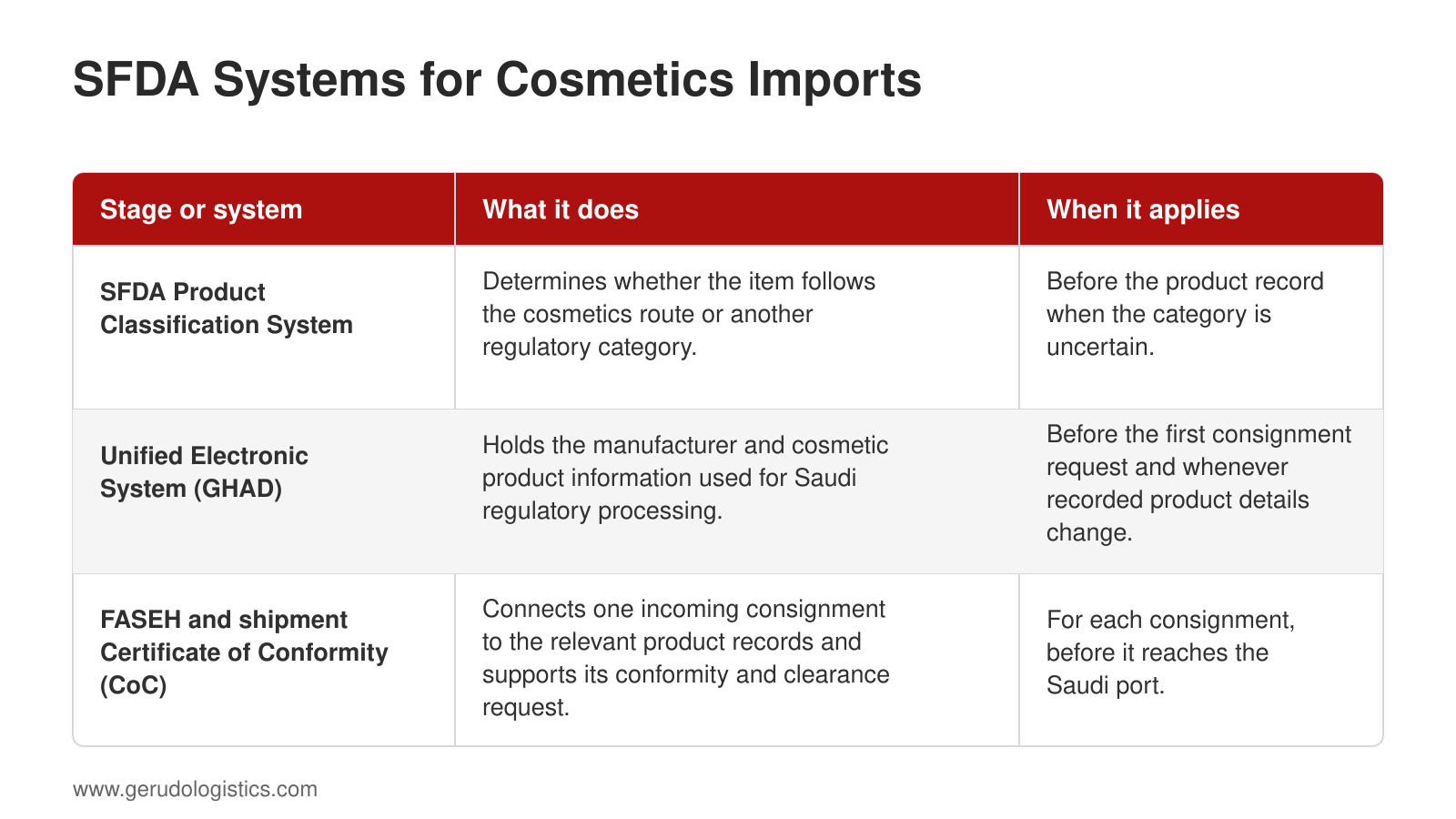
SFDA requirements operate at product level and shipment level. The systems have separate roles:
Confirm the Product Falls Under the Cosmetics Category
SFDA classification starts with what the product is intended to do. Products used on external body parts, teeth or oral mucosa to clean, perfume, protect or change appearance generally fit the cosmetics category.
Claims can move a product into another regulatory category. A moisturizer presented as skincare differs from a product claiming to treat eczema or cure acne. Injectables, derma rollers, electrical beauty devices and some combination kits also need separate classification.
The SFDA Product Classification System allows the Saudi company to request a formal classification when the route is uncertain. This decision comes before the product record because it determines which Saudi system and evidence apply.
Create the Manufacturer and Product Records in GHAD
GHAD is the SFDA portal used for establishment licenses and regulated-product records. The Saudi company responsible for the cosmetics activity creates or manages the manufacturer and product entries.
Older SFDA documents and industry materials may refer to the Electronic Cosmetics Insertion System (eCosma). Current cosmetics establishment licensing and product listing are handled through the Unified Electronic System, GHAD.
The product information and labeling also need to follow the applicable GCC Standardization Organization (GSO) technical regulations. GSO 1943:2024 covers cosmetic safety, packaging and labeling, while GSO 2528:2024 covers cosmetic claims.
The Chinese manufacturer supplies the technical and presentation data used in the record. A typical cosmetics file includes:
Manufacturer details: Legal name, production site and relevant quality information.
Product identity: Brand, product name, cosmetics category and intended use.
Ingredient list: Ingredients written with International Nomenclature of Cosmetic Ingredients (INCI) names, the standardized names used on cosmetics records and labels.
Sales presentation: Barcode, pack size, shade, color or other variant information.
Product images: Clear views of the container, outer packaging and label.
Label information: Final artwork, directions, warnings and claims intended for the Saudi market.
The record needs the final commercial version. Temporary artwork, a placeholder barcode or an incomplete shade range can leave the manufactured goods different from the product listed in GHAD.
Match the Finished Cargo to the GHAD Record
The importer and supplier compare the finished production batch with its product record before submitting the conformity request.
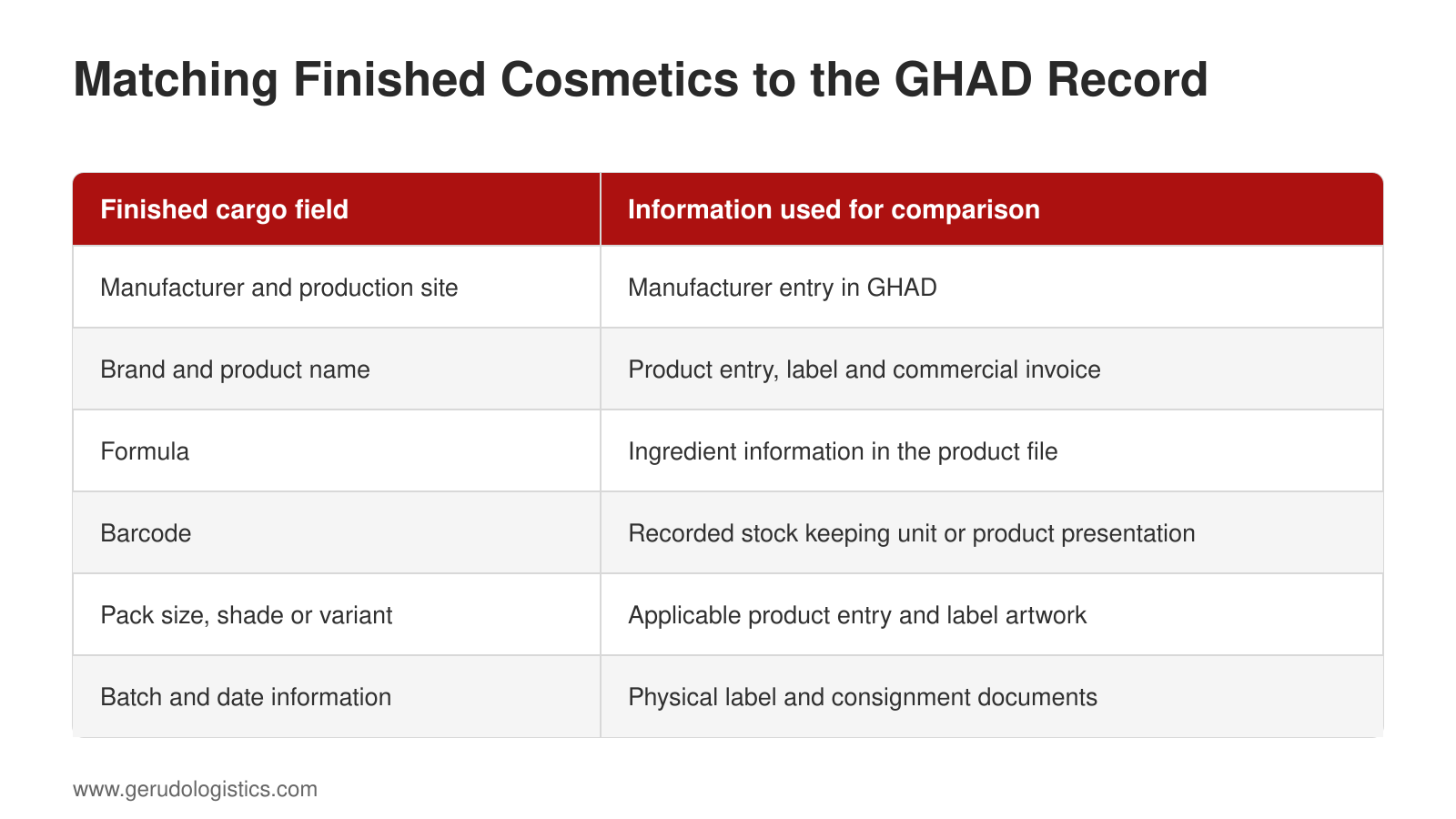
A new manufacturer, reformulated product, different barcode, additional shade or revised pack size can require an update or a separate product entry. The Saudi regulatory provider determines how the change is handled before the consignment application uses the affected stock keeping unit.
Request the Shipment Certificate of Conformity Through FASEH
The FASEH system is the SFDA portal for clearance requests covering cosmetics and other regulated products. The Saudi importer selects the cosmetics service and identifies the products included in the incoming consignment.
An SFDA-approved conformity assessment body reviews the consignment against the applicable product and document requirements. It may also carry out any required inspection, sampling or testing. The shipment Certificate of Conformity (CoC) is processed through FASEH after this review.
The request uses the final shipment data, including the invoice, packing information, stock keeping units, quantities and batch details. Each product needs to connect to the relevant GHAD record.
The CoC applies to that consignment. A later shipment uses a new request even when it contains the same products. SFDA states that the clearance procedure takes place before the consignment reaches the port, so the importer starts the FASEH work while the cargo is still being prepared in China.
Why Using Gerudo Logistics for Saudi Cosmetics Shipping
Gerudo Logistics, as a professional shipping agent based in China, we coordinate air and sea freight for DG cargo includes cosmetics. The transport status of each product can be reviewed separately before the order is booked.
This is useful when one order combines standard cosmetics with perfume, some nail products or formulas that require additional temperature protection. Gerudo Logistics can coordinate the applicable freight arrangement based on the product information, Safety Data Sheet and carrier acceptance.
The Saudi importer and its regulatory provider retain control of SFDA classification, GHAD records, FASEH requests and the shipment CoC.
Frequently Asked Questions About Importing Cosmetics to Saudi Arabia
Do Cosmetics Need SABER or SFDA in Saudi Arabia?
Cosmetics generally follow the SFDA route. SABER is the conformity platform commonly used for products overseen by the Saudi Standards, Metrology and Quality Organization (SASO), while devices or combination products may need a separate classification.
Can Cosmetics from Different Chinese Suppliers Share One Shipment?
Yes, when each product has the required Saudi record and the consignment application identifies every stock keeping unit. The freight forwarder also checks DG compatibility, carrier acceptance and document consistency before consolidation.
Can Cosmetics Be Shipped DDP to Saudi Arabia?
Delivered Duty Paid (DDP) works only when the named parties can take legal responsibility for the Saudi import, customs, tax and product clearance. A door-to-door quotation does not create a compliant local importer or replace the SFDA process.
Can Cosmetics and Electrical Beauty Devices Travel in the Same Shipment?
They can share a freight shipment after each item completes its own Saudi regulatory route. The cosmetic and device need separate records when they fall under different product systems, even if they are sold together as one kit.
Do Hotel Shampoo and Toiletries Follow Cosmetics Requirements?
Commercial hotel shampoo, body wash and lotion remain cosmetics when supplied as guest amenities. Their distribution through a hotel does not remove the applicable product and consignment requirements.
Can a Registered Cosmetic Be Shipped Under a New Brand or Barcode?
An existing GHAD record cannot automatically cover a new brand or barcode. The Saudi importer or regulatory provider must confirm whether the record can be updated or the changed product needs a separate entry before it is included in a FASEH request.