Shipping Frozen Food from China to the USA with Dry Ice in 2026
A frozen food shipment can leave China at the correct temperature and still fail before delivery. Dry ice may run out during airline handling or US clearance, the carrier may reject the package, or the food itself may not meet US entry requirements.
At a Glance: Dry ice is most suitable for small-volume, urgent, or high-value frozen food moving from China to the USA by air freight or express. Before packing, the importer should confirm product eligibility, carrier acceptance, packaging hold time, customs responsibility, and refrigerated final delivery.
This guide explains when dry ice is the right choice, how it compares with gel packs and active cold chain, what drives the shipping cost, and how importers should prepare for US clearance and transport delays.
When Dry Ice Is Suitable for Frozen Food Shipping
Dry ice is a passive cooling option for food that must remain frozen during a controlled air journey. The product should reach its required core temperature before packing because dry ice maintains temperature during transit rather than freezing warm cargo.
Small-Volume Shipments
Samples and trial orders are common dry ice shipments. Importers may need a few cartons for buyer approval, laboratory testing, menu development, quality checks, or an initial commercial order.
A small shipment often cannot support active equipment costs. A qualified insulated package with a route-specific dry ice load can be more practical for one carton or a limited number of cartons.
Urgent Shipments
Urgent replenishment may justify air transport when a distributor, food manufacturer, restaurant group, or retailer cannot wait for ocean reefer service.
The transit window must remain predictable. Dry ice is consumed throughout the journey, so the planned service must leave enough cooling time for normal airport handling and US release.
High-Value Frozen Products
High unit value can justify air freight, dangerous goods handling, insulated packaging, and refrigerated final delivery. Typical examples include premium seafood, specialised ingredients, limited-production desserts, and commercial evaluation stock.
The landed cost still needs review. The importer should compare the total logistics cost with the cargo value, sales deadline, and financial impact of delayed supply.
Shipments That Should Not Use Dry Ice
Dry ice is a weak choice when the product specification, cargo size, or route requires a different cold-chain system.
Chilled products: Food that must remain above freezing usually needs gel packs or another chilled solution.
Large commercial volumes: Regular pallet-heavy orders may suit active air equipment or anocean reefer container.
Unstable transit windows: Uncertain capacity or unresolved entry requirements can push the shipment beyond its packaging hold time.
Cold-sensitive food: Some products can suffer surface damage, texture changes, or packaging failure when exposed to very low local temperatures.
No destination cold-chain plan: The shipment should not leave China without a confirmed broker, refrigerated vehicle, receiving slot, or backup cold store.
Express and Air Freight Options from China to the USA
The main channel choice is between an integrated express network and general air freight. The difference lies in shipment size, booking control, customs handling, and destination delivery.
Express Shipping
Express shipping is commonly used for one or several cartons that need integrated collection, air transport, tracking, customs presentation, and delivery.
Carrier acceptance is shipment-specific. FedEx, UPS, and DHL offer dry ice or dangerous goods services on selected lanes, but conditions vary by Chinese origin station, approved account, service level, package size, dry ice quantity, food type, and US destination. The selected service must be confirmed before final packing.
Food acceptance requires a separate check. A carrier may accept UN 1845 while restricting the product itself or the required US entry process. Complex food entries may need a customs broker outside the standard express clearance model.
Air Freight
General air freight gives the importer more control over multi-carton cargo and selected palletised shipments. The forwarder can coordinate Chinese cold-chain collection, airline booking, dangerous goods acceptance, US brokerage, airport collection, cold storage, and refrigerated delivery.
Airline approval depends on the booking. The operator may review dry ice quantity per package, total dry ice across the shipment, aircraft type, and transit airport.
Route design affects the cooling window. A direct flight reduces handling points, while a transit service needs more time allowance. Selected palletised dry ice shipments can be workable, but regular pallet-heavy volumes should also be compared with active temperature-controlled equipment. Importers should compare a complete door-to-door plan rather than an airport-to-airport rate alone.
Cost of Shipping Frozen Food from China to the USA with Dry Ice
There is no standard rate for frozen food packed with dry ice. The quote depends on chargeable weight, dangerous goods handling, packaging, US entry work, and refrigerated delivery.
Air Freight Chargeable Weight
Chargeable weight is based on actual gross weight or volumetric weight, whichever applies under the carrier tariff. Dry ice, insulation, outer cartons, monitoring devices, and pallet material all increase the shipment weight.
Insulated boxes can create high volume. A light food sample may still produce a high chargeable weight when the package is large relative to its actual weight.
Dry Ice and Dangerous Goods Handling Charges
Dangerous goods charges may include airline acceptance, document review, airport handling, special booking, and local DG processing. The charging basis can vary by carrier and airport.
Dry ice is also a cost item. Procurement, packing, and the additional freight weight should appear separately in the quote.
Packaging and Temperature Monitoring Costs
Packaging cost depends on the insulation material, box size, required hold time, and whether route testing is needed. EPS, polyurethane, and vacuum insulated panels have different prices and performance levels.
Temperature monitoring can add data logger, placement, activation, and data retrieval costs. The importer should confirm who needs the record and how it will be used after delivery.
US Clearance and Cold-Chain Delivery Costs
Destination charges can include customs brokerage, FDA entry processing, airport handling, storage, cold-store transfer, refrigerated trucking, appointment delivery, and work outside normal hours.
Contingency services may add re-icing, emergency cold storage, extra handling, or redelivery charges when release takes longer than planned.
An accurate quote needs complete shipment data:
Product details: Food name, ingredients, manufacturer, and required temperature.
Package data: Food net weight, gross weight, carton dimensions, number of cartons, and dry ice per carton.
Route details: Chinese collection address, requested departure window, US airport or postcode, and delivery deadline.
Importer details: Importer of Record, FSVP contact where applicable, customs broker, and final receiver.
Packaging Method of Frozen Food Air Shipping to USA: Dry Ice vs Gel Packs vs Active Cold Chain
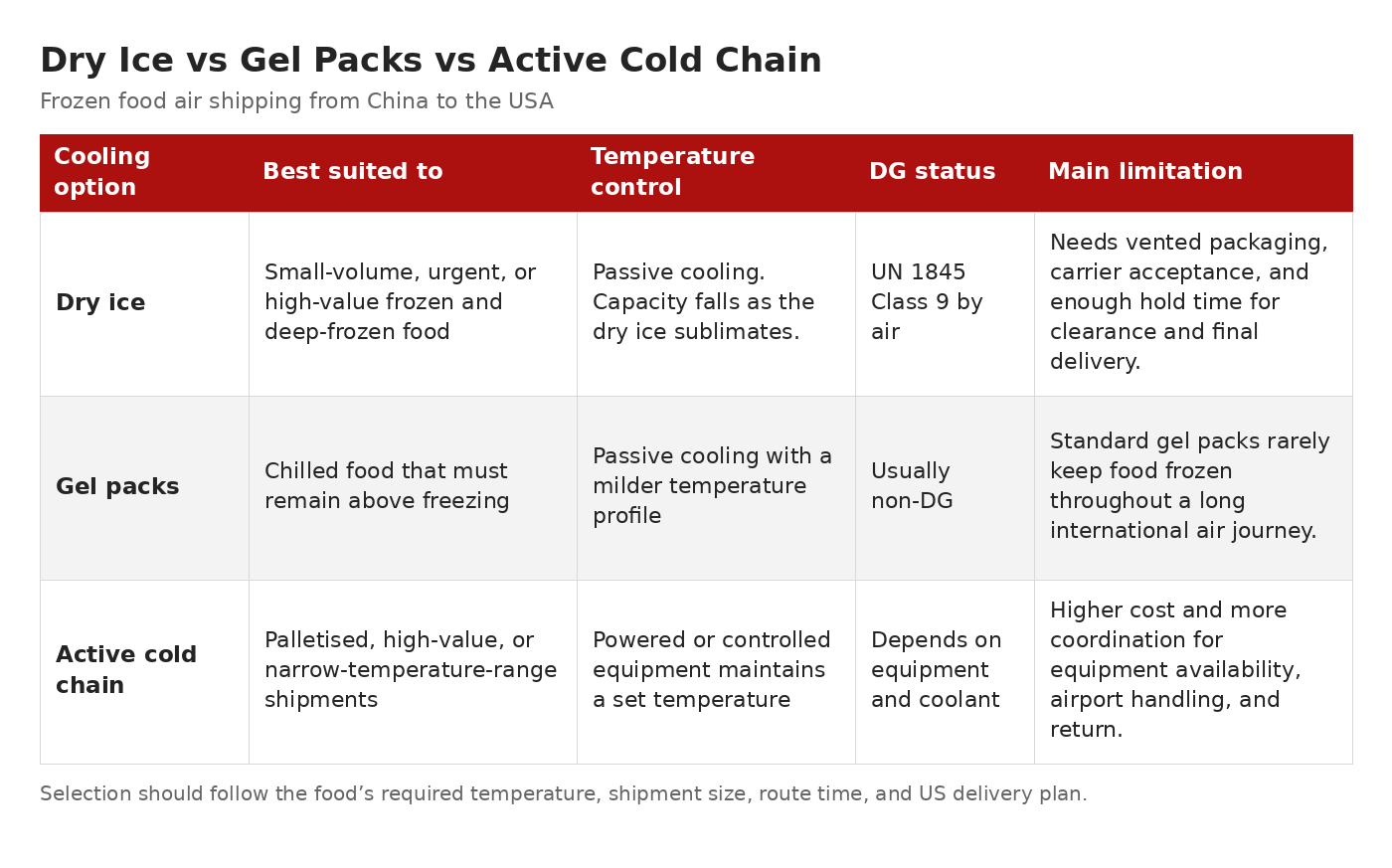
The cooling method should follow the product temperature range. Dry ice, gel packs, and active systems provide different levels of cooling and control.
Dry Ice
Dry ice packaging is used when food must remain frozen or deep frozen during air transport. Its cooling capacity falls as the dry ice sublimates.
The package must manage both temperature and gas release. It normally includes sealed food packaging, suitable separation from the coolant, insulation, and a strong outer box. Under US transport rules, the package must allow carbon dioxide gas to escape.
The dry ice quantity must match the route. Packaging performance, product mass, box size, starting temperature, ambient exposure, and expected handling time all affect the required amount. Full UN 1845 marking and documentation rules are explained in our dry ice shipping guide.
Gel Packs
Gel packs are mainly for chilled food that must remain above freezing. Their temperature profile can reduce the risk of freezing damage.
Standard gel packs rarely maintain frozen conditions through a long international air journey. The importer should obtain a precise temperature specification instead of relying on terms such as “keep cold”.
Active Cold Chain
Active temperature control uses powered or controlled equipment to maintain a set temperature. It can suit palletised cargo, narrow temperature ranges, or shipments that need more stable control.
Equipment planning adds cost and coordination. Availability, rental terms, airline compatibility, airport handling, and return arrangements must be confirmed before booking.
US Customs Clearance for Frozen Food Shipped with Dry Ice
Dry ice compliance and food admission are separate. Airline acceptance allows the UN 1845 shipment into the air network, while US authorities decide whether the food can enter the country.
FDA Facility Registration and Prior Notice
FDA requirements commonly include facility registration and Prior Notice. Facilities that manufacture, process, pack, or hold food for US consumption generally need registration unless an exemption applies.
Prior Notice data must match the entry records. The manufacturer, product description, quantity, and arrival details should be consistent across the invoice, transport documents, and FDA submission.
Sample wording does not create a general exemption. A shipment marked “sample” or “not for resale” still needs an eligibility review based on its product, purpose, sender, and receiver.
FSVP Importer and Importer of Record
The two importer roles serve different purposes. The Importer of Record manages the customs entry and bond responsibility, while the FSVP importer carries supplier verification duties when the rule applies.
FDA normally identifies the FSVP importer as the US owner or consignee at the time of entry. When neither exists, a US agent or representative of the foreign owner or consignee may act with written consent.
Service providers do not automatically take this responsibility. An express carrier, customs broker, warehouse, or freight forwarder becomes the FSVP importer only when the legal requirements and written appointment are satisfied.
Product-Specific US Agency Controls
The food category determines additional controls. Mixed products should be reviewed by their full ingredients rather than their commercial name alone.
Seafood: FDA seafood HACCP rules may require importer verification of the foreign processor.
Meat, poultry, and egg products: Entry can depend on eligible countries, products, and certified establishments.
Animal-derived ingredients: Some products may require APHIS permits, certificates, or supporting data.
Plant products: Fruits, vegetables, and related materials may fall under APHIS plant import controls.
Prepared foods: Dumplings, filled pastries, soups, and mixed meals should be assessed by ingredient composition.
Customs and Dry Ice Documentation
Document consistency is essential because the airline, customs broker, FDA, and other agencies may review different parts of the shipment record.
Commercial invoice: Accurate product description, ingredients where needed, quantity, value, manufacturer, buyer, and country of origin.
Packing list: Food net weight, carton count, dimensions, gross weight, and lot information where relevant.
Air waybill: Routing and dry ice details required by the carrier.
Food entry records: Prior Notice, facility data, FSVP details, and product-specific filings.
Supporting records: Health, sanitary, phytosanitary, permit, or eligibility documents where required.
Dry ice records: UN 1845 description, dry ice net quantity per package, and matching package marks.
Three weights should remain separate: food net weight, dry ice net weight, and total gross weight. A mismatch can stop carrier acceptance or create entry questions.
Managing Delays Before the Dry Ice Runs Out
Delay management should be agreed before departure. The importer needs the packaging hold time, escalation contacts, and an authorised recovery option for each stage of the journey.
Origin Acceptance and Flight Delays
The risk: Cargo may miss the airline cut-off, fail acceptance, lose booked capacity, or move to a later flight. Dry ice continues to sublimate while the shipment waits.
The importer’s action: Require written booking confirmation and pre-approval of the declared product, package, and dry ice quantity before final handover. Final acceptance still occurs after the carrier inspects the shipment. The forwarder should also state where the cargo can be held and whether authorised re-icing is available at origin.
The status update: After a flight change, request the new departure time, cargo location, elapsed hold time, and remaining cooling margin. A replacement flight is useful only when the package can still cover the revised route and US delivery.
US Customs or FDA Clearance Delays
The risk: Missing data, agency questions, document correction, examination, or sampling can hold the cargo at the arrival airport.
The importer’s action: Assign the customs broker, FSVP importer or designated compliance contact, and internal document owner before departure. During a delay, these parties should confirm the regulatory status and the next expected decision point.
The recovery plan: Identify a suitable cold store and an authorised re-icing provider near the arrival airport. Access cannot be assumed while the cargo remains under airline, customs, or FDA control.
Release and Final-Mile Delivery Delays
The risk: Cargo may clear outside working hours, miss refrigerated collection, lose its receiving slot, or arrive when the selected cold store has no space.
The importer’s action: Book refrigerated collection around the expected release window and confirm the receiving hours, unloading conditions, and emergency contacts. A backup cold store should be available for time-sensitive cargo.
The receiving check: After delivery, record package condition, product temperature under the agreed method, and any data logger result before placing the food into normal stock.
How Gerudo Logistics Handles Frozen Food and Dry Ice Shipments
Gerudo Logistics combines cold-chain planning with dangerous goods capability. We assess the product temperature, cargo size, timing, US eligibility, packaging hold time, and destination delivery plan before recommending dry ice, gel packs, active temperature control, or another solution.
Our service covers the complete logistics chain. We coordinate packaging review, UN 1845 carrier acceptance, air freight or express arrangements, customs document checks, US clearance support, delay planning, and refrigerated delivery. Importers can contact us before the supplier packs the food.
Frequently Asked Questions
Can Frozen Food Be Shipped from China to the USA with Dry Ice?
Yes, when three conditions are met: the food is eligible for US entry, the carrier accepts the shipment, and the package can maintain the required temperature through delivery. Dry ice is most practical for smaller, urgent, or higher-value air shipments.
Can FedEx, DHL, or UPS Ship Frozen Food with Dry Ice from China?
Selected services may accept it. Acceptance depends on the Chinese origin, US destination, account, service level, package size, dry ice quantity, and food category.
How Much Dry Ice Is Needed for International Frozen Food Shipping?
There is no fixed daily amount that works for every shipment. The calculation should use the total logistics time, insulation performance, box size, food mass, starting temperature, ambient exposure, and delay allowance.
Does a Frozen Food Sample Need FDA Prior Notice?
A sample description does not create a general exemption. Prior Notice and other requirements depend on the product, purpose, sender, receiver, and any specific exemption.
What Documents Are Required for Frozen Food and Dry Ice?
The common records include the commercial invoice, packing list, air waybill, Prior Notice, FSVP details where applicable, product permits or certificates, and UN 1845 information. The final list depends on the ingredients and agency controls.
Can Dry Ice Be Replenished During a US Customs Delay?
Re-icing may be possible after the responsible authority and cargo handler permit access. The provider, approval process, location, cost, and document updates should be confirmed before departure.
When Is Active Cold Chain Better Than Dry Ice?
Active temperature control may be better for palletised cargo, narrow temperature ranges, longer journeys, or food that needs more stable control. Equipment cost and return arrangements still need comparison with cargo value and deadline.
Conclusion
Dry ice is a specialised air logistics option for small-volume, urgent, and high-value frozen food moving from China to the USA. Its success depends on matching the product temperature, transport channel, packaging hold time, and US entry plan.
The importer should settle the full chain before packing. Carrier acceptance, customs roles, delay recovery, cold storage, and refrigerated delivery all need named parties and confirmed arrangements.