Can Liquid and Powder Dangerous Chemicals Be Shipped Together by LCL from China?
At a Glance: Liquid and powder dangerous chemicals can sometimes be shipped together under LCL from China, but only after a detailed combined review. Each product must qualify individually, and the pair must meet segregation, packaging, and route requirements. Final container placement depends on the consolidator’s load plan, not just booking intent.
An importer may have four drums of liquid dangerous chemicals from one Chinese supplier and two pallets of powder dangerous chemicals from another. Each order is too small for a full container, so combining them through less than container load shipping appears commercially sensible.
Mixed DG LCL can be possible, although liquid and powder are only physical forms. Each product must first qualify for a dangerous goods LCL service. The pair must then pass a combined review covering classification, segregation, package failure risks and the complete transport route.
The current IMDG Code is the 2024 Edition incorporating Amendment 42-24, mandatory from 1 January 2026. It applies requirements to each individual substance and gives particular attention to packing, stowage and the segregation of incompatible substances.
This guide concerns separately packaged liquid and powder dangerous chemicals sharing one LCL container. It excludes chemical blending inside one package. It also addresses a different decision from mixing dangerous goods and general cargo in a dedicated FCL container.
What Does Mixed Loading Mean in Dangerous Goods Shipping?
Mixed loading can describe several arrangements. An importer may use the phrase for two products under one booking, two pallets in one container or two packages placed inside one overpack. These arrangements require separate checks.
Multiple DG Products Under One Importer’s Shipment
One importer may purchase drums of liquid chemical and bags of powder chemical from the same factory or from separate suppliers. The forwarder can collect both products and submit them for linked LCL planning.
A linked booking remains an administrative arrangement. It does not confirm that both products will travel in the same container or on the same sailing.
Different Shipments in One LCL Container
LCL cargo shares container space with shipments belonging to other customers. The consolidator controls which accepted pallets and packages enter each container. Published Maersk LCL terms, for example, reserve the right to consolidate customer cargo with other shipments and arrange packages within the container.
The importer sees only part of the load plan. Two chemicals may be compatible with each other, while another shipment already assigned to the container creates a conflict.
Same Container, Same Pallet and Same Overpack
Approval for the same container does not automatically extend to a shared pallet or overpack. Packages that can occupy one container may still require separate pallets or different loading positions.
This article addresses container-level consolidation. Each liquid and powder product remains in its own compliant package and is presented as a separate handling unit.
Can Liquid and Powder Dangerous Chemicals Share an LCL Container?
Yes, they may share an LCL container in selected cases. A liquid and a powder can enter one consolidation when both products are accepted individually, the applicable dangerous goods entries permit the arrangement, and the complete route can handle the combined load.
Four conditions need to align:
Individual DG LCL acceptance: A specialist service must accept each UN entry, package type, quantity and route.
Combined compatibility: The pair must satisfy applicable segregation requirements and avoid an unacceptable reaction if either package fails.
Packaging suitability: Drums, bags, fibre drums, jerrycans or combination packages must remain sound through repeated LCL handling.
Route-wide acceptance: The origin Container Freight Station (CFS), consolidator, carrier, transshipment connection and destination CFS must support both products.
IMDG compliance is one part of the decision. Carriers also maintain commodity and route restrictions based on vessel safety and operating capability. Hapag-Lloyd, for example, publishes dangerous commodities that it rejects or accepts only under stated conditions.
Case Example: Mixed Liquid and Powder DG LCL from China
Consider a German importer buying two chemical additives from separate suppliers. The liquid is collected near Shanghai, the powder is collected in Suzhou, and both are intended for Hamburg.
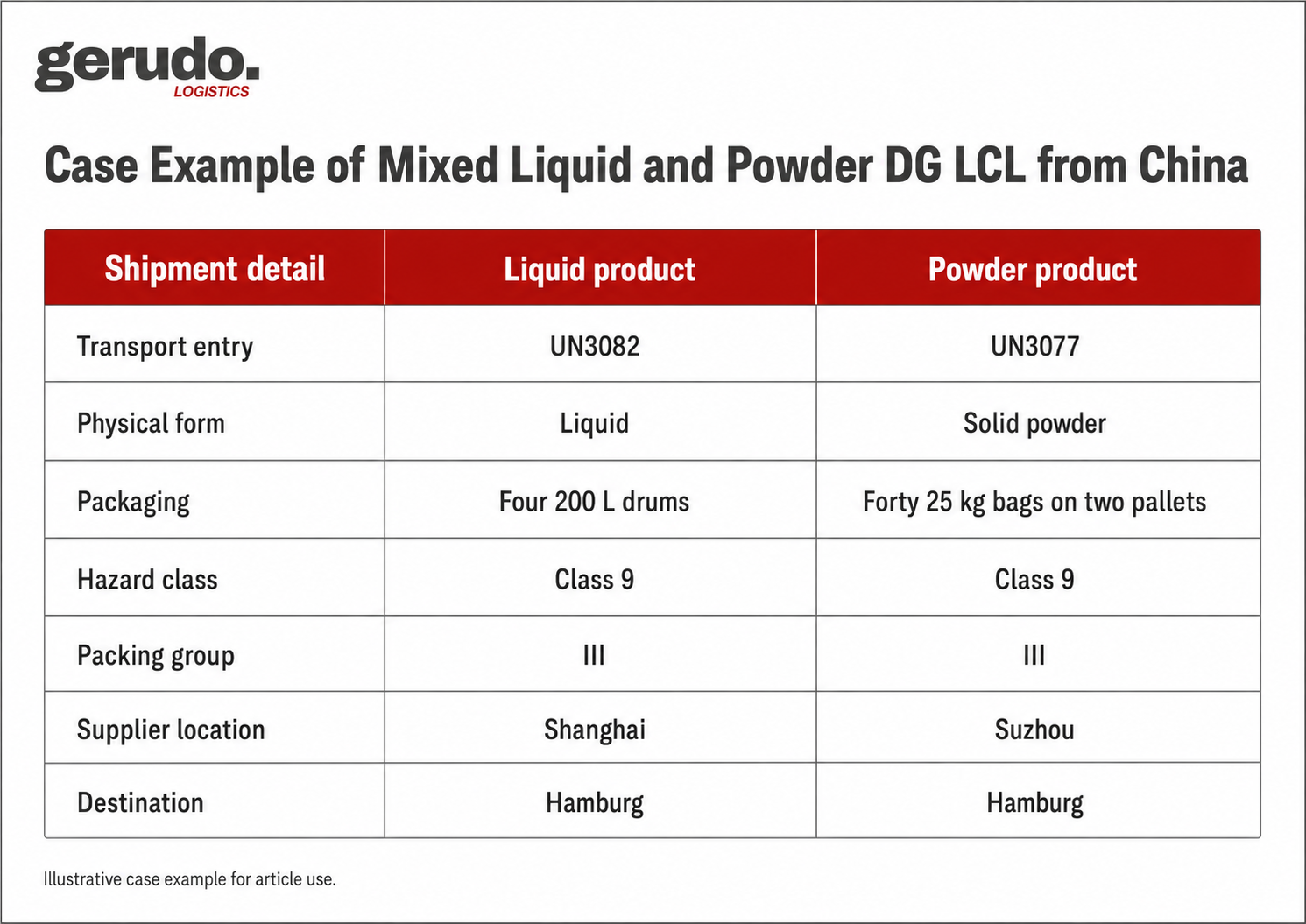
UN3082 covers environmentally hazardous substances in liquid form, while UN3077 covers environmentally hazardous substances in solid form. Both entries fall under Class 9 and Packing Group III, subject to the actual product properties and classification evidence, check our guide for Shipping UN3077 and UN3082 from China
The matching class and packing group do not confirm joint loading. The forwarder still needs the SDS, full transport descriptions, technical names where required, package specifications and quantities for both products.
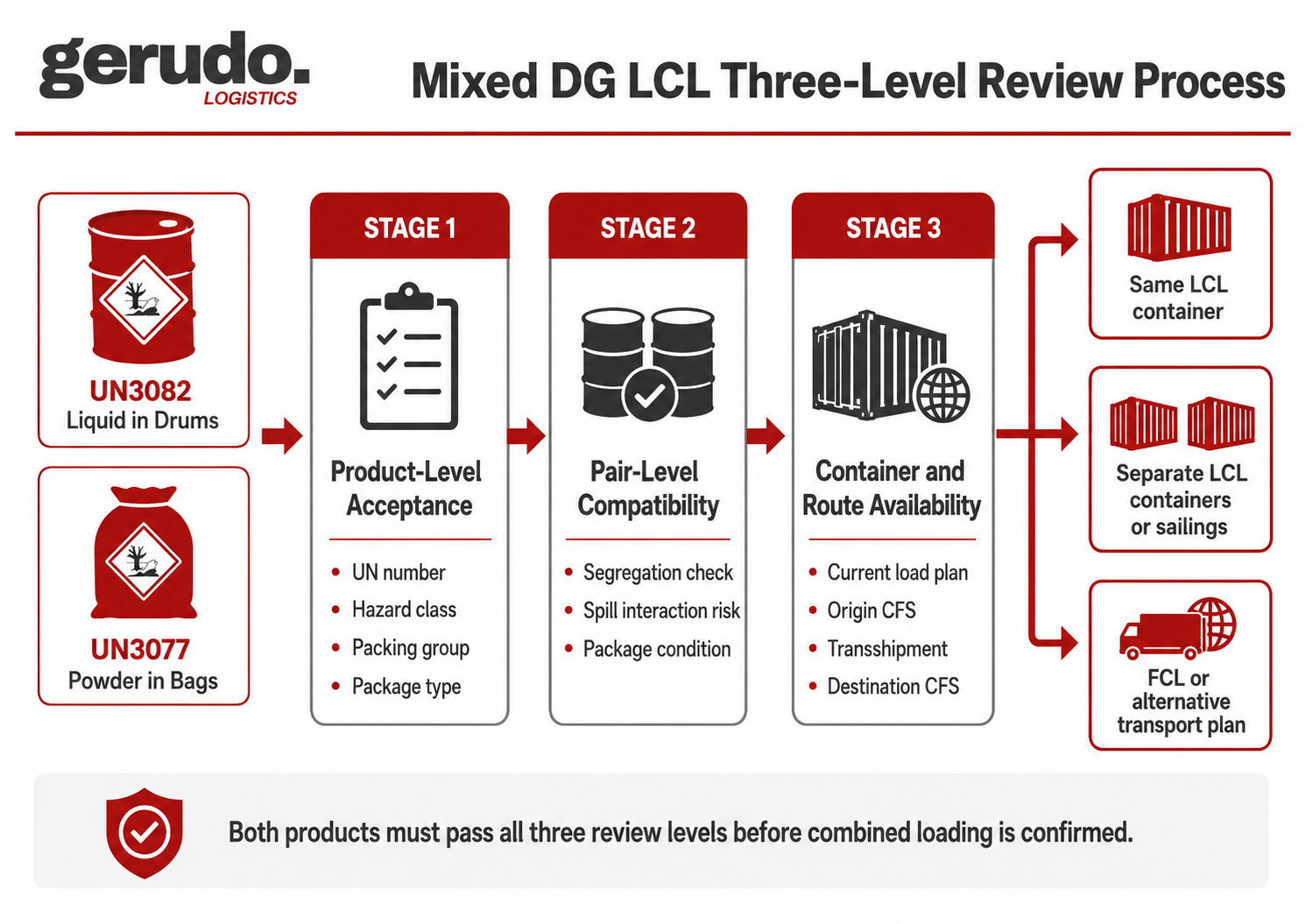
The review then asks three questions. Can each product enter the selected DG LCL service? Can the two products occupy the same cargo transport unit? Can that pair fit the full load plan for the proposed sailing?
The final result may split the cargo. Both products could receive DG LCL acceptance, while the consolidator places them in different containers because of other cargo booked for that week.
Why Separate DG LCL Acceptance Does Not Guarantee Combined Loading
A product-level approval confirms that one chemical can enter a service. A combined loading approval confirms that two products can share the same container under the proposed operating plan.
When Combined Loading May Be Possible
Both products must qualify independently. The consolidator reviews each UN number, Proper Shipping Name, hazards, packing group, marine pollutant status, special provisions, package type and quantity.
The pair must also satisfy the relevant segregation provisions. The IMDG Code applies detailed requirements to individual substances and specifically addresses the segregation of incompatible materials. A comparison such as Class 9 plus Class 9 is insufficient.
Combined loading may be considered when:
Classification is complete: Both SDS files and transport descriptions identify the actual products and agree with the shipping documents.
No segregation conflict applies: The two entries can occupy the same cargo transport unit under the relevant IMDG provisions.
Package failure risks are acceptable: Leakage or powder escape would not create an unacceptable reaction under the proposed controls.
Packages are suitable for LCL handling: The cargo can pass warehouse receipt, pallet movement, container loading and destination deconsolidation.
Compatible space is available: The consolidator has a current load plan that can accept the pair.
The full route accepts both products: Origin, transshipment and destination operations support the entries and packaging formats.
When the Products Cannot Share the Same Container
A segregation requirement can prevent joint loading. If the applicable entries require separation beyond what can be achieved inside one container, the products must enter different cargo transport units. A product requiring exclusive use also cannot share a normal LCL container.
A second reason is the reaction expected after package failure. Examples requiring close review include a flammable liquid beside an oxidising powder, an acidic liquid beside a solid that releases dangerous gas on contact with acid, or a water-reactive powder beside a water-based product.
The current load plan may block an acceptable pair. The liquid and powder may be compatible with each other, while a third dangerous goods shipment already assigned to the container creates a conflict.
Route restrictions can also intervene. The origin CFS may accept both products while a transshipment connection or destination CFS accepts only one. Carrier restrictions can vary by commodity, route and sailing.
Timing can create an operational rejection. Two suppliers may miss the same warehouse window, submit inconsistent documents or deliver packages that require correction.
What Happens When Combined Loading Is Rejected?
A rejected combination does not automatically require FCL. The forwarder should compare the practical alternatives:
Separate DG LCL containers: Each product enters a compatible consolidation on the same or a nearby sailing.
Different sailing dates: One product moves first, while the second waits for the next approved load plan.
Different transport modes: One product remains on ocean LCL and the other uses an approved air or multimodal option.
Dedicated FCL: A full container becomes relevant when volume, repeated LCL charges, waiting time or route restrictions make split consolidation inefficient.
FCL gives the importer a dedicated container, while classification, segregation and carrier approval still apply. The separate questions of exclusive use, container packing certification and securing are covered in ourFCL mixed loading guide.
Cross-Risks Between Liquid Drums and Powder Packages
Risks created by placing liquid and powder packages in the same shared cargo space.
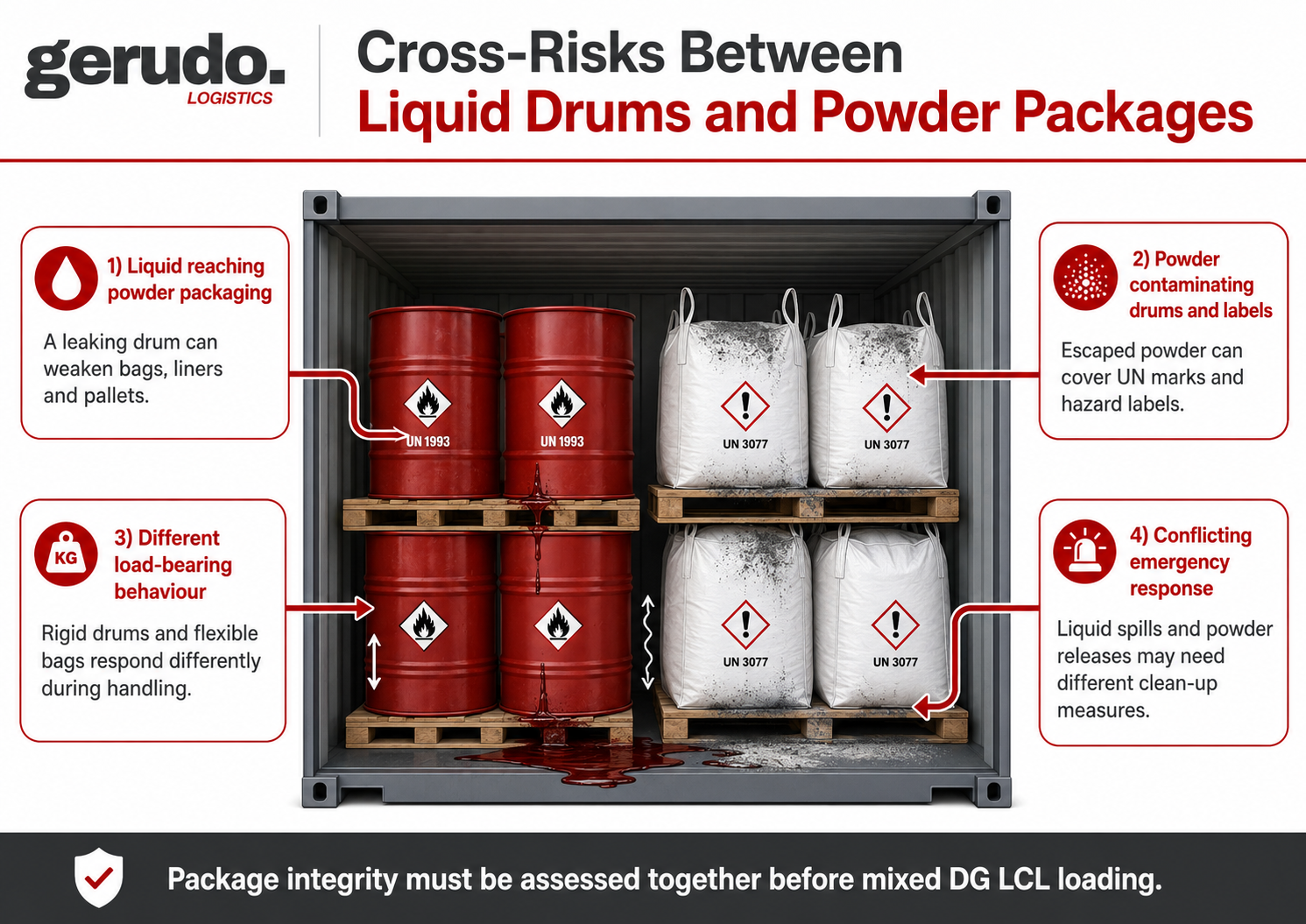
Liquid reaching powder packaging: A leaking drum can soak bags, inner liners or timber pallets, leading to loss of package strength, product degradation or reaction.
Powder contaminating drums and labels: Fine powder escaping from a seam can cover hazard labels, UN marks and drum closures, making the source of contamination harder to identify.
Different load-bearing behaviour: Rigid liquid drums and flexible powder bags respond differently to compression, vibration and pallet movement. Separate palletisation may be required.
Conflicting emergency response: A liquid spill and a powder release may require different absorbents, protective equipment, firefighting media or clean-up methods.
Exterior condition matters at CFS receipt. Weeping closures, wet drum surfaces, powder residue, torn bags or an unexplained odour can cause the warehouse to hold or reject the cargo.
Where specification packaging is required, the package must match the applicable IMDG packing instruction. A UN mark confirms the tested packaging design and does not establish chemical compatibility with every substance.
For a separate comparison of liquid packaging formats, see our guide toshipping dangerous goods liquids from China.
How to Check Whether Your DG Products Can Share an LCL Container
Importers should request a combined review before fixing collection dates. Two separate product approvals cannot be joined without checking the proposed combination.
Step 1 Collect Information for Both Products
Provide a separate file for each chemical:
Current SDS: Use the version matching the actual formulation and supplier.
Transport description: Include the UN number, Proper Shipping Name, technical name where required, hazards and packing group.
Additional transport data: Confirm marine pollutant status, flash point where applicable and relevant special provisions.
Consistent product identity: Align the product description across the invoice, packing list, labels and booking information.
The SDS is a starting document. It does not replace classification evidence, package data or carrier approval. See our dangerous goods shipping document checklist for the wider document set.
Step 2 Confirm Packaging and Quantity
The forwarder needs information that reflects the packages entering the warehouse:
Package type: State whether the cargo uses drums, fibre drums, bags, jerrycans, combination packaging, IBCs or another format.
Package performance details: Provide the applicable UN packaging mark and supporting information where required.
Quantity data: State the content per package, total package count, weights, dimensions and pallet count.
Current photographs: Show closures, seams, marks, labels, package surfaces and completed pallets.
Step 3 Submit One Combined Proposal
Send both product files to the same DG forwarder and state whether the products need one sailing, one LCL container or only coordinated delivery to the same destination.
Supplier information affects the plan. Provide pickup locations, cargo-ready dates and confirmation that both suppliers can follow the designated DG CFS instructions.
Step 4 Obtain Shipment-Specific Confirmation
Before releasing cargo to the warehouse, confirm:
Acceptance for each product: Verify the exact entries, package types and quantities.
Combined loading status: Confirm whether the products can enter the same container or will be split.
Approved route and sailing: Check the carrier, transshipment arrangement and destination CFS.
Warehouse instructions: Confirm the receiving window, package conditions and DG cut-off.
Contingency arrangement: Establish what happens if one supplier misses the cut-off or one package fails inspection.
Any material change can trigger a fresh review. Changes to formulation, package size, package count, supplier or route should be disclosed before delivery.
Professional Freight Forwarding for DG Shipments
Gerudo Logistics specialises in dangerous goods and chemical shipping from China. We review the SDS, transport classification, packaging, quantity, supplier locations and route information for each liquid and powder chemical, then determine whether the products can enter one DG LCL plan, require separate consolidations or need another transport arrangement.
Our services cover all applicable packaging formats, including drums, IBCs, bags, fibre drums, cartons, ISO tanks and other approved configurations. Through Guangzhou, Shenzhen, Shanghai, Ningbo, Qingdao, Dalian and other major Chinese gateways, we coordinate DG LCL, FCL, air freight, customs clearance and final delivery. Importers cancontact us for a shipment-specific review.
Frequently Asked Questions
Can liquid and powder dangerous chemicals use one LCL booking?
They may be submitted under one coordinated request, although the consolidator can place them in separate containers or sailings. The booking structure and the final load plan are separate decisions.
Does the same DG class mean two chemicals can share a container?
No. The exact UN entries, subsidiary risks, segregation provisions, chemical properties, packaging and full consolidation plan still need review.
Can UN3077 and UN3082 share an LCL container?
They may be considered for the same consolidation, but their shared Class 9 and Packing Group III status does not confirm compatibility. The technical names, package details, route and other cargo in the container must be checked.
Can liquid drums and powder bags be placed on the same pallet?
Same-container acceptance does not automatically approve a shared pallet. Weight distribution, package strength and leakage exposure may require separate pallets.
Can dangerous chemicals from two Chinese suppliers be consolidated?
Yes, when both products pass review and the suppliers can meet the same approved warehouse and schedule requirements. Separate origins add collection, timing and document coordination.
Who decides whether the products enter the same LCL container?
The consolidator controls the final load plan within IMDG requirements, carrier rules and route restrictions. The forwarder prepares the submission and coordinates the approval.
Why can both products be accepted but assigned to different sailings?
Another shipment in the current container may create a segregation conflict, or one route connection may have limited DG space. Cargo-ready timing and destination restrictions can also lead to separate sailings.
Is FCL required when the two chemicals cannot share an LCL container?
No automatic requirement applies. The products may move in separate consolidations, on different sailings or through different compliant modes, while FCL becomes an option when volume, timing and total cost support it.
Conclusion
Liquid and powder dangerous chemicals can sometimes share an LCL container from China. The decision depends on the exact transport entries, pair-level compatibility, package condition and complete consolidation plan.
Each product can receive DG LCL acceptance while the pair is assigned to different containers. Importers should request a combined review before fixing collection dates.
Where one container cannot accept both products, the alternatives are separate LCL consolidations, different sailings, another compliant mode or FCL.