How to Import Steel Structures from China: 2026 Costs & Logistics Guide
If you have ordered steel structures from China before, the process may have felt predictable. That changed on January 1, 2026, when China's Ministry of Commerce activated Announcement No. 79/2025, making export licenses mandatory for most structural steel products under HS Codes 7201 to 7307. At the same time, EU buyers now face Carbon Border Adjustment Mechanism (CBAM) compliance requirements that add a new documentation layer to every shipment heading to Europe.
These changes have caught importers off guard, stretching lead times and inflating landed costs for those who did not plan ahead. Clients who contacted us after placing purchase orders without verifying their supplier's export license status have faced 2 to 3 week delays at the origin port alone.
This guide covers what you need to know: which shipping method fits your cargo, what the real costs look like by destination, what documentation your customs broker will require, and how to find the right supplier before committing to an order.
Steel Structure Shipping Methods: FCL, Flat Rack and Break Bulk
Steel structures are among the most method-sensitive cargo in international freight. Dense, often oversized, and sometimes geometrically awkward, they demand a shipping decision based on physical specifications rather than cost preference alone. Getting this wrong means re-booking, re-lashing, or in the worst case, returning cargo to the factory.
FCL: 20ft and 40ft Standard Containers
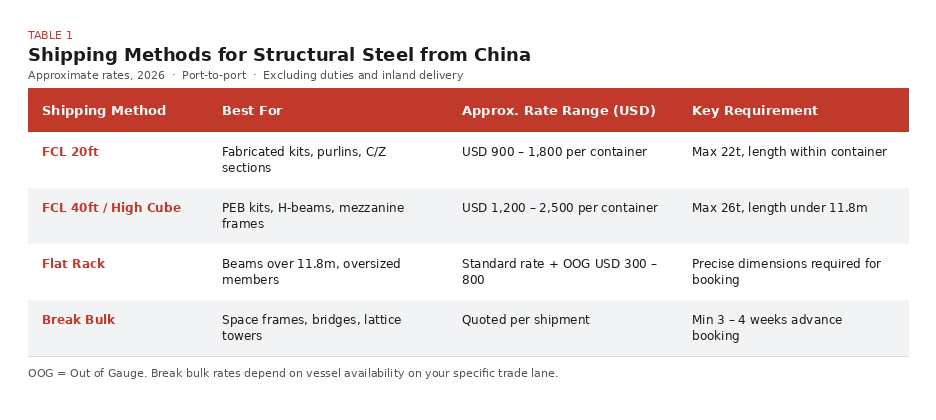
Full Container Load (FCL) is the default choice for fabricated steel kits such as purlins, C/Z sections, and flat-packed structural components. A 20ft container typically carries 18 to 22 metric tons of steel, and a 40ft carries 24 to 26 tons, though the practical limit depends on the destination country's road weight restrictions. In several Middle East markets, axle load limits on local highways restrict what can be moved by truck from the port, even if the container itself is within shipping weight tolerance.
For Pre-Engineered Building (PEB) kits and modular warehouse frames, most shipments move in 40ft High Cube containers. If your fabricator quotes a standard 40ft, confirm internal dimensions before accepting the loading plan.
Flat Rack Containers for Oversized Steel
When structural members exceed 11.8 meters in length, they will not fit inside a standard 40ft container. Flat rack containers handle oversized and out-of-gauge (OOG) cargo by removing the side walls, allowing long beams and lattice sections to be loaded and lashed securely. This is the standard solution for crane runway beams, long-span roof trusses, and large-diameter pipe sections.
Flat rack shipping carries OOG surcharges typically ranging from USD 300 to USD 800 per unit, depending on carrier and route. Lashing costs are additional. Always provide exact dimensions and weight per member when requesting a flat rack quote.
Break Bulk for Large-Span and Heavy Structures
Space frame structures, lattice towers, and welded plate girders often require break bulk shipping because their geometry makes container loading impractical. Break bulk cargo is loaded directly onto the vessel's cargo deck and secured with purpose-built bracing.
Break bulk is not a standard service on most trade lanes, and scheduling depends on vessel availability. From our experience coordinating large-span projects, break bulk booking windows are typically 3 to 4 weeks longer than FCL, and missed sailings are difficult to recover from without significant cost penalties. If your project has a fixed site mobilization date, plan this well in advance.
Steel Structure Shipping Costs: Freight Rates and Cost Example
Steel shipments almost always hit the weight limit before the volume limit, which means the cost per container is effectively fixed once loaded to capacity. The most important variable is the per-tonne freight rate on your specific route, not the container size.
The following FCL rate ranges reflect market conditions in early 2026. These are port-to-port estimates and do not include destination port handling, customs clearance fees, duties, or inland delivery:
Middle East (Jebel Ali, Dammam): USD 950 to 1,500 per 40ft container
India (Nhava Sheva, Chennai): USD 700 to 1,100 per 40ft container
Europe (Hamburg, Rotterdam): USD 1,600 to 2,800 per 40ft container
United States (Los Angeles, Houston): USD 2,000 to 3,500 per 40ft container
Southeast Asia (Jakarta, Manila): USD 600 to 1,000 per 40ft container
Duties and taxes are not included above because they depend on your destination country, product classification, and the specific mill your supplier uses. Your customs broker should calculate these separately based on your HS Code and origin before you commit to a purchase order.
Shipping Cost Example: Shanghai to Rotterdam
The following breakdown reflects a typical FCL shipment of a 22-tonne PEB warehouse kit from Shanghai to Rotterdam in early 2026.
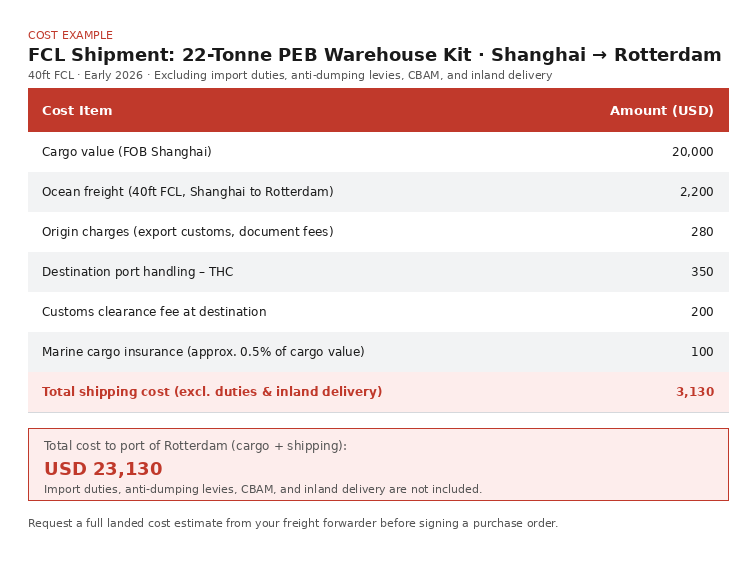
Total cost to port of Rotterdam: USD 23,130, before import duties, anti-dumping levies, CBAM compliance costs, and inland delivery to site. These additional items vary significantly by destination country and supplier, which is why a landed cost estimate from your freight forwarder is worth requesting before finalizing your purchase order.
Export License, Documents and Customs Compliance for Steel Imports
China Steel Export License 2026
Under Announcement No. 79/2025, Chinese exporters of steel products within HS Codes 7201 to 7307 must hold a valid Export License before loading can proceed. The license is held by the exporter, not the importer, but the importer bears the operational consequences if it is missing at the time of export customs declaration.
The licensing process typically adds 7 to 14 days to the dispatch timeline. Ask your supplier to confirm in writing that their license covers your specific product category and mill of origin. Request a copy of the license before placing your deposit. Trading companies sourcing from multiple mills may hold authorization for some mills but not others, so the mill assigned to your order matters.
Required Documents for Customs Clearance
A complete document set is the most effective way to prevent customs holds at the destination port. Missing any one of the following is the most common reason steel shipments are delayed for inspection.
Bill of Lading: confirming vessel, port, and cargo description
Commercial Invoice: stating the correct HS Code and unit price per tonne or per set
Packing List: detailed breakdown including piece marks, dimensions, and weights
Mill Test Certificate (MTC): stamped by the manufacturer, confirming steel grade and mechanical properties. An MTC not stamped directly by the producing mill is unacceptable for US and EU customs purposes
China Export License copy: mandatory from January 1, 2026
EU CBAM carbon emission data: required for EU-bound shipments, sourced from the producing mill
Anti-dumping duty declaration: required in the US and several other markets
Corrosion Protection
Steel loses value in transit faster than most other cargo. Salt air, container condensation, and delays at tropical ports all accelerate oxidation on voyages exceeding 20 days. Specify the corrosion protection standard in your purchase order and request photographic evidence of surface treatment before loading. For long voyages, hot-dip galvanization is the most durable option. For general industrial use, a zinc-rich epoxy primer is cost-effective and compatible with site-applied topcoats. For bundled sections on long routes, VCI (Vapor Corrosion Inhibitor) packaging provides additional protection.
How and Where to Source Steel Structures from China
Sourcing structural steel from China is not the same as ordering standard manufactured goods. Most steel structures are custom-fabricated to your drawings, which means the supplier relationship begins before production, not after. The distinction between a direct fabricator and a trading company matters here more than in most product categories.
A direct fabricator produces your structure in-house, controls quality at every stage, and holds their own Export License. A trading company sources from multiple mills, which introduces variability in quality, steel grade consistency, and, as of 2026, export license coverage. For custom structural projects, working directly with a fabricator is the lower-risk option.
Online Channels
Alibaba and Made-in-China.com are the most accessible starting points for identifying suppliers. Filter for "Gold Supplier" or "Verified Supplier" status, and prioritize listings with documented export history to your target market. Transaction volume is a more reliable signal than listing presentation.
When using these platforms, request a video call with the supplier before committing. Ask to see the factory floor, the production equipment, and a sample Mill Test Certificate from a recent export order. Suppliers who are reluctant to do this are almost always trading companies, not fabricators.
Offline Channels
China's structural steel production is geographically concentrated, which means visiting the right region gives you direct access to the highest-density supplier clusters.
Tangshan, Hebei: China's largest steel production base. H-beams, structural sections, and standard steel profiles are produced here at scale. Best suited for buyers sourcing large volumes of standard-grade material.
Qingdao, Shandong: A major hub for export-oriented steel fabricators, with direct port access. PEB kits, modular warehouse frames, and custom industrial structures are commonly produced here.
Wuhan, Hubei: The main production region for heavy structural components including bridge girders, large-span trusses, and industrial plant frameworks.
Foshan, Guangdong: Concentrated in light-gauge steel, cold-formed sections, and agricultural steel structures. Well-suited for buyers sourcing residential or lightweight commercial kits.
For buyers attending trade shows, the Canton Fair (Guangzhou, April and October) covers industrial materials and machinery in its second phase, and is the most accessible venue for meeting export-oriented fabricators from all four regions in one location.
What to Verify Before Ordering
Before placing a deposit with any supplier, confirm the following:
Export License status under Announcement No. 79/2025, covering your specific HS Code range
Steel grade certification: Q355B is the standard export grade; request a sample MTC from a recent completed order
Production capacity: confirm they can complete your order within your timeline without subcontracting the fabrication
Export references: ask for two or three contacts from past international buyers in your destination market
Skipping this step is the single most common reason first-time importers face delays, quality disputes, or documentation failures on structural steel orders.
How to Ship Steel Structures from China: Step-by-Step Process
The full cycle from purchase order to site delivery takes a minimum of 8 weeks, and closer to 10 to 12 weeks when custom fabrication, export licensing, and destination customs clearance are factored in. The timeline below assumes an FCL shipment with no major design revisions or documentation issues.
Step 1: Confirm supplier credentials and export license
Before placing a deposit, verify that your supplier holds a valid Export License under Announcement No. 79/2025 covering your specific product category and mill of origin. Request a copy of the license and check that the authorized HS Code range matches your product. At the same time, request the MTC specification sheet for the steel grade to confirm it meets your structural requirements.
Step 2: Finalize design drawings and piece mark schedule
Approved shop drawings are required before production begins. Design changes after cutting starts typically delay delivery by 1 to 2 weeks and can affect the piece mark schedule that customs documentation is built around.
Step 3: Specify corrosion protection in writing
Confirm the treatment standard in the purchase order and request photographic evidence of surface preparation and coating application before loading.
Step 4: Book freight and confirm container type
Provide your freight forwarder with exact dimensions and weight per member, not just the total shipment weight. For OOG cargo, book at least 3 to 4 weeks in advance to secure flat rack availability on your preferred sailing.
Step 5: Export customs clearance in China
Your freight forwarder files the export declaration with the correct HS Code and attaches the Export License. Allow 2 to 3 working days under normal conditions. Chinese national holidays can extend this, so factor public holiday dates into your dispatch schedule.
Step 6: Ocean transit and tracking
Monitor the shipment through your forwarder's tracking system. For break bulk, confirm lashing reports are issued before departure.
Step 7: Destination customs clearance and final delivery
Submit your import declaration with the full document set including MTC, Bill of Lading, Packing List, and any required anti-dumping or CBAM declarations. Customs processing time varies by country and port, but allow 3 to 5 working days as a baseline. Once released, arrange inland transport in advance.
Structural steel kits require a flatbed or lowboy truck, and the delivery site must have a crane or forklift capable of handling the heaviest individual members. Arriving at site without confirmed unloading equipment adds cost and delays that are difficult to recover on a project schedule.
Working with a Freight Forwarder for Steel Structure Shipments
At Gerudo Logistics, we handle structural steel shipments across our operations in ports Guangzhou, Shanghai, Ningbo, Qingdao, and Shenzhen, coordinating directly with fabricators and mills rather than relying on third-party origin agents.
For OOG and flat rack cargo, we manage carrier declarations and port-to-port coordination. In our experience, the documentation stage is where most steel shipments lose time, particularly when suppliers are navigating the new export licensing requirements for the first time. We verify Export License coverage before production is complete, which is the only point in the process where a gap can still be resolved without delaying the shipment.
We offer DDP (Delivered Duty Paid) terms to project sites, including inland delivery where required. Contact our team now for a landed cost estimate.
Frequently Asked Questions for Steel Structure Shipping
Do I need a special license to import steel structures from China?
As an importer, you do not hold the license yourself. Your Chinese exporter must have a valid Export License under Announcement No. 79/2025 before the goods can leave China. Verify this before paying your deposit.
How much does the export license requirement affect my lead time?
Plan for an additional 7 to 14 days. Suppliers who have already secured their licenses will not see this delay, but trading companies sourcing from multiple mills may face gaps depending on which mill produces your order.
What is the correct HS Code for fabricated steel structures?
Most prefabricated steel building structures fall under HS Code 7308.90. Structural sections such as H-beams typically fall under 7216. Your customs broker should confirm the precise classification, as misclassification triggers inspection delays and potential duty adjustments.
Are there anti-dumping duties on Chinese steel in the US and EU?
Yes. US rates can exceed 100% for some mills. EU rates vary by product category. Check current rates through USITC for the US or the EU's TARIC database, and verify at the mill level rather than the country level.
What steel grade should I specify?
Q355B is the standard export grade and is accepted as equivalent to S355JR (European) and ASTM A572 Grade 50 (US). Confirm the required grade in your purchase order and verify it on the MTC before shipment.
What is the minimum order quantity?
Most fabricators require a minimum of 20 to 25 metric tons for FCL shipping to be cost-viable. Smaller orders are possible via LCL but per-tonne costs increase significantly.
How do I prevent rust damage in transit?
Specify the protection method in the purchase order before production starts. For long voyages, hot-dip galvanization is the most durable option. For shorter routes, a zinc-rich epoxy primer combined with VCI packaging for bundled sections is standard practice.
Conclusion
The sourcing and shipping process for structural steel from China is predictable when the verification steps happen at the right stage. The 2026 export license requirement and CBAM data obligations are both manageable, but they need to be confirmed during supplier selection, not after a purchase order is signed.
The delays that cost importers the most are almost always documentation gaps identified too late: an Export License that does not cover the right product, an MTC that was not issued by the producing mill, or an AD rate that was not checked before the cargo arrived. Address these at the procurement stage and the shipment itself is straightforward.
For a full landed cost estimate covering freight, duties, and compliance for your destination market, contact the Gerudo Logistics team directly.