How to Ship Bulk Liquids and Chemicals from China by ISO Tank (2026)
Bulk liquid shipping from China presents a different set of decisions than standard dry cargo. Once your cargo volume exceeds what drums or intermediate bulk containers (IBCs) can handle cost-effectively, the question is no longer whether to use an ISO tank, but how to arrange the shipment correctly. Get the tank type wrong, and your cargo may be refused at port. Overlook cleaning certification or destination import permits, and you face delays that drums would never have caused.
This guide covers the practical decisions: which tank suits your product, how freight costs break down, what the documentation process looks like, and where the process typically goes wrong for first-time ISO tank shippers.
ISO Tank or Flexitank: Which One Fits Your Bulk Liquid Cargo?
Before evaluating tank types or freight costs, the first question is whether an ISO tank applies to your cargo at all. ISO tanks are designed for bulk liquids and certain liquefied gases.
If your product is a solid, powder, or packaged liquid shipped in drums or IBCs, an ISO tank is not relevant regardless of its DG classification. The starting point is your product's physical state at the time of shipment, not its hazard class.
Common products shipped from China in ISO tanks include:
Chemical and industrial liquids
Acids (sulphuric acid, hydrochloric acid, nitric acid)
Industrial solvents and liquid resins
Hydrogen peroxide
Petroleum products and liquefied gases
Food-grade liquids
Edible oils and vegetable oils
Alcoholic and non-alcoholic beverages
Dairy products and molasses
Wine and spirits
Note that food-grade liquids require dedicated food-grade ISO tanks and cannot share equipment with chemical cargo. The compliance path for each category is entirely separate, which affects both tank availability and documentation requirements.
ISO tanks are the standard choice when cargo volume exceeds 14,000 liters, when the product is classified as a dangerous good under IMDG, or when contamination risk makes single-use packaging unsuitable. They are reusable, pressure-rated, and accepted by ocean carriers for hazardous liquid cargo.
Flexitanks are single-use bladders fitted inside a standard 20ft dry container, carrying up to 24,000 liters at a lower per-shipment cost. They are approved for non-hazardous liquids only. If your product has a UN number, a flexitank is not an option.
For small test orders or products with no established depot network at the destination, drums or IBCs remain the simpler choice. Above a certain volume threshold, ISO tanks deliver better landed cost and cargo integrity for most bulk liquid trade lanes.
T-Code and Tank Type: Matching Your Chemical to the Right Container
The T-code system under the IMDG code determines which tank your cargo is legally permitted to travel in. This is not a preference or a cost decision. It is a regulatory requirement derived from your product's UN number, hazard classification, and packing group.
The most common configurations in China export trade are:
T11 standard ISO tank: used for non-hazardous and low-hazard liquids including industrial oils, non-DG solvents, and base chemicals. This is the most widely available tank type at Chinese depots.
T14 lined tank: required for highly corrosive chemicals such as hydrochloric acid or sodium hydroxide. The critical structural difference from T11 is not pressure rating but opening configuration: T14 mandates no bottom openings, meaning all loading and discharge must occur from the top. This eliminates the risk of valve failure at the base when carrying high-hazard corrosives. The internal lining (rubber or LLDPE) must also be chemically compatible with your specific product. Confirm both the lining material and the no-bottom-opening requirement with your supplier before booking.
T50 gas tank container: used for liquefied gases under pressure, including LPG and ammonia. These require specialist port handling at the destination, which must be confirmed before you commit to a vessel.
T75 cryogenic ISO tank: vacuum-insulated for extremely cold liquids such as LNG and liquid nitrogen. Trade lanes for cryogenic cargo are limited, and a specialist forwarder is required.
Food-grade ISO tank: dedicated tanks with specific hygiene certifications for edible oils, wine, and spirits. These tanks operate in closed loops and are never used for chemical cargo. Cross-contamination history is the key concern here.
Heated ISO tanks: equipped with steam coils or electric heating pads for high-viscosity products like paraffin or bitumen that solidify at ambient temperature. Transit time directly affects cost because heating adds complexity to depot handling.
In our experience, the most common sourcing error is a shipper booking a T11 tank for a product that requires a T14, because the supplier described the chemical as "mildly corrosive." The UN number, not the supplier's description, determines the T-code. Verify this before requesting a quote.
ISO Tank Freight Rates from China in 2026: What You Will Actually Pay
Ocean freight is only one line item in your total ISO tank cost. The full cost structure includes several components that first-time shippers routinely underestimate.
What makes up your total cost:
Ocean freight (port to port, based on 20ft ISO tank slot)
Tank leasing fee (if you do not own the tank; charged per trip or per day)
Origin depot handling (loading, pre-shipment inspection, DG compliance check)
Destination depot handling (discharge and tank cleaning before return or reload)
Inland transport at both origin and destination
DG documentation surcharge (applied by most carriers for hazardous cargo)
Destination import permits for regulated chemical goods
The table below shows indicative ocean freight ranges by major destination. These rates reflect 2026 market conditions and will vary based on product classification, carrier, and booking lead time.
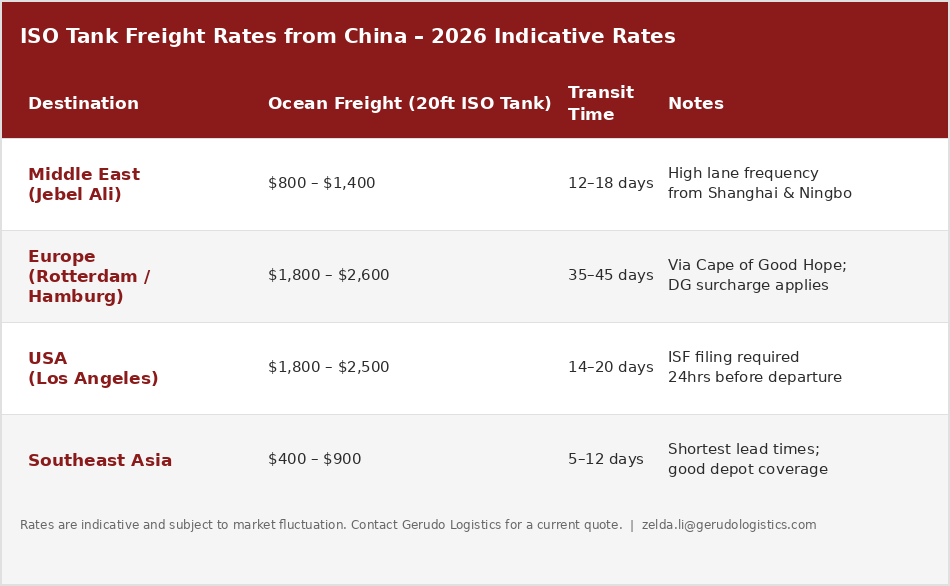
Tank leasing typically adds $200 to $500 per trip depending on tank type and the depot's location relative to your supplier's factory. Cleaning fees at the destination depot range from $150 to $400 and are a real budget item that frequently disappears from initial quotes. Request a full landed-cost breakdown before approving any booking.
Key Ports in China for ISO Tank Exports and Transit Times by Route
Port selection affects both cost and lead time. The right port is usually the one closest to your supplier with adequate ISO tank depot infrastructure, not necessarily the largest port by volume.
Shanghai: the largest ISO tank depot network in China and the default choice for suppliers in Jiangsu, Anhui, and greater Shanghai. Best ocean frequency to all major destinations.
Ningbo-Zhoushan: strong depot coverage serving the dense chemical manufacturing cluster in Zhejiang province. Good frequency to Europe and the US West Coast.
Qingdao: the practical gateway for northern China chemical manufacturers. Well-connected to Korea, Japan, and US West Coast lanes.
Tianjin: serves inland chemical plants in Hebei and Shanxi. Lead times from factory to port are longer, so build this into your booking schedule.
Shenzhen: the preferred export point for South China origins and Southeast Asia destinations. Shorter inland haul for Guangdong-based suppliers.
When requesting a quote, provide your supplier's city alongside your destination port. The nearest port with active ISO tank depot access is what determines your actual lead time, not the port with the best published schedule.
IMDG Compliance and Documentation for Chemical Liquid Exports from China
Compliance on ISO tank shipments is a shared responsibility between the shipper, the forwarder, and the importer. Understanding which documents are yours to provide prevents the most common causes of port holds.
Documents the importer or their supplier must supply:
MSDS / SDS (Material Safety Data Sheet): must be current, accurate, and consistent with the declared UN number. A mismatch between the SDS and the DG Declaration is the single most common reason ISO tank shipments are held at Chinese ports.
UN number and packing group: these must be confirmed with the supplier before booking. They determine the T-code, the DG surcharge level, and whether the carrier will accept the cargo at all.
Destination import permit: for regulated chemical goods, many markets require pre-approval before the vessel departs China. This is the importer's responsibility. Your forwarder can advise on which destinations require this, but cannot apply on your behalf.
Documents the forwarder or tank operator provides:
CSC plate (Container Safety Convention): confirms the tank is structurally certified. Under IMDG 6.7.2.19, ISO tanks must undergo a 2.5-year Intermediate Periodic Inspection and Test and a 5-year Periodic Inspection and Test. Verify that both certifications are current before accepting a leased tank.
DG Declaration: prepared by the forwarder based on information the shipper provides. Both parties sign it.
Clean certificate: issued by the depot after the tank has been cleaned and inspected following its previous cargo. Required before reloading. Budget the cost and allow time for this step.
In our experience, the documentation gap that causes the most delays is not missing paperwork but inconsistent data across documents. If the SDS says UN 1789 and the commercial invoice describes the product differently, customs will hold the shipment pending clarification.
Three Things to Confirm Before Booking an ISO Tank Shipment
Booking an ISO tank shipment without completing these three checks in advance is the most reliable way to encounter delays, refused bookings, or unexpected costs after the vessel schedule is already set.
1. UN number and required T-code Your product's UN number determines which tank type is legally required. This must be confirmed with your supplier before you request a freight quote, not after. If the T-code changes at the booking stage because the UN number was not verified upfront, the carrier may reject the booking entirely or require a new compliance review. Ask your supplier to share the SDS and cross-reference the UN number before any other step.
2. Depot availability at both ends Standard T11 tanks are widely available at major Chinese depots. Specialized tanks such as T14 lined, T50 gas, and T75 cryogenic units are held in smaller quantities and are not guaranteed at every port. Check with your forwarder that the required tank type is physically available at the origin depot before confirming your production schedule with the supplier. At the destination, verify that a receiving depot exists and accepts your specific tank type. Missing this check at the destination is a common cause of demurrage.
3. Destination import permit status Many markets require pre-approval before a regulated chemical can be imported, and this process must be initiated before the vessel departs China. The timeline for permit approval varies by country and product classification, ranging from a few days to several weeks. This is the importer's responsibility, not the forwarder's. If you are shipping to a new destination or a new product category for the first time, confirm permit requirements with a local agent or customs broker at the destination before finalizing the booking.
How to Ship Liquid Chemicals from China: Step-by-Step Process
The process below reflects what needs to happen on your end at each stage of the shipment, not just what the forwarder handles.
Confirm your product's UN number and required T-code with your supplier. Do this before requesting a freight quote, because the T-code affects which tanks are available and which carriers will accept the booking.
Share your MSDS and cargo volume with your forwarder to receive a compliant quote that includes tank leasing, DG surcharges, and depot fees.
Confirm whether you need a leased tank or whether the supplier has access to owned equipment. Supplier-owned tanks exist in high-volume chemical export operations but are less common. For most shipments, leasing through your forwarder is the standard and more practical arrangement, as it avoids maintenance and IMDG testing obligations on your end.
Approve the routing, port, and vessel schedule. DG bookings require more lead time than standard cargo. Aim for at least 10 to 14 days before the vessel cut-off.
Ensure your supplier has pump equipment available and understands filling limits. ISO tanks are not filled to a single universal percentage. The correct fill level depends on the product's thermal expansion coefficient, viscosity, and packing group, and must comply with IMDG requirements for the specific UN number. Overfilling is a compliance violation that can result in pressure buildup during transit. Confirm the exact fill specification for your product with your forwarder before the loading date, and do not rely on the supplier's estimate alone.
Review the DG Declaration, Bill of Lading, and tank certification before the vessel departs. Corrections after departure are costly and sometimes impossible.
Arrange import customs clearance and destination depot collection in advance. Chemical import clearance at destination frequently takes longer than dry cargo clearance. Do not leave this until after the vessel has sailed.
Ensure your site is ready to receive the tank before it arrives. In most cases, the ISO tank is delivered directly to your facility for discharge, not unloaded at a port depot. Confirm that your site has compatible connection fittings (such as Camlock) and adequate pump capacity for your product before the vessel arrives. If the delivery truck has to wait on site due to unpreparedness, trucking waiting charges apply and accumulate quickly.
Budget for cleaning, transport to the cleaning station, and tank return. After discharge at your site, the tank is transported to a certified cleaning station, cleaned, and inspected before a clean certificate is issued. That certificate formally closes the leasing period. Until it is issued, rental charges continue to accrue. Treat the clean certificate as the receipt that stops the clock, not just a compliance formality.
Step 7 is where shipments most often stall. Destination clearance for regulated chemical goods should be initiated before the vessel departs China, not after it arrives.
ISO Tank Shipping from China with Gerudo Logistics
Gerudo Logistics specializes in Dangerous Goods and bulk liquid shipping from China to global markets. For ISO tank shipments, our role covers T-code verification and DG documentation review before any booking is made, tank leasing coordination with certified Chinese depots across Shanghai, Ningbo, Qingdao, Shenzhen, and Guangzhou, and export customs clearance at origin.
For importers in the Middle East, India, Europe, and the United States, we design routing that accounts for lane frequency, DG acceptance policies by carrier, and destination depot availability. Where DDP delivery is required, we manage the full chain from factory collection to final delivery.
Frequently Asked Questions About ISO Tank Container Shipping from China
What is an ISO tank container?
A stainless steel pressure vessel in a standard 20ft frame, built to ISO specifications for transporting bulk liquids, gases, and some powders. Accepted by ocean carriers under IMDG for both hazardous and non-hazardous cargo.
What is a T-code and how do I know which one I need?
A T-code specifies the tank's pressure rating, valve configuration, and the hazardous materials it is certified to carry under IMDG. Your required T-code is determined by your product's UN number and packing group, both of which appear on the SDS. Your forwarder can confirm the correct T-code once you provide those details.
Can I ship hazardous chemicals in an ISO tank from China?
Yes, provided the tank carries the correct T-code and you supply a valid MSDS, a DG Declaration, and any destination import permits required for your product. DG bookings require more lead time than standard cargo, as not all carriers accept all classifications.
Is it better to lease or buy an ISO tank?
Leasing is the practical choice for most shippers. It removes maintenance and testing obligations and allows flexibility across products and routes. Buying only makes sense for closed-loop operations running the same product on the same lane more than 20 times per year.
What costs do shippers often miss when budgeting an ISO tank shipment?
Destination depot cleaning fees ($150 to $400), DG documentation surcharges, and destination import permits. Always request a full landed-cost breakdown, not just an ocean freight rate.
How long does ISO tank shipping from China take?
Southeast Asia: 5 to 12 days. Middle East: 12 to 18 days. USA West Coast: 14 to 20 days. Europe: 35 to 45 days (via Cape of Good Hope). Add 3 to 7 days for origin depot handling before vessel departure.
What happens if the required tank type is not available at the origin depot?
Specialized tanks such as T14 or T75 are held in limited quantities. If unavailable locally, your forwarder arranges repositioning from another depot, which adds cost and lead time. Confirm availability before finalizing your production schedule.
Conclusion
ISO tank container shipping from China is a well-established logistics format for bulk liquids, but it requires more upfront coordination than standard dry cargo. The T-code must match the product's UN number, the documentation must be consistent across all forms, and the destination clearance process should be initiated before the vessel departs. Getting these steps right removes the main sources of delay and unexpected cost.
If you are planning a bulk liquid or chemical shipment from China, Gerudo Logistics team is available to review your cargo specifications and provide a complete cost and routing plan. Contact us today