Magnetized Cargo from China: Shipping Methods, Costs & 2026 Tariffs
China supplies the majority of the world's consumer electronics, motors, audio equipment, and smart home devices. Most of these products contain permanent magnets.
What many importers do not realize until their shipment is stopped at the airport is that the presence of magnets in a finished product can trigger IATA Class 9 Dangerous Goods requirements for air freight, regardless of how the item is described on the invoice.
This guide covers which finished goods from China count as magnetized cargo, how to choose the right shipping method, what compliance steps apply to air freight, and what 2026 regulatory changes affect your landed costs.
What Counts as Magnetized Cargo?
Magnetized cargo is not limited to raw magnet materials. Under IATA regulations, any packaged shipment that generates a magnetic field exceeding defined thresholds qualifies as magnetized material, regardless of what the product is called or how it is invoiced.
Finished Goods That Regularly Require Magnetic Field Testing
Audio and Consumer Electronics:
Professional speakers and subwoofers with large NdFeB drivers
High-performance headphones with strong neodymium units
Soundbars and mid-to-large Bluetooth speakers
Motors and Power Equipment:
Servo motors and BLDC motors for industrial automation
Drone propulsion motors (brushless DC)
Hair dryer motors, vacuum cleaner motors, and robotic vacuum drive systems
Electric toothbrush and personal care device motors
Smart Home and Appliances:
Robotic vacuums (contain drive motors and magnetic sensors)
Magnetic phone mounts and MagSafe-compatible accessories
Smart door locks with magnetic latching components
Industrial and Professional Equipment:
Magnetic lifters, separators, and workholding chucks
Servo actuators for CNC equipment
Magnetic sweepers and cleaning tools
Toys and Educational Products:
Magnetic building tiles and construction sets (also subject to CPSC safety standards in the US)
Products That Generally Do Not Trigger Requirements
Magnetic phone cases and wallet accessories (small embedded magnets)
Magnetic closures on bags and packaging
Refrigerator magnets and decorative items
Magnetic stationery clips and whiteboard accessories
Hall effect sensors and small electronic components
The determining factor is field strength measured at distance from the outer packaging, not whether the product contains magnets.
A magnetic phone case produces negligible external field when packaged. A 6-inch professional speaker driver in a standard carton may exceed air freight limits.
Choosing the Right Shipping Method
The single most important decision for magnetized cargo is whether to ship by air or sea. This choice determines your compliance requirements, testing costs, and total landed cost.
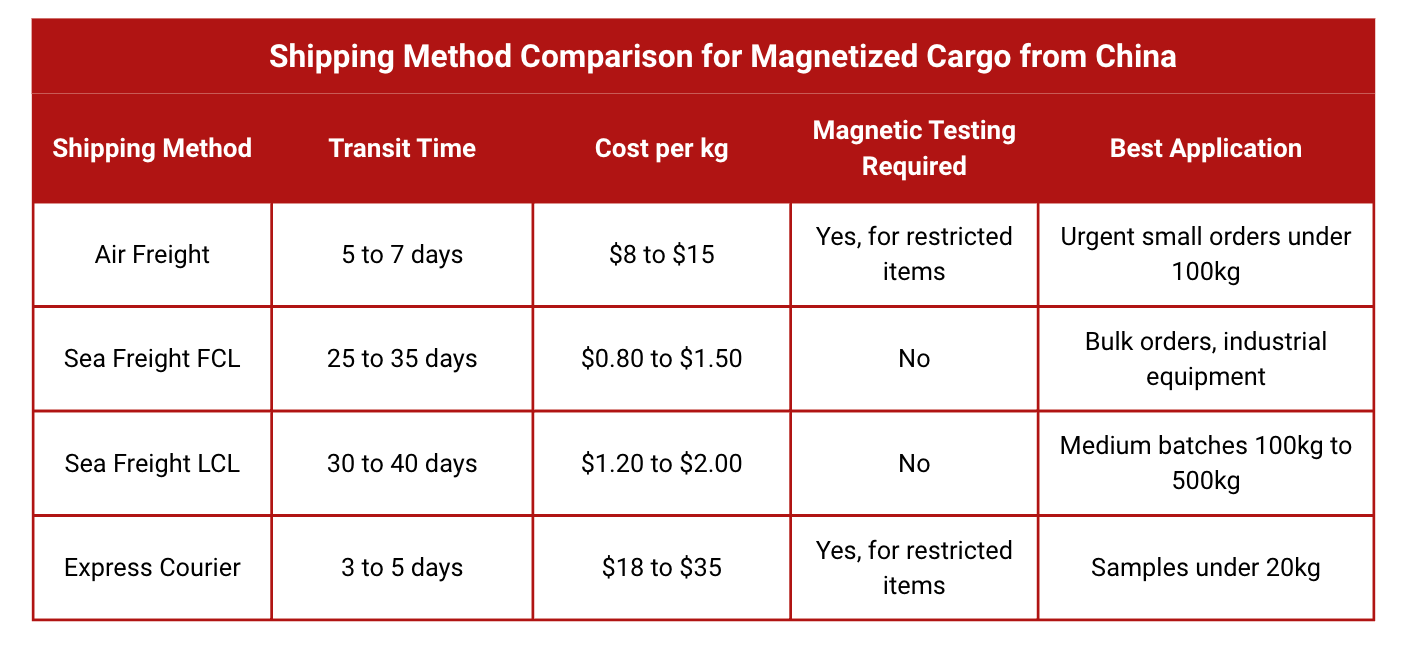
Sea freight removes all IATA magnetic compliance requirements. IMDG (sea freight regulations) has no field strength restrictions for commercial permanent magnet products. This is why industrial motors, professional audio equipment, and large speaker systems almost always move by sea. It is the compliant default for any product you are unsure about.
Air freight is practical for small, low-field products such as consumer accessories and light electronics that test below the 0.002 Gauss threshold. For products that require a DGM report, testing adds cost and 3 to 5 days of lead time but does not prevent shipment if results fall within limits.
Products that exceed 0.00525 Gauss have no air freight option. Large professional speaker drivers, industrial motors, magnetic lifters, and high-grade NdFeB drone motors typically fall into this category. If your supplier suggests air freight for these items without documentation, that is a compliance risk.
Real Cost Analysis: What You Actually Pay
Example 1: 50kg Speaker Drivers via Air Freight to USA
Product FOB: $4,000
DGM testing: $220
Air freight: $600
Shielded packaging: $120
Insurance and brokerage: $220
Subtotal CIF: $5,160
Standard duty HS 8518 (4.9%): $253
MPF and HMF: $21
Total landed cost: $5,434
Cost per kg: $108.68 (36% markup over FOB)
Example 2: 500kg Servo Motors via Sea Freight LCL to USA
Product FOB: $15,000
Sea freight LCL: $700
Insurance and brokerage: $400
Subtotal CIF: $16,100
Standard duty HS 8501 (2.8%): $451
MPF and HMF: $62
Total landed cost: $16,613
Cost per kg: $33.23 (11% markup over FOB)
Air freight costs $75 more per kilogram in this comparison. For a 500kg motor order, the difference is $37,500. Sea freight also removes DGM testing costs entirely and saves 3 to 5 days of lead time before shipment even departs.
Air Freight Magnetic Limits: Can Your Product Ship by Air?
IATA Packing Instruction 953 defines three outcomes based on magnetic field strength measured at set distances from the outer packaging surface. The measurement applies to the final packaged consignment, not the product alone.
General Cargo (No Restrictions): Field below 0.002 Gauss at 2.1 meters. Ships by air without any DG documentation. Typical products: small consumer accessories, magnetic phone cases, low-power earbuds.
Restricted Air Freight (Class 9, UN 2807): Field between 0.002 and 0.00525 Gauss at 4.6 meters. Requires "Magnetized material" notation on the air waybill, Class 9 handling label on each package, and carrier pre-notification. No full Dangerous Goods Declaration required at this level. Typical products: mid-size speakers, certain headphones, small servo motors.
Prohibited for Air Freight: Field above 0.00525 Gauss at 4.6 meters. Cannot be shipped by air under any standard service. Sea freight is the only option. Typical products: large professional speaker systems, industrial motors, magnetic lifters, high-grade drone motors.
Packaging design affects outcomes. A product that exceeds limits in a standard carton may pass after iron plate shielding is added inside the box. This is why DGM testing is done on the fully packaged consignment, and why changing box configuration after testing requires a new report.
The DGM Inspection Report
A DGM Magnetic Inspection Report from a certified Chinese laboratory confirms whether your packaged goods are "Not Restricted," classified as UN 2807, or prohibited for air. The report is accepted by DHL, FedEx, UPS, and airline cargo services.
Testing costs RMB 800 to 2,000 per SKU ($110 to $280), with standard turnaround of 2 to 5 working days. A report is valid only for the exact product in the exact packaging configuration tested.
2026 Regulatory Updates: Key Points for Importers
Section 301 Tariffs and Finished Goods
Since January 2026, the US applies 25% Section 301 duties to permanent magnets under HS 8505. Most finished goods are not affected by this directly:
Speakers and audio equipment (HS 8518): standard duty applies, not 25%
Electric motors (HS 8501): standard duty applies
Headphones (HS 8518.30): standard duty applies
Robotic vacuums (HS 8508): standard duty applies
The risk arises if CBP determines a finished product is essentially a magnet assembly with cosmetic housing. In that case, reclassification under HS 8505 and the full 25% surcharge becomes possible. Keep technical documentation showing that the magnet is a functional component within a complete finished product.
China Export Controls
For most commercial consumer electronics and standard motors, no special export license is required. The exception applies to finished products containing magnets with Dysprosium (Dy) or Terbium (Tb) above control thresholds, such as high-performance precision motors for industrial or aerospace use.
These may require a Dual-Use Item Export License from MOFCOM with 45 to 90 working days processing time. Confirm with your supplier for high-performance motor products before placing orders.
Step-by-Step Shipping Magnetized Goods from China to USA
Step 1: Pre-Order Product Assessment (Before Placing Order)
Before confirming your purchase order, collect the following from your supplier:
Magnet type and grade (ferrite, NdFeB standard grade, NdFeB high performance, SmCo)
Magnet dimensions and quantity per unit
Whether any previous DGM test report exists for this product
Intended packaging configuration (units per carton, carton dimensions)
This information determines your shipping method before you commit to a delivery deadline. A supplier who cannot provide magnet specifications is a compliance risk regardless of shipping method.
Key question to ask: "Has this product been tested for air freight magnetic compliance? Can you provide the DGM report?"
Many established Chinese electronics and motor manufacturers maintain valid DGM reports for their standard products. If a report already exists and your packaging matches, you can skip the testing step entirely for air freight.
Step 2: Select Shipping Method Based on Product Type
Use this decision framework:
Product contains no motors, no large speaker drivers, no industrial magnets: Assess for air freight. Request prior DGM report or budget for testing.
Product contains servo motors, BLDC motors, or professional speaker drivers: Default to sea freight. Air freight is likely impossible or requires expensive shielded packaging that adds significant weight cost.
Product is a consumer accessory with small embedded magnets (phone cases, magnetic cables, earbuds): Air freight almost certainly viable. Test once to confirm, then reuse the report for repeat orders.
Product is industrial magnetic equipment (lifters, separators, chucks): Sea freight only. Do not attempt air freight.
Book your shipment method and advise your supplier of expected cargo ready date. For sea freight, book space at least 2 weeks in advance. For FCL, 3 weeks minimum.
Step 3: Coordinate DGM Testing (Air Freight Only)
If shipping by air and no valid DGM report exists, your freight forwarder arranges testing with a certified lab. Allow 5 to 7 working days before cargo ready date to accommodate testing and potential packaging adjustments.
What your supplier needs to prepare:
Product in final production configuration (not prototype)
Packaged in the exact carton and inner box configuration that will be shipped
Sample quantity: typically 1 to 3 cartons per SKU
Testing outcomes:
Pass (Not Restricted): Product ships as general cargo, no DG documentation needed
Pass (UN 2807): Product ships with air waybill notation and Class 9 label
Fail: Lab advises on shielding options. Supplier adds iron plate shielding to carton interior and retests. Additional cost $50 to $150 per carton, and adds 3 to 5 working days
Fail after shielding: Product cannot ship by air. Switch to sea freight
Reusing reports: A passing DGM report can be used for all subsequent shipments of the same product in the same packaging configuration. It has no formal expiry date. Changing units per carton, carton size, or product variant requires a new test.
Step 4: Prepare Export Documentation
Required for all shipments:
Commercial invoice with correct 10-digit HS code and accurate FOB value
Packing list specifying product description (not "accessories" or "parts")
Certificate of Origin (Form A or CO depending on destination requirements)
Bill of Lading (sea) or Air Waybill
Additional for air freight restricted items (UN 2807):
"Magnetized material" and package count noted in the Nature and Quantity of Goods box on the air waybill
Class 9 magnetized material label (blue, white background, "KEEP AWAY FROM AIRCRAFT COMPASS DETECTOR UNIT") affixed to each package
Carrier pre-notification: inform the airline or express courier before tendering cargo
DGM Magnetic Inspection Report retained on file
HS code verification: Confirm the correct 10-digit HTS code with your customs broker before booking. For finished goods containing magnets, the HS code of the finished product governs, not the magnet component. Misclassification that CBP can connect to magnet content creates reclassification risk.
Step 5: Cargo Handover and Export Clearance
Your freight forwarder collects cargo from the supplier's factory or arranges pickup. For DG air cargo, the forwarder submits the air waybill notation and lab report to the carrier at acceptance. Carriers may reject cargo at this stage if documentation is incomplete or the product was previously rejected without disclosed reason.
Chinese export customs clearance for standard finished goods is typically same-day or next business day. Products requiring MOFCOM dual-use export licenses must clear this step before any booking is confirmed. Do not book cargo space until you have confirmed license status with your supplier.
Step 6: In-Transit Tracking and Port Arrival
For sea freight, your freight forwarder provides a Bill of Lading and vessel tracking once the container is loaded. Standard transit to US West Coast ports is 14 to 18 days from major Chinese ports; East Coast is 28 to 35 days.
File your ISF (Importer Security Filing) at least 24 hours before the vessel departs China. Late ISF filing incurs a $5,000 penalty per violation. Your customs broker handles this if you provide shipment details promptly.
For air freight, departure is typically within 24 to 48 hours of airline acceptance.
Step 7: US Customs Clearance
File formal entry within 5 days of arrival at the US port. Your customs broker submits:
Entry summary with HS code and declared value
Commercial invoice and packing list
Bill of Lading or Air Waybill
Certificate of Origin
For shipments with magnet content: Have technical product documentation ready to provide if CBP selects the shipment for examination. This includes product spec sheets, magnet specifications, and any prior DGM test reports. Physical examination rates for Chinese electronics range from 8% to 30% depending on product category and importer history.
Duty payment is required before cargo release. Your broker calculates duties based on CIF value and applicable HTS rates.
Step 8: Inland Delivery
Arrange final delivery from port to warehouse before cargo arrives. For sea freight, coordinate drayage from the port container yard. Most LCL cargo is deconsolidated at the freight forwarder's warehouse and delivered by standard trucking. For heavy industrial equipment or large motor shipments, confirm weight limits and loading dock access at your receiving facility before scheduling delivery.
Common Mistakes in Magnetized Cargo That Cause Delays
Booking air freight without confirming magnetic compliance. Large motors and professional speakers routinely exceed air freight limits. Discovering this after booking costs $400 to 800 in rebooking fees and adds 10 to 14 days. Confirm with a prior DGM report or quick field test before committing to air.
Vague product descriptions on customs documents. Declaring "electronic accessories" for servo motors or "hardware" for magnetic lifters triggers physical inspection and potential holds. Use accurate, specific descriptions that match the actual product.
Assuming the same DGM report covers all configurations. A DGM report is valid only for the tested packaging. Changing units per carton, carton dimensions, or adding padding changes the external field profile and requires a new test.
Missing the ISF filing deadline. For sea freight to the US, ISF must be filed 24 hours before vessel departure from China, not 24 hours before US arrival. Your customs broker needs booking confirmation and shipment details in advance.
Not verifying HS code before the first shipment of a new product. An incorrect code that draws CBP attention to magnet content can trigger reclassification under HS 8505 and the 25% Section 301 tariff. Verify with your broker before the first order, not after a hold.
Choosing a Freight Forwarder for Magnetized Cargo
Look for a forwarder with Class 9 dangerous goods handling experience, established access to certified DGM testing labs in China, and the capability to advise on HS code classification for finished goods containing magnets.
Ground presence in China is important. A forwarder whose team operates in key port including Shenzhen, Shanghai, or Guangzhou can manage test submissions and packaging adjustments directly with your supplier, which is significantly faster than coordinating remotely when a product fails initial testing.
At Gerudo Logistics, we manage dangerous goods shipments across multiple categories including finished goods with magnetized components. We coordinate DGM testing arrangements, advise on sea versus air routing based on product type, and provide landed cost estimates accounting for current HS duty rates. For partial loads, our LCL consolidation service reduces per-kilogram costs without compromising handling.
Contact Gerudo Logistics for DGM testing coordination, routing advice, and landed cost estimates for your magnetized cargo shipments from China.
Frequently Asked Questions
Q: My product contains a small magnet. Does it need a DGM report?
Not automatically. The requirement depends on field strength at the package surface, not the presence of magnets. Small embedded magnets in phone cases, closures, and accessories almost always fall below thresholds. Products with motors or large speaker drivers should be tested before air freight.
Q: Do speakers require dangerous goods paperwork for air freight?
It depends on driver size and strength. Small portable Bluetooth speakers typically pass as general cargo. Professional speakers with large NdFeB drivers often exceed air freight limits entirely and must ship by sea. Do not book air freight for speaker products without a prior DGM test.
Q: I import headphones, not magnets. Do I pay the 25% Section 301 tariff?
Headphones classified under HS 8518 are not subject to the 25% Section 301 tariff on HS 8505 magnets. Standard duty applies. The risk arises only if CBP determines the product is a magnet assembly rather than a finished consumer good.
Q: Can I reuse a DGM report for repeat shipments?
Yes, for the same product in the same packaging configuration. There is no formal expiry date. Any change to carton size, units per carton, or product specification requires a new test.
Q: What happens if my air freight shipment is rejected at origin?
The shipment is held and you must rebook sea freight or rework packaging with shielding and retest. Additional cost: $300 to 600. Additional time: 7 to 14 days. Pre-testing before booking is significantly cheaper.
Q: Do magnetic toys from China have additional US compliance requirements?
Yes. Beyond IATA air freight rules, magnetic toys imported to the US face CPSC standards regulating magnet flux index. These are separate requirements. A toy that passes DGM testing for air freight may still fail CPSC product safety standards for sale in the US.
Q: Does sea freight have any magnetic field restrictions?
No. IMDG regulations do not impose field strength restrictions on commercial permanent magnet products. Sea freight is the compliant default for all magnetized cargo regardless of field strength or product type.
Conclusion
The core decision for any magnetized cargo shipment from China is shipping method. Sea freight removes all IATA compliance complexity and costs significantly less per kilogram. Air freight works for small, low-field products where urgency justifies the premium and testing confirms compliance.
Most finished goods containing magnets ship by sea as standard commercial cargo. The compliance issues arise specifically when importers attempt air freight for products that were never designed with air transport magnetic limits in mind.