Importing Printing Ink from China: DG Compliance, Costs & Complete Import Guide (2026)
Order 500 kg of water-based DTF ink from China and it ships like any general cargo,standard documentation, no carrier restrictions, competitive LCL rates. Order the same volume in eco-solvent ink, and the picture changes: Class 3 Flammable Liquid classification, UN-certified drums required, carrier DG acceptance to confirm, and a Multimodal Dangerous Goods Form that must be correct before the container is accepted for loading. Same product category. Entirely different logistics requirements.
For B2B importers, printing companies, consumables distributors, OEM buyers, the compliance overhead is real. And in 2026, it is getting more structured. China has tightened export licensing for chemical products, VOC standards are being scrutinized at destination ports, and Section 301 tariffs on US-bound ink shipments remain in force.
This guide covers everything you need to know: how to classify your ink correctly, what documents are non-negotiable, how to calculate your landed cost, and how to choose a freight partner who can handle hazardous liquid cargo without delays.
Is Your Printing Ink a Dangerous Good?
The answer depends on the ink's chemical base, not its colour or intended use.
Classified as Dangerous Goods (Class 3 Flammable Liquid):
Eco-solvent and hard-solvent inks: contain flammable organic solvents. These are typically classified under UN 1210 (Printing Ink), though UN 1263 or UN 1866 may also apply depending on the specific resin/pigment ratio. They require UN-certified drums and a Multimodal DG Declaration for sea freight.
UV-curable inks with flash point below 60°C: acrylate-based formulations where flash point determines DG status. Always request SDS with flash point data confirmed. UN 1866 applies where classified.
Generally Non-Hazardous for Transport:
Water-based inkjet and pigment inks: non-DG, but SDS confirming non-hazardous status is still required by carriers and customs.
DTF pigment ink: non-DG under standard formulations. SDS confirmation required.
Dye sublimation ink: non-DG. Standard commercial packaging acceptable.
Latex ink: non-DG. No DG surcharges apply.
Bulk toner powder: non-DG, but fine particles require sealed anti-static packaging. Carriers reject improperly packaged powder regardless of DG status.
UV-curable inks with flash point above 60°C sit outside Class 3 and may be non-regulated or Class 9 depending on formulation. Do not assume non-DG status without SDS confirmation , the flash point must be documented, not estimated.
2026 Compliance Requirements for Importing Ink from China
Supplier Export Licensing: What Importers Must Verify
As of 2026, China's updated Regulations on the Safety Management of Hazardous Chemicals requires suppliers of certain chemical products to hold a valid export permit for "Sensitive Goods" before shipping. This applies directly to your supplier, but the operational risk lands with you if their licensing is not in order. Before placing an order for any solvent-based or UV-curable ink, verify that your supplier holds:
A current Hazardous Chemicals Export Registration Certificate
A valid business license covering chemical product export
Documented compliance with the specific ink category being shipped
Request copies of these documents. If a supplier cannot provide them, that is a disqualifying issue regardless of price.
The Three Documents You Cannot Ship Without
1. MSDS/SDS (2026-Compliant)
The Material Safety Data Sheet must comply with GHS Revision 9 formatting standards, which include updated hazard classification criteria and labelling requirements. The SDS must specify:
Exact chemical composition and CAS numbers
Flash point and flammability range
UN number and packing group
Emergency response information
An outdated SDS , one referencing older GHS revisions or missing specific component percentages , will cause delays at customs and may be rejected by the carrier's DG team outright.
2. DGM Certification / Dangerous Goods Declaration
The DGM (Dangerous Goods Management) Report is issued by a certified DG specialist and confirms cargo compliance with the applicable transport regulation. In practice:
For sea freight: this is the Multimodal Dangerous Goods Form (IMDG Form), completed and signed by a qualified DG declarant
For air freight: this is the Shipper's Declaration for Dangerous Goods under IATA DGR
Carriers will not accept DG cargo at point of loading without this document , no exceptions
3. UN Packaging Certification
Standard commercial plastic drums and jerry cans are not acceptable for Class 3 liquids in sea or air freight. Requirements:
Packaging must be UN-certified and carry the performance specification marking (e.g., 1H1/Y1.4/150/23/CN/...)
The packing group (PG I, II, or III) determines the required strength rating of the drum
Your supplier must provide a Packaging Test Certificate confirming the drums have passed the UN performance test
If your supplier is filling into uncertified drums and relabelling them, the shipment will fail carrier inspection at origin.
VOC Standards: What Importers Need to Verify
China's GB 38507-2020 sets mandatory VOC content limits for printing inks at the production level. As of Q1 2026, compliance is checked at point of manufacture , request the test report, not just a declaration. For destination-market requirements:
EU: Verify against the REACH SVHC candidate list (EC 1907/2006), updated by ECHA twice yearly. Certain acrylate monomers in UV inks have appeared on recent revision cycles.
USA: Novel ink formulations should be checked against the TSCA Chemical Substance Inventory under Section 13 before import.
All markets: China Customs has strengthened inspection procedures for liquid chemical cargo at major Guangdong ports including Yantian and Nansha. Shipments where the declared SDS composition does not match the physical cargo are increasingly selected for examination.
HS Codes and Import Tariffs
Correct Classification
The primary HS code for printing ink is Chapter 32.15:
3215.11: Black printing ink
3215.19: Other printing inks (colour, UV-curable, specialty)
Ink cartridges and toner cartridges, when imported as finished consumable assemblies, may fall under 8443.99 (parts and accessories for printing machinery), which carries different duty rates. Misclassifying ink in bulk as cartridge components , or vice versa , is a common error that triggers customs queries and potential penalties.
One classification point that catches importers off guard: 3D printing resins are not printing inks in the customs sense. Although the end-use involves "printing," photopolymer resins used in SLA and DLP printers are typically classified under 3824.99 (miscellaneous chemical preparations) or 3208 (solutions of polymers), not 3215. Applying a 3215 code to 3D resin will result in reclassification and potential penalties at customs.
Bulk Ink vs. Finished Cartridges: Key Differences for Importers
A question we regularly get from new importers: should I bring in bulk ink and fill locally, or import finished cartridges? The answer depends on your volume, facilities, and tariff exposure. The table below compares the two approaches across the dimensions that matter most.
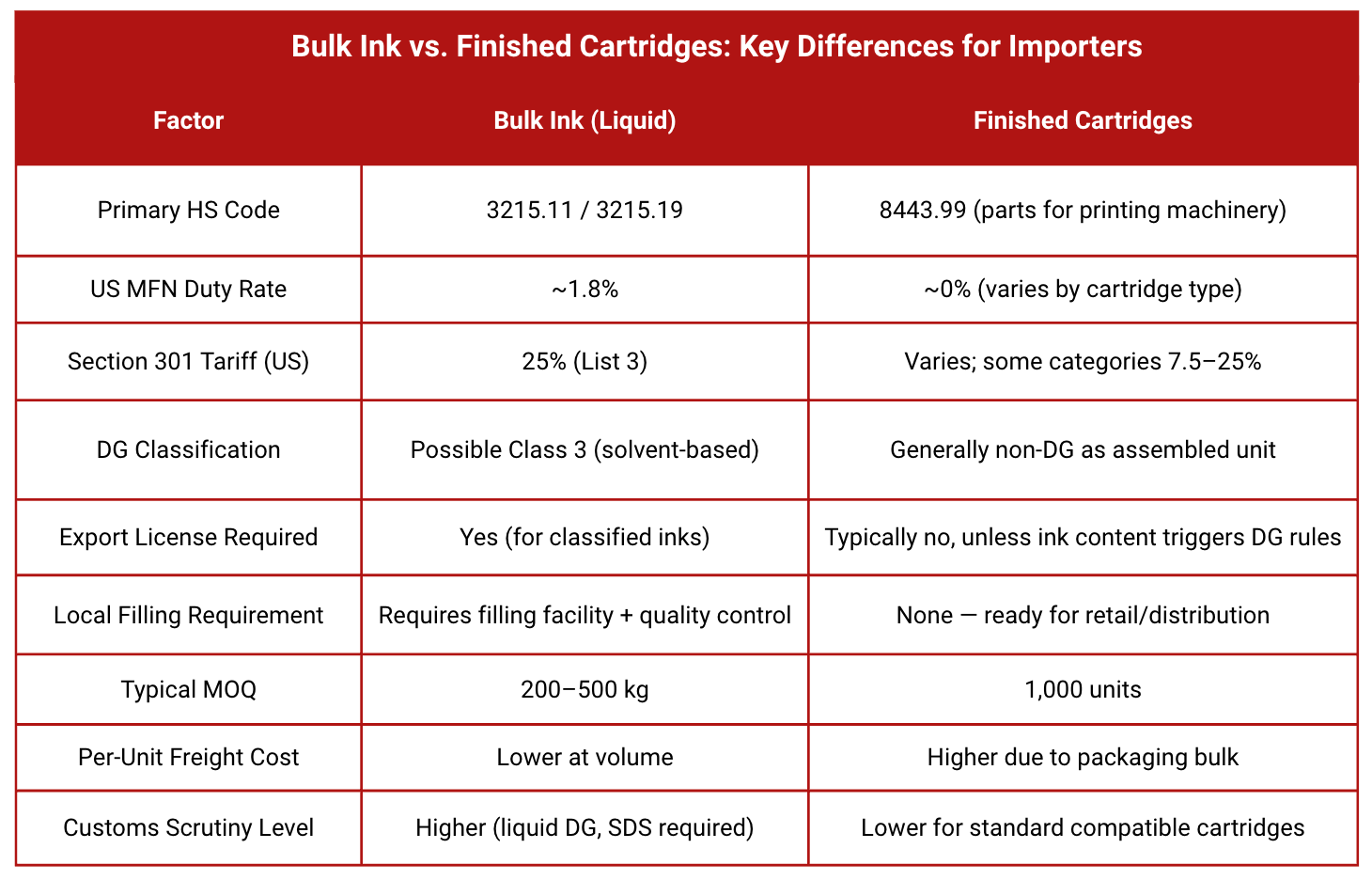
The cost advantage of bulk ink is real at scale, but the compliance burden is correspondingly higher. Finished cartridges are operationally simpler and often qualify for lower or zero MFN duties, though Section 301 exposure still applies to many categories.
Section 301 Tariffs and the Customs Ruling Risk
Printing inks classified under 3215.11 and 3215.19 remain subject to Section 301 List 3 tariffs, which currently apply at 25% in addition to the standard MFN duty rate. Some USTR exclusions have been extended through late 2026, but coverage is product-specific and requires verification against the current USTR exclusion list.
One risk worth stating plainly: some importers have attempted to reduce tariff exposure by incorporating ink into printer assemblies or packaging ink inside machine components, intending to import under a lower-duty parts code. US CBP treats this as tariff engineering. Where it lacks a legitimate business purpose beyond tariff reduction, it constitutes customs fraud. Consequences include:
Seizure of goods
Retroactive duty collection
In serious cases, criminal referral
If you are considering a non-standard import structure for ink products, obtain a Customs Ruling (CBP Ruling) from US Customs and Border Protection before proceeding. A ruling letter gives you legal certainty on classification. Proceeding without one does not.
For US importers, the practical calculation on a $10,000 CIF shipment of solvent-based ink looks like this:
MFN duty (approximately 1.8% for most ink categories): $180
Section 301 tariff (25%): $2,500
Merchandise Processing Fee (0.3464%, min. $27.23): $34.64
Total tariff and fee burden: approximately $2,715
This does not include freight, insurance, or customs brokerage fees. Budget a minimum of 30–35% above your FOB price as your total landed cost estimate for US-bound ink from China.
Shipping Methods for Ink Imports
Sea Freight (LCL and FCL)
Sea freight is the standard for bulk ink imports. Key points for DG cargo:
Not all LCL consolidators accept Class 3 liquids , your forwarder must confirm DG acceptance in writing before booking
Expect a DG surcharge of $30–80 per CBM on top of base LCL rates
FCL DG-rated containers are available but require advance arrangement
Transit times: Guangzhou or Shanghai to US West Coast 18–22 days; to Europe 25–32 days
Air Freight
Air freight for Class 3 ink is operationally restricted:
IATA DGR quantity caps limit how much liquid DG can be packed per inner package
Most airlines apply DG surcharges of $0.80–$1.50 per kg on top of base rates
Bulk ink shipments by air are commercially unviable for most orders
Air is appropriate for urgent high-value specialty inks (conductive, ceramic, security) or non-DG water-based inks in small volumes where speed justifies the cost premium.
Express Couriers (DHL / FedEx / UPS)
Most express carriers cap Class 3 liquids at 1 litre per inner package. Express is practical only for ink samples or small non-DG quantities. Commercial volumes are not suitable.
DDP (Delivered Duty Paid)
For importers without an established customs broker in the destination country, DDP service consolidates responsibility for import customs clearance, duty payment, and final delivery under a single contract. For DG shipments with multi-document requirements, the reduction in coordination overhead is often worth the premium over managing each leg independently.
Shipping Cost Estimates (2026)
Case A: 500 kg Solvent-Based Ink, China to USA (LCL)
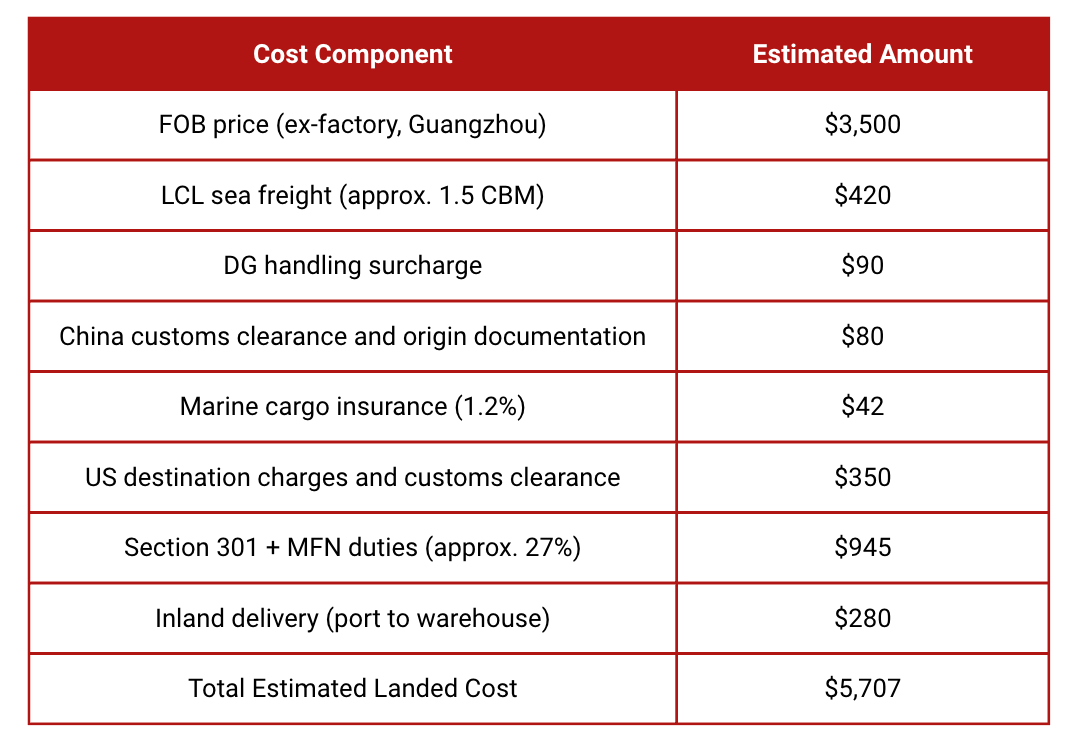
Rates are indicative estimates for planning purposes. Actual costs depend on specific routing, carrier, and market conditions at time of booking.
Case B: 1 x 20ft FCL, Water-Based Inks, China to Germany (Non-DG)
Water-based inks are non-DG and avoid the surcharges above. For reference on a 20ft FCL from Shanghai to Hamburg:
Base ocean freight: $2,800–$4,200
EU customs duty: approximately 6.5% for HS 3215.19
German VAT: 19% applied to CIF value plus duty
On a €15,000 CIF shipment: total duty burden approximately €3,200 before VAT recovery
Hidden Costs to Plan For
Detention and demurrage: If your import documentation is delayed, containers sitting at destination ports incur daily fees of $80–$200 per container after free time expires.
DG inspection fees: Customs authorities in some markets (Australia, UAE) conduct periodic inspections of DG shipments. Budget $150–$400 for potential examination fees.
Re-documentation charges: An incorrectly prepared DG declaration that must be revised after booking can cost $100–$300 in amendment fees and may delay loading.
How to Evaluate Chinese Ink Suppliers
Manufacturing Clusters
China's printing ink industry is concentrated in two areas:
Zhuhai (Guangdong Province): The dominant cluster for compatible inkjet ink and toner manufacturing. Brands like Print-Rite, Winnerjet, and Aomya operate here. The proximity to Guangzhou and Shenzhen ports reduces inland freight time and cost.
Shenzhen and surrounding Pearl River Delta: Strong in UV-curable, DTF, and specialty digital inks. Closer to air freight hubs for urgent shipments.
Verification Steps
Before committing to an order, carry out the following:
Request ISO 9001 and ISO 14001 certificates and verify the certificate number directly with the issuing body. Certificates can be forged.
Ask for a Lab Analysis Report for the specific ink batch you intend to import. This should include pH, viscosity, particle size (for pigment inks), and VOC content.
Conduct a video audit of the production facility. A credible manufacturer will allow you to inspect their filling lines, QC lab, and DG packaging area on camera.
Confirm export licensing status for any solvent or UV product line.
MOQ and Volume Alignment
Standard MOQs for bulk ink from established Chinese manufacturers:
Bottled/drummed ink: 200–500 kg minimum
Finished cartridges (compatible): 1,000 units minimum
Custom OEM formulation: typically 500 kg minimum with a development sample fee
Align your order volume with your freight economics. A 200 kg order shipped LCL may carry a higher per-kg freight cost than a 1,000 kg order. Run the landed cost calculation before negotiating MOQ, not after.
Step-by-Step Import Process
Step 1: Confirm ink composition and review the SDS Request the full SDS before placing the order. Confirm DG status, packing group, and VOC content. Share the SDS with your freight forwarder before booking.
Step 2: Supplier prepares DGM declaration and UN-certified packaging Your supplier's export team completes the Multimodal DG Form and confirms that all drums carry the correct UN performance marking.
Step 3: Freight forwarder confirms DG acceptance and books space Not all carriers accept Class 3 liquids. Your forwarder must obtain written confirmation from the shipping line or airline before issuing a booking reference.
Step 4: Export customs declaration in China The supplier or their local customs agent files the export declaration, referencing the correct HS code and attaching the DG declaration, SDS, and export license (if applicable).
Step 5: Ocean transit and cargo monitoring For reefer-sensitive ink formulations (some water-based inks degrade in extreme heat), confirm whether temperature-controlled containers are advisable for the transit route.
Step 6: Destination customs clearance Your customs broker at destination files the import entry, applies the correct HS code, and pays duties. For DG shipments, some customs authorities require the SDS to be submitted with the entry.
Step 7: Last-mile DG delivery Solvent-based inks may require a licensed DG carrier for the final delivery leg, depending on destination country regulations. Confirm this with your forwarder before the shipment departs China.
Ink Product Types and Import Logistics Profile
Understanding how different ink categories behave in transit helps you anticipate documentation requirements and freight costs before placing an order.
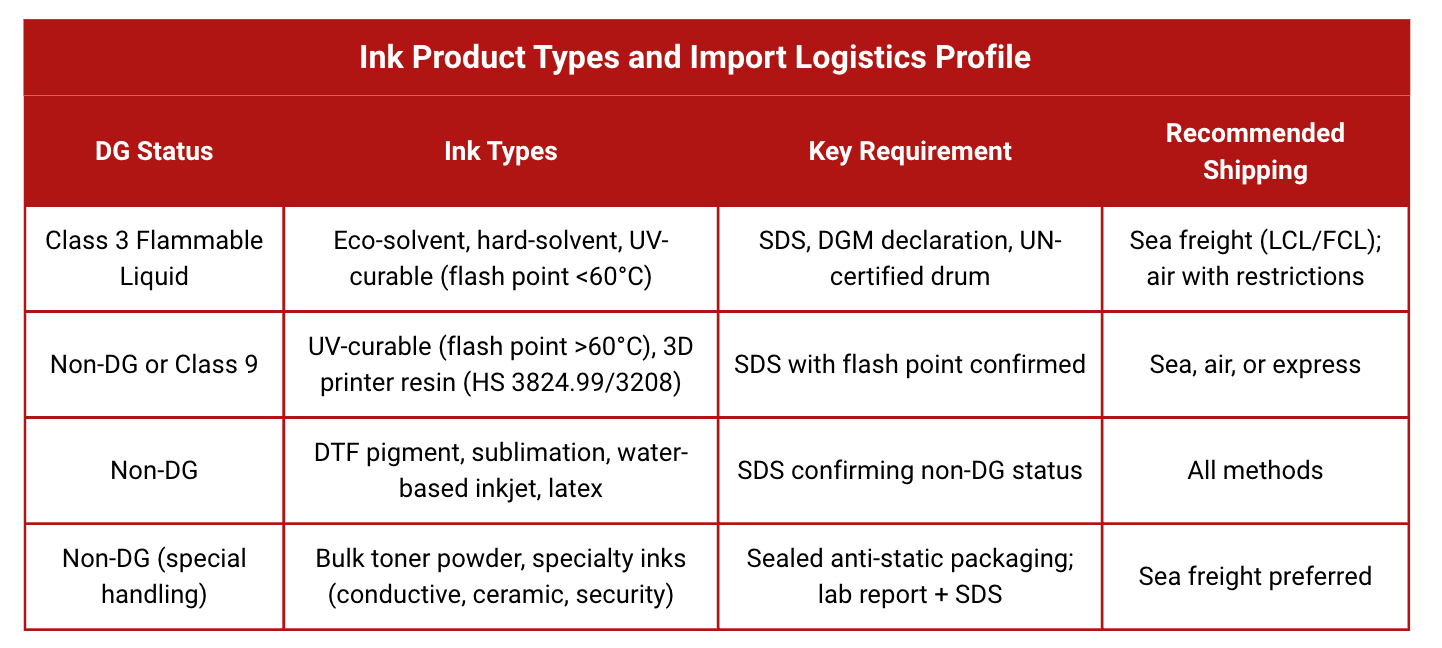
Your specific product's SDS determines the actual DG status. Always share the SDS with your freight forwarder before confirming a booking.
Frequently Asked Questions
Is printing ink classified as dangerous goods for shipping?
It depends on the formulation. Solvent-based inks and certain UV inks are classified as Class 3 Flammable Liquids under IATA DGR and the IMDG Code. Water-based inks, latex inks, and most sublimation inks are non-hazardous but still require a current SDS confirming that classification.
What is the most important document for ink customs clearance?
The Safety Data Sheet (SDS), updated to GHS Revision 9 standards. It determines the HS code, the DG classification, and the applicable safety protocols at both the Chinese customs clearance stage and destination import. An outdated or incomplete SDS is the single most common cause of shipment delays for ink cargo.
Does my Chinese ink supplier need a special license?
Yes. As of 2026, suppliers shipping classified chemical products , including solvent-based and reactive UV inks , must hold a valid Hazardous Chemicals Export Registration Certificate. Confirm your supplier's license status before placing an order.
What are the correct HS codes for printing ink?
The primary codes are 3215.11 (black printing ink) and 3215.19 (other printing inks, including colour, UV, and specialty formulations). Finished ink cartridges imported as complete assemblies may fall under 8443.99, which carries a different duty rate.
Can printing ink be shipped by air?
Yes, but with significant restrictions and cost implications. Class 3 liquid inks are subject to quantity limits per package under IATA DGR, and DG surcharges add $0.80–$1.50 per kg on top of base air freight rates. Air is practical for urgent, high-value specialty inks or non-DG water-based inks in small volumes. For bulk commercial orders, sea freight is the standard.
Are there Section 301 tariffs on Chinese printing ink for US importers?
Yes. Most inks classified under 3215.11 and 3215.19 remain subject to 25% Section 301 List 3 tariffs. Some product-specific USTR exclusions have been extended through late 2026. Verify current exclusion status at ustr.gov before calculating your import cost.
What is a DGM report and when is it required?
In Chinese export practice, a "DGM report" typically refers to a Dangerous Goods declaration completed by a certified DG specialist, confirming the cargo complies with applicable transport regulations. For sea freight, this is formalised as the IMDG Multimodal Dangerous Goods Form. Shipping lines and airlines require this document before accepting DG cargo for loading.
Why Partner with a DG-Specialist Freight Forwarder
Working with a forwarder who handles DG cargo as a core operation, not as an occasional exception, makes a practical difference at each stage of the shipment:
Carrier DG acceptance secured upfront. We confirm in writing that the shipping line accepts your specific DG class and UN number before issuing a booking. This prevents last-minute rejections at origin port.
Accurate DG documentation, first time. Our in-house DG team prepares the Multimodal Dangerous Goods Form against your SDS, not from a template. Errors in this document cause missed sailings and amendment fees.
Destination compliance covered. DG import requirements differ across the US, EU, Middle East, and Southeast Asia. We handle destination customs coordination, including DDP delivery, so you are not navigating each market's requirements independently.
Pre-shipment SDS and packaging review. We flag non-compliant packaging or outdated SDS documentation before the cargo moves, not after a carrier rejection.
Gerudo Logistics is headquartered in Guangzhou with operations across Shenzhen, Shanghai, Ningbo, Qingdao, and Dalian. DG and chemical shipping is our core business.
Contact us for a landed cost estimate specific to your ink type and destination.
Conclusion
Compliance is not the obstacle to importing printing ink from China , it is the foundation that makes the commercial side work. The classification error, the outdated SDS, the non-UN-certified drum, the misapplied HS code: each has a straightforward fix when addressed before the first booking. Each becomes expensive when discovered at a port of entry.
The 2026 environment has raised the bar on both sides: stricter licensing requirements in China, updated VOC standards under GB 38507-2020, and continued Section 301 tariff exposure for US importers. None of these are insurmountable. They require accurate information, the right documentation, and a logistics partner who understands DG cargo as a core competency.