Shipping Battery Energy Storage Systems from China: UN3536 Import Guide 2026
Chinese ESS manufacturers shipped more utility-scale battery systems to global markets in 2025 than in any previous year, driven by demand across Europe, the US, and the Middle East. The hardware side of that growth is well-covered. The logistics side is not. Shipping a containerized battery system from China in 2026 involves Class 9 dangerous goods compliance, heavy lift pre-planning, and a documentation set that tightened significantly on January 1.
This guide covers the full picture: which UN classification applies to containerized ESS cabinets, what documentation every shipment requires, how much it costs to ship to the US, Europe, and the Middle East, and the logistics failures that consistently delay first-time ESS importers.
Why Energy Storage Systems Are Classified as Class 9 Dangerous Goods
Energy Storage Systems covered in this guide are fully containerized utility-scale cabinets where the container itself is the product enclosure. This configuration is classified as Class 9 Miscellaneous Dangerous Goods under international transport regulations, regardless of capacity, voltage, or intended application.
For complete containerized ESS cabinets, the applicable UN numbers are:
UN3536: Lithium Batteries Installed in Cargo Transport Unit (CTU)
This is the formally designated classification under international regulations (IMDG/ADR). It applies when the entire container functions as the product enclosure—integrating the battery packs, BMS, thermal management (liquid cooling/HVAC), and fire suppression into a single unit.
Pro Tip: While these units resemble standard shipping containers (20GP, 20HQ, 40GP, 40HQ), they are technically Shipper's Owned Containers (SOC). Because they house 40+ tonnes of Class 9 DG, they require specialized stowage and cannot be treated as general dry van equipment.
Lithium batteries installed in a cargo transport unit. This is the correct classification for containerized ESS systems where the entire container functions as the product enclosure, with battery, BMS, thermal management, and housing integrated as a single unit. It is the most commonly misclassified shipment type in early 2026, with DGDs incorrectly submitted under UN3481 instead.
Most major carriers apply a payload limit of approximately 30 tonnes for 20HQ. ESS cabinets above 40 tonnes require special container arrangements or breakbulk handling and cannot be shipped in standard box types.
UN3551: Sodium-ion ESS cabinets. The same Class 9 classification and documentation obligations apply as for lithium-ion systems.
The DG classification requires carrier pre-approval, a specialist documentation set, and in some cases special stowage arrangements. Importers who present ESS bookings as standard general cargo consistently encounter delays that earlier preparation would have prevented.
Top Energy Storage System Brands Exported from China
The majority of utility-scale ESS export volume from China originates from a small group of vertically integrated manufacturers. These three account for a disproportionate share of the containerized liquid-cooled systems covered in this guide.
CATL
The dominant global supplier by installed capacity. Its EnerC liquid-cooled series and EnerX (Tianhe) platform are widely deployed in US, European, and Middle East utility projects. CATL also supplies cells to third-party integrators, meaning its technology is present in more shipments than the brand name alone suggests.
BYD
The MC Cube series offers a high degree of system integration and carries a strong project record in UK, German, and US grid-scale applications. BYD's vertically integrated supply chain gives it competitive pricing at volume.
Sungrow
One of the largest storage integrators globally. The PowerTitan 2.0 liquid-cooled system has become a reference point for high-power utility tenders. Sungrow sources cells from multiple suppliers, giving it flexibility in large international procurement processes.
What Documentation Does Every ESS Shipment Require?
The full required document set for an ESS shipment is:
UN38.3 Test Summary
Certifies the battery model has passed altitude simulation, thermal, vibration, shock, short circuit, and impact tests. Must correspond to the exact cell and pack configuration on the booking. Any design change or cell format change requires a new test.
Safety Data Sheet (SDS)
Must accurately identify the battery chemistry, applicable UN number, and emergency response procedures. A generic SDS covering multiple models is not acceptable.
Dangerous Goods Declaration (DGD)
Must be prepared and signed by a qualified DG professional. Containerized ESS cabinets ship under UN3536. This is the most frequently incorrect entry on first-time ESS bookings.
Marine Transport Identification Report
Mandatory under the 2026 IMDG amendments. Documents the thermal runaway risk profile of the specific battery model. Standalone document, separate from the SDS, and the most frequently missing item on rejected bookings in early 2026.
Commercial invoice
Must cite the correct HS code. HS 8507.60 is standard for lithium-ion battery packs; large containerized BESS units may require HS 8507.60.0020 at the sub-heading level. HS 8537.10 is being applied by some authorities to integrated ESS units where control and power distribution functions are considered the defining characteristic. This is a 2026 trend, not a settled rule. Confirm with a licensed customs broker before filing.
Packing list
Must specify cell format, net and gross weight per unit, and SoC at time of loading. Leading carriers require utility-scale ESS containers to load at 25% to 35% SoC. At major terminals including Long Beach and key European hub ports, this has moved from a carrier recommendation toward a port-level acceptance condition.
Refrigerant compliance documentation (liquid-cooled cabinets only)
If the system uses an A2L refrigerant such as R-32, confirm that the pressure test report and SDS are consistent and compliant with destination regulations. EU F-Gas rules and US EPA SNAP requirements both apply heightened scrutiny to mildly flammable refrigerants in 2026.
For the full 2026 SoC framework and IMDG amendment details, see our guides on IATA DGR 2026 battery shipping and shipping lithium batteries from China under the 2026 IMDG Code.
Which Shipping Method Works for ESS Cargo?
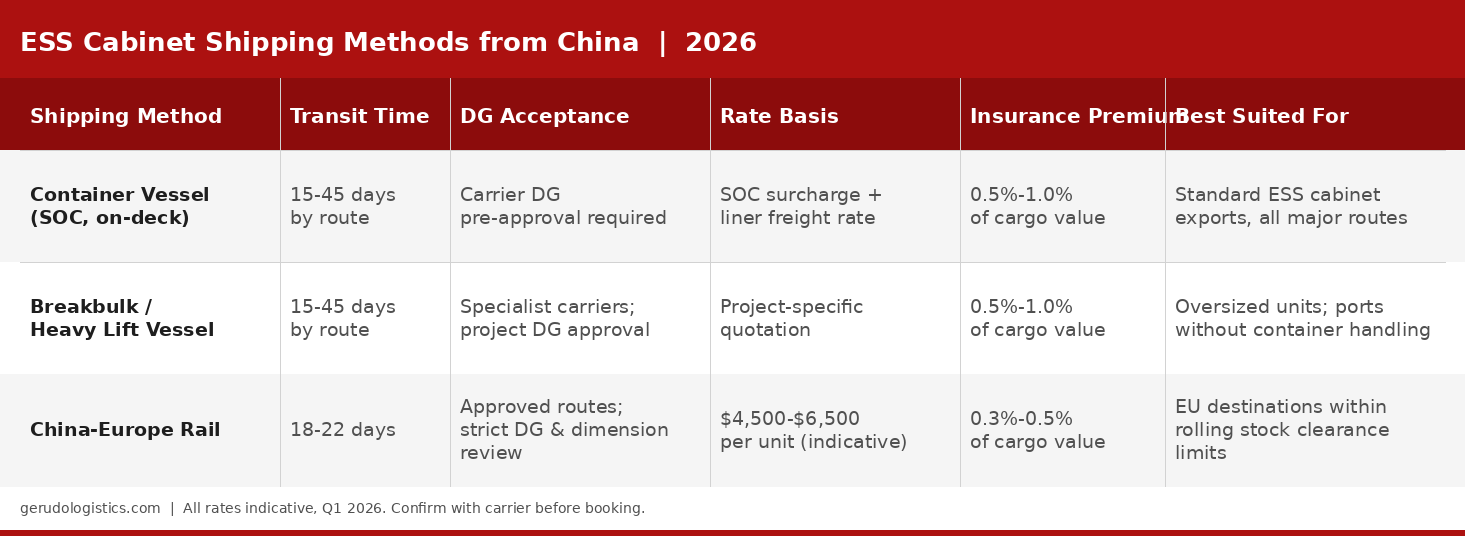
Three methods apply depending on project scale and destination.
Container vessel (SOC, on-deck)
The standard method for most ESS cabinet exports. The cabinet is loaded as an SOC unit and secured on deck on a container vessel, subject to Class 9 DG pre-approval from the carrier. This is the most commercially accessible option, covering the majority of routes to the US, Europe, and the Middle East. Carrier acceptance policies for UN3536 vary, and DG pre-approval must be confirmed before booking is finalised.
Breakbulk or heavy lift vessel
It applies where the cabinet exceeds standard on-deck stowage parameters, or where the destination port does not have container handling infrastructure. Each unit is lifted individually by crane and secured in the hold or on deck. This method requires specialist project cargo operators and longer pre-booking lead times.
China-Europe Rail
China-Europe Rail is an option for buyers targeting Germany, Poland, and Central European markets, subject to cabinet dimensions and weight falling within rolling stock clearance limits on the specific route. Transit runs 18 to 22 days under ADR/RID hazardous goods regulations. DG pre-approval on rail is stricter than for sea and can add 5 to 10 days to the booking process.
Air freight does not apply to this cargo class.
How Much Does It Cost to Ship an ESS from China?
As of Q1 2026, mainstream 314Ah LFP-based ESS systems are priced at approximately $75/kWh at the factory gate (EXW). A 5MWh system represents roughly $375,000 in equipment value. Freight, DG surcharges, and cargo insurance typically add 10% to 15% on top, putting the total logistics budget at $37,500 to $56,000 depending on destination.
Factory lead time for mainstream 314Ah systems is 45 to 60 days from purchase order to EXW. With DG documentation preparation and carrier pre-approval added, most orders require 55 to 75 days from purchase order to vessel loading.
Breakbulk and project cargo rates are negotiated per shipment based on unit dimensions, weight, port pair, and vessel availability. The figures below reflect Q1 2026 market benchmarks for ocean freight on the relevant trade lanes and provide a directional reference for project cost modelling. Final rates should be confirmed through quotation with a specialist project cargo operator.
US West Coast (Los Angeles / Long Beach)
Ocean freight: $2,450-$3,200 | Transit: 16-22 days
Section 301 tariff (HS 8507.60): 7.5%-25% additional duty. On a $375,000 system, that adds $28,000-$94,000 to landed cost. Confirm the applicable sub-classification with a customs broker before placing the purchase order.
US East Coast (New York / Savannah)
Ocean freight: $3,600-$4,800 | Transit: 28-35 days
Panama Canal congestion surcharges are factored into current pricing. Section 301 tariff exposure applies on this routing as well.
Europe (Rotterdam / Hamburg)
Ocean freight: $2,800-$3,900 | Transit: 35-45 days via Cape of Good Hope
EU ETS carbon surcharge: approximately EUR 80-110 per TEU, fully enforced in 2026, appearing as a separate carrier line item.
China-Europe Rail at $4,500-$6,500 reduces transit to 18-22 days for Central European destinations.
Middle East (Jebel Ali / Dubai)
Ocean freight: $1,950-$3,100 | Transit: 15-25 days
War risk surcharge: approximately $150 per TEU reflecting Hormuz Strait conditions in Q1 2026.
Additional DG-Specific Surcharges
These apply across all destinations and are separate from the base ocean freight rate:
Carrier DG Surcharge: $200-$400 per container
Dangerous Goods Declaration fee: RMB 900-1,500 per shipment
Special Stowage fee (5MWh+ liquid-cooled systems): $100-$200 where fire isolation and thermal separation are required
Routing and Port Considerations for BESS Shipment
Export Ports from China
Shanghai Nangang: The recommended first choice for UN3536 ESS cabinet exports. The only port in Shanghai with a dedicated ESS facility, routine overweight handling capability, and full-time DG supervision. Overweight units above 40 tonnes are accepted as standard.
Shenzhen (Yantian/Shekou): Primary hub for Guangdong-based manufacturers. UN3536 accepted with pre-approval; direct vessel-side loading preferred. Overweight units require pre-approval.
Ningbo: Active DG handling with broad carrier selection. Submit UN38.3 at least one week in advance. Overweight acceptance subject to terminal SWL; confirm crane capacity before booking.
Guangzhou (Nansha): A growing ESS export hub in 2026, designated as a key port for new energy cargo. UN3536 accepted; overweight units require pre-approval.
Receiving Ports
US West Coast: Los Angeles/Long Beach handles the majority of ESS arrivals.
US East Coast: Savannah is the preferred gateway for Southeast US project sites given its inland rail connectivity.
Europe: Rotterdam and Hamburg are the standard entry ports. Rotterdam's barge network is useful for distribution into Belgium and the Rhine corridor.
Confirm terminal-level acceptance for Class 9 ESS cargo before finalising port selection. Terminal restrictions on lithium battery volume operate independently of ocean carrier approvals, and a rejection after a confirmed booking creates a re-routing problem that most project schedules cannot absorb.
Heavy Lift Pre-Planning
A standard 5MWh cabinet weighs 43 tonnes or more, beyond the handling capacity of conventional port equipment. Before the purchase order is placed, verify the following for the intended discharge port and onward route:
Crane capacity rated for the unit's gross weight
Berth suitability for the vessel draft with cargo aboard
Road weight limits and bridge clearances to the project site
In our experience, heavy lift logistics at the destination takes longer to arrange than the DG documentation. A terminal that cannot discharge the unit on arrival creates a demurrage situation that is difficult and expensive to resolve.
How Gerudo Logistics Handles ESS Shipments
Gerudo Logistics manages dangerous goods shipments across all major trade lanes out of China, including large-format containerized ESS cargo requiring carrier pre-approval, special stowage coordination, and complete DG documentation preparation. UN38.3 verification, Dangerous Goods Declaration preparation, and Marine Transport Identification Report review are part of standard execution on every ESS booking we process.
For utility-scale cargo, we coordinate with carriers on stowage assignments and SoC documentation before submission. A booking rejection on a named vessel triggers a re-approval cycle that most ESS project timelines cannot absorb.
For importers managing multiple manufacturer relationships or parallel shipments, Gerudo provides consolidated documentation management and destination customs clearance coordination. Contact us to discuss your requirements.
Common Logistics Failures in ESS Shipments
1 - Wrong UN number on the DGD
A containerized 5MWh unit submitted under UN3481 instead of UN3536 will be flagged at DG review. Correcting it after booking typically costs 5 to 10 days.
How to Avoid: Confirm the correct UN number at the quotation stage, before the DGD is drafted.
2- SoC at loading above carrier threshold
Manufacturers routinely deliver systems at 50% to 80% SoC for quality verification. Cargo proceeding to port at that level without a documented discharge will be rejected.
How to Avoid: Specify SoC requirements in the purchase order, confirm in the pre-shipment inspection report, and ensure the packing list reflects the actual measured SoC at container sealing.
3- Missing or mismatched Marine Transport Identification Report
This report is model-specific. A generic document or one prepared for a different cell configuration will be rejected by the carrier's DG team.
How to Avoid:Request the report alongside the UN38.3 Test Summary at sample approval stage, not at the point of booking.
4- Refrigerant documentation incomplete (liquid-cooled cabinets)
For systems using A2L refrigerants such as R-32, the pressure test report and SDS must be consistent and compliant with destination regulations. EU and US authorities both apply heightened scrutiny to mildly flammable refrigerants in 2026.
How to Avoid:Confirm refrigerant classification and submit compliance documentation alongside the DG package.
5- Heavy lift arrangements confirmed too late
A terminal that cannot discharge a 43-tonne unit after the vessel has sailed leaves few options, all expensive.
How to Avoid: Complete heavy lift pre-planning before the purchase order is placed, in parallel with DG documentation.
6- Underestimating total landed cost
Equipment and ocean freight are usually well-modelled. These items are frequently not:
Section 301 tariff for US-bound cargo (7.5%-25% on HS 8507.60)
EU ETS surcharge for European routes (EUR 80-110 per TEU)
War risk premium for Middle East routing (approx. $150 per TEU)
DG surcharges ($200-$400 per container)
Build the full cost model before committing to a project price to the end customer.
Frequently Asked Questions for BESS Shipping
What is UN3536, and when does it apply?
UN3536 covers lithium batteries installed in a cargo transport unit, where the container itself is the product enclosure. It applies to all complete containerized ESS cabinets where the battery, BMS, thermal management, and housing form a single integrated shipping unit. It is frequently confused with UN3481 on the DGD, which applies to smaller battery-in-equipment configurations, not full cabinets.
Is a UN38.3 Test Summary required for every ESS model?
Yes, regardless of production history. Any modification to cell format or pack design requires a new test, and the report must match the exact configuration on the booking.
Do sodium-ion ESS products require the same documentation as lithium-ion?
Yes. Sodium-ion batteries ship under UN3551 as Class 9 DG and require the full documentation set. The chemistry differs; the transport obligations do not.
How does Section 301 affect US-bound ESS imports?
ESS cargo under HS 8507.60 carries a 7.5% to 25% Section 301 tariff depending on sub-classification. On a $375,000 system, that adds $28,000 to $94,000 to landed cost. Confirm the applicable rate with a customs broker before the purchase order is placed.
What is the EU ETS surcharge?
It applies to all ocean vessels calling at EU ports, fully enforced from 2026, adding approximately EUR 80 to EUR 110 per TEU as a carrier line item on the freight invoice.
How far in advance should I book freight?
At least 3 to 4 weeks before the target loading date. For utility-scale orders involving special stowage or heavy lift coordination, 5 to 6 weeks is more reliable.
Conclusion
Shipping Energy Storage Systems from China in 2026 is operationally manageable for importers who prepare the full picture in advance. The compliance framework has tightened: documentation gaps produce hard rejections, SoC thresholds are being enforced at terminal level, and heavy lift logistics at the destination require planning that most importers start too late.
The cost structure is transparent once all layers are visible: equipment at approximately $75/kWh, sea freight at $1,950 to $4,800 per 40ft HC depending on destination, DG surcharges and insurance adding 10% to 15%, and destination-specific tariff and levy exposure on top.
Importers who model all of these figures before committing to a project price are consistently better positioned to deliver on schedule and within budget.