How to Ship Refrigerants from China: DG Requirements, Costs and Port Guide
This guide is written for HVAC equipment distributors, refrigerant traders, and industrial gas importers sourcing from China. It covers the core requirements that determine whether a refrigerant shipment moves without incident: dangerous goods classification, shipping mode selection, documentation, compliance requirements at destination, and cost benchmarks using the USA as the primary route example.
Refrigerant Classification: Dangerous Goods Categories
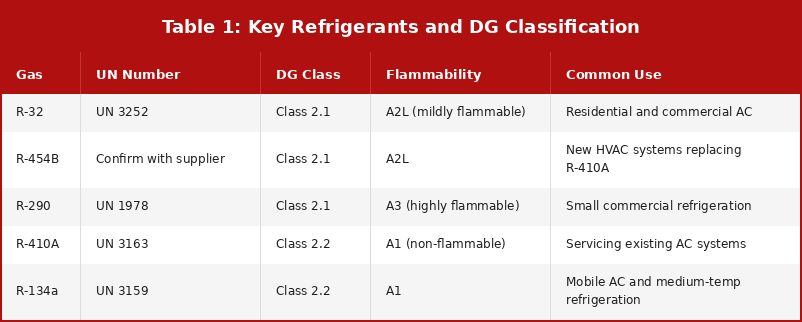
Refrigerants are classified as dangerous goods under IMDG (sea freight) and IATA (air freight) regulations. The classification determines carrier acceptance, stowage conditions, and documentation requirements. As an importer, you need to know which class your gas falls into because it directly affects which shipping modes are available and what your freight will cost.
Class 2.1 vs Class 2.2
The dividing line is flammability:
Class 2.1 (flammable gas): R-32, R-454B, and R-290 (propane). These gases face stricter carrier restrictions, require specific stowage conditions on vessels, and cannot move on passenger aircraft
Class 2.2 (non-flammable, non-toxic compressed gas): R-410A, R-134a, R-407C, R-744 (CO2). These gases face fewer carrier restrictions and can move by air freight for small volumes
Class 2.2 does not mean unregulated. Both classes require full DG documentation, labeling, and handling compliance. The non-flammable classification affects shipping options and cost, not whether DG rules apply.
What Importers Need to Verify from Suppliers
Your supplier and forwarder are responsible for cylinder compliance and DG packaging. What you need to confirm before placing an order:
The gas is correctly classified and the supplier has shipped this DG class internationally before
A Certificate of Analysis is available confirming the gas meets AHRI-700 standard (minimum 99.9% purity). Substandard refrigerant causes compressor failure and creates liability on your side at delivery
The supplier holds a valid MOFCOM export license for the specific gas. Many refrigerants are treated as dual-use items by China's Ministry of Commerce. Without this license, the shipment will not clear the Chinese port
Shipping Modes for Refrigerants from China
Sea Freight (FCL)
Sea freight is the standard mode for all cylinder-packed refrigerant shipments. Under IMDG rules, Class 2 compressed gases in cylinders must move as FCL. LCL consolidation is not permitted for this cargo type.
FCL 20ft: Standard for most commercial volumes. Both Class 2.1 and 2.2 gases are accepted subject to carrier DG pre-approval. A 20ft container typically holds 80 to 120 standard cylinders depending on size and packing configuration
FCL 40ft: Used for larger volumes or when co-loading with HVAC equipment, subject to DG stowage separation requirements
Cylinders move in standard dry containers at ambient temperature. Reefer containers are not required for compressed gases under normal conditions
Carrier DG pre-approval matters more for refrigerants than most other DG cargo. Not all carriers accept Class 2.1 gases on every service. Some impose stowage conditions such as above-deck positioning away from heat sources, which reduces available space and can affect scheduling. Confirm carrier acceptance at the booking stage, not after the container arrives at port.
Air Freight
Air freight is only practical for small, urgent volumes of Class 2.2 gases.
Class 2.2 gases are accepted on dedicated cargo aircraft for volumes typically under 500 kg
Class 2.1 gases (R-32, R-454B, R-290) are prohibited on passenger aircraft and face carrier-by-carrier restrictions on all-cargo services
For most commercial A2L volumes, air freight is neither cost-effective nor reliably available
ISO Tank (Bulk Industrial)
ISO tanks are used by high-volume industrial importers for bulk liquid refrigerant.
Capacity: 16,000 to 20,000 kg per tank
Requires receiving facilities equipped for bulk liquid unloading under pressure
Terminal pre-arrangement at both the Chinese loading port and the US discharge terminal is mandatory. Not all ports accommodate DG ISO tanks without advance notice
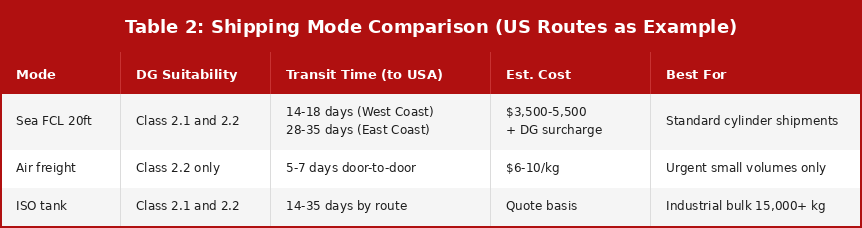
Transit times and freight costs differ significantly by destination. Europe, the Middle East, and Southeast Asia have their own routing options and rate structures. Confirm specific route availability and DG acceptance with your forwarder before booking.
Refrigerant Shipping Documentation: Full Checklist
Incomplete or incorrectly prepared documentation is the single most common cause of refrigerant shipment delays. Each document below serves a specific compliance function. Missing any one of them creates grounds for port hold, cargo refusal, or CBP examination.
Documents Prepared in China (Before Loading)
Shipper's Declaration for Dangerous Goods Required under IMDG for all classified DG cargo. Key requirements:
Must state the correct UN number, proper shipping name, DG class, packing group, and net quantity per package
Must be signed by a qualified DG shipper, not a standard freight agent
Errors on this form result in carrier rejection at origin
Safety Data Sheet (SDS/MSDS)Must be prepared in English and accompany the shipment. Covers chemical properties, handling procedures, and emergency response information. Destination port authorities may request the SDS on arrival, particularly for Class 2.1 gases.
Packing Certificate Required for sea freight under IMDG rules. Certifies the cargo has been packed in compliance with applicable regulations and the container is fit for transport. This is a separate document from the DG Declaration and is frequently missing from first-time DG shipments.
Certificate of Analysis (CoA) Confirms the gas meets AHRI-700 purity standards. Two requirements that are commonly missed:
Must reference the specific batch or production lot, not just the gas type
A generic CoA without batch identification is not sufficient for US customs purposes
MOFCOM Export License Copy Documentary proof that the Chinese exporter holds the required Ministry of Commerce authorization. Request a copy at the order confirmation stage. Do not wait until the day of loading.
Documents Prepared by the Importer or Broker (US Imports)
The following documents are specific to US import requirements. Importers shipping to other destinations should confirm equivalent requirements with their forwarder, as customs filing systems, duty structures, and regulatory bodies differ by country.
Commercial Invoice Must state the correct 10-digit HTS code for the specific gas or blend. Wrong classification flows through to incorrect duty calculation and potential CBP scrutiny. Verify your HTS code against the USITC tariff schedule before the invoice is issued.
ISF (Importer Security Filing) Key facts:
Filed electronically to CBP no later than 24 hours before the vessel departs the Chinese port
Late or missing ISF filing carries a $5,000 penalty per violation
Can trigger a do-not-load instruction from CBP before the vessel sails
EPA HFC Allowance Documentation For all HFC imports, proof of valid allowance holdings is submitted to CBP at entry. The allowances are tracked in the EPA GHGRP system. Not all customs brokers handle this submission routinely. Confirm your broker's experience with EPA HFC compliance before engaging them for this cargo type.
Bill of Lading The carrier-issued transport document confirming shipment details. Must be consistent with all other submitted documents. Discrepancies between the B/L and the commercial invoice or DG declaration are a frequent trigger for CBP documentary review.
Refrigerant Import Cost Breakdown:China to USA
Freight is one component of a multi-part landed cost. At current tariff levels, the Section 301 duty is typically the largest single cost item for HFC shipments from China, exceeding freight on most standard FCL volumes.
Ocean freight:
Base FCL rate from Shanghai or Ningbo to US West Coast: $3,500 to $5,500
DG surcharge: $200 to $500 depending on carrier and gas classification
East Coast routing (New York, Savannah) adds roughly $1,000 to $1,500 to the base rate
Other US-side fees per shipment:
Customs brokerage: $200 to $500
Merchandise Processing Fee (MPF): 0.3464% of cargo value (min. $27.23, max. $528.33)
Harbor Maintenance Fee (HMF): 0.125% of cargo value
Port terminal handling: $300 to $600 per container
ISF filing: $50 to $75
Worked example: 20ft FCL of R-32, approximately 10 tonnes, FOB Ningbo to Los Angeles, cargo value $18,000:
Ocean freight + DG surcharge: $4,550
Marine insurance (1.5% of cargo value): $270
Section 301 tariff (25% on $18,000): $4,500
MPF: $62
HMF: $22
Port terminal handling: $450
Customs brokerage and ISF: $350
Total estimated landed cost: $28,204
At current tariff levels, budget 50 to 60% above the FOB value as a planning figure for HFC imports from China. EPA allowance costs are borne on the supplier side but will be reflected in the FOB price you are quoted.
For a full breakdown of current US tariff rates on Chinese goods by HTS category, see our China tariff guide.
Top Chinese Ports for Refrigerant Shipping
The practical question for importers is which ports have the DG infrastructure to handle gas shipments and which carriers operate direct services to US gateways. Not every port accepts Class 2.1 gases, and DG surcharges vary by terminal.
Ningbo-Zhoushan
Highest volume DG chemical export port in China
Dedicated hazardous cargo terminals; accepts both Class 2.1 and 2.2 gases
Multiple direct weekly services to Los Angeles, Long Beach, and Oakland
Transit to US West Coast: 14 to 18 days
Primary loading port for Juhua Group (Zhuji, Zhejiang), one of China's largest fluorochemical producers
Shanghai (Yangshan)
Widest carrier selection among Chinese ports for DG chemical cargo
Highest service frequency to both US West and East Coast gateways
Transit to Los Angeles: 14 to 16 days on direct services
Best option when carrier choice and schedule flexibility are priorities
Qingdao
Primary export port for Shandong province producers, including Dongyue Group (R-32, R-125, HFC-143a, blending components)
Established DG terminal infrastructure with regular transpacific services
Transit to US West Coast: 15 to 20 days
Port selection affects more than transit time. DG surcharges, carrier acceptance windows for Class 2.1 gases, and terminal handling fees all vary. A supplier with a lower FOB price loading at a port with limited Class 2.1 carrier options can produce higher overall freight costs and longer booking lead times. Always ask the supplier which specific terminal they load from and confirm DG carrier availability before committing to an order.
Common Refrigerant Shipping Challenges from China
Most shipping problems with refrigerants originate on the China side. Understanding the friction points helps you plan lead times and ask the right questions when evaluating suppliers.
Cylinder Certification and Inspection Requirements
Before a cylinder-packed DG shipment can be loaded at a Chinese port, cylinders must hold valid inspection certificates from a China-recognized pressure vessel inspection body. Cylinders with lapsed certificates will be rejected at port.
Re-inspection is required on a set cycle depending on cylinder type and gas
A supplier needing re-inspection before loading may require 2 to 4 additional weeks not included in a standard production quote
Confirm cylinder certification status at the order stage, not when chasing a loading date
Co-Shipping Refrigerants with HVAC Equipment
Consolidating refrigerant cylinders and HVAC equipment in one container is possible but requires upfront planning. DG gases and non-DG equipment are subject to IMDG stowage separation rules, and not all carriers accept the combination without written stowage confirmation.
For most shipments, booking the two cargo types separately is the safer approach. It keeps the equipment shipment on schedule regardless of any DG acceptance issue. If consolidation is needed for cost reasons, confirm stowage compatibility with your forwarder before cargo is packed.
China Export Controls and Destination Restrictions
China has tightened export controls on refrigerants as part of broader dual-use chemical oversight. Before any shipment can proceed:
The exporter must hold a valid MOFCOM export license for the specific gas
The destination country must be permitted under current export control regulations
Some destinations face additional scrutiny not visible in a standard trade inquiry
Policies can change with limited notice. A destination permitted on a previous order is not automatically permitted on the next. Confirm eligibility with your forwarder at the start of each new order cycle.
How Gerudo Logistics Manages Refrigerant Shipments
Refrigerant imports sit at the intersection of DG compliance and US customs requirements. A forwarder without direct DG classification experience adds risk on this cargo type rather than reducing it.
At Gerudo Logistics, we manage refrigerant shipments across the full chain:
DG classification review and IMDG-compliant documentation preparation before cargo is loaded
Carrier selection and DG pre-approval coordination for Class 2.1 and 2.2 gases, with confirmed stowage conditions in writing before booking is finalized
Port coverage across Guangzhou, Shenzhen, Shanghai, Ningbo, Qingdao, and Dalian, covering all major Chinese refrigerant production and export regions
Customs clearance and duty payment under DDP terms, including coordination with your broker on EPA HFC allowance documentation timelines
Door-to-door execution from Chinese factory to your US receiving facility, with documentation aligned to departure schedules to avoid last-minute holds
We verify cylinder and packaging compliance at origin and work with DG-certified carriers on every refrigerant booking. For importers managing EPA allowance submissions alongside shipping logistics, we align documentation preparation with vessel departure timelines so both sides are ready when the cargo arrives.
Contact our team to discuss your refrigerant shipment requirements.
FAQs: Importing Refrigerants from China
Can I still import R-410A from China in 2026? Yes, for the service market only. New HVAC equipment has not used R-410A since January 2025. Valid EPA HFC consumption allowances are still required for every shipment.
What happens if I import HFCs without EPA allowances? CBP refuses entry. Fines exceed $50,000 per violation. Repeat violations result in a ban on future HFC imports.
What is the practical difference between Class 2.1 and Class 2.2 for shipping? Class 2.1 gases face stricter carrier restrictions and cannot move on passenger aircraft. Class 2.2 gases have more carrier options and can move by air for small volumes. Both require full DG documentation.
Do I need a Certificate of Analysis for every shipment? Yes. The CoA must confirm AHRI-700 purity (99.9% minimum) and reference the specific production batch. A generic CoA without batch identification is not sufficient.
What Section 301 tariff applies to refrigerant imports from China? Most HFCs under HTS 2903 and blends under HTS 3824 currently carry 25%. This rate has changed multiple times since 2018. Verify against your specific 10-digit HTS code before calculating landed costs.
Does my Chinese supplier need a government export license? Yes. MOFCOM requires an export license for many refrigerants before the shipment clears the Chinese port. Confirm this before placing your order.
Conclusion
Shipping refrigerants from China requires compliance work on both sides before cargo moves. On the China side: MOFCOM licensing, valid cylinder inspection certificates, and a batch-specific CoA meeting AHRI-700 standard. At destination: each market has its own import regulatory layer, and the documentation burden is consistently higher than most importers expect on their first order.
Working with a forwarder experienced in DG gas classification and destination-specific compliance reduces lead time uncertainty and avoids holds that are both costly and avoidable.