Shipping Photoresist from China: Freight Guide for Importers
The word photoresist tells a carrier very little about the actual shipment. One grade may be accepted as non-DG cargo, while another requires DG packaging and carrier approval because its solvent composition or flash point is different.
For importers shipping photoresist from China, the exact product grade determines which freight options are available. The SDS needs to match the product code and packaging, and the manufacturer's temperature range has to work with the planned transit. These details determine whether the shipment can move by courier, air freight or ocean freight, as well as the likely time and cost.
Is Photoresist Dangerous Goods?
Photoresist has no single dangerous goods classification. Solvent-based liquid grades can fall under Class 3, while a dry film grade can have non-DG transport status. The terms positive photoresist and negative photoresist describe the imaging process and do not determine how the product is shipped.
For example, published transport data for the negative photoresist AR-N 4240 and positive photoresist AR-P 5300 gives the same result: UN 1993, FLAMMABLE LIQUID, N.O.S., Class 3, Packing Group III. Both products contain a flammable solvent system even though they use different imaging processes.
Why Classification Changes Between Photoresist Grades
The following product differences can change the transport result:
Solvent system: Liquid photoresist often contains a carrier solvent such as propylene glycol methyl ether acetate. Its concentration and the finished product's flash point determine whether the liquid meets Class 3 criteria.
Product concentration: Grades in the same series can contain different proportions of solvent and solids. A change in viscosity or formulation can produce different physical data.
Physical form: Liquid photoresist presents leakage and flammable-vapor risks when it contains a regulated solvent. Dry film is supplied as a photosensitive layer between supporting films and does not present the same liquid-solvent exposure during transport.
Separate chemicals: Developer, thinner and photoresist remover are separate chemical products. Their classification does not follow the photoresist grade packed in the same order.
A product can carry health or environmental hazard statements under GHS and still be non-DG for transport. GHS labeling describes hazards during use and handling. IATA and IMDG classification determines whether dangerous goods procedures apply during air or ocean freight.
DG and Non-DG Results for Photoresist Grades
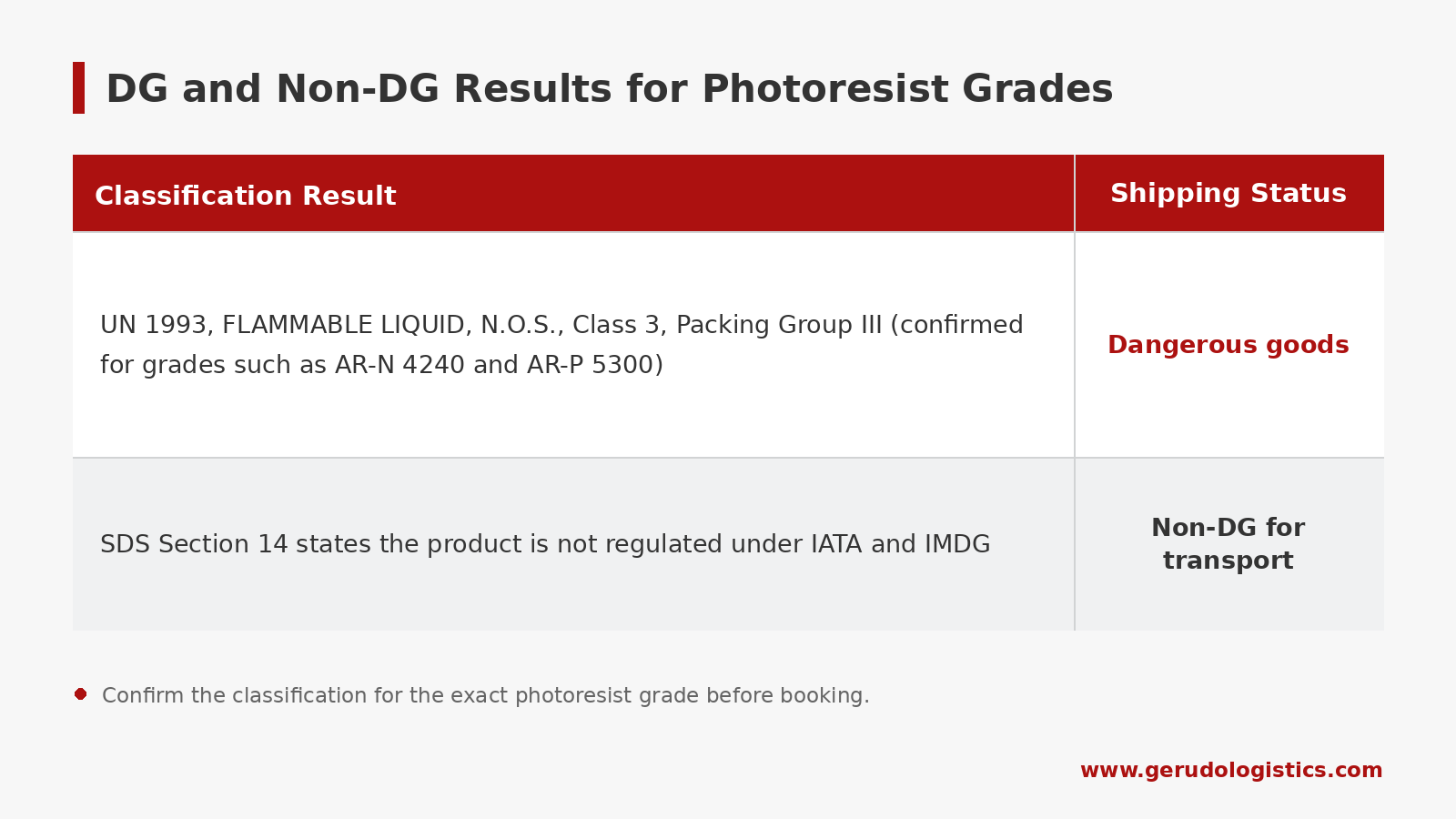
Every other transport result — including grades where air and ocean give different outcomes, or where the SDS transport entry is incomplete — needs to be confirmed against that specific product's own SDS Section 14 and transport appraisal before booking.
Shipping Photoresist from China: Air, Ocean and Express Freight
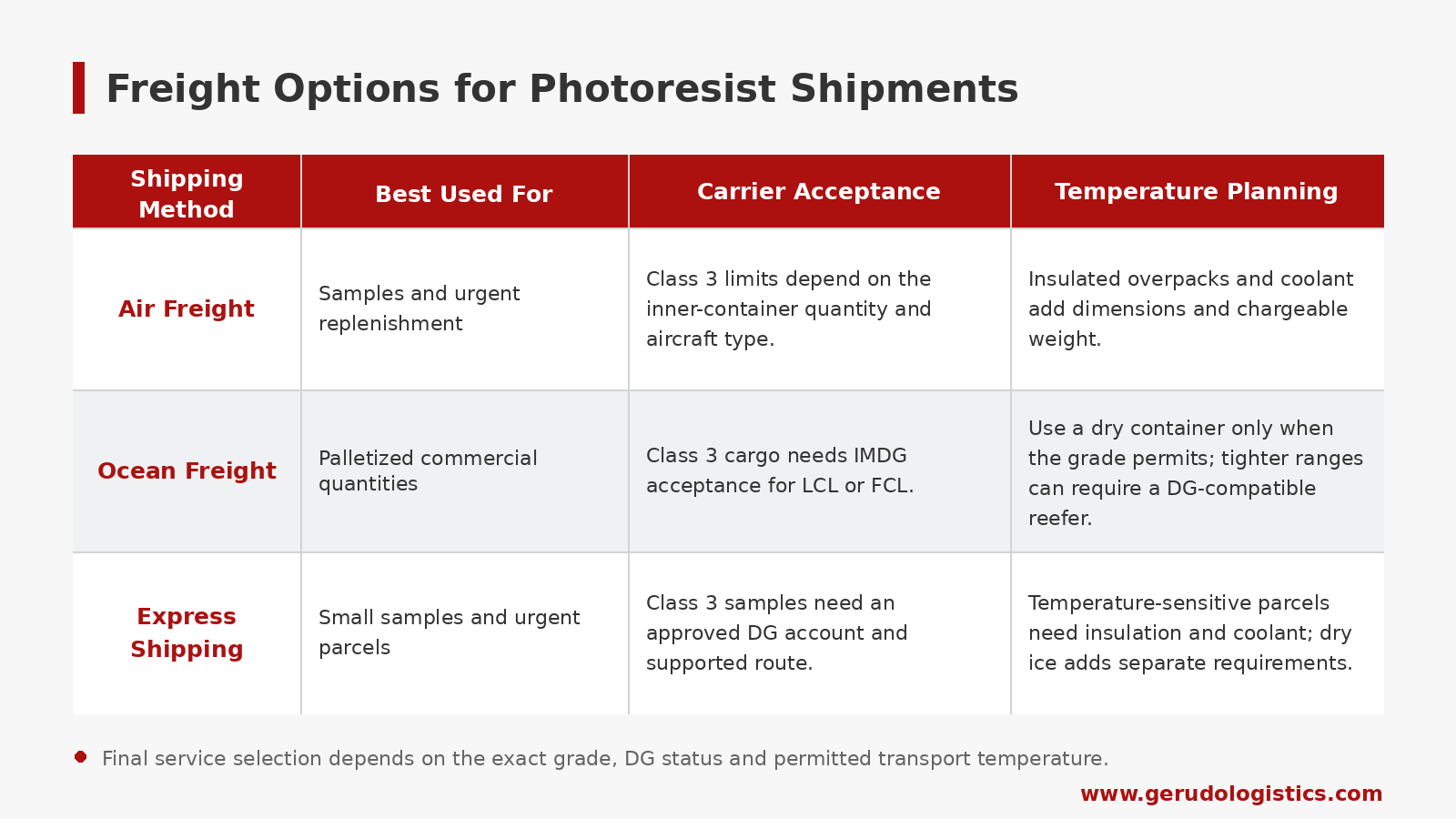
The shipping method for photoresist depends on the DG status of the exact grade, the quantity in each inner container and the manufacturer's transport temperature. Air freight and express shipping are usually used for samples or urgent replenishment. Ocean freight is more economical for palletized commercial quantities.
Air Freight for Photoresist
For Class 3 liquid photoresist, the quantity in each bottle, can or drum affects the applicable air packing instruction. Passenger aircraft and cargo aircraft can have different net quantity limits per package, which may require a large order to be divided across more packages or moved on a cargo aircraft service.
Temperature-sensitive grades can use insulated overpacks, gel packs or another approved coolant. These materials increase the package dimensions and chargeable weight, so the air freight cost can rise even when the net quantity of photoresist remains unchanged. The validated temperature-control period must cover the full door-to-door journey, including origin handling, customs clearance and final delivery.
Ocean Freight for Photoresist
A smaller commercial batch can move by LCL when a consolidator accepts the photoresist classification. FCL becomes more practical when the order occupies several pallets, requires a dedicated container or needs active temperature control.
Class 3 photoresist requires an IMDG-compliant booking for both LCL and FCL. LCL adds handling at the consolidation and deconsolidation warehouses, while FCL keeps the product in one container between loading and destination delivery.
Express Shipping for Photoresist Samples
A non-DG grade can use a standard chemical-acceptance service, while Class 3 samples require an approved DG express account and supported route. Temperature-sensitive samples need insulated parcel packaging and coolant, while dry ice adds separate UN 1845 requirements. The chemical sample shipping guide explains the packing and document requirements for small chemical consignments.
Photoresist Packaging Requirements
Photoresist packaging has to protect the product from leakage, light exposure and physical damage. Liquid photoresist and dry film require different package designs, while Class 3 liquid grades add dangerous goods packaging requirements.
Packaging for Liquid and Dry Film Photoresist
Liquid photoresist is usually shipped in the manufacturer's original light-protected container. Many grades use amber glass bottles or another opaque container because exposure to light can affect the product. Repacking into a clear or chemically incompatible bottle can damage the photoresist before it reaches the importer.
The outer package for liquid photoresist needs to address:
Container closure: Each bottle, can or drum remains upright and securely closed throughout vibration and pressure changes.
Leak containment: Absorbent material covers the liquid volume carried inside the outer package.
Bottle protection: Dividers or cushioning prevent glass bottles from touching each other or the sides of the box.
Light protection: The original amber or opaque container remains covered during transport and warehouse handling.
Package orientation: Upright arrows and package handling marks remain visible on the completed shipment.
Grade separation: Each inner container carries its own product code and label. Different grades are separated inside the outer package to prevent identification errors after arrival.
Different photoresist grades can share an outer package only when their classifications, packaging instructions and packing-together conditions allow it. Products with different temperature ranges are better placed in separate outer packages because one insulation and coolant plan may not suit both grades.
Dry film photoresist needs protection from moisture, heat, light and roll deformation. The roll normally remains in its original light-barrier packaging with the core and film edges supported.
Dry film packaging needs to include:
Moisture protection: The sealed inner bag remains intact until the product reaches the controlled production environment.
Horizontal roll support: Rolls are packed horizontally to reduce telescoping and movement between film layers.
Core protection: End supports prevent the core from shifting or collapsing.
Rigid outer carton: The carton protects the roll from stacking pressure, punctures and edge damage.
Light barrier: The manufacturer's opaque inner packaging remains closed during transit.
Humidity control: Desiccant is included only when the manufacturer permits it and the package is designed for controlled humidity.
A dry film roll can become unusable without visible damage to the outer carton. Compression can deform the roll edges, while heat can affect the photosensitive layer or cause the film layers to block together.
UN-Rated Packaging for DG Photoresist
Class 3 liquid photoresist may require UN-rated combination packaging. The liquid is placed in approved inner bottles or cans, which are then secured inside a tested outer box with absorbent and cushioning materials.
The UN performance code on the outer package indicates the packing groups it can support:
X marking: Packing Groups I, II and III
Y marking: Packing Groups II and III
Z marking: Packing Group III
A photoresist classified as Packing Group III can use packaging with a suitable X, Y or Z performance level when the complete package also meets the applicable packing instruction. The mark alone does not confirm that the package is suitable for the shipment.
The approved package design also specifies the permitted inner containers, closure method and maximum gross mass. Replacing glass bottles with plastic bottles, increasing the bottle volume or changing the cushioning can place the completed package outside the tested design.
For shipments prepared in China, the packaging record needs to correspond with the actual outer package and its UN mark. The dangerous goods package certificate guide explains how the certificate, manufacturer and package code need to match.
An insulated shipper placed around a UN-rated package can become an overpack. The required UN number, hazard label and orientation marks need to remain visible or be reproduced on the outside.
Confirmed non-DG liquid photoresist and non-DG dry film do not require UN-rated packaging solely because they are photoresist. They still need packaging that protects the exact grade from leakage, light exposure and physical damage.
Photoresist Storage Temperature During Transport from China
Photoresist temperature requirements depend on the exact grade. Published storage conditions for liquid photoresist can be considerably narrower than those for dry film.
For example, Allresist SX AR-N 4340/7 specifies storage at 8°C to 12°C. ETERTEC TPR2600R dry film specifies 5°C to 20°C with relative humidity of 50% ±10%.
Manufacturer Temperature Requirements by Grade
The storage temperature shown in the product documents is the starting point for planning the shipment. The importer needs the supplier or manufacturer to confirm the following information for the exact grade:
Transport temperature range: The minimum and maximum temperatures permitted during the complete journey.
Excursion limit: The highest or lowest temperature the product can tolerate outside its normal range.
Excursion duration: How long the photoresist can remain outside the specified range before a technical assessment is required.
Freeze sensitivity: Whether exposure to subzero temperatures can damage the formulation.
Dry film humidity limit: Whether humidity control is required in addition to temperature control.
A general instruction such as "keep cool" does not provide enough information to select the shipping plan. The permitted transport range and excursion duration need to be confirmed before booking.
What Happens After a Temperature Excursion?
A temperature excursion does not automatically make the photoresist unusable. The decision depends on the product grade, the recorded temperature and how long the shipment remained outside the permitted range.
After an excursion, the importer needs to take four actions:
Isolate the affected batch: Keep it separate from approved inventory and leave refrigerated containers sealed until they reach the manufacturer's specified handling temperature.
Collect the shipment record: Download the temperature data and record the batch number, minimum temperature, maximum temperature, excursion duration and any visible packaging damage.
Compare the result with the permitted limits: Use the manufacturer's written excursion allowance for that grade.
Request a product decision: Send the temperature record and batch information to the manufacturer or qualified quality team. Do not release the batch for production until its status has been confirmed.
Visual appearance alone cannot confirm that photoresist remains suitable for production. The freight provider can supply the transport and temperature records, while the manufacturer or importer's quality team determines whether the batch can be accepted, tested further or rejected.
Shipping Documents for Photoresist from China
Shipping documents must identify the manufacturer, trade name and exact photoresist grade shown on the product label. A confirmed non-DG grade uses the standard commercial documents together with classification evidence, while Class 3 photoresist also requires the applicable dangerous goods declaration and packaging records.
SDS Matching by Product Grade
The product identifier in SDS Section 1 should match the manufacturer, trade name and grade printed on the bottle, can, drum or dry film package. The same identity should appear on the commercial invoice, packing list and booking request.
For liquid photoresist, the following SDS details need to correspond with the grade being shipped:
Physical state: Liquid rather than dry film or another product format.
Flash point: The measured value for the actual solvent formulation.
Transport classification: UN number, Proper Shipping Name, hazard class and Packing Group in Section 14.
Storage conditions: Temperature and light-protection requirements for that grade.
Manufacturer: The company responsible for the formulation shown on the product label.
Some manufacturers issue one SDS for several grades in the same product series. In that case, the document needs to identify which grades it covers. A general SDS for an unnamed photoresist series does not establish the classification of the product inside the shipment.
The SDS also needs to remain consistent with the transport appraisal and Dangerous Goods Declaration. The separate MSDS guide for dangerous goods shipping explains the general document format and carrier review requirements.
Documents for Class 3 Photoresist Bookings
A fully regulated Class 3 photoresist booking usually requires the following documents:
Grade-specific SDS: Covers the exact product code and formulation.
Cargo Transportation Conditions Appraisal Report: Also called a transport identification report, it confirms the product's transport classification when requested by the Chinese airport, port, carrier or receiving warehouse.
Dangerous Goods Declaration: Prepared for the actual package quantity and transport mode. Air freight uses a Shipper's Declaration for Dangerous Goods, while ocean freight uses the applicable sea freight declaration.
Packaging evidence: Corresponds with the final outer package, UN packaging mark, assigned Packing Group and package type stated on the Dangerous Goods Declaration.
Commercial invoice: States the photoresist name, grade, intended use, quantity, value and HS code.
Packing list: States the package count, inner quantities, net weight, gross weight and dimensions.
Temperature instruction: Provides the permitted transport range when the shipment needs refrigeration or insulated protection.
Photoresist Details Required for Booking
Carrier review also requires the final shipment data. The supplier or importer needs to provide:
Product identity and transport status: Manufacturer, trade name, grade, liquid or dry-film format and the assigned UN number, Proper Shipping Name, hazard class and Packing Group.
Package configuration: Net quantity per inner container, outer package type, UN specification mark and number of inner containers.
Shipment totals: Number of outer packages, total net quantity, gross weight and dimensions.
Transport conditions: Permitted temperature range and the final insulation or coolant arrangement.
Related chemicals: Separate product identity and classification for any developer, thinner or remover in the consignment.
Changes to the bottle size, inner-container count, coolant arrangement or outer package after carrier acceptance can affect the approved packing instruction, chargeable weight or Dangerous Goods Declaration.
HS Code for Photoresist Shipping
HS 3707.90 is commonly used at the six-digit level for prepared photoresist materials covered as chemical preparations for photographic uses. The final eight-digit or ten-digit code depends on the destination country's tariff schedule and the form of the imported product.
The commercial invoice can use a description such as: “Photoresist, grade [product code], for semiconductor photolithography” or “Dry film photoresist, grade [product code], for printed circuit board production”
Descriptions such as “chemicals”, “coating material” or “industrial liquid” do not identify the product clearly enough for customs classification.
The HS code and dangerous goods classification serve different purposes. A Class 3 liquid grade and a non-DG photoresist grade can use the same customs heading even though their transport requirements are different.
Developer, thinner and remover products need separate HS classifications based on their composition and function. Their codes should not be copied from the photoresist simply because the products are ordered as one processing system.
Photoresist Shipping Support From Gerudo Logistics
Gerudo Logistics provides dangerous goods and temperature-controlled freight services for chemical shipments from China's main manufacturing and shipping regions. Our team coordinates carrier acceptance and route planning for DG and non-DG photoresist across approved packaging formats.
Support is available for commercial batches, laboratory samples and shipments containing related processing chemicals. Importers cancontact us with the product grade, quantity, packing details and destination for a shipment review.
Frequently Asked Questions About Shipping Photoresist from China
Does a Small Photoresist Sample Avoid Dangerous Goods Classification?
No. A smaller quantity does not change the product's hazard classification, although quantity-based provisions can change the permitted packaging, documentation or carrier options.
Is Limited Quantity Photoresist Considered Non-DG?
No. Limited Quantity is a form of regulatory relief for eligible dangerous goods. The product keeps its UN number and hazard class, while some packaging, marking or documentation requirements can change according to the transport mode.
Can Different Photoresist Grades Move in the Same Shipment?
They can share one consignment when each grade has been classified separately and their temperature ranges, packaging conditions and dangerous goods segregation requirements are compatible. The documents need to identify every grade rather than combining them under one general description.
Can Photoresist Ship With Developer, Thinner or Remover?
This is possible only after each related chemical receives its own transport classification. A developer can be corrosive, while thinner or remover can be flammable, so the combined shipment depends on carrier acceptance and segregation requirements.
Does the HS Code Determine Whether Photoresist Is Dangerous Goods?
No — HS code is a customs classification, while DG status comes from transport hazard data, so two photoresist grades can share the same HS code yet carry different UN numbers.
Can Photoresist Be Shipped Under DDP Terms?
DDP can be arranged only when there is a valid importer-of-record structure and the destination chemical requirements are covered. The Incoterm does not replace TSCA, REACH, chemical permit or local importer obligations.
What Happens if the Photoresist Formula Changes After Booking?
A formulation change requires a new classification and document review before the cargo moves. Keeping the same product name does not guarantee that the transport class, temperature requirement or destination chemical status remains unchanged.