How to Ship Portable Power Stations from China: A Complete Guide
An importer comparing two Chinese suppliers may see the same product name on both quotations: portable power station. One model could be a compact 300Wh camping unit, while the other is a 3kWh system with separate expansion batteries. Their battery capacity, weight, packaging, and carrier acceptance can lead to very different shipping arrangements.
Portable power stations can be shipped from China by sea freight, air freight, or approved express services. Importers first need to confirm the exact product configuration and dangerous goods status.
This guide explains how to compare transport options, estimate shipping costs, prepare the required documents, and handle the customs differences in major destination markets.
Quick Summary
Most portable power stations ship as UN3480 Class 9 dangerous goods
Sea freight is standard for commercial orders; air freight requires a battery state of charge of 30% or lower
US imports require an Importer of Record, a customs bond, and Importer Security Filing
Combined US customs duty can reach roughly 40%+ depending on HTS classification
Customs registration and filing systems differ by country, though the underlying document and battery classification requirements described in this guide apply globally
Are Portable Power Stations Classified as Dangerous Goods (UN3480)?
Yes. Most portable power stations contain rechargeable lithium-ion batteries and are transported as Class 9 dangerous goods. This also applies to models using lithium iron phosphate, commonly known as LiFePO4 or LFP batteries.
A typical portable power station is generally classified as UN3480, Lithium ion batteries because its primary function is to store energy and supply power to external devices. Its built-in inverter, display, and charging controls support that function but do not normally change the product into UN3481 equipment. The exact classification must still be confirmed for the model being shipped.
UN3481 applies when a lithium-ion battery is contained in or packed with the equipment it powers. A laptop battery, for example, powers the laptop itself. A portable power station mainly supplies electricity to phones, tools, refrigerators, and other equipment, which is why the finished unit commonly follows the UN3480 classification.
Battery capacity does not by itself change the dangerous goods class or UN number. Separate expansion batteries must be identified and classified as battery items rather than ordinary accessories.
Sea Freight vs Air Freight vs Express: Shipping Options from China
Sea freight is generally the best fit for commercial orders, while air freight serves urgent samples and replenishment. Express can work for small shipments when the selected service accepts UN3480 lithium batteries.
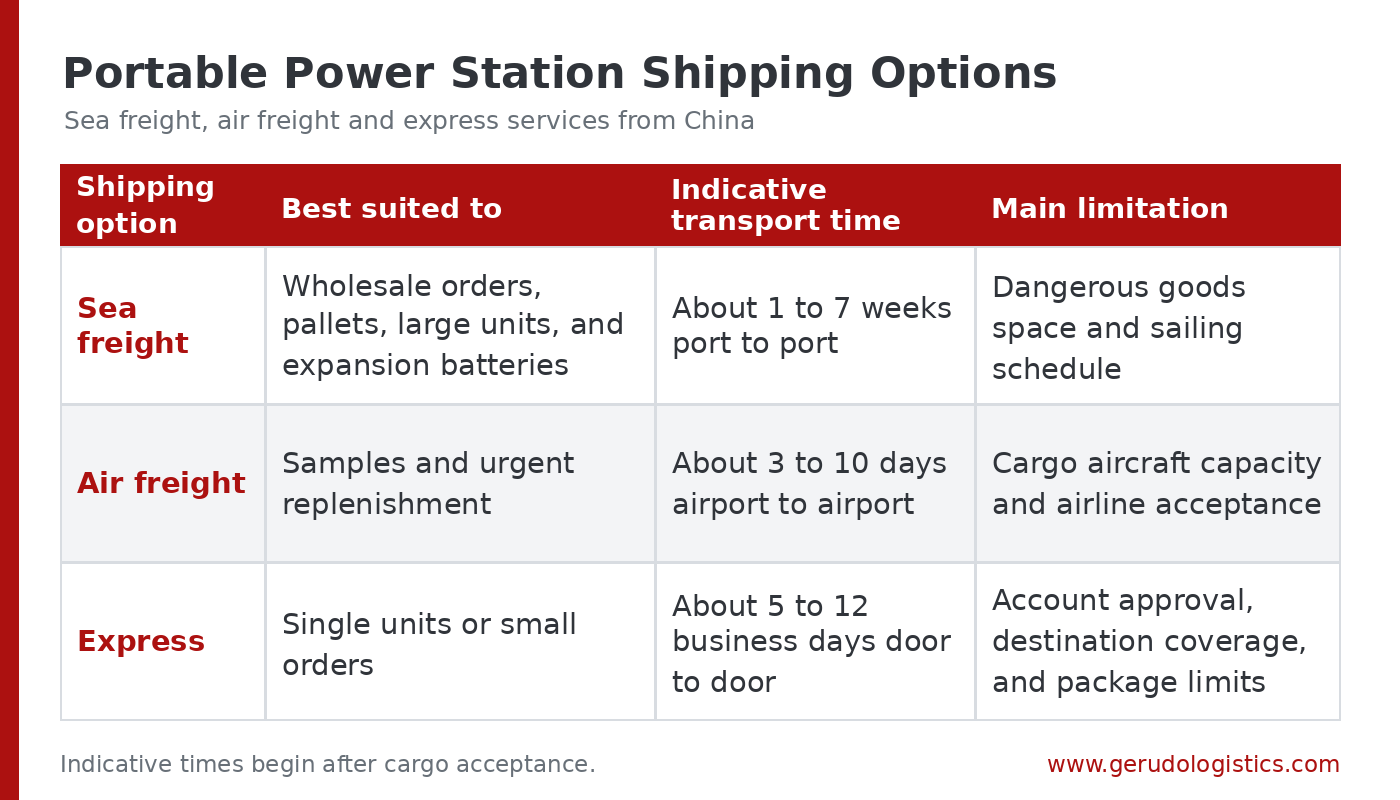
The ranges begin after cargo acceptance and exclude document review, pickup, customs clearance, and any final delivery outside the quoted service.
Sea Freight for Commercial Orders
Sea freight is suitable for multiple cartons, palletized orders, high-capacity units, and shipments containing separate expansion batteries. It offers more capacity for heavy products than air or express services.
Less-than-container load, or LCL, can suit smaller commercial orders when a dangerous goods consolidation service is available. Departure depends on the consolidation schedule and compatibility with other cargo in the container.
Full-container load, or FCL, becomes more practical as the order volume increases. It gives the shipment dedicated container space and removes dependence on an LCL consolidation schedule.
Air Freight for Samples and Urgent Orders
Air freight can suit samples, launch stock, replacement units, and urgent replenishment. Large or heavy models can lose much of the time and cost advantage because air freight uses chargeable weight and depends on cargo-aircraft capacity.
When a portable power station is classified as UN3480, it can travel only on cargo aircraft. Its state of charge must normally be no higher than 30 percent of rated capacity. Individual airlines can apply stricter acceptance conditions.
The flight may take only a few days, but booking approval and dangerous goods warehouse handling can extend the total schedule.
Express Shipping for Small Orders
Express shipping is available only when the shipment fits a carrier's fully regulated UN3480 service. The account holder must be authorized by the express company to tender dangerous goods, and the origin station must offer that service to the destination.
For example, DHL Express requires pre-approval before an account holder can ship lithium batteries. UPS accepts UN3480 air shipments only as fully regulated hazardous materials. FedEx applies country, city, service, and package restrictions to standalone lithium battery shipments.
A supplier who regularly ships ordinary electronics may therefore be unable to use the same account for a portable power station. Availability must be checked against the account number, Chinese origin station, destination postal code, package weight, dimensions, and number of units.
Express is most suitable for a single sample or a small model within the carrier's package limits. Larger units, separate expansion batteries, and multi-carton orders are generally better suited to air freight or sea freight.
How Much Does It Cost to Ship a Portable Power Station from China?
There is no standard shipping cost per unit. The total depends on the transport option, packed weight and dimensions, dangerous goods charges, route, destination services, and import taxes.
Main Freight Charges
Sea freight uses different calculations for LCL and FCL shipments. LCL rates are based on weight or volume, while FCL rates are based on the selected container type and route.
Air freight and express services use chargeable weight, which is the higher of actual weight and volumetric weight under the carrier's calculation. Portable power stations are often heavy for their carton size, but pallets and protective packaging can increase the chargeable volume.
Dangerous Goods Charges at Origin
A portable power station shipment can include additional charges for dangerous goods booking, warehouse handling, cargo declaration, carrier review, and required marks or labels. The charging basis varies by carrier and origin station.
Some charges apply once per shipment, while others depend on the number of packages or total dangerous goods weight. Packaging corrections and document revisions create additional costs when the supplier's preparation does not meet the confirmed booking conditions.
Destination Costs
Destination costs can include port or airport handling, customs clearance, examination fees, storage, and final delivery when these services form part of the quotation. LCL shipments may also have destination charges calculated by volume or shipment.
The UN number controls transport treatment, while the HS code affects customs duty. Import duties and taxes depend on the declared value, country of origin, destination market, and applicable tariff treatment.
China-origin products entering the United States may face additional tariffs. European Union imports can incur customs duty and import VAT, while other markets apply their own duty, VAT, or GST systems. These amounts remain separate from the international freight cost unless the quotation uses an agreed DDP arrangement.
Information Needed for a Shipping Quote
A usable quotation requires:
Product details: Product name, exact model, battery chemistry, and watt-hour rating
Order quantity: Number of main units and separate expansion batteries
Packed cargo data: Gross weight and dimensions for every carton or pallet
Pickup point: Supplier address or Chinese pickup city
Destination: Country, city, and postal code
Cargo-ready date: The date the supplier can release the finished shipment
Requested service: Sea freight, air freight, express, or a comparison
Delivery scope: Port-to-port, airport-to-airport, or door-to-door service
Available classification records: Current SDS and lithium battery transport records for the model
A quote based only on the product name and number of units remains preliminary because it does not establish chargeable weight, dangerous goods handling, or destination scope.
Packaging Requirements and Shipping Documents for Portable Power Stations
Before pickup, importers need to check the factory packaging, standard shipping documents, and lithium battery records for the actual models in the order.
Portable Power Station Packaging Requirements
Product condition: Units must show no swelling, leakage, structural damage, or signs of overheating. Damaged or defective batteries follow different transport restrictions.
Short-circuit protection: Battery terminals, connectors, and exposed electrical contacts must be protected against contact with conductive materials.
Accidental activation: Each unit must be switched off, and its controls must be protected from being pressed during transport.
Internal movement: Molded inserts, cushioning, or other fixing materials must hold the unit in place inside the carton. Separate accessories must not strike or press against the power station.
Outer packaging: Cartons must support the gross weight of the units and withstand normal handling. Heavy cartons may require palletization to reduce movement and handling damage.
Marks and labels: Dangerous goods marks, handling labels, and UN information must match the confirmed transport classification and shipping option.
Packaging photos: The factory should provide photos of the product label, internal packing, sealed carton, external marks and labels, and completed pallet where applicable.
Standard Shipping and China Customs Documents
Commercial Invoice: States the seller, buyer, product description, model, quantity, unit value, total value, currency, Incoterm, and country of origin.
Packing List: Shows the number of cartons or pallets, units per package, net weight, gross weight, and package dimensions. Main units and separate expansion batteries need distinct descriptions.
China Customs Declaration: The Chinese customs agent files the declaration using the product description, HS code, value, trade term, and shipper information. These details must match the invoice and packing list.
Bill of Lading or Air Waybill: The carrier issues a Bill of Lading for sea freight or an Air Waybill for air freight and express shipments. The consignee and shipment details must match the agreed customs arrangement.
Certificate of Origin: This is added when the destination country, buyer, bank, or tariff arrangement requires evidence of Chinese origin.
Lithium Battery Shipping Documents
Safety Data Sheet: The SDS identifies the battery chemistry, safety information, and transport classification. The carrier or freight forwarder commonly reviews it before accepting the booking.
UN 38.3 Test Summary: The summary confirms that the battery design passed the required UN transport tests. It must identify the manufacturer, test laboratory, battery model, test report reference, and test results required by the standard.
UN 38.3 Test Report: Some carriers and China-side handling facilities request the full report during shipment review. It must cover the battery design installed in the portable power station.
Battery Specification: The specification states the battery model, chemistry, nominal voltage, amp-hour capacity, watt-hour rating, and unit weight. These values must agree with the product label and other battery records.
Transport Appraisal: A Chinese carrier, airline, shipping line, warehouse, or freight forwarder may request an appraisal of the cargo's transport conditions. Its product name, model, and validity period must cover the planned shipment.
Dangerous Goods Declaration: The declaration records the UN number, proper shipping name, class, package count, weight, and packing details for the confirmed sea or air shipment. The required format depends on the shipping option and carrier.
Customs Import Requirements by Country: US, EU, Southeast Asia, and the Middle East
Commercial invoices, packing lists, transport documents, and battery records apply across most destinations. The following requirements distinguish several major import markets.
United States Import Requirements
Importer of Record: A US Importer of Record takes responsibility for the customs entry. A first-time importer may need to establish its importer identity with US Customs and Border Protection before filing.
Customs Bond: A formal commercial entry generally requires a single-entry or continuous customs bond. The bond must be arranged before the customs entry is submitted.
Importer Security Filing: Portable power stations arriving by sea require an Importer Security Filing. The importer or its filing agent submits the required data before the cargo is loaded in China.
European Union Import Requirements
EORI Number: A business importing portable power stations into the European Union needs an Economic Operators Registration and Identification number for customs declarations.
Customs Representation: The importer must confirm whether its customs representative acts directly in the importer's name or indirectly in the representative's own name. This choice changes who acts as the declarant and shares customs liability.
ICS2 Entry Data: Goods entering or transiting the European Union require an Entry Summary Declaration through Import Control System 2. The carrier or freight forwarder normally files the declaration using shipment data collected before arrival.
Southeast Asia Import Requirements
Southeast Asia does not use one regional customs system. Requirements must be confirmed for the destination country.
Singapore: The importer needs a Unique Entity Number, an activated Singapore Customs Account, and a Customs Import Permit submitted through TradeNet.
Malaysia: The importer or its agent submits the customs declaration and uploads the supporting documents required for clearance through the Malaysian Customs Import/Export Document System, known as MyCIEDS.
Indonesia: A commercial importer needs a valid Business Identification Number, or NIB, with customs access. The importer or its representative submits the Import Declaration, known as PIB, through Indonesia's customs system.
Middle East Import Requirements
Middle Eastern countries maintain separate importer registration and electronic clearance systems.
United Arab Emirates: Customs registration is handled by the authority in the emirate of import. A Dubai-based importer, for example, needs a Dubai Customs Business Code before it or its authorized representative can submit the customs declaration.
Saudi Arabia: A commercial importer must register and activate its account on the Fasah platform. Customs broker authorization and import clearance are also managed through Fasah.
Step-by-Step: Shipping a Portable Power Station from China to the USA
The shipping process begins before the supplier releases the order. The importer needs to coordinate the product details, shipping documents, customs procedures, insurance, and US delivery in the correct sequence.
Step 1: Select a Supplier and Confirm Shipping Terms
Select a supplier that can provide the required battery documents for the exact portable power station model being purchased. Confirm the main units, expansion batteries, solar panels, chargers, and other accessories included in the order.
Agree on the Incoterm before production finishes. The shipping terms must clearly assign responsibility for factory pickup, customs clearance in China, international freight, cargo insurance, US customs clearance, and delivery.
Step 2: Prepare the Shipping Documents
Collect the commercial and lithium battery documents listed in the previous section. Product models, battery specifications, quantities, carton counts, weights, and dimensions must be consistent across the invoice, packing list, SDS, UN 38.3 records, and booking information.
For ocean freight, provide the required Importer Security Filing data to the US customs broker before loading. The ISF generally must be submitted to US Customs and Border Protection at least 24 hours before the cargo is loaded aboard the vessel in China. Air freight and express shipments do not require an ISF.
Step 3: Complete Customs Clearance in China
The dangerous goods freight forwarder confirms carrier acceptance before arranging cargo pickup. The supplier then completes the approved packaging, marks, and labels and provides the final packing details.
The China-side shipping documents are submitted for customs declaration. After customs release, the shipment is handed over to the carrier under the accepted booking.
Step 4: Arrange Insurance and Track the Shipment
Arrange cargo insurance before the shipment leaves China unless the confirmed shipping terms place this responsibility on the supplier. The policy must identify the actual cargo and transport route without excluding the declared lithium battery shipment.
Track the shipment using the bill of lading, air waybill, or express tracking number. Send the final transport document and arrival information to the US customs broker so that the import entry can be prepared before arrival.
Step 5: Clear US Customs and Arrange Delivery
The Importer of Record confirms the customs bond and authorizes the customs broker to file the import entry. The broker uses the commercial invoice, packing list, transport document, importer information, and any supporting records requested by US Customs and Border Protection.
After CBP releases the shipment, delivery is arranged according to the agreed service scope and delivery address.
Ship Portable Power Stations with Gerudo Logistics
Gerudo Logistics specializes in dangerous goods freight from China and supports US importers shipping portable power stations and other lithium battery products. Our experience with Class 9 cargo helps importers establish a workable shipping plan before the supplier releases the order.
Each shipment is planned around the actual product configuration, order size, required delivery time, and current carrier acceptance. Gerudo Logistics provides coordinated China-to-USA freight service for both samples and commercial orders, giving importers one point of contact throughout the shipment.
Contact Gerudo Logistics to review your portable power station shipment and receive a quotation for delivery from China to the United States.
FAQs About Portable Power Stations from China to the USA
How Much Tariff and Duty Will I Pay When Importing Portable Power Stations from China to the USA?
The amount depends on the confirmed HTS classification and the tariff measures in effect when the goods enter the USA. If classified under HTSUS 8507.60.0020, the current layers can include the 3.4% general duty, a 25% Section 301 tariff, and the 12.5% forced-labor Section 301 tariff, producing a combined customs duty of 40.9% as of August 2026. This excludes the Merchandise Processing Fee, Harbor Maintenance Fee for ocean shipments, and other charges, so the US customs broker must confirm the current classification, Chapter 99 provisions, and any exclusion.
What Certifications Do Portable Power Stations Need for the US Market?
UN 38.3 testing relates to lithium battery transport, while UL 2743 is the principal safety standard for portable power packs and may be required by retailers, marketplaces, insurers, or local authorities. Amazon currently requests UL 2743 and UN 38.3 documentation, while models containing Bluetooth, Wi-Fi, or other intentional transmitters require the applicable FCC equipment authorization.
What Are the Shipping Regulations for Lithium Battery Power Stations?
Portable power stations containing lithium-ion or LiFePO4 batteries are generally regulated as Class 9 dangerous goods, and a unit designed mainly to supply external power may be reviewed as UN3480. The battery design must have passed UN 38.3 testing, while the packaging, marks, labels, shipping papers, and quantity restrictions depend on the transport mode and battery specifications; the carrier may also request an SDS or transport appraisal.
What Is the Total Landed Cost of Importing a Portable Power Station?
Landed cost includes the product price, China pickup and origin handling, international freight, insurance, customs duties and tariffs, customs and broker fees, terminal costs, and inland delivery, plus examination, storage, demurrage, or correction charges when applicable. Divide the completed shipment cost by the number of sellable units and use the final customs value and confirmed HTS classification to calculate the landed cost per unit.
Do I Need a Customs Broker to Import Portable Power Stations from China?
US law does not generally require an importer to hire a customs broker, but many commercial importers use one because portable power stations can involve customs classification, Section 301 tariffs, customs bonds, Importer Security Filing, and product-specific compliance information. The Importer of Record remains legally responsible for the entry and must provide complete product, valuation, origin, and transaction records.
What MOQ Should I Expect From a Chinese Portable Power Station Factory?
There is no standard minimum order quantity for portable power stations because the MOQ depends on the model, battery capacity, existing stock, branding, casing, firmware, packaging, and certifications. Some suppliers accept one or several test units, while customized orders require higher quantities, so ask for the sample quantity, production MOQ, customization MOQ, unit price, and packing data separately.
How Long Does Shipping Portable Power Stations from China to the USA Take?
Ocean transit from major Chinese ports is commonly around two to four weeks to the US West Coast and four to seven weeks to the East Coast, excluding dangerous goods booking, origin handling, customs clearance, examinations, and inland delivery. Air freight and approved express services can be faster when the battery specifications and carrier acceptance permit, while supplier production time must be added separately.