Dangerous Goods Package Certificate from China: Importer Verification Guide
A supplier may provide a Dangerous Goods Package Certificate and still be unable to complete the planned shipment. The document may relate to another product, packaging specification, quantity, manufacturer, or packing location.
For an importer, the main question is whether the certificate applies to the exact cargo submitted for dangerous goods booking. The review should connect the certificate with the product classification, physical packaging, final quantity, carrier acceptance, and origin port plan.
At a glance: For dangerous goods shipped from China, the term Dangerous Goods Package Certificate commonly refers to origin-side packaging records covering packaging performance and approved use. These records support the international shipment when they match the cargo presented for carrier approval and loading at the selected origin port.
What Is a Dangerous Goods Package Certificate in China?
The term Dangerous Goods Package Certificate is widely used in international logistics communication. For shipments originating from China, it commonly refers to two related records: a packaging performance inspection result and a packaging use appraisal result.
Packaging Performance Inspection Result
The performance inspection result concerns the packaging container produced by the packaging manufacturer. It may cover drums, jerricans, boxes, bags, combination packaging, intermediate bulk containers, or other regulated packaging.
The inspection scope depends on the package type, material, design, and performance level. Relevant checks may include drop resistance, leakproofness, stacking strength, or hydraulic pressure resistance.
Packaging Use Appraisal Result
The use appraisal result concerns the packed dangerous goods. It assesses whether the product has been placed in suitable packaging and whether the final packing method follows the approved conditions.
The packing configuration may include filling level, closure method, inner packaging, absorbent materials, cushioning, marks, labels, package weight, and package quantity. A suitable outer package can still fall outside the approved use when the inner containers or final packing method have changed.
What a Package Certificate Proves
A valid Package Certificate can support the packaging design, approved use, and defined shipment scope. It may identify the product, package type, package specification, quantity, weight, manufacturer, validity, and other conditions.
The certificate does not define the complete shipping file. The SDS, transport appraisal report, Dangerous Goods Declaration, packing list, carrier approval, and port acceptance remain separate parts of the dangerous goods shipping document process.
Which Dangerous Goods Shipments Need a Package Certificate?
Many fully regulated dangerous goods packed in drums, jerricans, boxes, bags, combination packaging, large packaging, or IBCs may require origin-side packaging records before carrier approval and loading at the selected origin port.
The requirement cannot be decided from the product name or hazard class alone. The applicability review should consider the UN number, Proper Shipping Name, Packing Group, packaging format, quantity, transport mode, and any applicable special provision.
Packaged Dangerous Goods under the Standard Process
The standard process commonly applies to dangerous goods moving in fully regulated quantities and using approved small or intermediate packaging.
The Package Certificate should support the final package configuration, including the package code, material, capacity, weight, package count, and arrangement used in the booking. A Class 3 liquid in plastic drums and a Class 8 liquid in combination boxes may both require packaging records, although the approved conditions can differ.
Limited Quantity, Excepted Quantity and Special Provisions
Limited Quantity and Excepted Quantity provisions can change the standard packaging and documentation route. Eligibility depends on the specific UN entry, Packing Group, inner quantity, outer packaging, total package weight, required marks, and transport mode.
A small order does not automatically qualify. The shipment must meet the applicable Limited Quantity or Excepted Quantity conditions before it is booked under that provision.
Special provisions can also change the packaging or document requirements for a specific UN number. Any supplier claim that the cargo is exempt should be checked against the current classification, package configuration, and selected transport mode.
Shipments That Follow a Different Compliance Route
Some specialised shipment formats follow a different approval or inspection route:
Gas cylinders and pressure receptacles: Cylinder approval, periodic inspection, filling controls, and gas classification need to be confirmed.
ISO tanks and tank containers: Tank instruction, inspection validity, cargo compatibility, and tank records require a separate review.
Bulk dangerous goods: The containment system follows the relevant bulk transport requirements.
Certain lithium battery shipments: Battery configuration, UN 38.3 evidence, packing instruction, package format, and carrier policy should align.
Radioactive and infectious substances: Class-specific packaging approvals and carrier controls apply.
For liquid chemicals, the documentation and operating plan differ between drums, IBCs, and ISO tanks.
How Is the Package Certificate Different from Other DG Documents?
Dangerous goods records describe the same cargo from different compliance perspectives. Shared shipment data should remain consistent, while each document serves a separate purpose.
Package Certificate and SDS
The SDS describes product hazards, composition, handling precautions, and transport information. It does not confirm packaging performance or approved use.
Section 14 should support the transport classification used across the shipping file. Product identity, physical state, flash point, UN number, hazard class, and Packing Group should remain consistent with the MSDS requirements for dangerous goods shipping from China.
Package Certificate and Transport Appraisal Report
The transport appraisal report supports the classification used for transport, especially when a trade name does not identify the regulated substance or mixture clearly.
The Package Certificate addresses packaging performance and approved use. A correct classification report cannot support packaging that exceeds its approved limits or differs from the physical package.
Package Certificate and Dangerous Goods Declaration
The Dangerous Goods Declaration presents the shipment classification, packaging, package count, quantity, and certification statement to the carrier.
The packaging details in the DGD should be supported by the Package Certificate and the physical cargo. The Proper Shipping Name, class, Packing Group, package type, and quantity should follow the same verified data used for the Dangerous Goods Declaration.
Package Certificate and Packing List
The packing list records the final package count, net weight, gross weight, and dimensions. It is a commercial shipping record rather than a packaging approval.
A difference in shipment data between the packing list and the Package Certificate may show that the approved quantity, package capacity, or gross weight no longer covers the shipment.
Who Is Responsible for Providing the Package Certificate?
The overseas importer usually does not apply for the document directly. Responsibility is divided across the supplier, manufacturer, packaging supplier, importer, and freight forwarder.
Manufacturer and Packaging Supplier
The packaging supplier normally provides the performance records linked to the package design, material, specification, UN packaging code, and performance level.
The dangerous goods manufacturer coordinates the use appraisal for the actual product, packaging, quantity, and packing operation. The importer mainly needs to confirm that these records relate to the manufacturer and packaging used for the planned shipment.
A visible UN packaging mark helps identify the packaging design and performance level. It does not provide the complete use appraisal for the packed cargo.
Trading Company or Supplier
A trading company or supplier may collect the records and send them to the importer or freight forwarder. The documents should still trace back to the relevant manufacturer, packaging source, and packing operation.
Importer and Freight Forwarder
The importer should confirm that the supplier can provide the required records before committing to a firm shipping date. Changes to the order, packaging, quantity, or delivery plan should be shared before booking.
The freight forwarder reviews whether the certificate supports the planned shipment and connects it with the classification, DGD, carrier approval, licensed factory-to-port trucking, and requirements at the selected origin port.
How Importers Verify a Package Certificate Before DG Booking
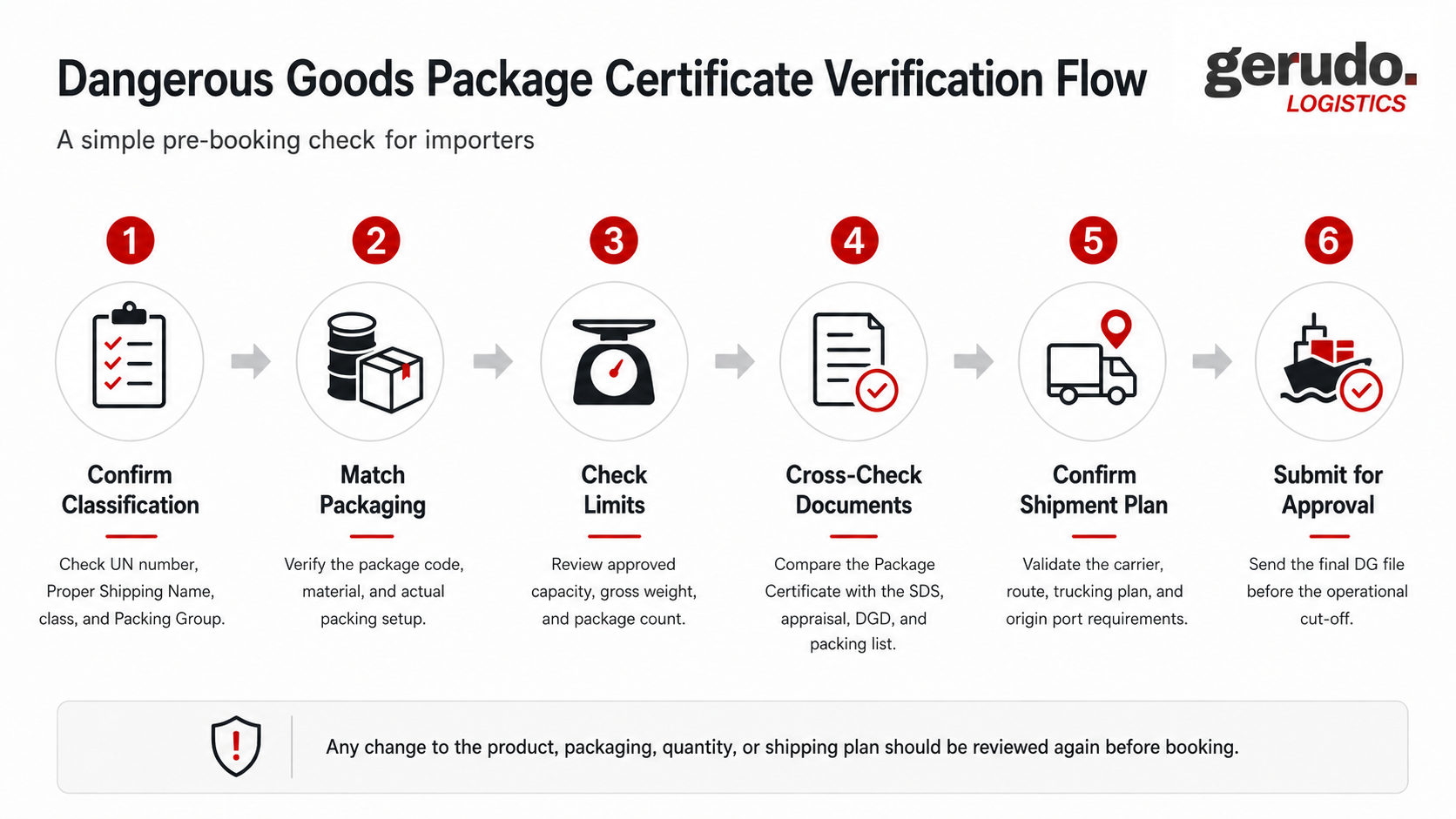
A reliable pre-booking review requires the Package Certificate, current SDS, transport appraisal report, final packing list, and clear packaging photographs. The file should be reviewed again after any material change.
Confirm the Product and Transport Classification
Start with the product identity. The commercial name, technical name, manufacturer, and formulation should refer to the same product across the complete document set.
Check the following classification fields:
UN number and Proper Shipping Name: The regulated entry should remain consistent across the transport documents.
Hazard class and subsidiary risk: A missing secondary hazard can affect packaging, segregation, and carrier acceptance.
Packing Group: A change in Packing Group can change the required packaging performance level.
Physical state and relevant properties: Liquid or solid state, concentration, flash point, and other relevant data should support the transport entry.
Match the Certificate to the Actual Packaging
Compare the physical packaging with the document and final packing specification. The package code, material, capacity, closure, inner packaging, absorbent material, cushioning, and outer package should match the approved arrangement.
For combination packaging, the inner container type, number, and capacity must agree with the outer package configuration.
Clear photographs should show the package, closures, dangerous goods marks, labels, and visible UN packaging mark.
Check the Approved Capacity, Weight and Package Count
The approved limits should be compared with the final packing list and cargo data:
Single-package capacity: Confirm the approved capacity or net quantity for each package.
Gross weight: Keep each packed unit within the applicable maximum gross weight.
Package count: Confirm that the records cover the final number of packages.
Manufacturer and packing location: Verify the entities and locations connected with the appraisal.
Validity and remarks: Check the dates, remaining scope, restrictions, and document-specific conditions.
A current certificate may still fall outside the final quantity, weight, or packaging scope.
Compare the Certificate with the DG Booking Documents
Complete a cross-document check before the carrier receives the booking:
SDS and transport appraisal report: Confirm the transport classification that the packaging needs to support.
Dangerous Goods Declaration: Check the Proper Shipping Name, class, Packing Group, package type, count, and quantity.
Packing list: Use the final package count, net weight, and gross weight.
Packaging photographs: Confirm the physical package, closures, marks, labels, and condition.
Carrier submission: Submit one consistent set of final cargo data.
The document review should be completed within the dangerous goods cut-off requirements. Carrier approval, document submission, VGM, and terminal receiving follow separate deadlines.
Why a Dangerous Goods Package Certificate Does Not Mean the Shipment Is Ready
A Package Certificate covers one part of the packaging compliance process. Carrier review, route assessment, origin port controls, document consistency, and final cargo verification still apply.
The Final Cargo Changed after Review
The final cargo may change after the certificate is issued. A revised formulation, concentration, UN number, Packing Group, package material, inner container, closure, capacity, weight, or package count can affect the approved scope.
These shipment changes should be reviewed before the DGD and carrier submission are finalised. The supplier should not assume that an earlier approval still applies because the trade name remains unchanged.
The Carrier or Route Does Not Accept the Cargo
A carrier restriction may apply even when the packaging records are correct. Acceptance depends on the UN number, class, subsidiary risk, quantity, equipment, vessel, transit port, destination, and carrier policy.
The route review should cover the complete journey. A shipment accepted at the origin port can still face a restriction at a transit port or on a connecting service.
Origin Port Arrangements Are Required
An origin port condition may require a specific terminal, restricted gate-in window, direct loading, limited yard time, advance declaration, or licensed dangerous goods trucking.
The selected port and terminal can affect the final route even after carrier approval. Factors should be checked against the relevant dangerous goods requirements at Chinese origin ports.
Operational Deadlines Are Not Met
A correct certificate can still arrive too late for the planned sailing. Late final packing or document correction can affect carrier approval, truck booking, origin port declaration, and terminal receiving.
How Gerudo Logistics Reviews DG Package Certificates Before Shipping
Gerudo Logistics reviews the Package Certificate as part of the complete dangerous goods booking file. We compare it with the SDS, transport appraisal report, DGD, packing list, and photographs of the actual packaging before carrier submission.
The document review covers the package code, capacity, weight, package count, manufacturer, validity, and declared cargo data. We also assess carrier, route, origin port, terminal, and licensed factory-to-port trucking requirements.
Gerudo Logistics handles dangerous goods in drums, combination packaging, IBCs, ISO tanks, and other approved formats under the applicable IMDG, IATA, ADR, and local requirements. The service can cover document review, factory pickup, multimodal transport, customs clearance, and final delivery.
You can contact us when a supplier's Package Certificate or dangerous goods document set requires review before booking.
Frequently Asked Questions
Is a UN Packaging Mark the Same as a Dangerous Goods Package Certificate?
No. A UN packaging mark identifies a packaging design and performance level. The Package Certificate records provide wider information about the performance inspection and approved use for the packed cargo.
Can a Supplier Reuse a Package Certificate from a Previous Shipment?
It may be possible when the document scope remains valid and covers the same manufacturer, product, packaging, quantity, weight, and packing operation. The complete file should be checked before booking.
Can One Package Certificate Cover Multiple Shipments?
This depends on the approved quantity, validity, remaining scope, and conditions shown in the relevant records. A previous use or unused balance should be verified before a later shipment is booked.
Does Limited Quantity Cargo Need a Package Certificate for a Shipment from China?
Qualifying Limited Quantity cargo may follow adjusted packaging inspection and use appraisal requirements. Eligibility depends on the specific UN entry, Packing Group, package limits, transport mode, marks, and current carrier conditions.
Can a Trading Company Provide the Package Certificate?
A trading company can collect and transmit the records. The documents should still trace back to the relevant dangerous goods manufacturer, packaging, product, and packing operation.
What Happens If the Packaging Changes after DG Approval?
A packaging change should be reported before cargo handover. The revised configuration may require another document review, updated carrier approval, or a different compliance route.
Is the Same Package Certificate Used for Ocean and Air Freight?
The same origin-side packaging records may remain relevant when they cover the product and packaging. Ocean and air freight apply different packing instructions and carrier conditions, so the file should be reviewed again for the selected transport mode.
Conclusion
A Dangerous Goods Package Certificate is an important origin-side packaging record for certain international dangerous goods shipments departing from China. It should cover the product, packaging configuration, approved limits, and packing operation relevant to the planned shipment.
The key shipment data should also remain consistent across the SDS, transport appraisal report, DGD, packing list, and carrier submission. Carrier, route, origin port, terminal, and transport mode acceptance remain separate parts of the shipping review.