How to Ship Chemical Samples from China by Air: The Complete 2026 Guide
Chemical samples can be shipped from China by air when current product information supports the classification, the final package meets the applicable air transport conditions, and the carrier accepts the complete route before cargo release. The shipment will move as non-DG cargo, Excepted Quantity, air Limited Quantity or fully regulated dangerous goods.
Calling a product a sample, for testing or no commercial value does not change its air transport classification. A small bottle of paint, resin, adhesive or cleaner can still be dangerous goods if its composition and properties meet the relevant criteria.
The available air shipping path depends on the actual formulation, concentration, transport classification, quantity in each inner packaging, passenger or cargo aircraft limits, and carrier acceptance for the complete route.
This guide covers commercial chemical samples with known formulations, including liquids, powders, resins, coatings, adhesives and cleaning products.
Air Shipping Options for Chemical Samples from China
Chemical samples normally follow one of four air transport paths. The correct path must be confirmed from the product data and final packaging before the supplier hands the shipment to a carrier.
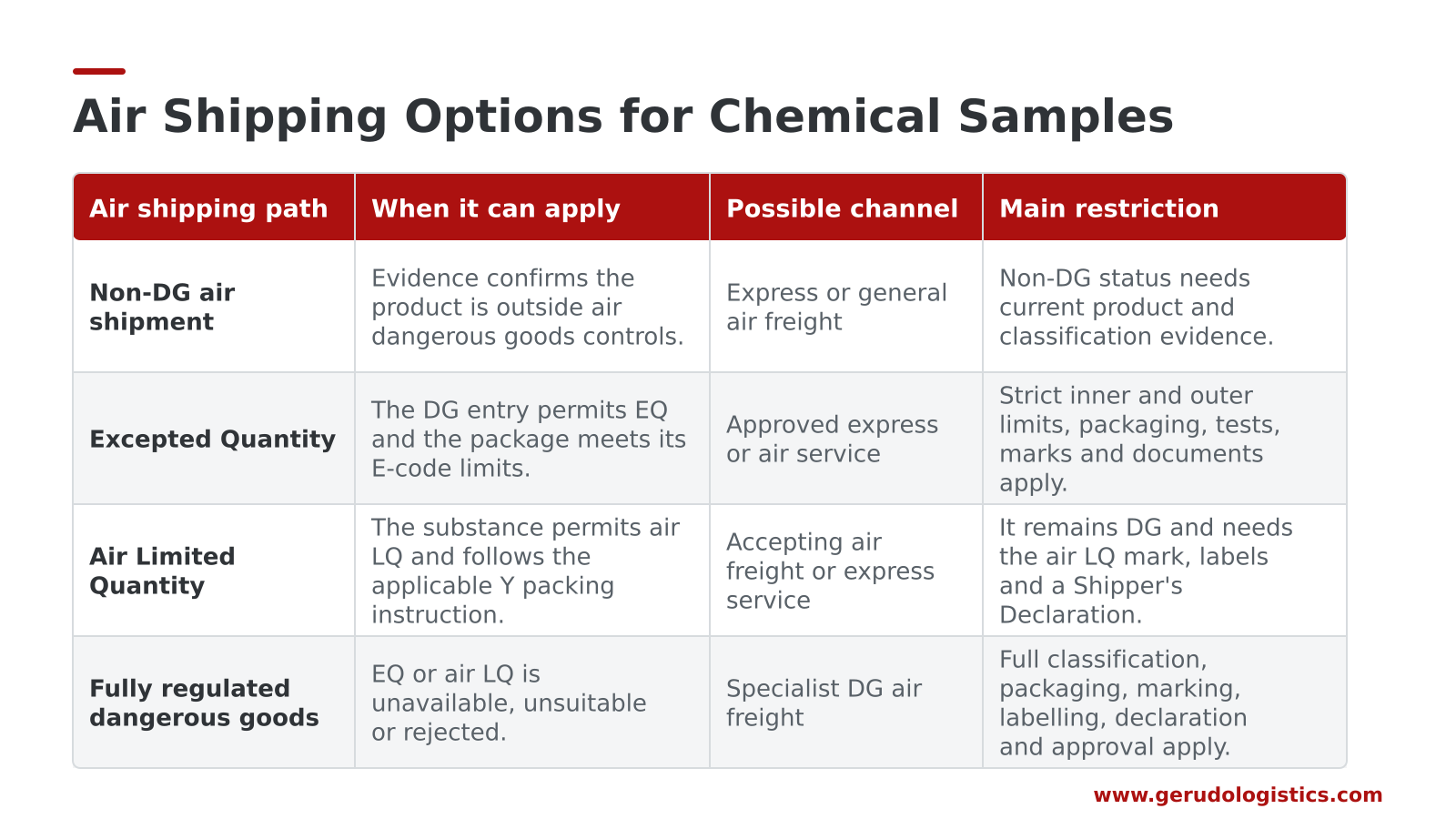
Chemical Samples Shipped as Non-DG
A sample can move as non-dangerous goods only when its actual composition and properties support that status. The supplier's product description or a statement that the cargo is harmless does not provide enough evidence when the SDS or test data indicates a regulated hazard.
Chemical Samples in Excepted Quantities
Excepted Quantity (EQ) can apply to very small amounts of certain dangerous goods. Eligibility depends on the E-code assigned to the transport entry, the quantity in each inner packaging, the total quantity in the outer package and every associated packaging condition.
EQ removes some standard dangerous goods requirements. It still requires the prescribed package construction, tests, mark and Air Waybill statement.
Chemical Samples as Air Limited Quantities
Air Limited Quantity (air LQ) applies only when the dangerous goods entry provides a Y packing instruction and the package meets that instruction. Air LQ limits and documentation differ from the limited quantity provisions used for sea transport.
Air LQ entries use a Y packing instruction, with the same instruction shown on the Shipper's Declaration. The package also carries the air limited quantity mark with a Y in the centre.
Fully Regulated Dangerous Goods Samples
The sample must follow the fully regulated dangerous goods path when no quantity exception applies or the proposed carrier does not accept the exception. The applicable packing instruction determines the package type, quantity limits, marks, hazard labels and declaration details.
A smaller total shipment does not create a valid air option when the substance is forbidden, the inner packaging exceeds the permitted limit, or the complete route has no accepting carrier.
Express vs Air Freight for Chemical Samples
Express and air freight are carrier channels. They do not replace the classification decision. The same sample can qualify for an air transport provision and still fall outside an express company's accepted commodity or route list.
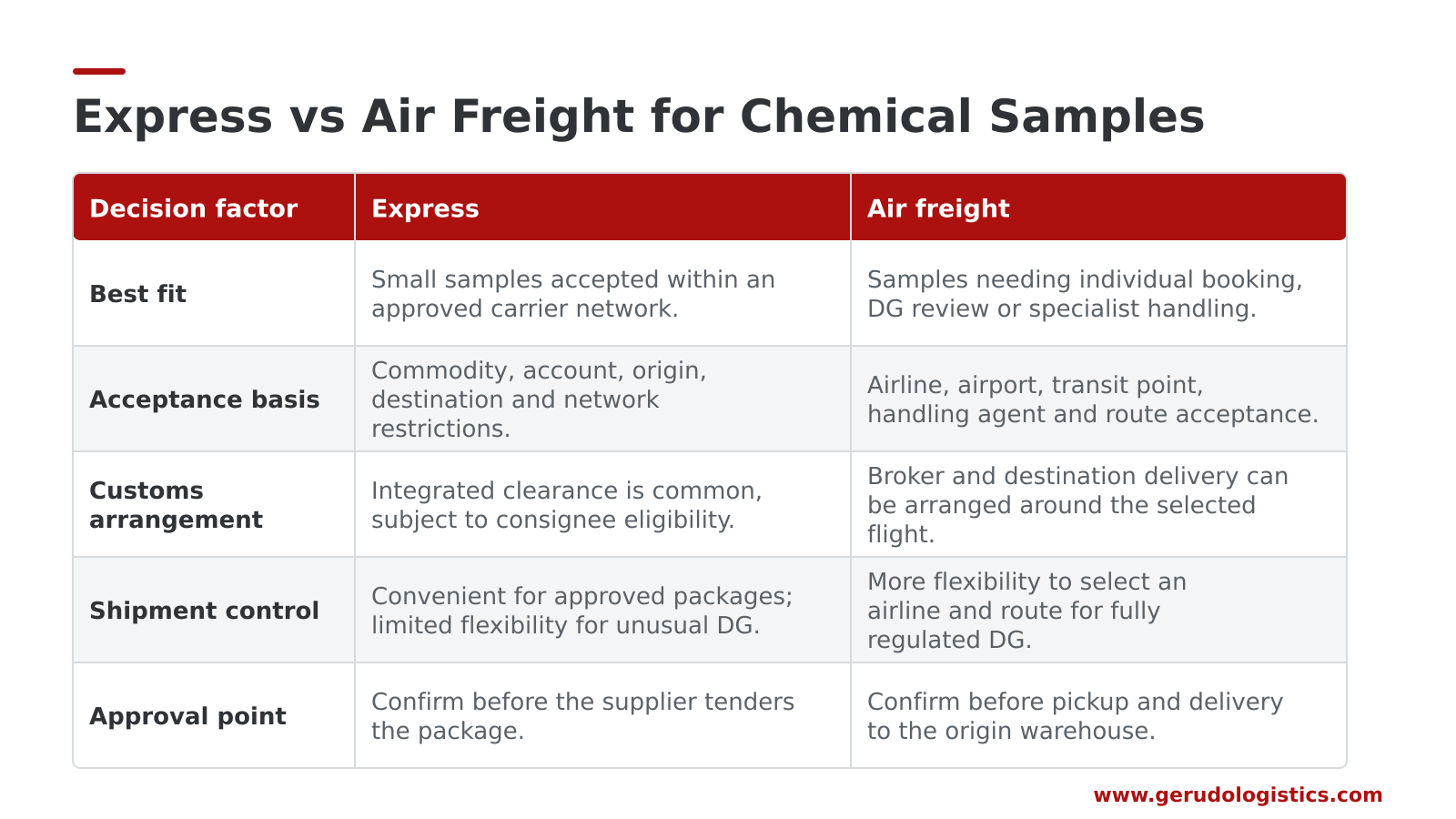
An express shipment usually moves through a fixed network with several flight and handling points. This makes route-wide acceptance important even when the origin station can receive the package.
Freight-forwarded air cargo allows the shipment plan to be built around an airline that accepts the UN entry, packing instruction and destination. It is usually the more realistic channel for fully regulated chemical samples or packages that require separate DG handling.
Carrier rules can be stricter than the underlying dangerous goods regulations. DHL, for example, accepts dangerous goods only under approved account, commodity, origin and destination conditions. Advance notification and approval can also apply.
Carrier Approval for Chemical Samples Shipped from China
Ask the freight forwarder or express carrier to review the proposed shipment before the supplier hands over the package. The review should cover the actual product, planned packaging and full route.
Information Required for Carrier Approval
Provide the following information:
Classification: UN number, Proper Shipping Name, hazard class, subsidiary risk and Packing Group, where applicable. The selected carrier, departure airport or cargo terminal can also request a transport appraisal or classification report.
Inner quantities: Net quantity per bottle, jar, bag or other inner packaging, plus the number of inner packages.
Outer package: Package type, number of packages, dimensions, gross weight and total net quantity.
Packaging evidence: Clear photographs of the inner containers, closures, cushioning, absorbent material, outer package, marks and labels.
Route: Chinese origin city, destination city and postcode, plus any required transit point already identified.
Aircraft condition: Passenger aircraft eligibility or Cargo Aircraft Only status.
Express status: The account and shipper approval required for the proposed dangerous goods service.
Regulatory compliance does not guarantee acceptance by every carrier or routing. Obtain written acceptance for the submitted product, package and full route before authorising the supplier to release the sample.
The final packed cargo must match the accepted information and enter through the approved pickup arrangement or receiving point. Any change to the product, quantity, package, route or handover arrangement requires another review.
Preparation Time Before Cargo Release
The preparation period can include SDS and classification review, packaging adjustments, carrier approval, route confirmation, China pickup and origin warehouse acceptance. These steps take place before the airport-to-airport or door-to-door transit period begins.
Ask the freight forwarder to separate the expected preparation period from the estimated transit time. The supplier should release the sample only after the packaging, documents, carrier and receiving arrangement have been confirmed.
Packaging Requirements for Shipping Chemical Samples by Air
Non-DG samples still need packaging that can withstand ordinary air transport handling. Use compatible, securely closed inner containers, secondary leak containment for liquids, suitable absorbent and cushioning material, and a rigid outer package. Protect powders against accidental release and prevent incompatible samples from contacting each other.
EQ and air LQ packages must follow the applicable inner quantity, outer quantity, closure, pressure, test, mark and label conditions. Review the current air Limited Quantity or Excepted Quantity provisions before choosing either route.
Fully regulated DG packages must follow the packing instruction assigned to the transport entry. The required China-origin packaging records must match the final product, inner packaging, outer package, quantity and closure method.
Read our Dangerous Goods Package Certificate guide that explains how importers can verify that connection.
Documents for Shipping Chemical Samples from China
The exact document set depends on the chosen path, carrier and destination. Prepare the following information for review, then confirm the final list before the supplier releases the package:
MSDS/SDS: The document must cover the actual manufacturer, formulation and concentration presented for shipping.
Classification evidence: A transport appraisal or classification report can be requested by the selected carrier, departure airport or cargo terminal.
Commercial invoice: State the true product name, intended use, quantity and a defensible customs value.
Packing information: Provide the number and type of packages, inner quantities, gross weight and dimensions. Prepare a separate packing list when the selected service or customs process requires one.
Air Waybill details: Use the standard cargo description for non-DG shipments, the prescribed EQ statement for Excepted Quantity packages, or the dangerous goods entry required by the carrier.
Shipper's Declaration for Dangerous Goods: Air LQ shipments use the applicable Y packing instruction on the declaration. Fully regulated DG also requires the declaration, while a compliant EQ shipment normally does not.
Packaging evidence: Provide the records, photographs, marks and labels needed to support the selected non-DG, EQ, air LQ or fully regulated DG path.
Destination documents: Confirm any chemical declaration, permit, registration evidence or consignee authorisation required in the destination country.
The commercial invoice should state the true product name, intended use and a reasonable customs value. No commercial value does not remove the need for an invoice or permit the importer to declare a zero value without an acceptable customs basis.
Product identity must remain consistent across the SDS, transport appraisal, invoice, packing list, Air Waybill and Shipper's Declaration.
Shipping Chemical Samples from China by Air: Step by Step
The classification, packaging, documents and carrier conditions should already be confirmed at this stage. The following steps cover the physical movement of the shipment from the Chinese supplier to the booked air service.
Step 1: Verify the Finished Package
The supplier sends photographs of the finished package and confirms the final package count, gross weight and dimensions. Gerudo Logistics checks these details against the accepted booking before arranging collection.
Step 2: Collect the Shipment in China
Gerudo Logistics arranges pickup from the supplier and directs the shipment to the approved express receiving point or air cargo warehouse. The supplier uses the assigned collection and warehouse references when handing over the cargo.
Step 3: Complete Origin Warehouse Acceptance
The receiving facility weighs and checks the shipment against the booking and supporting documents. Any discrepancy identified at this stage must be resolved before the cargo enters the export process.
Step 4: Complete China Export Formalities
Gerudo Logistics coordinates the export customs declaration and applicable origin handling procedures. The declared product identity, quantity, value and HS code must remain consistent with the commercial documents.
Step 5: Hand Over the Cargo for Departure
Once the required customs and origin acceptance procedures are complete, the shipment enters the approved express network or is handed over for the booked flight. The Air Waybill and departure information are then provided to the consignee or destination broker for import preparation.
Customs Clearance for Chemical Samples
Carrier acceptance covers transport. The importer must separately confirm that the destination country permits the chemical, use and quantity, and that the consignee can complete customs clearance.
Check the following before booking:
Product declaration: Use the actual chemical or product name and testing purpose.
Customs value: Declare a defensible value even when no sale takes place.
HS classification: Confirm the code from the composition and product function.
Importer eligibility: Verify that the consignee can act as importer or appoint the required local party.
Chemical controls: Check registration, notification, licence, restriction and labelling requirements in the destination market.
Conditional exemptions: Confirm whether a research, testing or small-quantity provision applies and what records it requires.
For the United States, an R&D exemption from a new-chemical notice does not automatically remove TSCA import certification. Certification also applies to chemicals received by mail or commercial carrier, including material intended for research and development.
Read our TSCA Import Certification guide to understand the certification process and required information.
Common Reasons Chemical Sample Air Shipments Are Rejected
Unsupported Classification Evidence
The carrier can reject a shipment when the non-DG description lacks supporting evidence or the SDS covers a different manufacturer, formulation or concentration. The classification documents must match the chemical sample being shipped.
Incorrect Air Quantity Provision
EQ or air LQ eligibility becomes invalid when the inner quantity, number of containers or outer package limit exceeds the applicable allowance. Maritime limited quantity rules and smaller bottles alone do not establish compliance with air transport requirements.
Non-Compliant Packaging
The package can fail acceptance when its containers, closures, absorbent material, cushioning, marks or labels do not match the selected transport path. The supplier must complete any required repacking before the carrier reviews the shipment again.
Incomplete Carrier Approval
A standard express account or origin-station approval does not confirm acceptance across the full route. Releasing the sample before the carrier approves the product, package and routing can lead to storage, return, repacking or rerouting charges.
Missing Destination Requirements
The shipment can be stopped when the consignee lacks the required import eligibility, chemical registration basis, permit or customs instructions. The importer should confirm these requirements before the supplier releases the cargo in China.
Chemical Sample Air Shipping Costs from China
The cost of shipping a chemical sample from China depends on its transport classification, final packaging, route and required service scope.
Net weight alone does not determine the price. Minimum freight charges, dangerous goods handling fees and restricted-commodity surcharges can make a small chemical sample more expensive than general cargo of the same weight.
The selected shipping path also affects the cost.
A non-DG sample accepted by an express carrier usually requires less preparation than fully regulated dangerous goods. Excepted Quantity and air Limited Quantity shipments still have specific packaging, marking and documentation requirements. Fully regulated DG shipments generally require specialist preparation, declaration and cargo handling.
The main quotation items normally include:
Shipment preparation: Classification review, compliant packaging and dangerous goods documents where required.
Origin handling in China: Supplier pickup, export customs declaration and delivery to the approved receiving facility.
Air transport: Express or air freight charges, including applicable dangerous goods handling fees.
Destination services: Import customs clearance and final delivery when included in the requested service.
The quotation should identify which services are included. Inspection, storage, repacking, return and rerouting should appear separately as conditional charges. Importers should compare quotations using the same classification, packed dimensions, route and delivery scope; otherwise, a lower price may simply exclude a required service.
How Gerudo Logistics Supports Chemical Sample Shipping from China
Gerudo Logistics is a China-based dangerous goods freight forwarder supporting international chemical sample shipments by air. We help importers determine whether a sample can move as non-DG cargo, Excepted Quantity, air Limited Quantity or fully regulated dangerous goods.
Our service can cover shipment review, carrier approval, pickup in China, export customs formalities and air transport. Destination customs clearance and delivery can also be arranged for confirmed products and routes.
For a shipping review, send Gerudo Logistics the current SDS, product name, quantity, package details, pickup location and destination before the supplier releases the sample.
Frequently Asked Questions for Chemicals Air Shipment
Can I Ship a Chemical Sample Without an SDS?
Do not release the sample without enough current product information to support its air transport classification. In practice, the manufacturer should provide an SDS covering the actual formulation and concentration. The carrier can also request a transport appraisal or classification report.
Do Chemical Samples Need a Shipper's Declaration for Air Shipping?
Non-DG shipments do not need a Shipper's Declaration, and a compliant Excepted Quantity shipment normally does not. Air Limited Quantity and fully regulated dangerous goods shipments require one, completed according to the applicable transport entry and packing instruction.
Do Chemical Samples Need UN-Certified Packaging?
It depends on the air shipping path and assigned packing instruction. Fully regulated dangerous goods commonly require UN specification packaging. Non-DG, Excepted Quantity and air Limited Quantity shipments must meet the packaging conditions that apply to their respective paths.
How Much of a Chemical Sample Can Be Shipped by Air?
There is no single sample-size limit. The permitted amount depends on the UN entry, E-code or Y packing instruction, quantity per inner packaging, outer package limit, aircraft restriction and carrier acceptance.
How Long Does Carrier Approval Take for a Chemical Sample Shipment?
There is no fixed approval period. Timing depends on whether the SDS and classification evidence are complete, whether the final packaging matches the submission, and whether every carrier and handling point on the route accepts the shipment.
Can I Use My Own DHL or FedEx Account to Ship a Chemical Sample?
Only when the account has the required dangerous goods approval and the carrier accepts the product, hazard class, package, origin, destination and full route. A standard express account does not automatically permit dangerous goods shipping.
Can I Consolidate Chemical Samples from Multiple Suppliers in China?
Yes, when each sample has been classified and the consolidation point is approved to receive the relevant cargo. The complete shipment still requires packaging, compatibility, document and route review before release.