Shipping Book Sewing Machines from China: Complete Import Guide (2026)
Compared to shipping dangerous goods, a book sewing machine can feel like a welcome change - no hazmat classification, no special vessel stowage requirements, no DG paperwork stack. That relative simplicity is real.
The machine itself ships as general cargo. But the cleaning solvents packed alongside it may be Class 3 flammable liquids, the crate may fail ISPM-15 inspection, and the destination may lack any equipment to unload a 3-ton machine. Each is a preventable problem.
This guide covers what importers need to plan and execute a book sewing machine shipment from China without avoidable delays at customs or destination.
How to Ship a Book Sewing Machine from China
For the machine itself, there are two practical shipping options: Full Container Load (FCL) sea freight and Less than Container Load (LCL) sea freight. Air freight is reserved for urgent spare parts and critical electronic components - not complete units.
FCL is the right choice for most book sewing machine shipments. Here is why:
Semi-automatic machines weigh 700-1,500 kg. Fully automatic systems can reach 2,300-3,500 kg.
At this weight, sharing a container with unknown cargo creates a real damage risk.
Precision components - needles, cams, cast iron frames - can be permanently damaged by other freight shifting during transit.
LCL works only in limited cases:
The machine is a single lightweight unit under approximately 500 kg.
Budget constraints rule out a full container.
Accept that cargo damage risk is higher and transit times are longer due to consolidation handling.
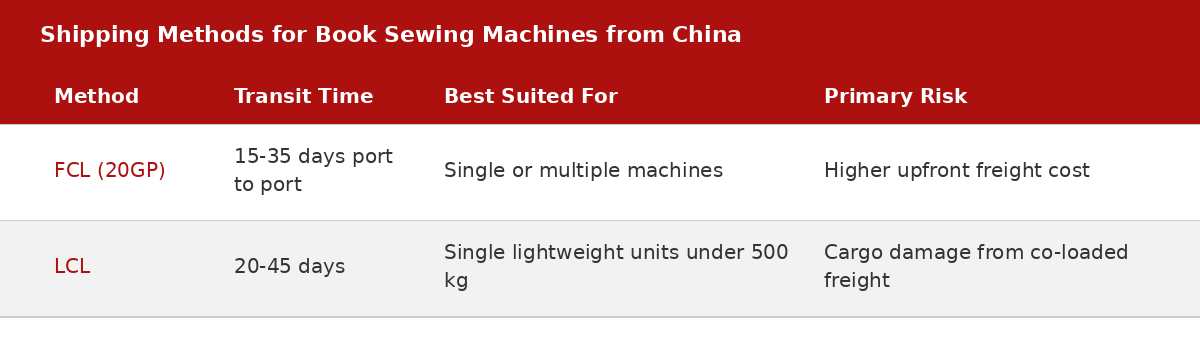
On container size: a 20GP handles most single machine shipments. A 40HQ becomes relevant when shipping multiple units or a full automatic line that includes auxiliary components.
Shipping Costs from China to Your Markets
The rates below are approximate market ranges for 2026. They exclude port handling charges, customs brokerage, inland delivery, and surcharges. For urgent spare parts or electronic components, air freight rates run $3-9 per kg depending on destination.
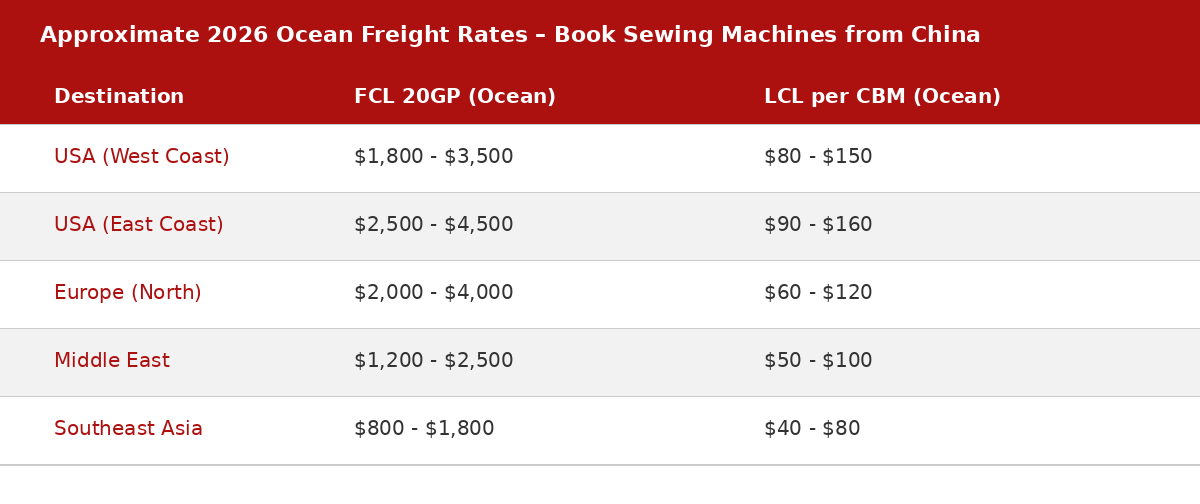
Two cost factors importers often miss:
Heavy weight surcharge (OWS): Fully automatic systems are dense relative to their footprint and frequently trigger carrier weight thresholds. Always request an all-in quote, not just the base ocean rate.
Total landed cost: Budget 25-40% above the FOB equipment price. This covers freight, customs duties, port handling, inland delivery, and insurance. Plan on landed cost, not FOB price, when comparing sourcing options.
How Long Does It Take to Ship a Book Sewing Machine from China
Sea freight port-to-port transit by destination:
USA West Coast (Los Angeles, Long Beach): 12-18 days
USA East Coast (New York, Savannah): 25-35 days
North Europe (Hamburg, Rotterdam, Felixstowe): 25-32 days
Middle East (Dubai, Jeddah): 12-20 days
Southeast Asia (Singapore, Jakarta, Manila): 7-14 days
Add 5-10 days for customs clearance and inland delivery to get a realistic door-to-door estimate:
USA West Coast: 20-30 days door to door
USA East Coast / North Europe: 35-50 days door to door
Middle East: 20-32 days door to door
Southeast Asia: 15-26 days door to door
For urgent spare parts, air freight runs 5-7 days door to door to most major markets.
Documentation gaps are the most common cause of timeline extensions. Missing CE certificates, absent MSDS for consumables, or incorrect HS code declarations can each add 1-3 weeks at destination customs.
Where to Source Book Sewing Machines in China
Online Channels to Buy Your Machine
Online sourcing platforms are the practical starting point for most overseas importers:
Alibaba: Widest supplier pool, largest range of price points and machine types.
Made-in-China.com: Tends to list more established manufacturers with export track records.
Global Sources: Useful for verified suppliers targeting the professional equipment segment.
On all three platforms, prioritize direct manufacturers over trading companies. A manufacturer can offer factory inspection access, production timelines, and model modifications. A trading company typically cannot, and any issue that surfaces after shipment is harder to resolve through an intermediary.
Before placing a full order:
Request a product video or live video walkthrough of the machine running under power. Mechanical condition is difficult to assess from photos alone.
For high-value orders, arrange a third-party pre-shipment inspection in China. Problems found before loading are far easier to resolve than problems found at delivery.
Confirm CE certification is available if the machine is destined for the EU or UK.
Check after-sales support terms, particularly parts availability and response time.
Main manufacturing regions for book sewing machines in China
Wenzhou (Zhejiang): The most significant cluster for post-press and bookbinding equipment. Most Wenzhou suppliers export through Ningbo or Shanghai port.
Shanghai / Yangtze River Delta: Established manufacturers for higher-specification automatic systems, with direct access to Shanghai port.
Guangdong: Semi-automatic and entry-level machines with strong export networks, typically shipping through Shenzhen or Guangzhou port.
Factor in the distance from your supplier's facility to the intended export port when assessing lead times and inland freight costs.
Packaging Requirements for Ocean Transit
Standard pallet or shrink-wrap packaging is not adequate for a book sewing machine on ocean transit. Salt air humidity and mechanical vibration over a 3-5 week passage damage precision components. Needles, micro-hooks, cams, and exposed steel surfaces are all vulnerable to corrosion without proper protection.
Required packaging standards:
Vacuum aluminum-foil wrapping: The machine must be fully enclosed in moisture barrier foil with industrial desiccant packs sealed inside. This is the correct standard for ocean export of precision steel machinery.
ISPM-15 compliant timber crate: The outer crate must use heat-treated or fumigated timber meeting the ISPM-15 international standard for wood packaging. Non-compliant crates are subject to rejection or compulsory treatment at many destination ports. Confirm the crate carries the ISPM-15 mark before the container is sealed.
Internal securing: The machine must be blocked, strapped, and padded inside the crate - timber blocking at the base, steel strapping to internal load points, and rubber or foam padding at all mechanical contact surfaces. A machine that shifts in transit can sustain internal damage that is only discovered when powered on at the destination.
Required Shipping Documents for Book Sewing Machines
Core shipping documents required for all shipments:
Commercial Invoice: Must state the correct HS code (8440.10 for book sewing machines). An incorrect code triggers customs queries and clearance delays.
Packing List: Itemize each component with crate dimensions, gross weight, and net weight.
Bill of Lading (sea) or Airway Bill (air): Issued by the carrier. Primary shipment document and title to cargo.
Certificate of Origin: Required for preferential tariff treatment and trade agreement compliance in certain markets.
Destination-specific requirements:
CE Declaration of Conformity: Mandatory for EU and UK entry under the Machinery Directive (2006/42/EC). Customs in these markets regularly hold machinery shipments that arrive without it. Confirm this document with your Chinese supplier before shipment and verify it covers the specific model being exported.
MSDS (Material Safety Data Sheet): Required for any chemical consumables in the same shipment. See the hidden dangerous goods section below.
Hidden Dangerous Goods in Your Shipment
The book sewing machine itself has no dangerous goods classification. The risk lies in the consumables importers commonly pack in the same container when setting up a new machine.
Common hidden DG items and their classification:
Solvent-based glue pot cleaners: These typically contain flammable organic solvents - Class 3 Dangerous Goods under the IMDG Code. They require a UN number, a Dangerous Goods Note (DGN), and UN-certified packaging. Shipping without proper declaration can result in port holds, shipment rejection, or fines. See Gerudo's guide to Class 3 flammable liquid shipping from China for detail.
PUR hot melt adhesives: Moisture-sensitive. Certain formulations may carry temperature control requirements during transit. Submit the MSDS for review before booking.
UV-curable binding adhesives: Some formulations carry Class 9 (miscellaneous dangerous goods) characteristics. MSDS review is required before booking. See Gerudo's industrial glue and adhesives shipping guide for guidance.
PLC motherboard lithium battery: Most programmable machines carry a small button cell (such as a CR2450) on the PLC board to retain system memory. This falls under UN 3481 (lithium ion batteries contained in equipment). It qualifies for small format exemption - but must be noted on the commercial invoice to avoid delays at X-ray screening at Chinese port terminals.
The practical rule: Declare all consumables to your freight forwarder before booking - regardless of whether you think they are hazardous. A DG-certified forwarder will assess each item, arrange compliant packaging, and handle container segregation where needed.
Common Pitfalls When Importing Book Sewing Machines from China
Destination unloading capacity
A fully automatic book sewing machine crated for export can weigh 3,000-4,000 kg. Many urban print shops do not have loading docks or forklifts rated for this. Confirm unloading capacity at the delivery address before the shipment departs China. If the facility cannot handle the weight:
Arrange a tail-lift truck for the final delivery leg.
Coordinate a local crane service in advance.
Resolving this before loading is far cheaper than improvising on delivery day.
Common customs delay triggers
These three documentation issues account for most avoidable holds:
Missing CE certificate for EU or UK-bound machinery.
Absent MSDS for chemical consumables in the same container.
Incorrect HS code on the commercial invoice.
Each can add 1-3 weeks to the clearance timeline, plus unexpected brokerage and storage costs. In the worst cases, non-compliant consumables result in the entire container being held pending re-documentation or return to origin.
Why Work with a Specialist Freight Forwarder
A general freight forwarder moves a crated machine from port to port. Most cannot do the following:
Identify the Class 3 solvent cleaner packed in the same container before it triggers a compliance event at a Chinese terminal.
Assess whether UV adhesive in your consumables kit requires a DG declaration under IMDG rules.
Review crating specifications and load plans before the container is sealed.
DG identification at intake - before booking, not after arrival at port - is what separates a clean clearance from a shipment that gets held, re-documented, and re-routed at the importer's cost.
For heavy industrial machinery, a specialist forwarder also manages heavy weight surcharge planning, container load assessment, and cargo securing requirements. A corrected load plan before sealing costs a conversation. A damaged machine after delivery costs a claim, a repair cycle, and production downtime.
Gerudo Logistics is a China-based freight forwarder with established capability in dangerous goods, heavy cargo, and complex shipments.
Headquartered in Guangzhou with operations across Shenzhen, Shanghai, Ningbo, Qingdao, and Dalian, Gerudo handles cargo that requires more than standard freight execution - including regulated consumables that accompany industrial equipment.
From cargo classification and packing verification to customs clearance and final delivery, every shipment is executed under IATA, IMDG, and applicable local regulations.
To discuss your book sewing machine shipment from China, contact our team.
Frequently Asked Questions
Can I ship a book sewing machine and cleaning solvents in the same container?
Yes, but it requires a DG segregation assessment and proper documentation for the solvents, including a Dangerous Goods Note and UN-certified packaging. Your freight forwarder should review the full cargo manifest before the booking is confirmed.
What HS code applies to book sewing machines from China?
Book sewing machines classify under HS heading 8440.10 (bookbinding machinery, including book sewing machines). Confirm the correct 10-digit code with your customs broker for the specific destination market, as country-level digit extensions vary.
Does a book sewing machine require CE certification to enter the EU?
Yes. Industrial machinery entering the European Union must carry a CE Declaration of Conformity under the Machinery Directive (2006/42/EC). Request this document from your Chinese supplier before shipment and verify it covers the specific model being exported.
Should I use FCL or LCL for a single machine?
FCL is the practical choice for most machines over approximately 500 kg. Co-loading a heavy precision machine with unknown cargo creates a meaningful risk of physical damage. Once handling, insurance, and transit time are factored in, the cost difference between LCL and a 20GP FCL narrows considerably.
How long does sea freight take from China to the United States?
Port-to-port transit to the US West Coast runs 12-18 days; East Coast ports run 25-35 days. Add 5-10 days for customs clearance and inland delivery, giving door-to-door timelines of 20-30 days (West Coast) and 35-50 days (East Coast).
Does the PLC battery in a book sewing machine require special declaration? The lithium button cell on most PLC motherboards qualifies for exemption as UN 3481 (lithium ion batteries contained in equipment) under small format provisions. It must still be noted on the commercial invoice to prevent inspection delays at Chinese port terminals.
What is a realistic total landed cost above the FOB price?
Budget 25-40% above the FOB equipment price to cover ocean freight, port handling, customs duties, inland delivery, and insurance. Request a full landed cost breakdown from your freight forwarder before committing to a purchase price.
Conclusion
Shipping a book sewing machine from China is straightforward when the preparation is right. FCL in a moisture-protected, properly secured crate handles most shipments without issue. Documentation is manageable when CE certificates and MSDS for consumables are confirmed before departure.
The risk most importers miss is the dangerous goods classification of the consumables packed alongside an otherwise standard machine. A freight forwarder with DG handling capability addresses that before the booking - not at the port, and not after a hold has already been issued.
For a freight assessment on your next book sewing machine shipment from China, contact the Gerudo team.