FCL vs LCL Shipping from China to the USA: How to Choose and What It Really Costs (2026)
Choosing between FCL (Full Container Load) and LCL (Less than Container Load) is one of the most common decisions importers face when shipping from China to the USA. Most people compare the headline freight rate and stop there. That approach leads to the wrong choice more often than not.
The real decision depends on your cargo volume, your cargo type, your delivery deadline, and, if you are moving dangerous goods or temperature-controlled cargo, the carrier restrictions that apply to your shipment.
This guide covers:
How FCL and LCL costs are actually structured
How to calculate the breakeven point for your shipment
Transit time differences and what they mean in practice
Special rules for DG and reefer cargo on the China-USA lane
A five-question checklist to reach a clear decision
The Full Cost Structure of FCL and LCL Shipping
The freight rate quoted on a booking sheet is never the full cost. Both FCL and LCL carry additional charges that importers frequently overlook at the planning stage.
FCL Cost Structure
When you book a full container, you are paying for the exclusive use of that container from the Chinese port to the US port of discharge. The total cost is made up of:
Ocean freight — the base rate per container (20GP, 40GP, or 40HQ)
Origin charges — booking fee, documentation fee, and terminal handling at the Chinese port (typically $150-$300 combined)
Destination charges — terminal handling and delivery order fee at the US port (typically $200-$450)
Bunker Adjustment Factor (BAF) — fuel surcharge, varies by carrier and route
Peak Season Surcharge (PSS) — applied during Q3-Q4 and pre-Chinese New Year periods
FCL pricing is straightforward: you pay a flat rate for the container regardless of how much of it you fill.
Container size options on the China-USA lane:
20GP — 33 CBM usable volume, maximum payload approximately 28,000 kg. Suited to dense, heavy cargo.
40GP — 67 CBM usable volume, same maximum payload. The standard choice for most general cargo.
40HQ (High Cube) — 76 CBM usable volume. Suited to light, bulky cargo where volume is the constraint rather than weight.
One practical point: if your cargo weighs more than 15 tonnes per container, verify that the destination port and inland trucking provider can handle the gross weight. Some US inland routes have axle weight restrictions that affect container weight limits.
LCL Cost Structure
LCL pricing looks cheaper per booking but carries more cost layers. The full cost includes:
Ocean freight — charged per CBM (cubic meter) or per tonne, whichever is higher
Origin CFS fee — Container Freight Station handling at the Chinese port, where your cargo is consolidated with other shipments (typically $8-$15 per CBM)
Destination CFS fee — deconsolidation at the US port, where your cargo is separated from the shared container. This is a fixed fee per shipment, not per CBM. In Los Angeles and New York, this typically runs $150-$250 per shipment regardless of volume
Documentation fee — usually $50-$80 per bill of lading
BAF — applied per CBM
The destination CFS fee is the figure most importers miss. Because it is a flat fee, small shipments absorb it at a much higher cost per CBM than large ones.
How to Calculate the Breakeven Point FCL vs LCL
The breakeven point is the cargo volume at which FCL becomes cheaper than LCL on a total cost basis. Below that volume, LCL is more economical. Above it, FCL wins.
The formula:
Breakeven CBM = Total FCL cost / LCL cost per CBM (all-in)
Example 1: Shanghai to Los Angeles (West Coast)
40GP FCL all-in cost (ocean freight + origin charges + destination charges): approximately $2,500-$3,200
LCL all-in cost per CBM (ocean freight + origin CFS + destination CFS spread across volume): approximately $75-$95 per CBM
Breakeven: $2,800 / $85 = approximately 33 CBM
Example 2: Shenzhen to New York (East Coast)
40GP FCL all-in cost: approximately $3,200-$4,000
LCL all-in cost per CBM: approximately $90-$110 per CBM
Breakeven: $3,600 / $100 = approximately 36 CBM
These figures are market reference ranges for 2026. Confirm current rates with your freight forwarder before making a booking decision.
The practical takeaway: if your cargo is above 15 CBM, it is worth running the FCL calculation. If it is above 30-35 CBM on most China-USA routes, FCL is almost always cheaper on a total cost basis.
FCL and LCL Rates and Transit Times on Major China-USA Routes
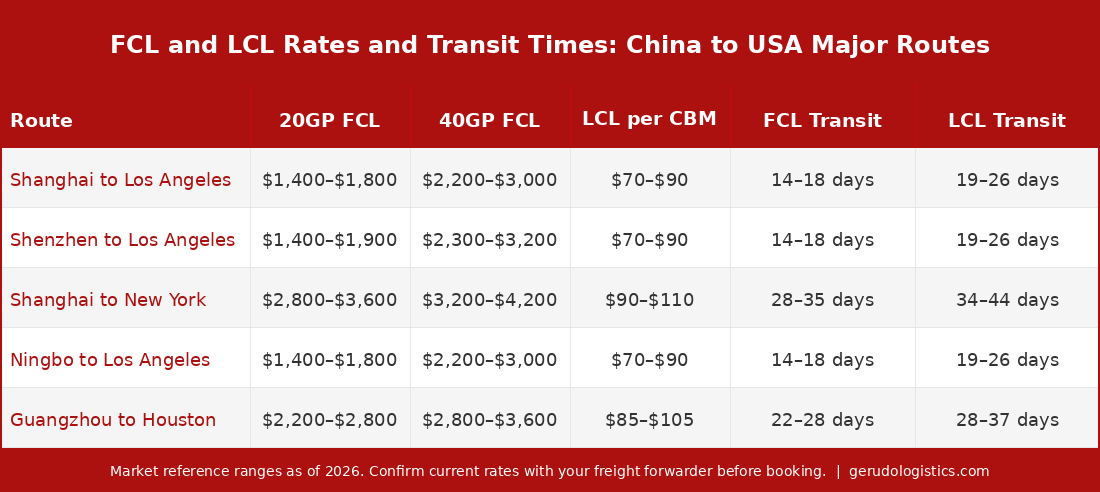
Rates are market reference ranges as of 2026 and subject to change. Confirm current rates with your freight forwarder. LCL transit times include CFS handling at origin and destination.
How Transit Time Differences Affect Your Shipment Planning
The transit time gap between FCL and LCL is wider than it appears on a rate sheet. Here is where the extra days actually come from on LCL:
CFS consolidation wait at origin. Your cargo sits at the CFS facility until enough other cargo accumulates to fill the shared container. This adds 2-5 days before the vessel even departs.
Fixed weekly sailing windows. LCL services on most China-USA routes depart on fixed weekly schedules. If your cargo misses the cut-off, it waits for the next sailing.
Destination CFS deconsolidation. After the container arrives at the US port, it goes to a CFS facility before your cargo is released. This adds 2-5 working days to port-to-door time.
Customs hold risk. A customs examination on any other shipment in the same container can delay the release of your cargo. With FCL, your container moves independently.
Peak season delays. During Q3-Q4, CFS facilities in Los Angeles and New York operate under heavy backlogs. LCL transit times on the West Coast lane have extended to 30+ days total during peak periods.
For time-sensitive shipments, the stated LCL transit time is a minimum, not a guarantee.
Where FCL Has an Advantage on Transit
FCL containers move on a direct port-to-port basis. Once loaded, the container does not stop for consolidation or deconsolidation. Customs examination, if required, applies only to your shipment and does not affect anyone else's cargo.
For importers managing just-in-time inventory or working against a retail deadline, this predictability has real value. A one-week delay in an LCL shipment caused by another shipper's documentation issue is not a theoretical risk. It happens regularly at busy US ports.
Where LCL Has an Advantage on Frequency
LCL offers more departure options. Because you are not waiting to fill a full container, you can ship smaller quantities more frequently. This suits importers who want to maintain tighter inventory cycles rather than holding large stock positions.
On the Shanghai-Los Angeles lane, LCL consolidators typically offer multiple weekly departures. On less-served routes such as Guangzhou to Houston, departure frequency is lower and the consolidation wait at origin may be longer. Confirm departure schedules with your freight forwarder for your specific port pair.
Why DG Cargo on the China-USA Lane Usually Requires FCL
If you are importing dangerous goods, the FCL vs LCL decision is shaped by carrier restrictions as much as by cost.
Limitations of LCL for DG cargo:
Most consolidation carriers on the China-USA lane impose strict limits on DG acceptance. Class 3 (flammable liquids) and Class 8 (corrosives) are frequently refused outright by LCL consolidators.
Carriers that do accept DG in LCL apply a DG surcharge on top of the standard LCL rate, typically adding 30-50% to the per-CBM cost. This shifts the breakeven point significantly lower.
US-side CFS facilities are not universally licensed to handle DG cargo. If your consolidator's preferred CFS cannot accept your shipment class, the booking falls through after you have already committed to the schedule.
DG LCL shipments require a certified DG packing declaration and, in many cases, segregation requirements that further limit the carrier pool.
The practical result:
In our experience, DG importers who request LCL quotes on the China-USA lane frequently find that available carrier options are limited to one or two consolidators, pricing is higher than anticipated, and lead times are longer due to the narrower sailing schedule.
For most DG cargo categories, FCL from 10-12 CBM upward is more cost-effective and operationally reliable than pursuing LCL.
If you are unsure whether your cargo qualifies as dangerous goods, or which DG class applies, confirm with your freight forwarder before requesting quotes. Misclassifying DG as general cargo on a shared container is a compliance violation.
What Reefer Cargo Importers Need to Verify Before Booking LCL
Reefer LCL service exists on the China-USA lane, but it comes with constraints that make it unsuitable for many temperature-controlled shipments.
Key limitations:
Compatible temperature requirements. All cargo in a shared reefer container must require the same temperature setpoint. If your product needs -18°C and another shipper's cargo requires +4°C, they cannot travel together.
Limited CFS cold chain capability. Not all CFS facilities in the USA maintain unbroken cold chain during deconsolidation. This is a critical gap for pharmaceutical cargo, premium frozen seafood, or any product with a narrow temperature tolerance window.
Longer transit risk. Reefer LCL adds the same 5-10 extra days as standard LCL. For cargo with a shelf life constraint, those extra days may exceed acceptable limits.
Higher per-CBM cost. Reefer LCL rates are already elevated above standard LCL. When you add the reefer surcharge, the breakeven against a reefer FCL shifts to a lower volume than on dry cargo lanes.
For high-value cold chain cargo, including pharmaceuticals, premium frozen seafood, and chocolate, the cost of a reefer FCL is almost always justified by the reduction in temperature excursion risk alone.
Five Questions to Reach a Clear Decision
Use these questions to identify the right option for your specific shipment:
1. What is your cargo volume?
Under 5 CBM: LCL is almost always the right choice
5-15 CBM: Run the breakeven calculation using the formula above
15-30 CBM: Compare total FCL and LCL all-in costs carefully
Above 30 CBM: FCL is typically more economical on China-USA routes
2. Is your cargo classified as dangerous goods?
Yes: Assess carrier DG acceptance first, then compare costs. FCL is often the only practical option above 10 CBM.
No: Proceed to cost comparison
3. Does your cargo require temperature control?
Yes: Confirm US-side CFS cold chain capability before booking LCL. For products with tight temperature tolerances, default to reefer FCL.
No: Proceed to cost comparison
4. Do you have a hard delivery deadline?
Yes: Factor the additional 5-10 days of LCL transit into your planning. If the deadline is firm, FCL removes the CFS delay risk.
No: LCL is a viable option if the cost works
5. How frequently do you ship?
Monthly or more: Regular LCL bookings may be more practical than holding inventory for FCL volume
Quarterly or less: Consolidating volume into FCL shipments typically reduces per-unit cost
A Note on Cargo Value
Cargo value affects insurance cost but does not directly change the FCL vs LCL decision. However, high-value shipments traveling LCL carry a higher risk of partial damage during CFS handling, since cargo is loaded and unloaded more frequently than in an FCL container.
For cargo valued above $50,000 per shipment, the reduced handling risk of FCL is worth factoring into the total cost comparison, even if the pure freight numbers favor LCL. Marine cargo insurance covers most damage, but the claims process takes time and disrupts your supply chain.
Import duties are a separate landed cost component — the current China tariff guide covers applicable rates by product category if you are working through a full cost model.
How Gerudo Logistics Handles FCL and LCL from China to the USA
Shipping FCL and LCL on the China-USA lane is straightforward when cargo is standard. It gets more complicated when your shipment involves dangerous goods or temperature-controlled products — and that is where most generic forwarders fall short.
Gerudo Logistics operates FCL and LCL services from Guangzhou, Shenzhen, Shanghai, Ningbo, Qingdao, and Dalian to major US ports including Los Angeles, Long Beach, New York, Savannah, and Houston.
For specialist cargo, we work through the carrier and facility questions before you commit to a booking. That means confirming DG acceptance conditions and applicable surcharges upfront, and verifying cold chain capability at the US-side CFS before recommending LCL for reefer shipments. Discovering a carrier refusal or a CFS limitation after a sailing date is locked in is a problem that proper pre-booking checks prevent.
For a cost comparison on your specific shipment, contact our team.
Frequently Asked Questions
What is the typical breakeven point between LCL and FCL on China-USA routes?
On most China-USA lanes, FCL becomes cheaper than LCL on a total cost basis at approximately 30-35 CBM for a 40GP container. This breakeven shifts lower for DG cargo, where LCL surcharges significantly increase the per-CBM cost.
Why is my LCL quote higher than expected?
LCL quotes often exclude the destination CFS fee, which is a flat charge per shipment of $150-$250 at major US ports. Small shipments absorb this fixed cost at a high per-CBM rate. Ask your freight forwarder for an all-in quote that includes both origin and destination handling.
Can dangerous goods travel in an LCL container?
Some DG classes can travel LCL, but carrier acceptance is limited on the China-USA lane. Class 3 and Class 8 are frequently refused by LCL consolidators. Carriers that do accept DG apply a surcharge that raises the effective per-CBM rate significantly. Confirm DG acceptance before requesting a formal quote.
Why is LCL transit time longer than FCL?
LCL involves consolidation at origin and deconsolidation at destination, each adding 2-5 days to the timeline. Your cargo also waits at the CFS facility for the weekly sailing cut-off. During peak season, CFS backlogs at Los Angeles and New York extend total transit further.
Is a 20GP or 40GP container more cost-effective?
A 40GP typically offers a lower cost per CBM than a 20GP on most China-USA routes. The exception is heavy cargo approaching the weight limit of a 20GP container, where the extra space in a 40GP cannot be used. Confirm the weight-to-volume ratio of your cargo before choosing container size.
Rates referenced in this article reflect 2026 market ranges and are subject to change. Contact your freight forwarder for current quotes before making a booking decision.