Golf Carts From China: Import and Shipping Guide
Golf carts can be shipped from China by sea, but the transport plan depends on the battery, final packing, quantity and destination. A supplier may provide the vehicle price and basic dimensions while the forwarder still lacks the information needed to confirm carrier acceptance, container loading and delivery.
For an importer, the main question is how the exact carts will move from the factory in China to the receiving address. That means confirming whether the vehicles can be accepted for the planned route, choosing an appropriate sea freight arrangement, understanding how packing changes container use, and preparing for customs clearance and unloading at destination.
This guide explains how to ship golf carts from China, covering supplier preparation, battery review, LCL or FCL booking, container loading, destination clearance and final delivery.
At a glance: sea freight is usually the practical option for commercial golf cart orders. Small shipments can sometimes move by LCL, while multi-unit orders are commonly compared against FCL. Lithium-powered carts need a transport review before booking, and the final packed configuration has a direct effect on freight cost and container capacity.
Can Golf Carts Be Shipped From China?
Yes. Golf carts can generally be shipped internationally from China once the vehicle, battery and route have been reviewed and an acceptable transport plan is available.
Lithium-powered models require a battery and vehicle transport assessment before booking. Lead-acid models follow a different assessment, so the supplier still needs to identify the exact battery type and installation condition.
Shipping acceptance does not by itself mean that a golf cart can legally be sold, registered or used at destination. A supplier may market a cart as street legal, while registration eligibility depends on the destination market, intended use and specification of the actual vehicle.
Import Requirements for Golf Carts at Destination
For the USA, requirements depend partly on the vehicle specification. Gasoline-powered golf carts can fall within EPA requirements for nonroad spark-ignition engines. Importers also need to determine whether the vehicle falls within current antidumping and countervailing duty measures covering certain low-speed personal transportation vehicles from China. These measures can apply to certain finished or unfinished and assembled or unassembled vehicles, so partial disassembly does not by itself place the cart outside the scope.
For the EU, a generic supplier “CE certificate” does not by itself prove that a golf cart is approved for road use. The applicable conformity or vehicle type-approval requirements depend on the product configuration and intended use.
What the Forwarder Needs Before Booking
A reliable freight quotation and booking plan needs information about the cargo in its final shipping condition. Catalogue dimensions and a basic supplier quotation are useful at the enquiry stage, while the final transport plan needs more specific data.
Ask the supplier to provide:
Cargo profile: exact model, quantity, final packed dimensions, gross weight and packing configuration.
Battery profile: chemistry, manufacturer, model, voltage, capacity, installation condition and applicable UN38.3 information for lithium batteries.
Shipment profile: factory or pickup location, cargo-ready date, Incoterm, destination port and final delivery location.
Packed dimensions can differ substantially from the vehicle dimensions shown in a product brochure. A cart may travel fully assembled, or the supplier may remove the roof, windshield, wheels or selected accessories before packing.
That difference changes the freight footprint, also can affect the LCL charge or the number of carts that can be loaded into a container. For a multi-unit order, packing photos or a loading drawing also help the forwarder assess the proposed loading arrangement.
Battery information needs to match the actual battery installed in the finished vehicles. If the factory changes the battery model during production, the revised information needs to be reviewed before the transport plan is finalised.
For more detail on the wider vehicle framework, see shipping electric vehicles from China.
How Golf Carts Are Shipped From China
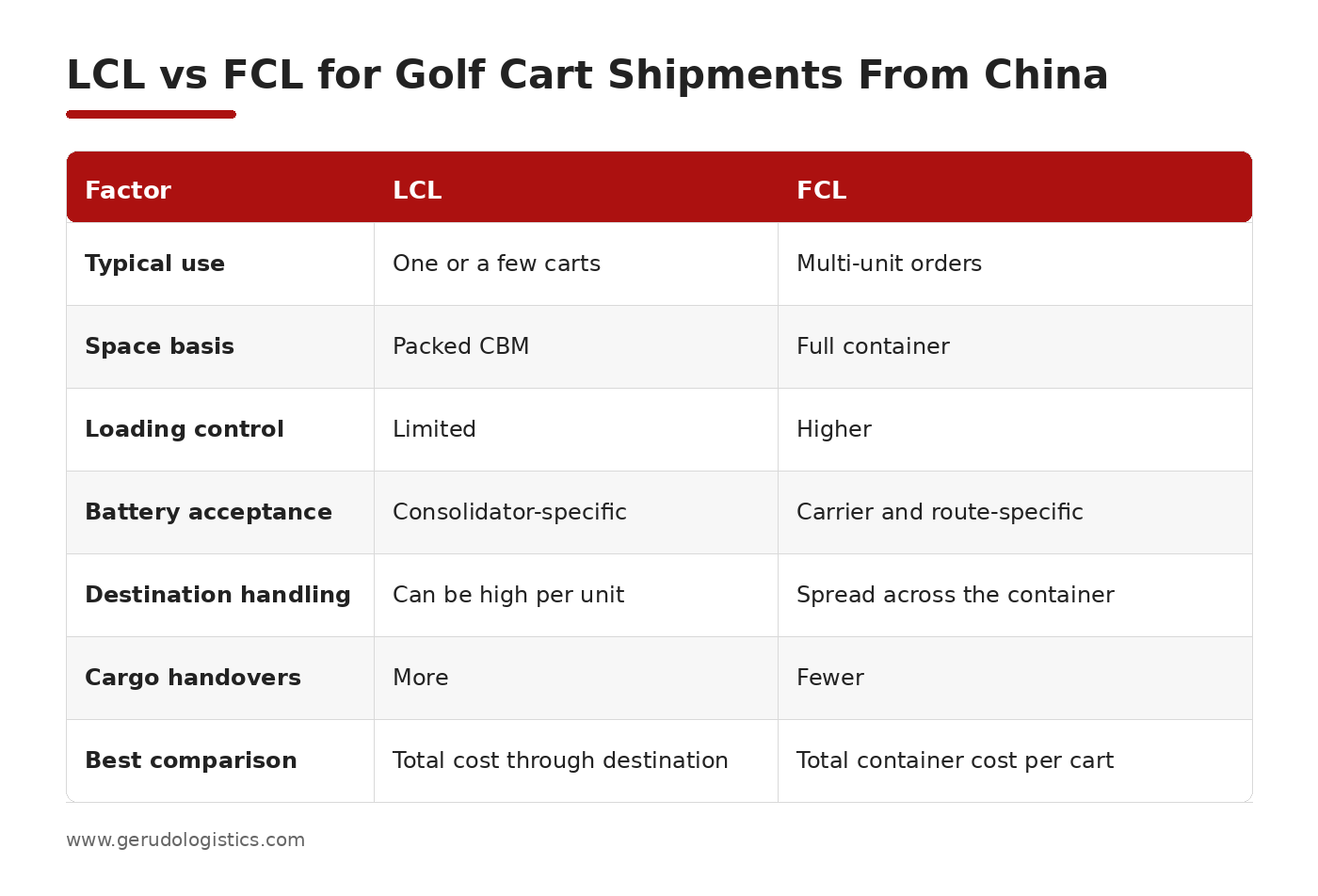
Sea freight is usually the practical option because golf carts occupy significant space and battery-powered models can require additional carrier review. The main choice is between LCL for smaller shipments and FCL for multi-unit orders.
Shipping One or a Few Golf Carts by LCL
A single cart or a small number of carts can sometimes move by LCL sea freight. The forwarder first needs to confirm that the consolidator accepts the vehicle under its applicable battery and transport status.
LCL pricing should be reviewed through destination. The ocean charge based on CBM is only one part of the movement, and consolidation, CFS handling, documentation, deconsolidation and destination charges can materially change the total cost per cart.
Lithium-powered carts can also have fewer LCL options because consolidator acceptance varies by route and cargo treatment. This needs to be confirmed before the supplier releases the cargo.
Shipping Multiple Golf Carts by FCL
For several carts, FCL provides greater control over loading and cargo handling. Common options include 20GP, 40GP and 40HQ, with the final choice determined by the packed configuration and loading plan.
A 40HQ can provide useful additional space for a multi-unit shipment, although there is no universal number of carts per container. A two-seat cart packed with its roof removed creates a very different loading profile from a six-seat lifted model.
Golf carts can also travel fully assembled or partially disassembled. Removing the roof, windshield, wheels or selected accessories can improve container utilisation, although it increases preparation and assembly work at destination.
The better option depends on the total logistics result. A compact packing plan can reduce freight while creating additional receiving costs if the buyer needs extra labour, tools or equipment after arrival.
How Battery Type Changes the Booking Process
This section focuses on electric golf carts. Gasoline-powered carts follow a different transport review because the fuel system, rather than a traction battery, becomes one of the main booking considerations.
For electric golf carts from China, battery chemistry can change carrier acceptance, documentation, route availability and cargo handover timing. This is why the battery review belongs before the booking rather than after the carts reach the port area.
Lithium Golf Carts
Under the current IMDG framework, an applicable lithium-ion battery-powered vehicle is assigned UN3556, Vehicle, lithium ion battery powered, Class 9. IMDG Code Amendment 42-24 became mandatory on 1 January 2026.
Some lithium-ion battery-powered vehicles can qualify for an exception under the applicable IMDG vehicle provisions when the specified conditions are met. The forwarder therefore needs to determine the treatment for the actual vehicle before submitting the booking.
Where the cart moves as regulated Class 9 cargo, the carrier's dangerous goods process applies. The selected shipping line and route can also have their own acceptance instructions, cut-off requirements and documentation checks.
The installed lithium battery needs to meet the applicable UN38.3 testing requirements, and the corresponding test information needs to identify the battery design being shipped. Battery voltage or capacity alone cannot establish the transport treatment.
For deeper technical background, seeshipping battery products from China and the2026 IMDG lithium battery guide.
Lead-Acid Golf Carts
Lead-acid carts follow a different transport assessment. The forwarder needs the exact battery type and installation condition before confirming how the vehicle can be accepted and booked.
If a supplier offers lithium and lead-acid versions of the same cart, the physical dimensions may remain similar while the booking conditions differ. Each battery configuration should therefore be quoted on its own transport status.
Gasoline-powered golf carts need a separate vehicle review. For sea freight, a flammable-liquid-powered vehicle can fall under UN3166, Class 9, unless the conditions for an applicable IMDG exception are met. The fuel-system condition and the carrier's own vehicle acceptance requirements therefore need to be confirmed before booking. For USA imports, the importer should also check the applicable EPA requirements for the installed nonroad spark-ignition engine.
How Container Loading Affects Golf Cart Freight Cost
Container loading is one of the areas where a supplier's headline shipping claim can differ from the actual freight result. Container capacity depends on the loading arrangement, rather than nominal cubic volume alone.
A supplier may state that a certain number of carts fits into one 40HQ. That figure is useful only when it refers to the same model and packing method being purchased.
Before relying on a loading quantity, confirm:
Final packed dimensions and loading orientation for each cart.
Rack or frame use if the supplier plans to use vertical space.
Securing method and door clearance for the proposed arrangement.
Destination unloading requirements, including forklift access or additional labour where needed.
A simple CBM calculation provides a useful starting point. If one packed cart measures 2.95 m × 1.35 m × 1.20 m, the packed volume is:
2.95 × 1.35 × 1.20 = 4.779 CBM
Ten identical packed units give:
4.779 × 10 = 47.79 CBM
The 47.79 CBM figure is a freight-planning input. Vehicle shape, usable floor space, rack design, securing and the container door opening still affect the actual loading result.
Partially disassembled carts and rack systems can improve container utilisation, but the receiving side needs to be considered at the same time. A tighter loading plan can require a forklift, additional labour or more assembly after delivery.
For a multi-unit shipment, a loading drawing or photographs from a previous shipment of the same model provide stronger evidence than a generic container-capacity claim.
From the China Factory to Final Delivery
Once the vehicle, battery and packing information are confirmed, the shipment moves through a clear logistics chain. The importer does not need to manage each operational task, but understanding the sequence helps ensure the next stage is prepared before the cargo moves.
Pre-booking review: The forwarder confirms the transport plan, route and any required carrier acceptance.
Booking and pickup: For FCL, the container can be positioned for loading at the factory or another suitable location. For LCL, the carts move to the nominated consolidation facility.
China-side handling and customs processing: The commercial invoice, packing list, booking information and any applicable dangerous goods documentation need to match the actual shipment.
Ocean freight and destination clearance preparation: The shipment moves while the destination customs representative prepares the import entry using the commercial and product information.
Final delivery and unloading: The receiving site needs suitable access and any equipment required for the chosen packing configuration.
At destination, customs clearance deals with the HS classification, customs value, duties, taxes and any additional import measures. Transport classification and customs classification serve different purposes, so UN3556 does not determine the vehicle's HS code.
The receiver should inspect the carts and separated components when the shipment is opened. Packing records and arrival photographs can help document visible transit damage or missing components.
Golf Cart Shipping Cost From China
There is no fixed cost for shipping golf carts from China because the shipment profile changes between orders. The quote depends on the packed volume, quantity, battery treatment, pickup location, route, LCL or FCL choice and destination services.
A complete cost review can include:
China-side logistics: pickup, packing, loading and origin handling.
International freight: LCL or FCL ocean freight and any applicable regulated cargo charges.
Destination logistics: terminal or CFS charges, customs clearance and final delivery.
Import costs: duties, taxes and any additional trade measures that apply to the destination and vehicle.
A useful commercial calculation is:
Total product and logistics cost ÷ number of carts = estimated landed cost per cart
Incoterms need to be compared on the same basis. An EXW quotation leaves more China-side logistics with the buyer, while FOB, DAP and DDP allocate different portions of the movement between the parties.
For USA-bound carts, applicable trade-remedy duties can become a major part of the landed cost. Their treatment needs to be checked separately from normal customs duty and freight.
A shipment is generally ready for detailed booking once the battery status, final packing, carrier acceptance, destination clearance arrangement and delivery plan are sufficiently clear. Missing information means the transport plan remains provisional until the relevant point is confirmed.
Why Choose Gerudo Logistics for Golf Cart Shipping From China
Gerudo Logistics specialises in dangerous goods and battery-powered cargo shipping from China, giving importers a practical advantage when moving lithium or other regulated golf carts. Our experience covers standard vehicle shipments and cargo that requires additional carrier or regulatory review.
With operations across Guangzhou, Shenzhen, Shanghai, Ningbo, Qingdao and Dalian, Gerudo Logistics can coordinate sea freight and door-to-door delivery from major China manufacturing regions to global markets. Importers cancontact us for a shipping plan based on the vehicle type, quantity and destination.
Frequently Asked Questions for Golf Cart Shipment
Can One Golf Cart Be Shipped From China?
Yes. A single golf cart can sometimes move by LCL when the consolidator accepts the vehicle and battery status. The complete destination charges should be included when comparing the total cost.
Are Lithium Golf Carts Dangerous Goods for Sea Freight?
Lithium-ion battery-powered golf carts can fall under UN3556, Class 9, under the current IMDG framework. Applicable vehicle provisions can change the final transport treatment, so the exact cart and battery need to be reviewed before booking.
Can Golf Carts Be Shipped by LCL?
Yes, selected golf cart shipments can move by LCL. Availability depends on battery status, consolidator policy, route and destination handling conditions.
How Many Golf Carts Fit in a 40HQ Container?
There is no universal number. The actual quantity depends on the model, final packed dimensions, loading orientation, degree of disassembly and any rack system used by the supplier.
Is It Better to Ship Golf Carts Fully Assembled?
Fully assembled carts reduce assembly work after delivery but usually use more container space. Partial disassembly can improve container utilisation when the receiving side is prepared for reassembly.
Does a Lithium Golf Cart Need UN38.3 Information?
The installed lithium battery needs to meet the applicable UN38.3 testing requirements. The supplier should provide information that corresponds to the battery design installed in the cart.
What Documents Are Needed to Ship Golf Carts From China?
The commercial shipment normally requires an invoice and packing list, together with the transport document for the sea movement. Battery-powered carts can also require battery information and dangerous goods documentation according to the applicable transport treatment.
What HS Code Is Used for Golf Carts?
Conventional golf carts are commonly classified under HS 8703.10, which covers golf carts and similar vehicles. In the USA, the HTSUS specifically lists golf carts under 8703.10.50.30. The final classification still needs to be confirmed against the actual vehicle specification and destination tariff schedule, particularly for modified low-speed vehicles or products subject to additional trade measures.
Can a Chinese Street-Legal Golf Cart Be Registered Locally?
Registration depends on the destination market and exact vehicle specification. A supplier's street-legal description does not establish eligibility in every country.
What Should USA Importers Check Before Shipping Golf Carts From China?
USA importers should check whether the vehicle falls within the current low-speed personal transportation vehicle AD/CVD scope before finalising landed cost. The scope can cover certain golf carts in assembled or unassembled form, so the exact product and entry treatment need review.
How Much Does It Cost to Ship Golf Carts From China?
The cost depends on packed volume, quantity, battery treatment, route, LCL or FCL selection and destination services. A useful quotation should cover the movement through final delivery rather than ocean freight alone.