How to Ship Crop Protection Drones from China
For importers, a crop protection drone shipment is often mixed cargo. A new drone body with an empty spraying tank is normally handled as general cargo. Lithium battery packs, wireless control devices, and chemical residue require separate review before booking.
This guide explains how to ship agricultural sprayer drones from China by sea freight, air freight, or express service. It focuses on cargo classification, battery documentation, packing information, customs classification, US tariff exposure, and import requirements in the United States, Europe, Brazil, and Indonesia.
Is Your Crop Protection Drone Dangerous Goods?
A crop protection drone is not automatically DG goods. The transport status depends on the cargo inside the order, including the drone body, spraying tank, battery packs, charger, remote controller, RTK (Real-Time Kinematic) module, and accessories.
The FAA (Federal Aviation Administration) notes that drones may contain items classified as dangerous goods, including lithium batteries, fuel cells, and certain parachute system components. For agricultural spraying drones, lithium battery packs are usually the main DG concern.
Drone body and empty spraying tank
A new drone body with an empty spraying tank is normally handled as general cargo. This covers the frame, arms, motors, pumps, nozzles, landing gear, radar, flow meter, and dry spraying components.
The cargo description needs to match the real product. “Agricultural sprayer drone with empty spraying tank” is more accurate than “drone parts” or “electronic equipment” The description identifies the unit as a working agricultural UAV (Unmanned Aerial Vehicle), rather than a toy drone or a generic electronic device.
Lithium batteries in the shipment
Most agricultural sprayer drones use lithium-ion or lithium polymer battery packs. These battery packs are reviewed under dangerous goods rules, even when the drone body itself is treated as general cargo.
IATA guidance states that lithium cells and batteries must be tested according to the UN Manual of Tests and Criteria, Part III, Subsection 38.3. The same guidance covers lithium battery transport classification and packing logic for air cargo.
Battery configuration affects the transport plan. A battery shipped alone, packed with a drone, or installed in a drone may follow different packing and declaration rules. The booking review needs the exact battery model, Wh (Watt-hour) rating, quantity, and packing method.
For battery-specific 2026 rules, see lithium battery shipping from China under the 2026 IMDG Code.
Used drones and spraying tank residue
A spraying tank creates additional risk when the unit is used, tested with liquid, or returned after field operation. Residue from pesticide, liquid fertilizer, disinfectant, or other chemicals may affect cargo description, carrier acceptance, cleaning proof, and destination inspection.
For normal commercial imports, the cleaner shipment profile is a new drone with an empty, dry, unused tank. Used equipment needs separate cargo review before it is treated as ordinary machinery.
Shipping Methods for Agricultural Sprayer Drones
Complete crop protection drone sprayer drone kits usually move by sea freight when the order includes multiple battery packs, chargers, and spraying accessories. Air freight is reserved for urgent parts or limited battery shipments. Express service is mainly suitable for small accessories and selected low-risk shipments.
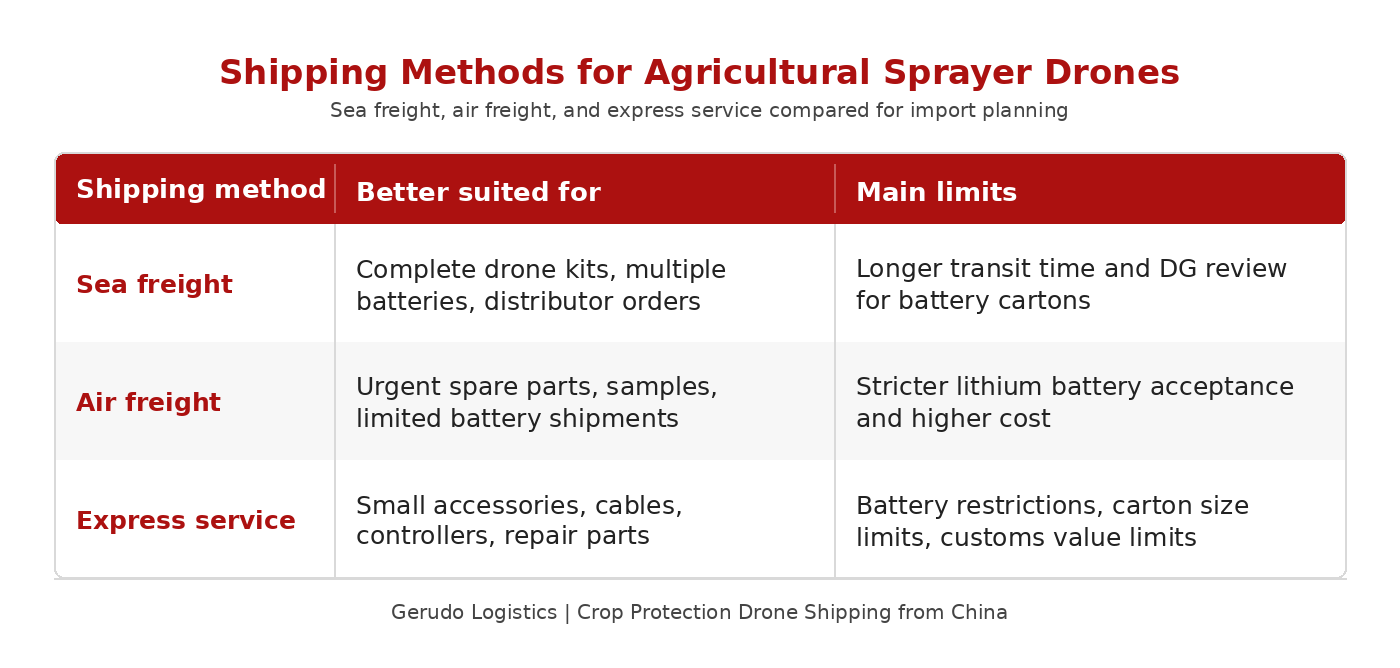
Sea freight for complete drone kits
Sea freight is usually the preferred mode for complete agricultural drone kits. A full order may include the drone body, smart batteries, charger, remote controller, RTK module, propellers, spraying parts, and repair accessories.
Sea freight gives more room for bulky cartons and multiple battery packs. It also provides a better structure for mixed cargo review when the shipment contains general cargo items and DG battery cartons in the same order.
LCL (Less than Container Load) can work for smaller orders when the battery documents are complete.
FCL (Full Container Load) is more suitable for multiple units, distributor orders, and shipments with a larger number of battery cartons.
Air freight for urgent parts
Air freight is used for urgent spare parts, small sample orders, and limited battery shipments. It is more sensitive to lithium battery limits than sea freight.
IATA notes that air transport requirements for lithium batteries depend on configuration and Watt-hour rating for rechargeable batteries. Agricultural drone batteries therefore require review before the cargo is packed.
Air freight is normally more suitable for motors, pumps, radar units, RTK parts, controllers, chargers, nozzles, and other urgent components. Complete drone kits with several high-capacity battery packs need a stricter acceptance review.
Express limits for drone batteries
Express service is convenient for small accessories, but full agricultural drone kits often face size, battery, value, and customs entry limits. Oversized cartons and spare LiPo (Lithium Polymer) battery packs can make express service unsuitable.
Express may be used for propellers, small repair parts, cables, and controllers without battery restrictions. Once lithium battery packs are included, express acceptance depends on battery type, quantity, packing method, and destination rules.
Essential Documents for Shipping Crop Protection Drones
Crop protection drone documents need to identify the machine, battery packs, charging equipment, and radio-control devices separately. A normal invoice and packing list are not enough when the shipment includes high-capacity lithium batteries, RTK modules, remote controllers, and chargers.
Commercial and customs documents
Commercial invoice: records the buyer, seller, product name, quantity, unit value, total value, trade terms, and currency used for customs declaration.
Packing list: confirms carton count, gross weight, net weight, packed dimensions, and the contents of each package.
Product specification sheet: identifies the drone model, tank capacity, maximum takeoff weight, battery type, charger type, and main technical parameters.
Product photos: show the drone body, battery labels, charger, remote controller, RTK module, accessories, and outer cartons before pickup.
Customs description: states the actual product use, such as agricultural sprayer drone or crop protection drone with empty spraying tank.
Lithium battery documents
UN38.3 test summary: confirms that the lithium battery model has passed the required transport safety tests.
MSDS or SDS: explains the Material Safety Data Sheet or Safety Data Sheet for battery chemistry, hazard information, handling conditions, and emergency response details.
Battery specification sheet: confirms voltage, capacity, Wh rating, battery chemistry, model number, and manufacturer information.
Battery label photos: show whether the battery rating, model number, and warning marks are visible and consistent with the documents.
Battery packing information: confirms whether batteries are shipped alone, packed with the drone, or installed in the drone.
For DG goods document checklist, refer to documentation for dangerous goods shipping.
Product compliance documents
User manual: explains the product function, control method, charging method, and agricultural spraying use.
CE marking documents: support EU market access review for drones, chargers, controllers, and other electronic components.
FCC documents: support US review for radio frequency devices, including remote controllers and wireless transmission modules.
Radio equipment records: support destination review for remote controllers, RTK modules, telemetry devices, and wireless transmission units.
Charger and adapter certificates: support electrical safety and market access review for charging equipment and power adapters.
Packaging and Freight Cost for Crop Protection Drone Shipping
An agricultural sprayer drone is foldable, but the final packed volume is often much larger than the product photo suggests. Freight cost depends on the packed dimensions of the drone carton, the number of battery cartons, and whether chargers and spare spraying parts are packed together.
Packed volume and chargeable weight
A foldable agricultural drone may look compact in product photos. The final shipping volume can still be high after protective foam, reinforced cartons, or wooden cases are added.
For sea freight, the key pricing factor is usually CBM (Cubic Metre). For air freight and express service, chargeable weight may be higher than actual weight when cartons are large.
Battery packing and accessory count
Battery packs can change carton count, DG review, and carrier acceptance. Chargers, power adapters, spare propellers, spraying parts, and repair items also affect final size and weight.
A freight quote based only on the drone body may become inaccurate once spare batteries and accessories are added. The packing list needs to show the complete order, including all battery cartons and spare parts.
HS Code and Customs Clearance for Crop Protection Drones
For a complete agricultural sprayer drone, the main customs classification reference is HS (Harmonized System) heading 8806 for unmanned aircraft. The key factor is usually MTOW (Maximum Take-off Weight), together with whether the drone is imported as a complete unit or only as parts.
HS code for the drone unit
For mini and medium crop protection drones, common US references include:
HTSUS 8806.23.00.00: unmanned aircraft with MTOW more than 7 kg but not more than 25 kg.
HTSUS 8806.24.00.00: unmanned aircraft with MTOW more than 25 kg but not more than 150 kg.
Base duty rate: generally Free for complete unmanned aircraft under these headings.
China additional duty note: US tariff listings for heading 8806 may include Chapter 99 references, especially 9903.88.01 for covered China-origin goods.
The United States International Trade Commission publishes HTSUS (Harmonized Tariff Schedule of the United States) classification references for heading 8806, while the US China tariff reference list identifies additional Section 301 duties on products of China.
A clear customs description identifies the real product. Use a phrase such as “agricultural sprayer drone with empty tank and lithium battery packs” instead of a loose description that hides the function of the goods.
US Tariffs on Crop Protection Drones from China
For China-origin crop protection drones imported into the United States, the special issue is not the base tariff under the drone heading. The base duty can be Free, while China-origin additional duties may still apply through Chapter 99 tariff reporting.
As of July 9, 2026, the tariff planning picture is:
Main drone tariff code: HTSUS 8806.23.00.00 or 8806.24.00.00 for many complete agricultural sprayer drones, depending on MTOW.
Base duty: generally Free for the complete unmanned aircraft unit under heading 8806.
Section 301 duty: usually 25% ad valorem for covered China-origin goods under Chapter 99 heading 9903.88.01. The USTR (Office of the United States Trade Representative) maintains the China Section 301 tariff action materials.
Temporary Section 122 duty: CBP (U.S. Customs and Border Protection) issued guidance for a temporary 10% duty under HTSUS 9903.03.01 from February 24, 2026 through July 24, 2026, unless an exemption applies.
Current planning rate: usually 25% on top of the Free base duty from Section 301. During the temporary Section 122 period, the total may reach 35% if the 10% surcharge applies and no exemption is available.
The practical conclusion is direct: a China-origin crop protection drone under HTSUS 8806 usually has a Free base duty, but the importer should plan for at least a 25% Section 301 additional duty. Entries before July 24, 2026 may face a higher 35% planning rate when the temporary Section 122 surcharge applies.
Separate declaration for accessories
Drone accessories may need separate declaration lines when they are packed separately or listed separately on the invoice. This includes lithium batteries, chargers, remote controllers, RTK modules, spray parts, and repair parts.
Separate declaration does not mean every accessory follows a different HS code in every shipment. The invoice and packing list need to show what is included, as batteries, chargers, radio equipment, and spare parts may receive different customs, tax, or certification treatment from the complete drone unit.
Import Requirements for Crop Protection Drones by Markets
United States
FCC equipment authorization: The FCC (Federal Communications Commission) regulates radio frequency devices before they are marketed, imported, or used in the United States. Crop protection drone shipments with remote controllers, telemetry units, RTK (Real-Time Kinematic) modules, or wireless transmission devices need FCC review.
For US-specific drone import planning, see how to import drones from China to the USA.
Europe
CE marking for market access: Crop protection drones, chargers, controllers, and electronic accessories may need CE marking documents before being placed on the EU (European Union) market.
RED radio equipment rules: Remote controllers, RTK modules, telemetry units, and wireless transmission devices may fall under RED (Radio Equipment Directive) 2014/53/EU.
Brazil
ANATEL certification: ANATEL (Brazilian National Telecommunications Agency) certification may apply to drone radio equipment, remote controllers, telemetry devices, and wireless transmission devices.
Brazil drone certification procedure: Imported drones may fall under Brazil’s drone certification procedure, with different review levels depending on device complexity and risk category.
Indonesia
Telecom equipment certification: Remote controllers, RTK modules, telemetry devices, and wireless links may require Indonesia telecom equipment certification.
Radio device type approval: Drone control and communication devices may need local radio device type approval before sale or use in Indonesia.
Why You Need a Professional Freight Forwarder for Crop Protection Drones
A crop protection drone shipment often combines general cargo, lithium battery packs, chargers, wireless control devices, and spare accessories in one order.
At Gerudo Logistics, we help importers reviews the cargo composition before booking and separates the shipment into general cargo items, dangerous goods items, and destination compliance-sensitive items. This review determines whether the shipment should move by sea freight, air freight, express service, or a mixed arrangement with separate battery handling.
For agricultural sprayer drones, our team verifies the battery documents, carton data, cargo description, and transport mode before pickup is arranged, reducing the risk of carrier rejection, customs questions, or delays caused by incomplete DG information.
If you are planning to ship crop protection drones or other battery-included equipment from China, contact us to have a review first!
FAQ About Shipping Crop Protection Drones from China
Are crop protection drones dangerous goods?
The drone body is usually general cargo when the spraying tank is new, empty, and clean. Lithium battery packs are normally the dangerous goods part of the shipment.
Can agricultural drones be shipped by air?
Yes, air freight can be arranged for certain agricultural drone shipments. Acceptance depends on battery type, Wh rating, quantity, packing method, and airline rules.
Can I ship the drone without batteries?
Yes. A drone without batteries is often easier to review as general cargo, while customs classification and destination compliance still apply.
What battery documents are needed?
The usual battery documents include UN38.3, MSDS or SDS, battery specification sheet, Wh rating, label photos, carton photos, and packing information.
Do spraying drones need telecom certification?
Often, yes. Remote controllers, RTK modules, telemetry units, Wi-Fi links, and other radio devices may require destination telecom approval.
Can pesticide be shipped with the drone?
Pesticide needs to be reviewed as a separate chemical product. If pesticide is packed with the drone, the shipment may require chemical classification, DG documents, and destination pesticide registration checks.