China Freight Forwarder vs Local Freight Forwarder: How to Choose?
In a recent enquiry, a prospective client had chosen a familiar freight forwarder in the destination country. The booking was still arranged through a China shipping agent, so every supplier question passed through several contacts and time zones. The importer also struggled to identify which China-side charges were included in the quotation.
The real question was not whether the importer chose a China freight forwarder or a local freight forwarder. It was how many handovers stood between the importer and the people handling the cargo in China. The comparison below shows how to find that answer before booking.
China Freight Forwarder vs Local Freight Forwarder at a Glance
The provider's address reveals little about who performs the work. This table separates direct control from agent coordination at each stage of a shipment from China.
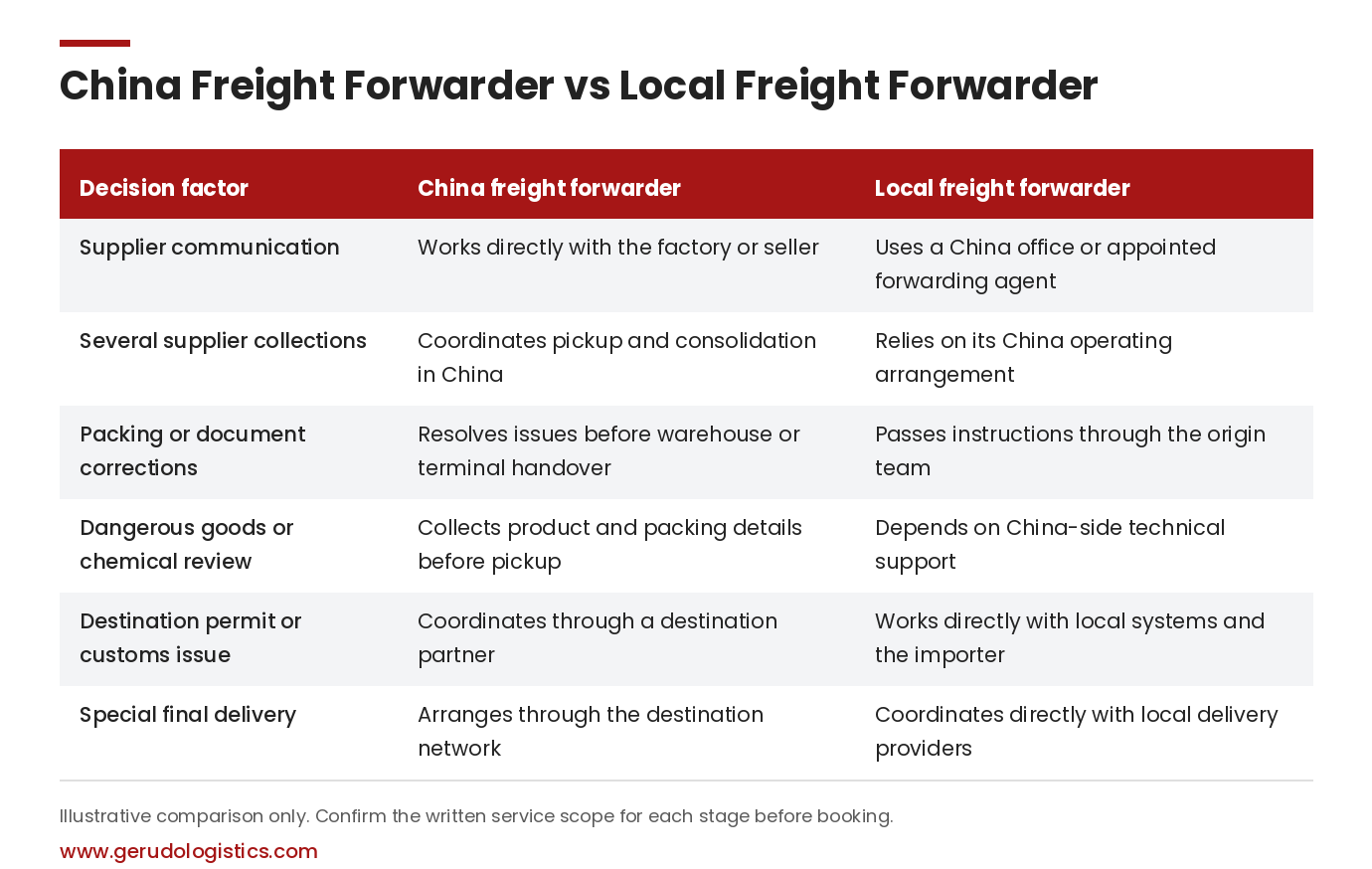
Two providers can share the route. The written scope must name who controls the supplier handover, main booking, customs declaration, final delivery and changes across stages.
When to Choose a China Freight Forwarder
Origin problems are cheapest to correct before collection. A missing carton mark can be fixed at the factory; after warehouse delivery, the same job can require unloading, relabelling, storage and a new cut-off. A China freight forwarder is close to the supplier when that intervention is still possible.
Direct China-side management matters most for:
Several suppliers: Pickup dates, receiving references and cargo data need to be combined into one shipment.
Document differences: The commercial invoice, packing list, booking data or Safety Data Sheet (SDS) use conflicting product names, quantities or weights.
Packing corrections: Carton marks, labels, pallets or inner packaging need attention before collection.
Special cargo: Dangerous goods, chemicals or temperature-controlled cargo need review before a warehouse or carrier accepts them.
Buyer-controlled freight: The purchase term allows the importer to appoint the forwarder for pickup or main transport.
Example scenario: An importer combines 72 cartons from five suppliers in Yiwu. The less-than-container-load (LCL) shipment occupies 5 cubic metres (CBM) and weighs 1,050 kg. Two suppliers use shortened product names, one omits the carton marks, and the fifth order will finish three days late.
The China freight forwarder moves the first four collections closer to the fifth order's completion. It assigns the warehouse references and corrects the product names and carton marks. One consolidated packing list is then issued, and the early orders avoid three storage days. For higher-risk purchases, complete the Chinese supplier and product checks before releasing the cargo.
When to Choose a Local Freight Forwarder
Destination uncertainty changes the balance. A local freight forwarder adds the most value when repeat general cargo needs little intervention in China. A permit, customs instruction or unusual delivery still has to be handled locally. In this narrower situation, the local team works directly with the customs broker, warehouse and delivery site.
The clearest cases are:
Local approval controls the schedule: The goods need a permit, registration or inspection at destination. Send the required product records before the cargo leaves China.
Delivery has unusual conditions: The site requires an appointment, special vehicle, unloading equipment or temporary storage.
An established local team already works well: The importer has a trusted customs broker, warehouse and delivery provider.
Before accepting that structure, obtain the name of the China office or agent. Require the service scope to identify who contacts the supplier, checks cargo readiness and handles a failed collection.
Where these tasks are managed indirectly, the local provider shall be restricted to customs clearance or final delivery only, while origin and international transport remain under the China freight forwarder.
Is a China Freight Forwarder Cheaper Than a Local Freight Forwarder?
Where a freight forwarder is based does not determine whether its quotation is higher or lower.
Total cost depends on which transport stages each forwarder manages directly. For an origin-heavy shipment, a China freight forwarder quotes the supplier collections, consolidation, document correction, repacking and special-cargo review performed in China.
Example calculation below compares two quotations for the same 40-foot container, collected from a supplier in Shanghai and delivered to a commercial address in the Los Angeles area.
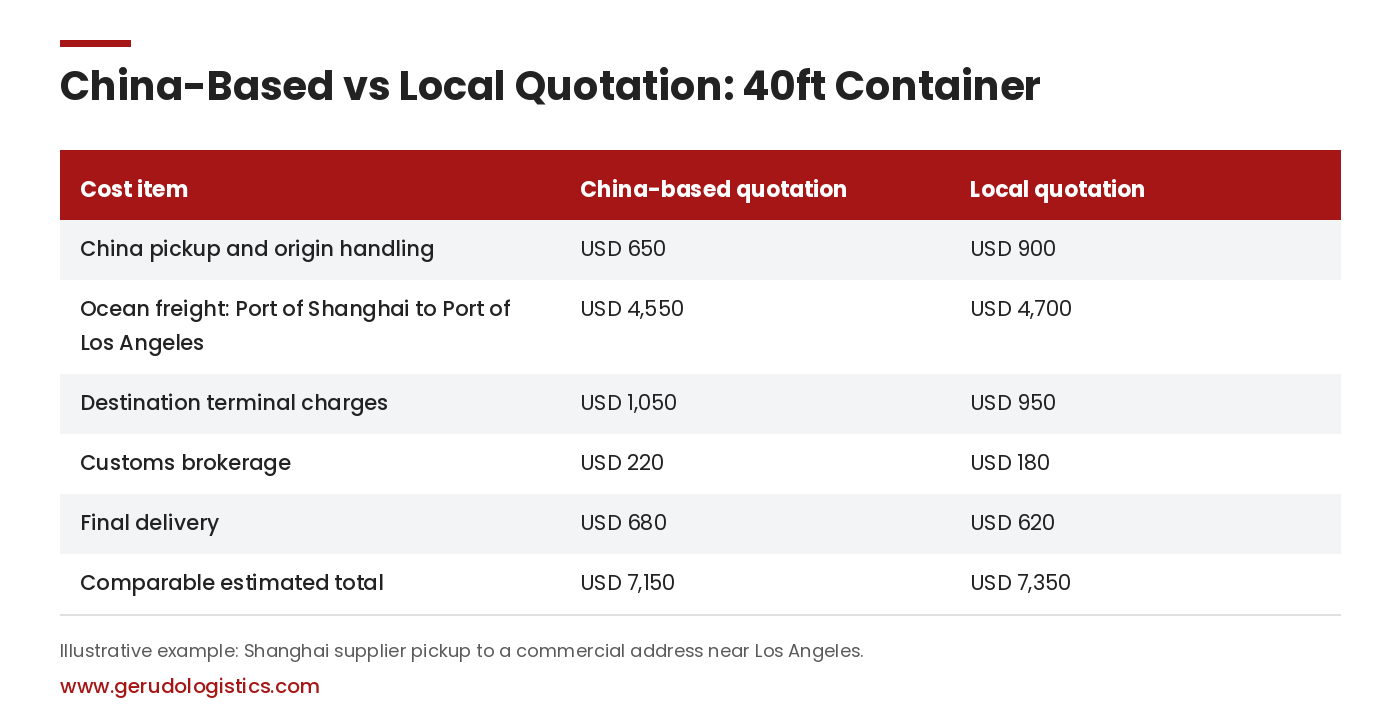
The China-based quotation is USD 200 lower in this example. It saves USD 400 across origin handling and ocean freight, while the local quotation saves USD 200 after arrival.
Compare each quotation on four points:
Service endpoint: Identify the terminal, warehouse or delivery address where each quotation ends.
Included work: Compare pickup, origin handling, ocean freight, destination handling, customs service and delivery line by line.
Conditional charges: Separate the quoted amount from storage, examination, repacking, demurrage and failed-delivery costs.
Rate status: Record the validity date and whether carrier space is confirmed.
How Incoterms Affect Freight Forwarder Choice
Incoterms decide who controls each transport stage, not where the freight forwarder is based. They show when the importer can appoint a China freight forwarder.
EXW: The supplier makes the goods available but does not handle origin customs clearance. Before pickup, the buyer needs a China freight forwarder to confirm who will complete the China customs declaration.
FCA: The supplier clears the goods at origin and hands them to the buyer's carrier at the named place. The buyer can appoint the China freight forwarder from that point.
FOB: For a suitable sea shipment, the supplier places the cargo on board at the named port. The buyer chooses the main carriage.
CIF: The supplier books ocean carriage and insurance to the destination port. The buyer needs the carrier, route and destination charges before accepting the arrangement.
DAP: The supplier manages transport to the named destination; the buyer manages import clearance and import charges.
DDP: The supplier manages delivery and import formalities. Before agreeing, confirm that the supplier or its appointed party can legally complete import clearance at the destination.
Where the buyer controls the main carriage, appoint the China freight forwarder before the supplier books independently. Under a seller-controlled term, obtain the carrier, route, handover point and destination charges before accepting the quotation.
Choosing a Freight Forwarder for Complex Cargo from China
For complex cargo, critical checks occur before pickup. Dangerous goods need origin acceptance, chemicals need matching product records, and temperature-controlled cargo needs the correct release temperature. A forwarder working in China can resolve these conditions before the supplier hands over the cargo.
Dangerous Goods Ship from China
Origin checks determine whether a dangerous goods booking from China can proceed. The cargo and packing data must meet the requirements of the warehouse, China Customs, terminal and carrier. A booking reference alone does not confirm acceptance.
A China-based team needs to settle four points before the cargo moves:
Packaging evidence: Where China Customs packaging inspection applies, the supplier needs the relevant performance and use-appraisal documents commonly called the Dangerous Goods Packaging Certificate (危包证).
Port and terminal choice: Shanghai, Ningbo, Qingdao, Shekou and Nansha do not offer identical options for every UN number, carrier or sailing.
Alternative routing: If the proposed Shanghai service cannot accept the cargo, Hong Kong can be assessed as another route. The mainland pickup, border handover, Hong Kong handler and onward carrier still need separate confirmation.
Timing: Warehouse cut-offs and carrier reviews are tied to the planned departure. A late packaging photo or corrected document can lead to storage or rebooking.
An overseas forwarder relays changes through a China agent, so a missing file can wait until the next China working day.
Ask for a live status: completed checks, the current reviewer and the remaining blocker. A specialist China freight forwarder can provide that answer during China working hours.
Chemicals Ship from China
Chemical cargo creates a product-identity problem before it creates a booking problem. The invoice, packing list, SDS and label need to describe the same formulation. Even a non-dangerous chemical can be refused because it is a liquid, powder, strong-smelling product or unclear mixture.
Suppose the invoice says "coating additive", the SDS uses a model number and the drum label shows a Chinese trade name. A China freight forwarder can confirm the formulation, grade and concentration with the supplier before correcting the records. It can also arrange a transport condition appraisal if the warehouse requests one.
The SDS guide for shipping from China explains which details must remain consistent. Destination registration and customs work begin after the cargo file is usable.
Temperature-Controlled Cargo
Image this, an frozen shipment has a -18°C booking set point, but the cargo reaches the container at -10°C. The shipment already has a temperature problem. A reefer maintains cargo temperature; it does not replace pre-cooling at the factory.
Before pickup, the China freight forwarder confirms the supplier's release temperature and any required pre-cooling. The forwarder also checks the equipment set point, pre-trip inspection and power arrangement during inland transport. If customs inspection or a missed cut-off causes a wait, the plan needs suitable cold storage or powered reefer support.
Who should lead the shipment? If release temperature, pre-cooling or powered handling remains unresolved, put the China freight forwarder in charge of supplier release and the main booking. The destination provider can take over pre-clearance, cold storage and refrigerated delivery, but it cannot reverse earlier temperature exposure.
End-to-End Freight Forwarding from China with Gerudo Logistics
Gerudo Logistics is a China-based freight forwarding company serving importers worldwide. We manage international shipments from China through one agreed transport plan and one main point of contact.
For dangerous goods, chemicals and temperature-controlled cargo, our local team applies its knowledge of Chinese ports, documentation and carrier acceptance before departure, then coordinates the approved plan through to the destination port. This connects China-side execution with the overseas handover without requiring the importer to manage separate origin agents.
Review our dangerous goods shipping services or contact Gerudo Logistics directly to consult your shipment!
Frequently Asked Questions About China and Local Freight Forwarders
Does a China Freight Forwarder Need an Office in the Destination Country?
A China freight forwarder does not need its own office in the destination country. It can coordinate destination services through an appointed local provider. Ask for that company's name and the party responsible for communication.
Does the Freight Forwarder's Location Affect Customs Duty?
The freight forwarder's location does not change the legal customs duty rate. Customs authorities calculate duty under the destination country's tariff schedule using the classification, customs value and origin.
What If the Supplier Insists on Using Its Own Freight Forwarder?
If the supplier insists on using its own freight forwarder, check the Incoterm and identify which transport stages the supplier controls. Obtain the carrier, route, handover point, destination charges and the name of the party reviewing the cargo records before accepting the arrangement.
Is a China Shipping Agent the Same as a Freight Forwarder?
Not always. Importers use China shipping agent for companies arranging freight from China, while maritime operations also use ship agent for the party representing a vessel or carrier during a port call.
Is a Customs Broker the Same as a Freight Forwarder?
No. A customs broker files import declarations and works with customs authorities, while a freight forwarder arranges transport and cargo handovers. One provider can coordinate both services, but the quotation needs to separate the transport and customs scope.