Shipping Dangerous Goods from China: Port Guide 2026
Most importers don't choose which Chinese terminal handles their dangerous goods. The supplier picks a port, the freight agent books a terminal, and by the time the importer has visibility on the routing, the booking is already confirmed.
For standard cargo, that arrangement is usually fine. For dangerous goods, terminal selection directly affects whether your cargo is accepted, how long it can legally stay in the yard, and whether the loading procedure is compatible with your UN number.
This guide covers China's five main DG-capable ports and the operational rules that affect every hazmat shipment from China.
Why Port Selection Matters for DG Cargo from China
Standard dry cargo can sit at a Chinese port terminal for four to seven days within free time. DG cargo cannot.
Three port-level factors affect every dangerous goods shipment:
1. Terminal acceptance Not all terminals within a port accept all DG classes. Acceptance policies vary by terminal, by season, and by individual carrier rules. A Class 5.1 oxidizer accepted at one terminal may be refused at another in the same port city. This information is not on any public schedule - your forwarder confirms it directly with their port agent before the booking is placed.
2. Free time limits Most Chinese port terminals limit DG containers to under 48 hours in the yard. After that, storage fees accumulate daily. Some terminals require immediate gate-out for certain DG categories - the container must leave before any storage time begins.
3. Loading procedures Certain high-risk DG classes cannot be yard-stored at all. They require direct loading: the container arrives at the berth and is loaded directly onto the vessel within a defined time window. Miss that window and the cargo misses the sailing.
These three factors vary by port, by terminal, and by time of year. They are not uniform across China, and they are not always visible until a booking is already in place.
China's Five Main Dangerous Goods Ports
A brief note before the breakdown: what importers call a single "port" often covers several terminals operating under different rules. This is especially pronounced at Shanghai, where Waigaoqiao and Yangshan handle different trade lanes with distinct DG procedures.
Shanghai Port
Shanghai is China's largest container port by volume and handles most DG classes for international trade.
Key points for DG shippers:
Waigaoqiao serves coastal and Asia-Pacific lanes; Yangshan serves deep-sea, long-haul routes
Both terminals carry distinct DG cutoff times, phase-in procedures, and acceptance policies
Certain high-risk cargo, including some Class 2 gases and Class 5 peroxides, requires direct loading rather than yard storage
Documentation screening is thorough; a mismatch between SDS Section 14 and the DG declaration will cause a hold
Shanghai is the default port for large-volume DG shipments on major global routes. The trade-off is complexity. Terminal-specific rules require careful pre-booking confirmation for every DG shipment.
Shenzhen (Shekou Terminal)
Shekou is the primary DG terminal for South China and one of the most operationally established terminals for hazmat cargo in China.
Key points:
Strong record with lithium batteries: UN 3480 (lithium ion, standalone), UN 3481 (lithium ion in/with equipment), UN 3090 (lithium metal, standalone), UN 3091 (lithium metal in/with equipment)
Well-suited for electronics with DG components and consumer goods containing regulated battery content
Serves routes to the Middle East, Southeast Asia, and Europe
Summer heat restrictions apply to certain DG classes
For South China origins, Shekou is typically the most practical terminal for Class 9 cargo and battery shipments.
See our guide to shipping lithium batteries from China for a full breakdown of battery-specific Shipping requirements.
Guangzhou (Nansha Terminal)
Nansha is Guangzhou's main deepwater terminal and a growing DG hub for the Pearl River Delta manufacturing base.
Key points:
Handles Class 3 flammable liquids, Class 8 corrosives, and an expanding range of DG categories
Serves chemical and industrial cargo from Guangdong province
Routes to the Middle East, Southeast Asia, and emerging market destinations
Terminal acceptance for complex or high-risk classes should be confirmed before booking
Nansha is a practical option for Guangdong-origin DG cargo when Shekou schedules or service coverage do not align.
For Class 3 cargo, our guide to shipping flammable liquids from China covers the compliance requirements in detail.
Importers sourcing from Guangdong manufacturers can find region-specific logistics guidance in our Guangdong sourcing guide.
Ningbo-Zhoushan Port
Ningbo-Zhoushan is one of the world's highest-volume container ports and a major hub for industrial chemical exports from eastern China.
Key points:
Established handling record for Class 3 flammable liquids and Class 8 corrosives
Serves manufacturing clusters in Zhejiang province and the broader Yangtze River Delta
Summer heat restrictions apply to flammable liquid yard storage
Well-connected to major carrier services on Europe, Middle East, and US trade lanes
For Class 8 cargo, our guide to shipping corrosives from China covers the documentation and classification requirements that apply at the origin port.
Qingdao Port
Qingdao is the main international gateway for North China and the primary Shipping route for Shandong's chemical manufacturing base.
Key points:
Handles a broad range of DG classes for North China origins
Serves chemical and industrial cargo from Shandong province
Routes to Northeast Asia, Middle East, and Europe
Terminal acceptance for high-risk DG classes should be verified before booking
For Class 6 cargo moving out of North China, our guide to shipping Class 6 dangerous goods from China covers the classification requirements and documentation checklist.
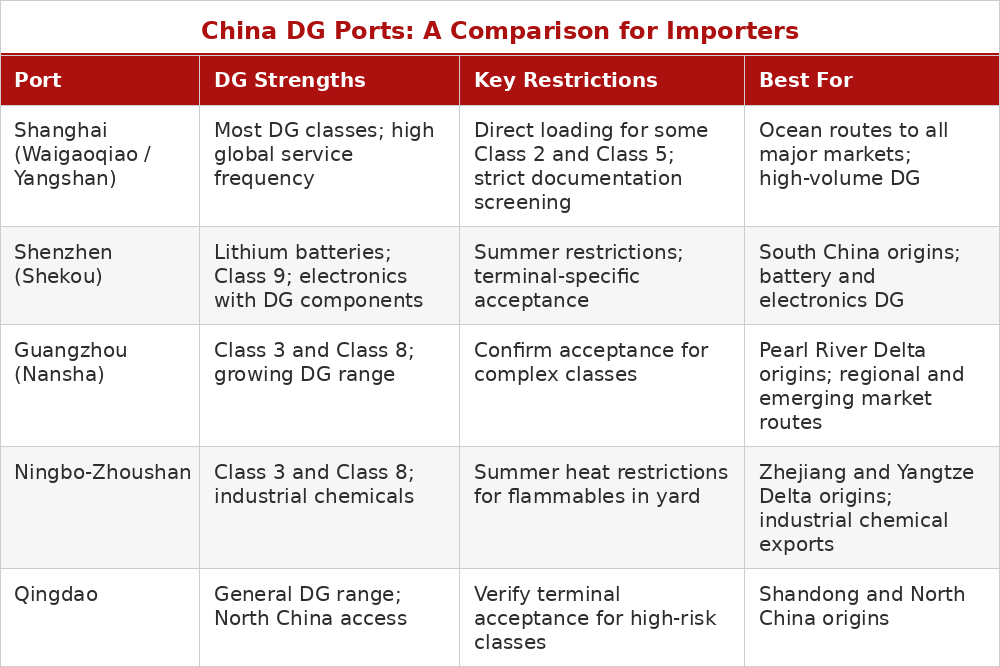
Port Comparison: China DG Shipping at a Glance
Hong Kong as an Additional China DG Transshipment Option
Hong Kong operates as a separate customs territory under its own Dangerous Goods Ordinance. For sea freight, it applies the IMDG Code directly.
For South China shippers, Hong Kong is a legitimate transshipment option in specific situations:
Cargo originates near Shenzhen or the Pearl River Delta and the geography supports the routing
Carrier service coverage or schedule via Hong Kong aligns better with the delivery timeline
The shipment involves complex DG categories where Hong Kong's international hub connections offer routing advantages
One distinction worth understanding: mainland Chinese ports require a Dangerous Goods Package Certificate, issued by China Customs (GACC), confirming that the packaging passed inspection.
Hong Kong, as a separate regulatory territory, operates outside that requirement. This reflects a difference in jurisdiction. Hong Kong-origin cargo still needs to meet full IMDG requirements. The certificate difference is a routing consideration, not a compliance shortcut.
Hong Kong handles lower DG volumes than the mainland hubs and offers fewer carrier options. For regular or high-volume DG shipments from China, mainland ports remain the primary route.
Operational Rules at Chinese Port Terminals
DG Free Time
DG containers face significantly shorter free time at Chinese port terminals than standard dry cargo. Most terminals limit hazardous containers to under 48 hours in the yard. Some require immediate gate-out for specific DG categories.
What this means for planning:
Confirm the terminal's DG free time limit before booking, not after
Coordinate inland pickup to avoid any yard dwell beyond the limit
Build zero buffer into DG schedules
In our experience, free time overruns on DG cargo are one of the most common and most avoidable cost surprises in shipping DG from China.
Direct Loading
Direct loading applies to certain high-risk DG categories. These cannot enter the terminal yard at all.
How it works:
The container arrives at the berth within a defined window before crane operations begin
It is loaded directly onto the vessel, bypassing the yard entirely
If the truck is delayed and the window is missed, the cargo misses the vessel
This requirement typically applies to certain Class 2 gases and Class 5.1 oxidizers and peroxides. Your forwarder should confirm whether your specific UN number is subject to direct loading before any booking is confirmed. This cannot be resolved on the day of loading.
Seasonal and Event Restrictions
Chinese port terminals apply additional DG restrictions during certain periods:
Summer heat (primarily July and August): some terminals restrict or ban Class 3 flammable liquids and Class 5.1 oxidizers from the yard
Major national events: ports near large Chinese cities may implement temporary DG volume controls on short notice
Typhoon season: South China ports including Shekou and Nansha may face weather-related operational interruptions
These restrictions are not always published with long lead times. For summer DG shipments in particular, confirm terminal policies at the time of booking.
What Chinese Ports Require for DG Shipping
Every DG shipment from a mainland Chinese port requires the following documents:
Dangerous Goods Package Certificate - issued by China Customs (GACC) after inspection of the packaging used; confirms inner and outer packaging passed testing for maritime transport stresses; mandatory for all DG cargo from mainland Chinese ports
DG Declaration - states the UN number, proper shipping name, hazard class, and packing group
Safety Data Sheet (SDS) - must be GHS-compliant; Section 14 (Transport Information) must be complete and accurate
Packing Certificate - confirms the cargo was packed in accordance with IMDG requirements
The most common documentation failure point is Section 14 of the SDS. Port inspection teams cross-check the transport classification on the SDS against the DG declaration. A mismatch triggers a hold.
Verify your supplier's SDS before the cargo leaves the factory. At port, a documentation error means a delay, not a quick fix.
In our experience, SDS Section 14 issues account for more Chinese port holds on DG cargo than any other single document problem. For the full 2026 IMDG compliance requirements for lithium battery shipments, our lithium battery IMDG compliance guide covers the current classification and documentation rules.
Lithium Battery Shipping from China
Lithium battery shipments from China require the correct UN number before any port booking:
UN 3480 - lithium ion batteries, standalone
UN 3481 - lithium ion batteries, in or with equipment
UN 3090 - lithium metal batteries, standalone
UN 3091 - lithium metal batteries, in or with equipment
Shekou and Nansha are the primary terminals for consumer and electronics battery volumes from South China. Shanghai handles larger-scale industrial and EV-related battery cargo. Individual terminals may carry volume caps or specific booking windows for battery shipments.
For a complete breakdown of battery shipping requirements, see our guide to shipping batteries from China. For shipments involving battery energy storage systems, see our BESS shipping guide.
Five DG Port-Selection Mistakes Importers Make
1. Accepting the supplier's default routing Suppliers book the port nearest their factory or the one their agent uses regularly. That port may not accept your specific DG class or may not serve your destination efficiently. Always confirm the planned terminal before the booking is finalized.
2. Not checking terminal DG acceptance before booking Terminal acceptance policies change. A class accepted on a previous shipment may now face new restrictions due to updated terminal rules, seasonal policies, or carrier decisions. Confirm for every shipment involving complex or high-risk DG categories.
3. Missing the direct loading window Direct loading cutoffs leave no room for trucking delays. This is a pre-booking coordination problem, not a day-of problem. If your cargo requires direct loading, that logistics chain needs to be locked in when the booking is made.
4. Treating documentation requirements as static China's DG shipping requirements are updated regularly. Packaging certification standards, SDS requirements, and customs screening procedures evolve. Relying on documentation practices from previous years is a reliable way to generate holds and re-inspection fees.
5. Not checking seasonal restrictions at booking time Summer restrictions on flammables and oxidizers at Chinese port terminals are predictable. A Class 3 shipment booked through a terminal that bans flammable liquid yard storage in July will be held on arrival. Check current terminal restrictions at the time of booking.
Ship Your DG Cargo from China with Gerudo Logistics
Gerudo Logistics handles specialist cargo - dangerous goods and temperature-controlled shipments - from China to global markets. Headquartered in Guangzhou, with operations across Shenzhen, Shanghai, Ningbo, Qingdao, and Dalian, we work across China's main DG ports and maintain current knowledge of terminal-level acceptance policies, direct loading requirements, and seasonal restriction schedules.
For DG shipments, our involvement starts before any port booking. We review cargo classification, confirm documentation completeness against current port requirements, and verify terminal acceptance for the specific UN number - before vessel space is secured. That preparation is what prevents the holds and missed sailings that hit less-prepared shippers.
We handle specialist cargo across DG hazard classes and packaging formats, whether drums, IBCs, ISO tanks, or other approved configurations.
For importers sourcing chemical, battery, or other regulated cargo from Chinese suppliers, we manage the full China-side process from factory pickup through customs clearance and final delivery.
Contact our team to discuss your DG shipment.
Frequently Asked Questions
Which Chinese ports can handle dangerous goods shipments? The five main DG-capable ports for international container freight are Shanghai, Shenzhen (Shekou), Guangzhou (Nansha), Ningbo-Zhoushan, and Qingdao. Port and terminal selection depends on your cargo's UN number, origin in China, and destination route.
What is the Dangerous Goods Package Certificate and is it required? The Dangerous Goods Package Certificate is issued by China Customs (GACC) after an inspection of the packaging used for your DG cargo. It confirms the packaging passed testing for maritime transport stresses, and it is mandatory for all DG cargo from mainland Chinese ports.
Can I ship lithium batteries from any Chinese port? Consumer and electronics battery volumes from South China ship primarily through Shenzhen (Shekou) and Guangzhou (Nansha). Shanghai handles larger industrial and EV-related battery cargo. Individual terminals may carry volume limits or specific acceptance windows for battery shipments, so confirm terminal acceptance before booking.
What happens if DG cargo is undeclared or misdeclared at a Chinese port? China's Maritime Safety Administration and Customs maintain zero-tolerance enforcement for DG misdeclaration. Consequences include container holds, large administrative fines, shipper blacklisting, and in serious cases, criminal liability. The exposure extends to the carrier and forwarder as well.
Does my cargo require direct loading, and how do I find out? Direct loading requirements apply to certain Class 2 gases and Class 5 oxidizers and peroxides that cannot be yard-stored at the terminal. Your forwarder should confirm whether your UN number carries this requirement as part of pre-booking checks. It cannot be resolved on the day of loading.
How do seasonal restrictions affect DG shipping from China? During peak summer heat, typically July and August, some Chinese port terminals restrict or ban Class 3 flammables and Class 5.1 oxidizers from the yard. Restrictions can also apply during major national events with short notice. Confirm terminal policies at the time of booking and build scheduling buffer into summer DG shipments.
Conclusion
Port selection is one of the least visible decisions in a DG shipment and one of the most consequential. The terminal determines whether your cargo class is accepted, how long it can stay in the yard, and whether the loading procedure works for your specific UN number.
China's five main DG export ports cover most regulated cargo categories. Each has distinct strengths, restrictions, and procedures. Knowing which port fits your cargo class, verifying documentation before the cargo leaves the factory, and checking seasonal restrictions at booking time are the three most direct steps importers can take to reduce DG shipping delays from China.