How to Verify a Chinese Supplier: Checks for Dangerous Goods and Chemical Shipments
You may have found a Chinese supplier offering the right chemical product at an acceptable price. Before placing the order or paying a deposit, verify the company behind the quotation, the factory producing the goods, and the documents supporting the product.
Supplier due diligence is particularly important for dangerous goods and chemical purchases. A discrepancy may remain hidden until the supplier has completed production and the freight forwarder, warehouse, carrier, or export authority reviews the cargo. At that stage, correcting the company documents, product classification, or packaging can delay the shipment and weaken the importer's position before the final balance is paid.
This guide explains where to check a Chinese supplier, how to identify every company involved, how to verify chemical licenses and product documents, and what to confirm before each payment.
Collect the Supplier Information Required for Verification
Begin by requesting enough formal information to identify the supplier and every company involved in the transaction.
Company identity
Registered Chinese company name: Use the complete Chinese name shown on the business license. English names may be translations, brands, or platform names.
Unified Social Credit Code: Use this 18-character code to locate the correct legal entity in Chinese official records.
Business license: Request a clear copy of the complete document and compare it with the official company record.
Registered address: Compare this address with the contract, licenses, factory information, and other company documents.
Companies involved in the transaction
Factory address: Confirm where the product will be manufactured, filled, stored, and packed.
Actual manufacturer: Identify the company controlling production when the seller is a trading company or export agent.
Contracting company: Confirm which entity accepts responsibility for supplying the goods.
Payment recipient: Obtain the complete bank beneficiary name before arranging the deposit or final payment.
Exporting company: Identify the entity that will appear as the exporter or shipper where applicable.
Chemical licenses: Request licenses relevant to the company's actual production, trading, or storage activities.
Platform record
Platform account holder: Record the legal company operating any Alibaba, Made-in-China, or other B2B account.
Use the registered Chinese name or Unified Social Credit Code for official searches. Keep a copy of the original information supplied so that later changes can be identified.
Check the Supplier Through Chinese Official Records
Use the supplier's official Chinese identity to review its public records. Each system provides a different part of the company profile.
National Enterprise Credit Information Publicity System
Search the National Enterprise Credit Information Publicity System using the registered Chinese name or Unified Social Credit Code. Compare the result with the business license supplied by the company.
Basic company facts
Company status: Confirm that the entity remains active and registered.
Registered name: Check the exact Chinese name against the contract and invoices.
Unified Social Credit Code: Confirm that every document refers to the same legal entity.
Legal representative: Record the person legally registered as the company representative.
Establishment date: Read this together with the company's claimed operating history.
Registered address: Compare it with the factory, office, license, and contract addresses.
Registered capital: Treat this as a background indicator alongside operating history and other evidence.
Business scope: Check whether the registered activities support the company's claimed role.
Risk and compliance records
Administrative licenses: Review the license holder, type, scope, and validity.
Administrative penalties: Examine the subject, date, and relevance of any disclosed action.
Abnormal operation records: Ask the supplier to explain unresolved entries.
Serious violation records: Escalate the review before making payment.
An active registration confirms that the legal entity remains registered. Continue with the factory, license, product, contract, and payment checks before making a commercial decision.
Credit China
Search Credit China using the same registered name and Unified Social Credit Code. Review publicly disclosed credit information and administrative actions associated with the company.
Confirm that each result belongs to the correct entity. Record any relevant issue and request supporting documents when the supplier provides an explanation.
China Enforcement Information Disclosure Website
Search the supplier, manufacturer, contract party, and payment recipient where appropriate. Examine the subject, amount, date, and current status of any public enforcement record.
Several unresolved records may justify stronger payment controls, professional legal review, or additional financial due diligence.
Licensing Authority Records
When a supplier provides a hazardous chemical production, operation, or related license, record its identity details and its scope and validity details.
License identity: license number, license type, license holder.
Scope and validity: authorized address, permitted scope, issue date, expiration date, issuing authority.
Search the issuing authority's public records or the relevant local emergency management authority's licensing information. Contact the authority named on the license when online confirmation is unavailable.
The license holder, facility, and permitted activity should correspond to the company performing the relevant work.
B2B Platform Records
Alibaba, Made-in-China, and similar platforms provide supplementary information about the supplier.
Review the legal entity operating the account, years on the platform, stated business type, and product categories. Also review factory photographs, audit reports, transaction information, and buyer feedback.
For a Verified Supplier or audited supplier report, check the audit provider, audit date, inspected company, inspected address, covered activities, and report limitations.
Compare the platform information with the official Chinese company record, actual manufacturer, contract party, and payment recipient.
Identify Every Company Involved in the Transaction
Chemical supply transactions may involve several Chinese entities. Map each company and its responsibility before signing the contract.
Identify the manufacturer, trading company, sales company, contract party, payment recipient, exporter, and warehouse or dispatching company. Ask for a written explanation whenever different company names appear.
A trading company may manage sales, communication, documents, and export coordination while another company manufactures the product. Obtain the manufacturer's registered name, factory address, relevant licenses, and product documents.
Check the companies named on the SDS, chemical licenses, test reports, and appraisal reports. These identities should form a clear relationship with the seller and actual product.
A Hong Kong company, group company, or export agent may receive payment or manage exports for a mainland manufacturer. Request written confirmation of the relationship, the responsibility of each entity, and the reason for using the separate company.
Confirm the Factory and Production Capability
Verify the facility where the product will be manufactured, filled, stored, and packed.
Ask for a live video walkthrough. It should cover the factory entrance and company signage, office area, production lines, and main equipment — as well as raw material storage, finished-goods storage, the filling or packing area, quality control area, and relevant safety equipment.
Request the factory address before the video call. Compare it with the registered company address, chemical license, SDS, audit report, and other supplier documents.
For higher-value orders, customized formulations, or products with significant compliance risk, consider a third-party factory audit.
A relevant audit may cover:
Company and site: legal company identity, control of the production site, production equipment, staffing.
Operating capability: production capacity, quality management, raw material control, batch traceability, storage conditions, packaging capability.
Test production claims against the planned order. Ask about normal output, batch size, lead time, quality control records, and procedures for formulation or specification changes.
Verify the Contract Party and Payment Recipient
Compare the legal and commercial documents before making a payment.
Contracting party: business license, sales contract, Proforma Invoice, quotation.
Payment recipient: company stamp, bank beneficiary, Commercial Invoice.
Communication: company email domain and contact details.
The contract should also state:
Product and packaging: exact product, grade or formulation, quantity, packaging, labeling.
Process and payment: required documents, production schedule, inspection arrangements, payment stages, procedure for correcting nonconforming goods or documents.
If the payment recipient differs from the contract party, request a written explanation identifying the relationship between the companies and the recipient's role.
Confirm any bank account change through a previously verified company contact. Use established contact details rather than the new contact information contained in the payment-change message.
Determine the Additional Checks for Your Product
The next stage depends on the product, the supplier's role, and the evidence already available.
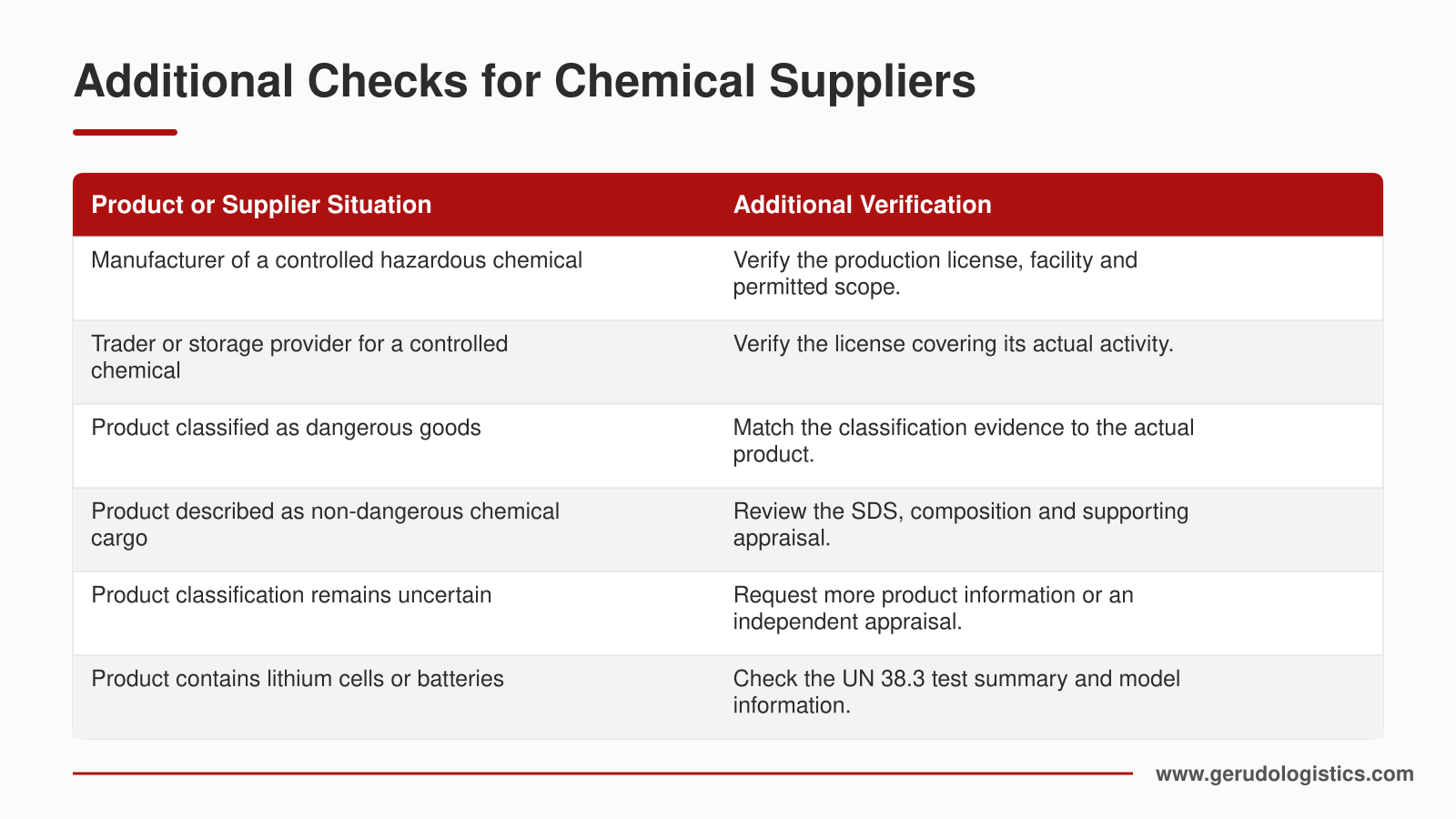
Some products require more than one type of review. Apply each check to the specific company, facility, formulation, and order under consideration.
Verify the Supplier's Hazardous Chemical Licenses
Follow a defined sequence when checking whether the supplier's chemical licenses support its claimed activities.
Identify the product: Determine whether the product falls within the relevant Chinese hazardous chemical controls.
Identify the activity: Establish whether the supplier manufactures, trades, stores, or arranges the export of the product.
Identify the responsible company: Confirm which legal entity performs each activity and where it takes place.
Check the license: Compare the license holder, facility address, permitted activity, product scope, issue date, expiration date, and issuing authority.
Resolve company differences: Obtain documents connecting a trading company, related company, previous company name, or separate factory to the licensed entity.
For a trading company, identify the actual manufacturer and obtain the manufacturer's relevant license information. Confirm who produced the goods and who issued the product documents.
For products outside the applicable hazardous chemical licensing scope, record the evidence supporting the supplier's description of the product.
Match the Chemical Product to Its Supporting Documents
Build one product file containing the commercial, technical, and supplier records for the exact goods being purchased. Understand what documents are needed for DG cargo shipping from China.
Confirm the Product Identity
Product identity: product name, commercial name, chemical name where available, intended use, model or grade.
Composition and packaging: composition, key concentrations, physical state, packaging format, batch or formulation reference.
Compare these details with the sample, specification sheet, quotation, contract, SDS, Commercial Invoice, and available reports.
For formulated products, confirm that the documents cover the current formula. Changes in concentration, solvent, additive, or active ingredient may affect the product information and classification evidence.
Compare the Main Chemical Documents
The supplier may provide several documents with different purposes. Review them together and compare each document with the actual product.
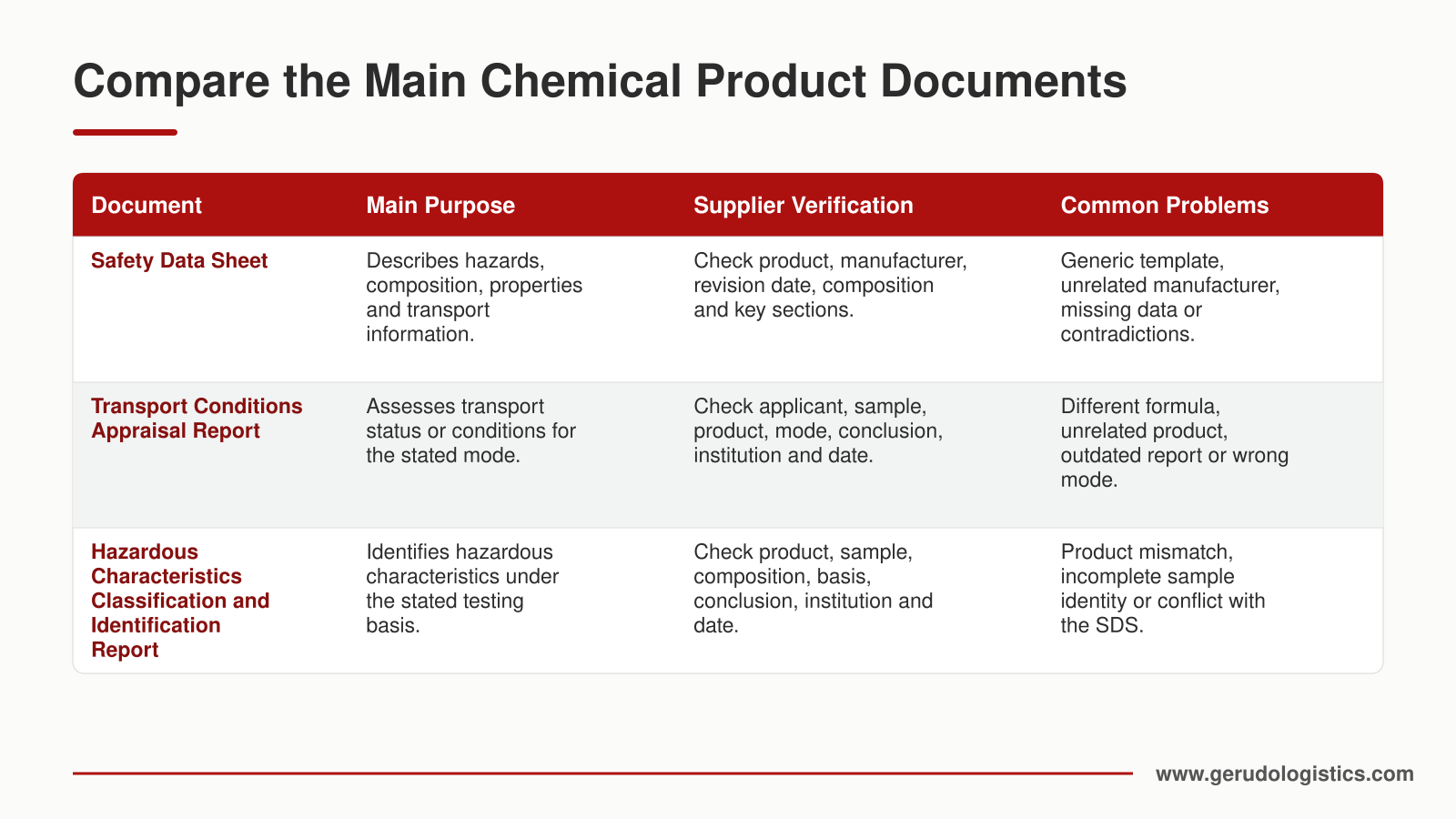
Review the Key SDS Sections
Use the SDS to confirm that the supplier's product, composition, hazard information, and transport information remain consistent.
Section 2 — Hazard identification: Check the stated hazards, signal word, pictograms, and hazard statements.
Section 3 — Composition: Check the ingredients, concentration ranges, and chemical identifiers relevant to the product.
Section 9 — Physical and chemical properties: Review physical state, flash point, pH, boiling point, viscosity, and other relevant properties.
Section 12 — Ecological information: Review aquatic toxicity, persistence, bioaccumulation, and environmental hazards where relevant.
Section 14 — Transport information: Check the UN number, proper shipping name, hazard class, packing group, and environmental transport status where assigned.
Compare these sections for consistency. For example, the concentrations in Section 3 should support the hazard information in Section 2. The flash point or other relevant properties in Section 9 should align with the transport information in Section 14. Environmental hazards identified in Section 12 should be addressed consistently in the transport review.
Ask the supplier to explain material inconsistencies and provide updated or supporting evidence where required.
Check Product Descriptions and HS Codes
Compare the product description across the quotation, contract, SDS, specification sheet, test reports, Commercial Invoice, Packing List, and proposed customs declaration.
The description should accurately identify the product, composition, grade, model, or intended use where those details affect customs or product review.
Review the HS code suggested by the supplier against the product's material, composition, function, and actual condition. Ask the destination customs broker or the importer's classification specialist to confirm the code used for import declaration.
Separate the HS Code from the UN Number
An HS code is used for customs classification. It affects customs declarations, duty treatment, trade controls, and import requirements.
A UN number identifies dangerous goods for transport. It connects the cargo to the applicable transport name, hazard class, packing group, and related conditions.
The two systems serve different purposes. Compare both with the actual product and supporting documents.
Descriptions such as accessories, materials, samples, or cleaning products may provide insufficient information. Require a precise commercial description supported by the product documents.
Verify the Dangerous Goods Classification
When the product is classified as dangerous goods or its status remains uncertain, review the evidence supplied for that conclusion.
Classification identifiers: UN number, proper shipping name, hazard class, subsidiary risk where applicable, packing group where assigned, marine pollutant status where applicable.
Supporting evidence: product composition, physical state, relevant test data, supporting report, manufacturer, formulation or model.
Compare the classification information across the SDS, appraisal reports, product specification, and other supporting records.
For lithium cells, lithium batteries, or products containing them, request the applicable UN 38.3 test summary. Compare the cell or battery manufacturer, model, tested design type, and product configuration with the goods being purchased.
Record pending classification questions before approving production or final payment. The supplier should provide accurate product information and cooperate with further assessment when the existing evidence is incomplete.
Complete the Checks Before Each Payment
The following supplier due diligence checklist shows when each part of the review should be completed. Use the earlier sections for the full verification method.
Before Paying the Deposit
Company identity: Confirm the registered Chinese company and official record.
Transaction roles: Identify the manufacturer, seller, contract party, and payment recipient.
Factory: Verify the facility and production capability.
Contract and payment: Confirm the contract party and deposit beneficiary.
Chemical licenses: Identify the applicable license, holder, facility, scope, and validity.
Product documents: Review the sample, specification, SDS, and available reports.
Product classification: Identify gaps requiring further review.
Packaging: Include the agreed packaging requirements in the order.
Freight forwarder review: Seek an initial review when shipping feasibility may affect the purchase.
Before Paying the Balance
Company identity: Recheck following any company or contract change.
Transaction roles: Confirm the final exporter and dispatching party.
Factory: Inspect or verify the completed production batch where required.
Contract and payment: Confirm the final beneficiary and investigate any payment change.
Chemical licenses: Confirm that the relevant license remains valid.
Product documents: Match the final documents to the mass-produced goods.
Product classification: Confirm that final evidence corresponds to the actual product.
Packaging: Compare the completed packaging with the agreed specification.
Freight forwarder review: Complete the final document and packaging review before cargo release.
Resolve material inconsistencies before proceeding to the next payment stage.
Recognize Warning Signs Before Paying the Supplier
Pause the transaction when important information remains inconsistent or cannot be verified.
Company and license signs
Refusal to provide the registered Chinese company name.
A Unified Social Credit Code belonging to another company.
Unexplained company names across official and commercial documents.
An unidentified actual manufacturer.
A factory address with no clear connection to the supplier or license holder.
A chemical license held by an unrelated company.
A license scope that does not correspond to the claimed activity.
Refusal to provide reasonable factory evidence.
Product and document signs
An SDS naming another product or manufacturer.
A generic SDS reused across different formulations.
An appraisal report covering another product, sample, or transport mode.
A test report belonging to another model or company.
Inconsistent product descriptions across documents.
An unsupported or implausible HS code.
Payment signs
Payment requested to a personal or unexplained company account.
An unexpected bank account change.
Repeated pressure for payment while material questions remain unresolved.
Documented relationships and legitimate business changes can explain some differences. Record the explanation and supporting evidence before continuing.
How Gerudo Logistics Supports Supplier Verification
Gerudo Logistics is a China-based freight forwarder specializing in dangerous goods and chemical shipments from China. We help overseas importers identify product, classification, document, and packaging issues before a Chinese supplier releases the cargo.
Contact us before paying the deposit when shipping feasibility could affect the purchasing decision. Before paying the final balance, our team can review the supplier's final shipping information and identify points that still require clarification or approval.
This early involvement helps the importer address transport-related gaps while the supplier remains responsible for completing the order and preparing the cargo.
Frequently Asked Questions for Chinese Supplier Verify
Can I Verify a Chinese Supplier Through Alibaba Alone?
Alibaba can provide preliminary company, platform, transaction, and audit information. Complete the review using the supplier's registered Chinese name, Unified Social Credit Code, official records, factory evidence, applicable licenses, product documents, contract, and payment details.
How Can I Check a Chinese Company Using Its Business License?
Find the registered Chinese name and Unified Social Credit Code on the business license. Search those details in the National Enterprise Credit Information Publicity System and compare the company status, legal representative, address, registration date, business scope, and public records with the supplied document.
Can a Trading Company Sell Dangerous Goods or Chemicals?
A trading company may sell or coordinate the export of chemical products within the scope of its actual business and applicable requirements. Identify the actual manufacturer, relevant license holder, document issuer, contract party, exporter, and payment recipient.
How Can I Verify a Chinese Hazardous Chemical License?
Request a complete license copy and record the license number, holder, authorized address, permitted scope, expiration date, and issuing authority. Search the issuing authority's public records or contact the relevant authority when online confirmation is unavailable.
Does an SDS Confirm the Product's Transport Status?
An SDS provides product hazard and transport information for review. Confirm that it corresponds to the actual manufacturer, formulation, physical state, and current product. Review supporting appraisal or classification evidence when the product status remains uncertain.
When Should I Ask for a Transport Conditions Appraisal Report?
Request the report when it is relevant to the product or required by the proposed transport provider, warehouse, carrier, or export process. Confirm that it covers the actual product, current formulation, and stated transport mode.
Should I Contact a Freight Forwarder Before Paying the Supplier?
Contact a specialist freight forwarder before paying the deposit when shipping feasibility may affect the purchase. Complete the final product, document, classification, and packaging review before paying the balance or authorizing cargo release.