Indonesia Transshipment: What Importers Shipping from China Need to Know
A container arriving at an Indonesian port can still be days away from the buyer's receiving warehouse. When another connection is involved, arrival at the intermediate port tells the importer only that one part of the journey is complete. The next question is whether the cargo is ready for its onward movement.
For buyers sourcing from China, Indonesia transshipment planning starts with that handover. This guide explains how to assess the proposed connection and make delivery decisions when the original arrangement changes.
At a Glance
Transport type: Indonesian terms distinguish goods that remain aboard from goods unloaded before continuing.
Documents: The incoming and onward records need to identify the same cargo, including any approved equipment changes.
Delivery estimate: A published schedule, confirmed booking and actual departure indicate different stages of progress.
Waiting costs: Customs storage conditions and commercial free time need separate checks.
Special cargo: Dangerous goods (DG) acceptance and reefer arrangements need to cover the intermediate handling as well as the vessels.
Indonesia Transshipment Types
Transshipment commonly means transferring cargo between transport services at an intermediate location. A sealed container can change vessels without its contents being unpacked. The Indonesian terms below distinguish whether unloading occurs; their English labels are explanatory translations.
Through Carriage vs. Onward Carriage
Through carriage (Angkut Terus): the container stays on the same vessel through the customs office — no unloading. A vessel can call at an Indonesian port and the container never comes off; that alone doesn't count as a vessel transfer.
Onward carriage (Angkut Lanjut): customs unloads the container before it continues. Even if the container stays sealed and closed, discharging it from the vessel still counts as unloading.
Cargo Handling and Clearance Location for Indonesia Transshipment
What actually happens to the cargo determines what the importer needs to arrange next. These are different jobs:
Moving a sealed container
Removing pallets
Changing equipment
Splitting cargo between shipments
The transport proposal needs to identify which operation is intended, because a vessel connection does not automatically include those additional services.
The final destination determines which clearance question matters:
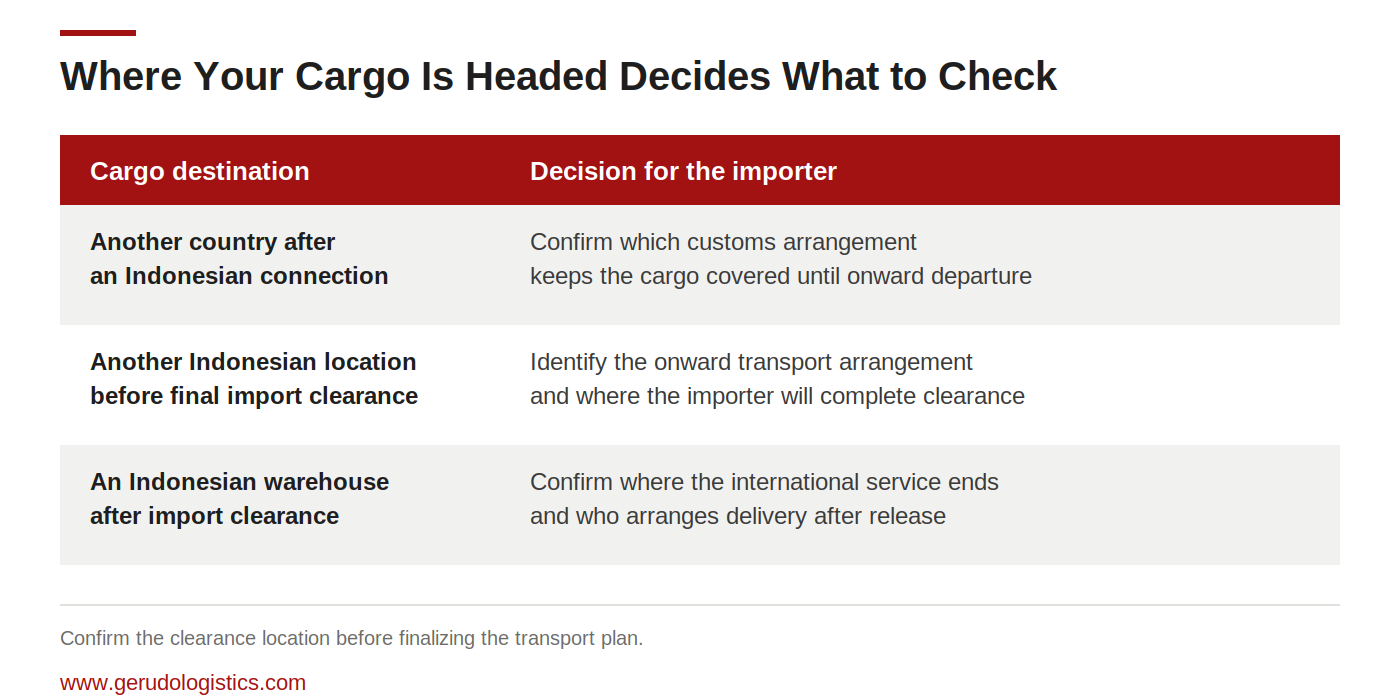
For goods entering Indonesia, the clearance location belongs in the transport plan from the beginning. A quote for shipping from China to Indonesia needs to identify the agreed destination, otherwise you can't tell an intermediate arrival apart from cargo that's actually ready for local delivery.
Indonesia Transshipment Requirements
PMK 51/2026 took effect on August 30, 2026, replacing the corresponding 2019 regulation. It governs Angkut Terus and Angkut Lanjut. The Indonesian Ministry of Finance regulation provides the legal basis for the terminology and customs provisions discussed here.
Documents for Indonesia Transshipment
Cargo documents give everyone the same description of what's moving:
Chinese supplier: Provides the product and packing details needed for the shipment.
Importer: Verifies the purchase, destination and receiving information.
Forwarder: Identifies the party responsible for customs submissions and coordinates corrections before the deadline.
A useful shipment document pack includes:
Commercial invoice: Product descriptions, quantities, values and trading parties that reflect the purchase.
Packing list: Package counts, weights and marks that identify the physical goods.
Transport document: The bill of lading or air waybill showing the relevant transport and receiving details.
Product information: Specifications and safety or temperature information needed to assess transport acceptance.
Receiving instructions: The agreed destination, delivery contact and latest acceptable receiving date.
Manifest matching links the arrival record to the onward movement record. Under Article 4, the outward manifest must reference the incoming registration number, date, item number and subitem number. If something doesn't match, these are the exact fields to check first.
Can you trace the same goods through every record? That's the real question. Compare the product description and package count against the packing list. If a container or seal number changes, ask for the handover record that explains why — don't expect every reference number to stay identical.
A shipment split creates a separate quantity check. The records need to show how much cargo went into each onward shipment and what remains in storage. Treat an unexplained shortage differently from a documented partial dispatch; the next action depends on which has occurred.
For small-scale imports from China to Indonesia, the importing party also needs to be established before departure. A forwarder coordinating transport does not, by that fact alone, become the entity responsible for bringing the goods into the Indonesian market.
Temporary Storage for Onward Carriage (Angkut Lanjut)
Article 3 permits two storage types outside Indonesia's customs territory: temporary storage (TPS) and distribution-center TPS (TPS Pusat Distribusi). Any other location needs separate customs approval.
What's actually happening to the cargo? Ask the forwarder which applies, since each needs different approval:
Waiting with a sealed container (no handling)
Opening the container for cargo handling
Transferring goods to another facility
Who's responsible while cargo waits? Name one contact who arranges release to the next carrier, reports any delay, and — if a guarantee or special approval is needed — explains why and who provides it.
What triggers a charge? Customs conditions decide whether the goods can stay; free time decides when charges start. Having free time left doesn't mean customs has approved the wait.
Indonesia Transshipment Times and Costs
Transshipment time runs through the connection, including the wait for the onward service. An estimated time of arrival (ETA) at the intermediate port alone can't tell you when the cargo reaches the warehouse. A useful estimate goes all the way to the receiving point and spells out what stages are still left.
Onward Bookings and Delivery Estimates
Three transport status updates answer different questions:
Published schedule: Shows the intended service dates; it does not establish a booking for the specific cargo.
Confirmed booking: Identifies the planned carriage for that shipment; loading and departure still need to occur.
Actual departure: Confirms that the cargo has left on the onward service, based on a shipment-specific carrier or forwarder update.
A workable connection needs enough time for the transfer itself. Ask the forwarder to check three things: when the cargo actually arrives, the onward loading deadline, and how much handling happens in between. A container still waiting to be discharged, or waiting on a document fix, isn't ready, even if the next vessel has space.
If a connection is missed, what matters is the next service that will actually accept the cargo. Compare its departure with the buyer's latest receiving date before treating a short scheduled connection as the best option. For time-sensitive stock, that comparison is more useful than looking only at the first vessel's ETA.
With a through booking, the importer can ask the contracting carrier or forwarder how the intermediate connection is handled within the agreed service. For separately booked legs, establish who bridges the gap between the first carrier's release and the next carrier's acceptance. That handover needs an owner before the cargo arrives.
Transshipment Charges and Free Time
A comparable quotation uses the same delivery endpoint and cargo-handling assumptions. A port-only quote and a door-to-door shipping service to Indonesia cover different work. Identify any remaining destination or delivery charges before comparing their totals.
Potential additional charges depend on what happens during the connection:
Waiting: Storage or container-use charges begin after the applicable free period.
Reefer operation: Power and monitoring costs depend on the facility's terms and what the quote includes.
Extra handling: Unpacking, repacking or changing containers adds work beyond a sealed-container transfer.
Location changes: Moving to another terminal or approved facility adds a separate transport stage.
Booking changes: Amendments, cancellations or replacement carriage can create charges under the provider's terms.
For every charge, get three things: what triggers it, the rate and unit, and the exact start date. With those, you can compare waiting for the existing service against paying for an alternative — instead of just comparing two unexplained totals.
For example, a cheaper onward freight rate does not establish a cheaper recovery. Add the cost of releasing the cargo from its present location and moving it to the replacement service. Include any existing booking charges that remain payable before comparing the options.
For less-than-container-load (LCL) cargo, deconsolidation means removing goods from a shared container for sorting or onward handling. That operation can affect both timing and cost. When comparing full-container-load (FCL) and LCL shipping to Indonesia, establish whether the proposed connection keeps the cargo in the same container or requires this extra stage.
DG and Reefer Transshipment in Indonesia
Dangerous Goods Acceptance During Transshipment
For dangerous goods shipped from China, the transshipment review needs to cover the applicable International Maritime Dangerous Goods (IMDG) Code requirements and acceptance at the Indonesian connection. The actual classification, packaging and quantity matter. A product name alone provides too little information for the carrier or facility to assess the shipment.
A safety data sheet (SDS) helps communicate the product's hazards, but the transport review also needs the shipment configuration. Where applicable, this includes the UN number, hazard class and packing group. Packaging type and quantity need to match the goods offered for carriage.
Useful DG acceptance confirmation identifies the cargo and covers the relevant parts of the route:
Incoming service: Acceptance for the declared product, quantity and packaging.
Intermediate facility: Acceptance for the planned waiting period and any unloading or repacking.
Onward service: Acceptance for the same cargo configuration, including changes made during handling.
A general statement that a company handles DG leaves shipment acceptance unresolved. A more useful response identifies the cargo details reviewed and any condition still outstanding. The importer can then distinguish a confirmed arrangement from a quotation awaiting a technical decision.
If the proposed recovery changes the transport mode, the acceptance review needs to follow that change. Air transport has its own requirements, so sea acceptance does not establish an air option. Obtain confirmation for the actual replacement service before committing to the additional freight cost.
Reefer Handling During Transshipment
For refrigerated cargo, temperature continuity includes the time between vessel discharge and loading onto the next service. The arrangement needs to cover power during terminal waiting and temperature protection during any movement between locations. A vessel booking alone leaves those handovers unanswered.
The supplier's product specification establishes the required transport conditions. Give the forwarder the temperature requirement and any relevant ventilation or monitoring instructions. If a proposed connection cannot accommodate them, resolve that limitation before accepting the route.
With the original reefer, the key handover is between the vessel, terminal and onward service. Establish who monitors the equipment while it waits and who receives an alarm or power-interruption report. The response contact matters most when the importer is in another time zone.
A cold-storage transfer adds unloading and reloading outside the original container. Before agreeing, establish that suitable space and replacement equipment are available. The handover records need to connect the received quantity with the goods loaded into the next reefer.
Temperature records provide evidence with different limits. Reefer operating data describes equipment conditions, while a separate logger records conditions at its location. Neither automatically establishes the temperature throughout the whole product load; interpret an apparent excursion against the product's limits and the available records.
For refrigerated food entering the Indonesian market, food-entry requirements belong in the purchase review alongside transport planning. The relevant Indonesia food import requirements concern market entry; maintaining temperature does not resolve missing product approvals.
Food continuing to another country needs a separate destination-document check before repacking or splitting. Establish whether the existing certificates and lot records will still identify the onward goods. Refer any required replacement or amendment to the responsible issuing party before handling begins.
Transshipment Delays and Route Changes
A useful delay update tells you four things: where the cargo is, what's blocking it, who can fix it, and the earliest realistic next departure, plus any charges already building up. Without these, you can't tell a real option from a tentative suggestion.
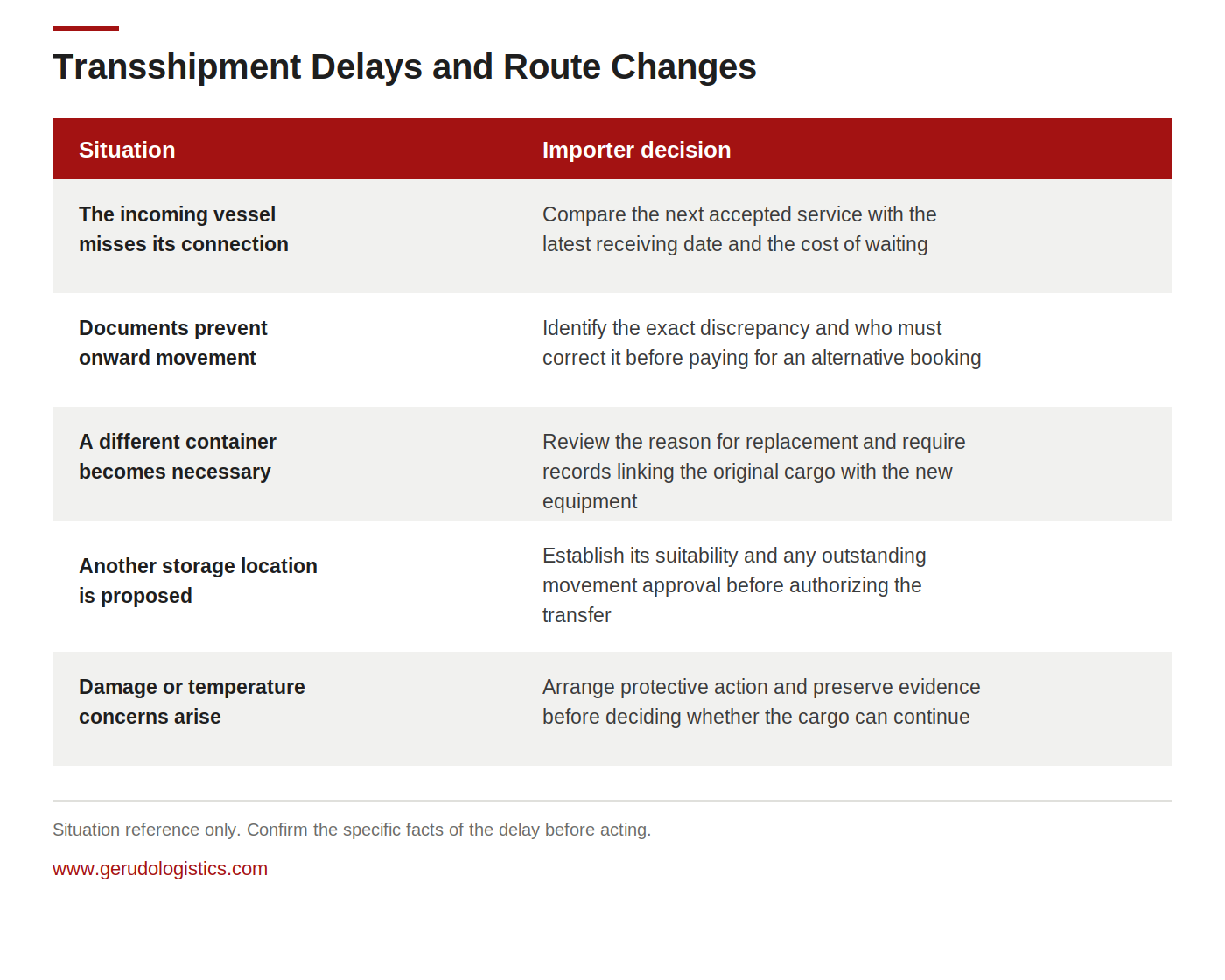
A revised transport plan needs to identify the new route and what still prevents execution. Separate confirmed arrangements from items awaiting acceptance or approval. This prevents an importer from treating a proposed recovery date as a firm customer commitment.
For an urgent order, partial dispatch is an option to assess against the actual cargo and bookings. Identify whether the priority quantity can be separated, documented and accepted on the replacement service. Compare the extra handling and transport cost with the business value of receiving only that portion sooner.
Where damage or shortage is involved, preserve a cargo evidence file. Relevant records include photographs, package counts and timed handovers; reefer cases also need available temperature data. Ask the insurer or claims handler whether a survey is needed before repacking or disposal changes the evidence.
Customer delivery commitments need a revised receiving estimate after the recovery starts. Use the cargo's confirmed progress and the remaining release and delivery stages. Explain any unresolved stage to the receiving warehouse so it can plan staff and unloading capacity appropriately.
Shipping Support from Gerudo Logistics
Gerudo Logistics specializes in dangerous goods, chemical and cold chain shipping from China. Our team supports overseas importers with cargo preparation and transport planning suited to the product and intended destination.
For shipments involving Indonesia, Gerudo Logistics can review the proposed connection and cargo requirements before confirming the available service scope. Share the product, quantity and delivery requirement through our contact page to discuss a suitable arrangement.
Indonesia Transshipment FAQ
Does Transshipment in Indonesia Change the Country of Origin?
Transshipment alone does not turn Chinese-origin goods into Indonesian-origin goods. Origin claims must follow the final destination's applicable criteria and supporting evidence.
Does Transshipment Require a New Bill of Lading?
A new bill of lading is not automatic whenever cargo changes vessels. The document arrangement depends on the transport contract, separately booked legs and any changes accepted by the carrier.
Does Cargo Insurance Cover Storage During Transshipment?
Insurance coverage depends on the policy's transit, storage and exclusion terms. Ask the insurer to confirm cover for the planned waiting period and any later change of location or duration.
Who Can Authorize a Route Change If the Supplier Booked Shipping?
Change authorization depends on the transport contract and the carrier's requirements; the supplier or its forwarder could hold the booking authority. Establish who can instruct the carrier before the importer approves replacement carriage.
Who Pays Extra Storage Charges If a Connection Is Missed?
Payment responsibility depends on the relevant contracts, charging terms and circumstances of the delay. The party receiving an invoice is not necessarily the party that ultimately bears the cost, so review both the charge and any claim against another party.