Dangerous Goods Packaging Guide: Shipping from China to the USA
A dangerous goods parcel can clear the international leg from China and still be rejected when it enters a US parcel network. Dangerous goods parcel packaging from China to the USA is determined by the confirmed transport classification, actual packed quantity, transport modes used, and the accepting US carrier.
The package must meet the requirements for every transport leg. This guide explains how importers can verify the inner packaging, outer packaging, marks, labels, and the US handoff before the supplier releases the parcel.
Identify Packaging Requirements for DG Parcels from China to the USA
Identify the packaging requirements by matching the confirmed transport classification and final packed quantities with the requirements for every transport leg. Use the following review order:
Transport classification: Confirm the UN number, Proper Shipping Name, primary class, subsidiary risk, and Packing Group where assigned.
Packed quantities: Record the quantity in each inner packaging, number of inner units, total net quantity, and gross package weight.
Transport legs: Check the international mode, passenger or cargo aircraft status where relevant, and the planned US delivery service.
Package design: Match the applicable packing instruction to the inner receptacle, outer packaging, performance level, gross weight limit, and assembly instructions.
Confirm whether the parcel follows fully regulated requirements or an applicable quantity-based provision before selecting the packaging instruction. A small bottle or low-value sample does not automatically qualify for reduced requirements.
For air transport from China, apply the current air packing instruction and relevant airline variations under the IATA Dangerous Goods Regulations. If a consolidator later enters the parcel into USPS, UPS, or FedEx, the selected US service must also accept the commodity, quantity, package, marks, labels, and electronic data. International acceptance alone does not confirm final delivery acceptance.
Preparing Inner and Outer Packaging for Dangerous Goods Parcels
The supplier must prepare the package in the form approved for the selected packing instruction. Changing the bottle size, cap, liner, cushioning, outer box, or closure method after review can invalidate the packing plan.
Importers should request final packed quantities and photographs before pickup in China. The photographs should show the inner packaging, closures, cushioning, completed outer box, and every marked or labeled face.
Prepare the Inner Packaging Before Pickup in China
Inner packaging must contain the product under the temperature, pressure, vibration, and impact conditions expected in transport. The receptacle, cap, gasket, liner, absorbent material, and cushioning must also be compatible with the contents.
Liquids
Prepare liquid dangerous goods around three containment checks:
Receptacle and ullage: Use leakproof inner receptacles with enough unfilled space for liquid expansion. Plastic receptacles must resist softening, permeation, and embrittlement caused by the contents.
Closures: Meet the applicable air-pressure requirements and use a positive secondary closure where required. This can include tape, a locking ring, or another method permitted by the packing instruction. A friction cap without an approved retaining method is insufficient for an air package.
Absorbent and cushioning: Use compatible absorbent and intermediate packaging where required. Separate and cushion each receptacle so glass, plastic, or metal containers cannot strike one another or move freely inside the box.
The absorbent quantity must correspond to the stated contents. It also needs to retain its function if a receptacle leaks during handling or transport.
Batteries and Battery-Powered Products
Battery packaging starts with the battery chemistry and the way it is presented for transport. Loose batteries, batteries packed with equipment, and batteries contained in equipment can use different UN numbers and packing instructions.
Check the following before accepting the supplier's packing proposal:
Battery configuration: Match the package to the exact configuration shown on the commercial documents. Do not use a contained-in-equipment arrangement for spare batteries packed beside the product.
Short-circuit protection: Insulate exposed terminals and prevent contact with conductive materials. Place each spare battery in its own complete enclosure where the applicable instruction requires it.
Movement and activation: Secure batteries and equipment against shifting, crushing, and accidental activation. Protect switches or controls that could turn the device on inside the parcel.
Battery condition: Separate damaged, defective, recalled, leaking, or swollen batteries from standard parcel arrangements. These batteries require a separate classification, packaging, and carrier review.
The battery model must be covered by a valid UN 38.3 test summary. Watt-hour rating, lithium content, battery condition, net battery quantity, and state of charge can affect the available air provision. Thelithium battery shipping guide explains these classification and document checks in more detail.
Wet batteries require a separate packing review:
Terminal protection: Prevent short circuits and contact with conductive components.
Leak prevention: Keep spillable batteries securely upright and use packaging that can contain the corrosive electrolyte.
Correct chemistry: Do not apply lithium battery packing instructions to lead-acid or other battery chemistries.
Solids, Powders, and Other Dangerous Goods Articles
Powders, granular materials, and solid articles create different containment risks. The package must prevent product loss while also protecting the article from movement or damage.
Powders and granules: Use siftproof inner packaging. Add a sealed bag or liner where particles could escape through seams or closures.
Material compatibility: Confirm that the product does not react with the bag, liner, cushioning, or outer packaging.
Solid articles: Restrain the article against movement, abrasion, and impact. Protect exposed terminals, sharp edges, release mechanisms, and moving components.
Temperature response: If a solid can soften or become liquid at temperatures expected in transport, use packaging capable of containing it in that state.
Do not combine different products merely because they fit inside one box. Materials that could react, generate heat, release dangerous gases, or form an unstable substance cannot share the same outer packaging. The applicable packing instruction and carrier must also permit the mixed packing arrangement.
Select the Correct Outer Packaging
The outer packaging must match the packing instruction and the complete package design. A UN mark on a box does not approve every inner container or every dangerous good.
Verify the outer package against these points:
UN packaging code: When UN specification packaging is required, confirm that the code authorizes the packaging type and material. The X, Y, or Z performance level must be suitable for the assigned Packing Group.
Tested design: Use the inner receptacle type, liners, cushioning, dividers, and other components covered by the package design. Substituting a component can invalidate the test basis.
Closure method: Follow the packaging manufacturer's closure instructions, including the specified tape type, width, pattern, and application method. Additional tape does not correct an unauthorized or poorly assembled package.
Package limits: Keep the completed parcel within the applicable net quantity, gross weight, dimension, and inner-unit limits. Use the lowest limit set by the packing instruction, packaging design, or carrier.
Box condition: Use a rigid, dry, and undamaged outer box that can withstand automated parcel handling.
Do not assume that a carrier-branded express box can serve as DG outer packaging. UPS and FedEx restrict the use of their supplied packaging for hazardous materials, apart from specific authorized exceptions. Carrier-specific box-strength or package-testing conditions can also apply when the transport rules permit non-specification outer packaging.
Dangerous Goods Marks and Labels for China-to-USA Parcels
Package marks and labels identify the contents, hazards, and handling restrictions. They must reflect the final packed contents and the exact provision used. A correctly assembled box with incorrect external information remains noncompliant.
UN Numbers and Other Required Package Marks
Check three groups of information on the completed parcel:
Contents and parties: A fully regulated package normally displays the required UN number and Proper Shipping Name. Add shipper and consignee details, orientation arrows, the OVERPACK mark, or a commodity-specific mark when applicable.
Packaging certification: The UN specification mark identifies the tested packaging design, material, performance level, manufacturer, and year or country information. It does not identify the dangerous goods inside.
Provision-specific marks: Apply an LQ, EQ, lithium battery, dry ice, environmentally hazardous substance, or Cargo Aircraft Only mark only when the shipment meets the conditions for that mark.
Use the required design, dimensions, colors, and placement. Every mark must remain durable, legible, unobstructed, and large enough for the package.
The package description must also agree with the transport documents.
For a fully regulated shipment, compare the package count, packaging type, UN number, Proper Shipping Name, class, Packing Group, and net quantity against the Dangerous Goods Declaration before the supplier tenders the parcel.
Hazard and Handling Labels
Hazard labels and handling information have different functions. Check each group separately:
Hazard labels: Apply the primary hazard label and each required subsidiary risk label. Place them on the same package face when space permits.
Label condition: Use the prescribed design, color, size, and hazard class number. A label cannot wrap around an edge or sit beneath tape, strapping, a document pouch, or the address label.
Handling information: Apply orientation arrows, Cargo Aircraft Only labels, lithium battery marks, or quantity-based marks only when the selected provision requires them.
Final comparison: Compare photographs of every package face with the carrier-approved marking and labeling plan. Include the two opposite sides used for orientation arrows.
Do not add a hazard label as a general warning. Some provisions remove the standard hazard-label requirement, and USPS permits only specified hazardous materials labels within its network. An unnecessary label can conflict with the declared provision or make an otherwise mailable parcel appear prohibited.
Ask the carrier to review any parcel that contains several UN numbers or more than one hazard. The review needs to cover the relationship between the marks, labels, packed contents, and transport document.
Remove Old or Conflicting Marks From Reused Cartons
A reused carton can retain an old UN number, hazard label, lithium battery mark, quantity-based mark, barcode, or address. Parcel systems and handlers can act on that obsolete information.
Before reuse, complete these checks:
Old marks and labels: Remove or completely cover every item that does not apply to the current shipment. Crossing out a label with a pen is insufficient when the original symbol remains recognizable.
Old barcodes: Make every previous barcode unreadable so the parcel system scans only the current shipping label.
Package condition: Check flaps, seams, punctures, moisture damage, compression, residue, and previous closure areas. Reuse the carton only when the applicable requirements and carrier permit it.
Original design: For a UN specification box, confirm that the current inner packaging matches the authorized design. Reassemble the box according to the packaging manufacturer's instructions.
US Inland Delivery Requirements for Dangerous Goods Parcels
A parcel accepted for international transport does not gain automatic access to every US parcel network. USPS, UPS, and FedEx Ground apply their own commodity limits, service restrictions, shipper qualifications, packaging conditions, and electronic data requirements.
Confirm Carrier Acceptance Before Shipping from China
Confirm the USA delivery carrier and service before the supplier packs the goods. A late change can alter the permitted quantity, outer-box requirement, marks, labels, electronic fields, or account approval.
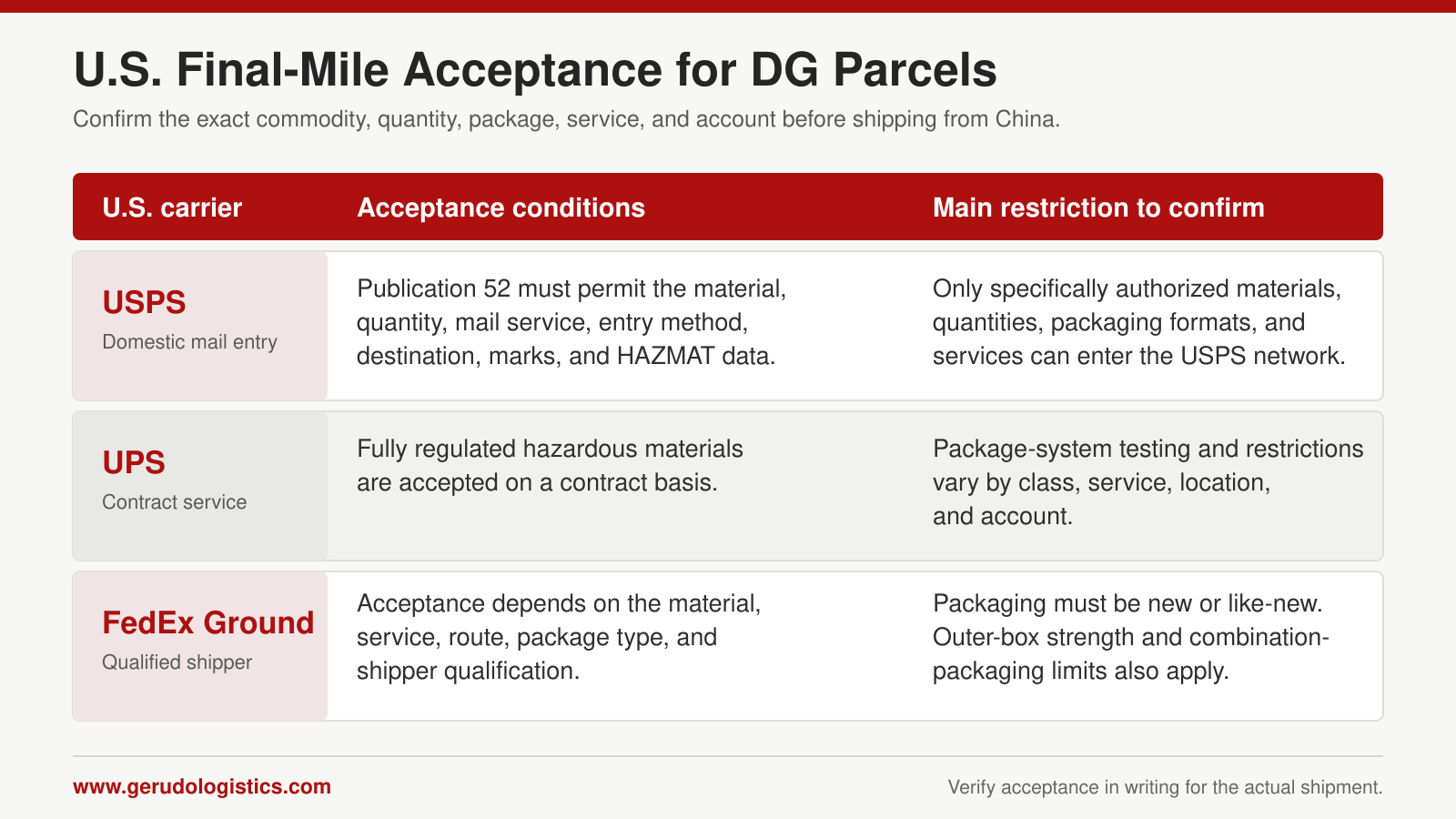
The consolidator or U.S. delivery partner must confirm acceptance in writing for the actual shipment. A general statement that the carrier handles dangerous goods does not confirm a specific UN number, quantity, package, ZIP code, or service level.
Match Package Marks With Electronic HAZMAT Data
For USPS domestic entry, the party generating the shipping label must declare the hazardous-material status through the correct electronic record. Importers do not normally create this manifest data themselves.
Ask the U.S. final-mile provider to confirm:
Label ownership: Identify who generates the domestic label and hazardous-material data.
Electronic coding: Transmit the correct hazardous-material Service Type Code and Extra Service Code, including ESC 857 or an accepted content-specific code where applicable.
Entry arrangement: Confirm whether the parcel enters the USPS network at origin or destination and which domestic service will be used.
Record consistency: Make sure the electronic record matches the service, transport restriction, marks, and endorsements shown on the parcel.
Assign this responsibility before the parcel leaves China. A ground-only lithium battery parcel cannot enter USPS with non-HAZMAT data or an air-capable service.
Updated July 2026 USPS Hazmat Quality Checks and Fees
Effective July 12, 2026, USPS introduced a Hazmat Quality compliance category for applicable commercial parcels. It increased enforcement of existing requirements for physical packaging, visible marks, selected service, and electronic HAZMAT data.
Before a dangerous goods parcel enters the USPS domestic network, verify three areas:
USPS Packaging Instruction: Confirm that the parcel follows the applicable requirements for rigid outer packaging, cushioning, leak prevention, short-circuit protection, or protection against accidental activation.
Visible package information: Place each required DOT mark and USPS endorsement clearly on the address side. Remove old or conflicting marks and keep every barcode readable.
Electronic consistency: Make sure the service, HAZMAT indicator, barcode information, and physical marks describe the same material and transport restriction.
USPS applies a 100 percent compliance threshold to its Hazmat Quality checks. An applicable commercial parcel that fails a required validation can incur a $50 Hazmat Noncompliance Fee.
For China-to-USA shipments, this means the USPS delivery arrangement must be confirmed before the supplier finalizes the packaging.
If the package markings, electronic data, or selected service do not match, the U.S. provider may need to correct the data, relabel the parcel, change the service, or transfer it to another carrier before USPS entry. This can add handling costs and delay delivery. If an applicable parcel is entered with a validation failure, the $50 Hazmat Noncompliance Fee can also apply.
The HAZMAT Handling Fee is separate from the noncompliance fee. USPS charges $7.50 per parcel for Priority Mail Express and Priority Mail, while USPS Ground Advantage currently has a $0 HAZMAT Handling Fee. Importers should include the applicable handling fee in the U.S. final-mile quotation and confirm which party will bear it. A $0 handling fee for USPS Ground Advantage does not remove any packaging, marking, electronic-data, or acceptance requirements.
Get a Packaging and Route Review From Gerudo Logistics
Gerudo Logistics is a China-based freight forwarder specializing in dangerous goods and chemical shipments to global markets.
Our team reviews the proposed packaging, marks, labels, transport classification, packed quantities, and route before the supplier releases the parcel. We also confirm which carrier or U.S. final-mile approvals remain pending.
To request a quote, provide the product name, intended use, current SDS, UN number and Packing Group where assigned, quantity per inner packaging, number of inner units, total net and gross weight, carton dimensions, and packaging photographs. Please also include the pickup address in China, destination ZIP code, cargo-ready date, and UN 38.3 test summary for lithium batteries.
Contact Gerudo Logistics before finalizing the packaging or arranging pickup in China.
FAQs About Dangerous Goods Parcels From China to the USA
Can Different Dangerous Goods Be Packed in the Same Parcel?
Only when the applicable packing requirements and carrier permit the combination. The products must be compatible, individually prepared, and within every quantity and package limit; some carriers also cap the number of compatible hazardous materials in one outer package.
Can a UN-Certified Box Be Reused?
It can be reused only when the applicable requirements allow it, the box remains in new or like-new condition, and the current package follows the tested design and closure instructions. Remove old marks, check for damage or residue, and confirm carrier acceptance before packing.
Can a Dangerous Goods Parcel Be Repacked After It Arrives in the USA?
Yes, but a qualified party must reassess and prepare it before offering it to the next carrier. Repacking can require new packaging, marks, labels, shipping documents, and electronic HAZMAT data.
Can Packaging Approved for Air Transport Enter a U.S. Ground Network Without Repacking?
It can enter without repacking when the package also meets the U.S. ground requirements and the selected carrier's conditions. Air approval alone is insufficient if the carrier rejects the package design, quantity, marks, labels, data, commodity, or service arrangement.
Does Limited Quantity Status Guarantee Acceptance by a U.S. Carrier?
No. Limited Quantity status reduces specified regulatory requirements, while the carrier can apply narrower commodity, route, account, packaging, and data conditions. Confirm the actual parcel and service before it leaves China.
Conclusion
A dangerous goods parcel is ready for release only when the completed packaging and external marks match the confirmed transport classification, packed quantity, and selected service. Before collection in China, obtain written confirmation that the final packed parcel is accepted for both the international transport leg and U.S. inland delivery.