Dangerous Goods Declaration: What Importers Sourcing from China Must Get Right in 2026
When a Dangerous Goods Declaration (DGD) contains an error, the first sign is rarely a polite email from your carrier.
More often, it is a notification that your cargo has been offloaded at a transshipment port, that your vessel has sailed without it, or that the destination terminal is refusing delivery. By that point, the demurrage clock is running and your customer needs answers. Your supplier, meanwhile, is pointing at the signed document as proof they did their part.
The DGD is the document your Chinese supplier submits to the carrier certifying that China hazmat goods have been correctly classified, packaged, and labelled for transport. The supplier signs it. If there is an error, the financial consequences fall on you as the importer.
Knowing what the document requires and where suppliers commonly get it wrong, is one of the most practical risk controls available when sourcing dangerous goods from China.
What a DGD Is and Why It Is Your Problem as the Importer
A Dangerous Goods Declaration is a transport document, also called a Shipper's Declaration for Dangerous Goods in air freight. It tells the carrier how a shipment has been prepared for transit: classification, packaging type, quantity, and labelling.
It is not interchangeable with a Safety Data Sheet (SDS/MSDS). The MSDS covers chemical properties, hazard data, and safe handling instructions for the product itself. The DGD is transport-specific: it tells the carrier what is in the container, how it has been packaged, and what classification applies to this shipment.
Both documents are required for most dangerous goods shipments. They cannot substitute for each other.
Your Chinese supplier signs the DGD. The document originates with them, but if there is an error, you face the consequences at the destination. If the cargo is rejected at destination, the cost of port storage, return shipping, and disposal is a commercial matter between you and your supplier. The carrier is not liable.
Most importers do not see the DGD until after the cargo has left China, which is too late to catch an error.
The Real Costs When a DGD Is Wrong
The most immediate consequence is cargo offloading. If a vessel departs with a DGD that does not match the physical cargo and the discrepancy is found at a transshipment port, the container gets pulled and held. Offloading, storage, re-inspection, and re-booking can cost several thousand dollars depending on the port and delay.
At the destination, a DGD error can trigger a customs hold or cargo seizure. Authorities in markets including the EU, the United States, and Australia treat DG documentation failures as regulatory violations, with fines assessed against the importer of record.
The most serious exposure is General Average liability. If misdeclared dangerous goods are linked to a vessel fire or incident, all cargo owners on that vessel may be drawn into a General Average claim, including those whose goods were not involved.
In our experience, the most common source of this risk is a supplier using an outdated DGD template. A lithium battery shipment where the declared watt-hour rating does not match the actual product is a typical example: the cargo clears China without issue, and the problem surfaces at a foreign port during manifest audit.
When Is a Dangerous Goods Declaration Required and What Does It Contain
A DGD is required for any shipment containing goods classified as hazardous, regardless of packaging format or shipment size. This covers all hazard classes in full regulated quantities, most Limited Quantity (LQ) shipments, and lithium batteries above specific watt-hour thresholds.
The required fields on a DGD are consistent across sea and air modes:
Shipper and consignee details - full legal name and address of both parties.
UN number - the four-digit code identifying the hazardous substance.
Proper Shipping Name - the regulated name for that UN number, not a trade name.
Technical Name - for N.O.S. entries, the specific chemical component in parentheses.
Hazard class and Packing Group - the class and risk severity level (I, II, or III).
Quantity and type of packaging - exact count and UN-specification packaging type.
Flashpoint - required for Class 3 liquids.
Shipper's signed declaration - confirmation that all of the above is accurate.
Most DGD rejections trace back to errors in the Proper Shipping Name, Technical Name, or Packing Group. Suppliers using copied templates frequently leave the Technical Name blank or carry over an incorrect Packing Group from a previous shipment.
The Cargo Types That Generate the Most DGD Rejections from China
Dangerous goods declaration lithium batteries cases represent the highest volume of errors from Chinese suppliers. The pattern is consistent across UN 3480 (lithium-ion batteries), UN 3090 (lithium metal batteries), and UN 3481 (lithium-ion batteries in or packed with equipment). Suppliers frequently claim a Section II small-quantity exemption to avoid preparing a full DGD.
In most cases, the battery specifications exceed the threshold or the required labelling is absent. In 2026, major carriers have tightened pre-acceptance checks, and an incorrect exemption claim is caught at the acceptance desk.
Other common rejection scenarios:
Flammable liquids, N.O.S. (UN 1993, UN 1866): The Proper Shipping Name for these generic UN numbers requires a Technical Name in parentheses identifying the specific chemical. Suppliers using copied templates often omit this field entirely.
Class 9 goods, UN 3082 (Environmentally Hazardous Substance): Many importers do not associate this classification with dangerous goods at all. Certain lubricants, agricultural chemicals, and personal care products can fall under UN 3082. Suppliers may ship with no DGD prepared, which is a more serious failure than an incomplete document.
Limited Quantity (LQ) shipments: LQ status relaxes packaging requirements. A transport document identifying the cargo as dangerous goods is still required. If your supplier says LQ goods need no DGD, ask in writing which transport document they are submitting instead.
Corrosives, Class 8: A Packing Group error on the DGD creates a mismatch with the labelling on the packaging. The cargo gets held for inspection at the terminal.
How DGD Requirements Differ Between Sea and Air Freight
Sea and air freight follow different regulatory frameworks, and the DGD requirements are not the same. A supplier who routinely handles sea freight DGDs may not be prepared for air freight documentation at all.
Sea freight (IMDG):
Document title: Dangerous Goods Declaration
Technical Name required for N.O.S. entries
Flashpoint required for Class 3 liquids
Typically 2 originals (varies by carrier)
Submit 24-48 hours before vessel cut-off
e-submission accepted or required at major Chinese ports
Regulatory edition: updated on a two-year cycle
Air freight (IATA):
Document title: Shipper's Declaration for Dangerous Goods
Technical Name required; stricter enforcement at acceptance
Flashpoint required where applicable
2 originals for carrier, 1 copy for shipper
Must be submitted before cargo acceptance; no grace period
e-submission increasingly required by major IATA carriers
Regulatory edition: IATA DGR updated every January 1
For air freight, there is no correction window after cargo acceptance. If your supplier cannot submit a correct declaration before the deadline, the booking is lost.
What to Check When Your Supplier Sends You a DGD
Most importers receive the DGD after the cargo is already packed and the booking is confirmed. The five checks below are the most likely to catch a rejection-level error before the cargo moves.
UN number and Proper Shipping Name match. Confirm the Proper Shipping Name on the DGD is the regulated name for that UN number, not a trade name or abbreviation.
Technical Name is present for N.O.S. entries. Any UN number with "N.O.S." in the name requires the specific chemical component in parentheses. If the DGD shows only a generic N.O.S. description, send it back before cut-off.
Packing Group matches the product hazard level. Mismatches are common for adhesives, coatings, and cleaning agents, where multiple Packing Groups are possible under the same UN number.
Quantity and packaging type reflect the actual shipment. If the order quantity or container type changed after the DGD was drafted, the document must be reissued.
The declaration is signed. Digital workflows sometimes circulate unsigned copies. Confirm the signature block is complete before the cargo cut-off date.
When a DGD Needs to Be Reissued
A DGD covers the specific shipment it was prepared for. Several situations require a new document before the cargo clears at destination:
Vessel delays past a regulatory update date. The IATA DGR edition changes every January 1. If your cargo is in transit around that date, confirm the document's validity with your forwarder before the vessel departs.
Supplier modifications after the DGD was issued. Partial orders, packaging substitutions, or quantity changes all require a corrected DGD. Assurances that the discrepancy is minor do not protect you at customs.
Carrier format requirements. Some carriers require their own DGD template beyond the regulatory minimum. If the carrier requests a revised document after booking, the reissue must happen before cargo cut-off.
What the e-DGD Shift Means for Your 2026 Booking Timeline
An e-DGD is the electronic version of the Dangerous Goods Declaration, submitted through the carrier's digital platform rather than delivered as a paper document at the terminal. Major Chinese ports and international carriers are moving toward e-DGD as a standard requirement in 2026, and the key implication for importers is timing.
With paper DGDs, suppliers could sometimes finalise the document on cargo delivery day. The e-DGD submission window closes earlier. The document must be submitted and approved through the carrier's digital system before cargo reaches the terminal.
Here is a rough guide to what the submission timeline looks like in practice:
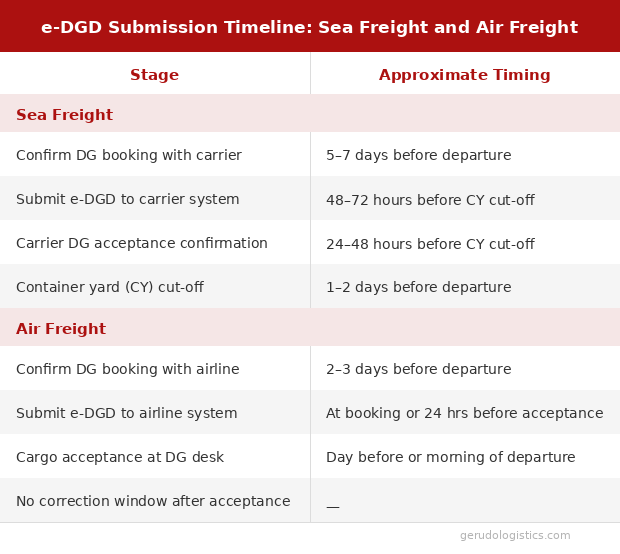
Timelines vary by carrier and port. Confirm the specific requirements for your lane with your freight forwarder before booking.
Two practical checks before you confirm any DG booking:
Does your supplier have access to the carrier's electronic submission platform?
Has your supplier completed the carrier's DG shipper registration?
If either answer is no, the e-DGD cannot be submitted regardless of whether the document content is correct.
Why You Need a Freight Forwarding Expert to Handle DG Documentation
As a dedicated China freight forwarder agent for DG and reefer cargo, Gerudo Logistics prepares and reviews Dangerous Goods Declarations for all hazard classes under both IMDG (sea freight) and IATA (air freight) frameworks.
We handle dangerous goods in all packaging formats: drums, intermediate bulk containers (IBC), ISO tanks, flexi-bags, and unit load devices. For multi-modal shipments, we coordinate documentation across the full transport chain, including ADR compliance for road legs at destination.
For importers moving a China hazmat goods category for the first time, or onboarding a new DG supplier, we offer a pre-shipment document review covering UN classification, packaging compliance, and DGD content. We work across all hazard classes without restriction to a single product type or packaging format.
Frequently Asked Questions
What is a dangerous goods declaration?
A Dangerous Goods Declaration is a legally binding transport document where the shipper certifies that hazardous cargo has been correctly classified, packaged, and labelled for a specific journey. It is required by carriers for sea, air, and road transport. In air freight, it is also called a Shipper's Declaration for Dangerous Goods.
When is a dangerous goods declaration required?
A DGD is required for any shipment containing goods classified as hazardous under IMDG (sea), IATA (air), or applicable road transport regulations. This includes all hazard classes in full regulated quantities and most Limited Quantity shipments. LQ shipments still require a transport document identifying the cargo as dangerous goods, even where packaging requirements are relaxed.
How do I fill out a dangerous goods declaration?
The DGD must include shipper and consignee details, UN number, Proper Shipping Name, Technical Name (for N.O.S. entries), hazard class, Packing Group, quantity and packaging type, flashpoint where applicable, and the shipper's signed declaration. Your freight forwarder should review the completed document before cargo cut-off. If you need a dangerous goods declaration sample or template, Gerudo Logistics can provide one as part of our pre-shipment review.
Who is responsible for the accuracy of the DGD?
Your Chinese supplier signs the DGD and bears legal responsibility for its accuracy. As the importer, you do not sign the document. Any errors, however, result in commercial and regulatory consequences at the destination that fall on you.
Does a dangerous goods declaration for lithium batteries differ from other cargo?
Yes. Lithium battery shipments under UN 3480, UN 3090, and UN 3481 (batteries in or packed with equipment) require a full DGD unless the shipment meets the Section II small-quantity exception. Carrier enforcement has tightened in 2026, and a mismatch between the declared and actual watt-hour rating is a common reason for booking rejection.
Does UN 3481 need a dangerous goods declaration?
Yes. UN 3481 covers lithium-ion batteries contained in or packed with equipment and is subject to the same DGD requirements as UN 3480 unless Section II thresholds are met. Many suppliers incorrectly assume batteries shipped inside a finished device are automatically exempt.
How long must a freight forwarder retain dangerous goods paperwork?
Under IMDG, DG transport documents must be kept for a minimum of three months after the voyage is complete. IATA sets the same minimum period, counted from the flight date. Some national authorities and carriers require longer; confirm the applicable requirement for your trade lane with your forwarder.
What is the difference between an MSDS and a DGD?
The MSDS (or SDS) describes the chemical properties of a substance: composition, hazards, and safe handling. The DGD certifies how a specific shipment has been packaged, labelled, and classified for transport. Both are required for most dangerous goods shipments and cannot substitute for each other.
Conclusion
The Dangerous Goods Declaration is one of the few documents in an import transaction where a supplier error creates an immediate problem for you. The cargo stops, or it moves and gets held somewhere difficult to resolve. Either way, the cost falls outside what most importers budget for.
The most effective control is a pre-shipment DGD review before the cargo reaches the terminal. If you are sourcing dangerous goods from China and are uncertain whether your current process is catching errors, speak with a specialist forwarder before your next booking.